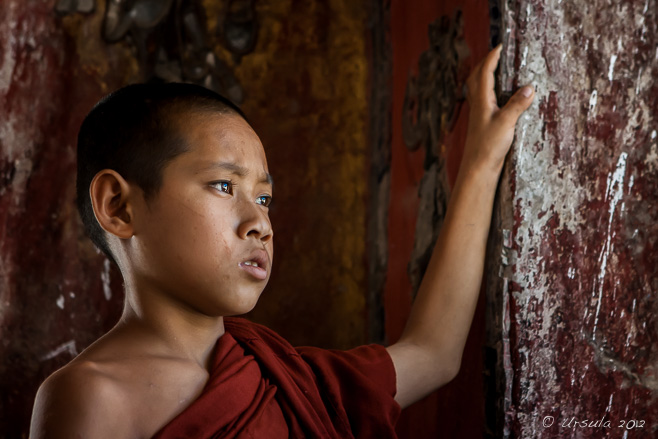
Novice in the Shrine A young Burmese novice in the shrine-room at Shwe Yan Pyay Monastery, Nyaung Shwe.
David DuChemin, a man whose words are as richly textured as his magnificent photographs, recently wrote a blog post on the difference between an “Iconic Photograph [and] a Photographed Icon”.
“If I can find something that resonates more strongly with the human heart or imagination, I have a shot at the kind of connection in a photograph that one day others might call iconic. It’s the connection that matters. It’s the meaning.” (DuChemin)
I can’t help but agree with him. He goes on to say that one’s best work often comes from being somewhere often enough or long enough to see something different – something that tells a story or makes that connection.
Of course, we don’t all have the skills, imagination, time, or talent that DuChemin brings to his craft. Taking our own “copy” of an iconic image can be a big part of the travel experience. If we can also bring something of ourselves to the image, it might be original, and if we have some talent and skill, it might even be art. But, too often when travelling – especially with a group – our experiences are constrained or dictated by others, and there is little time to experiment.
Travelling with a photo group, as I was when I visited the Shwe Yan Pyay Monastery, just outside Nyaung Shwe in Myanmar, brings a special set of opportunities and challenges. On this occasion, I was travelling with photographer Karl Grobl, who is good at coming up with photo-concepts, and local guide Mr MM, who makes those ideas come to life. A photo group can help you take short-cuts: you can share models and ideas, and you should be in the right locations at the best light.
But, you are not the only person trying to get that iconic shot – and when your turn comes up, the moment might have passed. I had done my homework before arriving at Shwe Yan Pyay Monastery and I knew I wanted some novices in those iconic oval windows.
For a number of reasons, it didn’t work out that way.
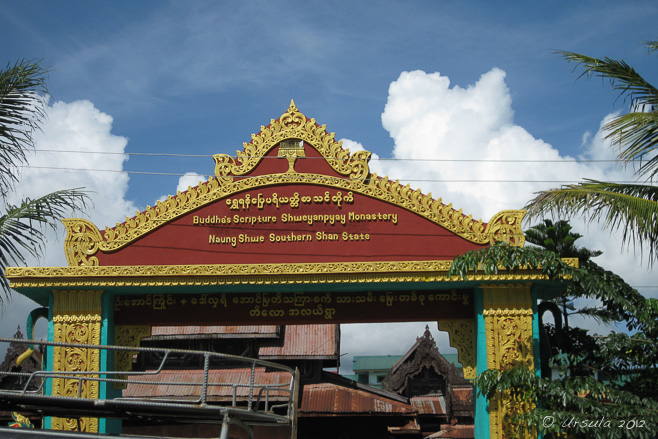
Entrance to the Monastery A gilded entry arch leads into the red-painted teak Shwe Yan Pyay Monastery.
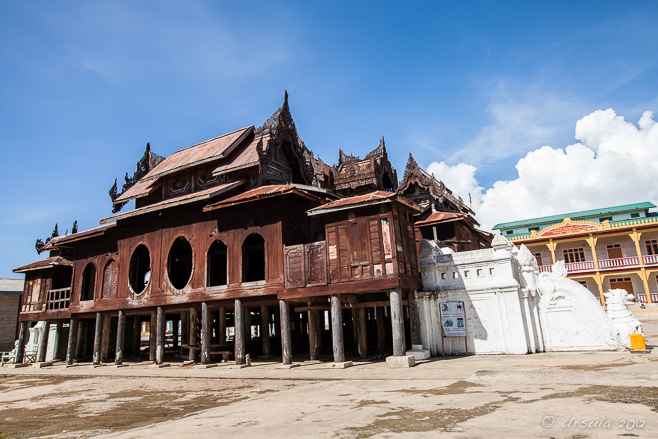
Old Burmese Teak Built in the early 19th century, the monastery is focussed on providing a home – with religious and secular education – for boys from poor families in the region.
Novices at Study
Novice at Study It must be difficult for the young boys to live in the dormitory without their families.
Novice With Kitten Many of them have kittens to keep them company.
Monastery Windows It’s the iconic scene: the windows, where tourists wait and hope…
Novice in a Window … that a monk or two will look out and be framed by the ancient teak.
Novice with a Book Novices are scattered around the monastery rooms, …
Novice with a Book … trying to find patches of light in which to study.
Novice in a Window
Light and Dark
Novice in a Hallway
Monk at Study
Novice in the Light
Carved Wall Textures are everywhere.
Novices Washing Back outside, it is bright and sunny. Novices cool down at the wash basins.
The Walkway The central sanctuary has an arched walkway all around. Light angles sharply into the dark corridor.
Remembrance Buddha Each Buddha is dressed in robes and its niche is inscribed.
Remembrance Buddhas The walkway is dotted with niches – each one with its own Buddha image.
Sweeping Rice In the central courtyard, women look after the drying rice.
Old Abbot At the door to the kitchen-dining building, the abbot watches over proceedings.
Abbot’s Hands Traditional protective tattoos are visible on his hands and other exposed parts of his body.
Novices at the Windows Finally! Some novices smile out of some windows; but, it’s the plain windows of their dormitory – not the oval windows I was hoping for.
The Chef Like the abbot, the chef has protective Sak Yant tattoos.
The Dinner Gong The chef uses a brake drum as a very effective dinner gong to call the novices to lunch. Theravada monks and novices don’t eat in the afternoons, so this will be their last meal of the day.
Lining up for Lunch The novices line up with their bowls as the abbot and the chef dish up food.
Monks at Lunch All the monastery residents sit at low tables to eat their mid-day meal.
It is a balancing act: knowing which photos you want to take, so you don’t miss them, against being open and ready to participate in what is there.
I’m still working on it: I was upset with myself for not getting the “iconic” shots of monks in teak-framed windows that I had wanted – but I still left the monastery with a rich experience I hadn’t been expecting.
Billy Buttons on the Horizon Mount Kosciuszko is home to some unique flora – cheerful yellow Billy Buttons (Craspedia Canens) are just one of many species.
Another year draws to a close…
I find that the period of “limbo” between Christmas and New Year is a good time to reflect on the past: on the trials and accomplishments of the year that is finishing.
I, personally, have been incredibly lucky this past year – with new babies and new adventures – but the events of the world around me have had an impact. I often feel weighted down by the disasters and acts of insanity that I see in the nightly news and feel the need to withdraw: to wrap myself in healing nature and refresh my spirit. There can be no better place to recharge one’s batteries and to make plans for the future, than the mountains.
They do say you should start as you mean to go on, and go on as you began, so, we spent the first days of this year in the Snowy Mountains, walking and cycling some of the trails in Australia’s Kosciuszko National Park.
Join me for some blue skies and fresh air.
Guthega Dam Guthega Dam is a concrete gravity dam – one of the sixteen major dams that make up the Snowy Mountains Hydroelectricity Scheme. We were attempting – not for the first time – to find the track to Mount Tate.
Trees on Guthega Trig Bush fires from years past have decimated the gum trees: in places, only their silver skeletons remain.
Red and Green Red patches of Sheep Sorrel (Acetosella vulgarise) growing amongst the blocks of granite contrast with the fresh green grass on the hillside.
Falls Creek Waterfall We missed the turn that would have taken us off the management track and up to Guthega Trig; instead we ended up blocked by the metal decking at Falls Creek. After a picnic lunch, we returned the way we had come.
Blueberry Flax-Lilies – (Dianella Revoluta) Wildflowers line the overgrown pathway above the Snowy River between Falls Creek and Guthega Dam.
Blueberry Flax-Lilies – (Dianella Revoluta) The Flax-Lilies flower from spring through summer. The fruit, which contains 3-4 seeds, turns blue to purple and lasts for many months.
The Pathway Back The track follows the hip of the hill – high over the Snowy River below.
Viper’s Bugloss (Echium vulgar) Not all the flora is indigenous. Like the related Paterson’s Curse, Viper’s Bugloss is an invasive weed, with control orders in place.
Daisies
Seaman’s Hut Another day, we cycled the six kilometres up from Charlotte Pass to Seaman’s Hut, …
Silver Snow Daisies (Celmisia Tomentella) … parked our bicycles in the lee of the hill and ate our lunch under a blue sky, …
Granite and Alpine Everlasting (Leucochrysum Albicans) … before continuing up hill on foot, …
Path to the Top …and ascending to the top of Mount Kosciuszko – Australia’s highest “peak” (2228m).
Candle Heath (Richea Continentis) Endemic to the Australian alpine country, the spiky leaves of the Candle Heath make tracts of mountainside un-passable.
Billy Buttons (Craspedia) At lower altitudes – but still above tree-line – the Billy Buttons add a splash of yellow to the mountainsides.
Billy Buttons (Craspedia) Also known as Woolyheads, Billy Buttons are members of the daisy family, and native to Australia and New Zealand.
Mountain Celery (Aciphylla Glacialis)
Purple Eyebright (Euphrasia Collina) on the Mountainside
Overlooking Rawson Pass The nine kilometres back down the Old Summit Road is SO much easier than the ride and walk up!
Silver Snow Daisies (Celmisia Tomentella)
Chamomile Sunrays (Rhodanthe Anthemoides) beside the Roadway
Rocks and Alpine Flowers
As an introduction to The New York Times Year in Pictures 2015, Steven J. Erlanger writes:
There were some good news stories as well – and it is, of course, up to each of us to contribute to a better world in some small way. But, sometimes, to maintain our spirits – and sanity – we just need time out.
Here is hoping the new year brings us all better things.
Seaman’s Hut, Old Summit Road, Koscuiszko National Park, Australia
Hello Ursula.
Your photo,s of alpine plants are good. And I can see you have gone to a lot of trouble to get the correct botanical names. Daisy plants are hard to get the correct botanical names . You have photo,s marked as Rhodanthe anthemoides.
These are incorrect . They are Leucochrysum albicans ssp. alpina.
The photo of the Native celery Aciphylla glacialis is the Male form of this plant.
Hoping this is some help to you. JoeReplyCancel
Mother and Nursing Child Winter mornings are cold and dark in the huts of Otjomazeva, a kraal village in the Kunene Region of Namibia, but the people are warm and welcoming.
The Solstice (Yule or Litha – depending which hemisphere you are in) has just passed. Today is Christmas Eve here in Australia.
It makes me think of my family – scattered as they are – and of the families I have met in my travels. These families can take very different forms from the “norm” I grew up with (more on that some other day), but the core human bonds are recognisable wherever you go.
Earlier this year, I had the great privilege – thanks to photographer Ben McRae, Pedro Ferrão Patrício from Photoburst, and Namibian guide Morne Griffiths – of spending some time with traditional tribal Himba people. We were welcomed into Otjomazeva, a tiny kraal village near Epupain Namibia.
There are about 50,000 indigenous Himba(singular: OmuHimba, plural: OvaHimba) people living on both sides of the Kunene River: in the Kunene region (formerly Kaokoland) of northern Namibia and in Angola. Semi-nomadic pastoralists, the Himba quite consciously maintain their cultural traditions and subsistence lifestyle.
I took hundreds of photos during my visits to the village, some of which I’ll post at another time. Right now, I’d like to just share just a few pictures of the simple village itself, and some portraits of a Himba woman and her child.
Otjomazeva Morning Sleep – as they say – is over-rated. It was very early – quiet, cold, and dark – when we left our campsite. The pre-dawn light was pale and pink as we approached the Otjomazeva kraal.
Morning Rolls It was still dark when we entered the kraal (with prior permission, of course) and I thought the “logs” in front of the huts were piles of donated blankets we had dropped off in the village the day before …
First Stirrings … until one of them moved! There is not enough room in the huts for everyone, and many of the community slept outside, rolled in their blankets against the winter cold.
Morning Huddle Noiselessly the day slowly comes to life. People gather around meagre fires waiting for the porridge to boil.
Tall and Beautiful This young woman’s regal bearing captured my attention, as she stood, wrapped in her soft cow hide.
Mother and Child She, her wrap, and her baby girl are coloured with the ochre paste (Otjize) that Himba women wear all over their skin and hair.
Himba Mother The unique Himba hairstyle worn by married women is created by weaving long hair extensions – from goat or cow hair, and often including some of their husband’s hair – around the head, and coating these plaits with the ochre paste. Babies generally have their heads shaved, sometimes with a little tuft left on the top.
Applying Ochre Paste The women are surprisingly happy to have myself and one of my companions inside their hut as they go through their daily ritual of re-applying the otjize. It is pitch black in the huts – the only light is from the low open doorway and the odd holes in the wattle and daub walls. Even so, you can just see the sculptured sheepskin Erembe headpiece that our Angolan visitor has put back on after she re-pasted her hair.
Mixing Otjize The paste of liquified butterfat and ochre has a wonderful perfume, thanks to the resin of the omuzumba shrub. It’s baby’s turn to be rubbed with the paste, and she sits watching me while her mum prepares it.
Chatter This woman is an extended family member who is visiting from neighbouring Angola. Her time in the village is spent catching up on local gossip. When she smiles, you can see the gap in her front teeth: traditionally, both boys and girls around age twelve have the front bottom teeth (incisors) knocked out and the two top front teeth filed into an upside “V” . …
Smiling Profile … This seems tragic to me, especially considering how beautifully white their teeth are!
Mother and Child
Mother and Child
“It Takes a Village” Children in the Himba village are never far from an arm or a lap – or a comforting breast.
All around the world, families and friends gather to celebrate. Where I grew up, the celebrations this time of year were either for Christmas or Hanukkah. But, if there is one thing travel teaches you, it is that “family” and “celebration” take very different forms the world over.
So, whether you are celebrating Christmas or Hanukkah; Rohatsu or Mawlid an Nabi or Zarathosht Diso; Solstice – or nothing at all; I hope you can take the time to appreciate your family, and to make peace within your community. In the words of Charles Dickens:
[…] I had the wonderful privilege of spending time with some Himba people in Northern Namibia (see: Mother and Child; Model Shoot). The Himba are a beautiful, proud tribe who have deliberately resisted integration […]ReplyCancel
[…] are immediately recognisable by their distinctive hairstyles (see: Mother and Child; Women of the Himba; Himba Model Shoot), which are determined by their age, gender and […]ReplyCancel
[…] I had the wonderful privilege of spending time with some Himba people in Northern Namibia (see: Mother and Child; Model Shoot). The Himba are a beautiful, proud tribe who have deliberately resisted integration […]ReplyCancel
The Angel Inn – Broad St, Ludlow Originally built in the 1500s with a top story added as late as the 1700s, The Angel operated as an inn from as early as 1555.
The term “black and white village” refers to several old English villages in the counties of Herefordshire and Shropshire in the West Midlands of England.
These villages are known for their timbered and half-timbered houses, some dating to medieval times. The framework of the houses was made from unseasoned green oak, which darkened over time; painting the beams black was a relatively recent innovation. The panels between the beams were covered with plaster – or sometimes with brick – and painted with lime wash.
Ludlow, a thriving medieval market town in the Shropshire Hills with top class restaurants and around 500 heritage listed buildings, is a particularly finest example of a “black and white village”.
Every Town has a Grain Store Walking into the town centre from the train station is like walking into the past… Apparently, this old warehouse has been converted into flats. Who would know?
Walking Street Are these “brownstones”? As in: buildings made of brown Triassic-Jurassic sandstone bricks? I don’t know – but there is a real sense of stately permanence on Corve Street, Ludlow, as one walks past the Richard C Swift Ltd – “Quality family bakers since 1863” – shopfront.
The Famous Feathers The Feathers Hotel is one of about 500 heritage-listed buildings in Ludlow – and one of its best known and most-photographed. Built in 1619 by local lawyer Rees Jones, it is a Tudor-style half-timbered building.
Inside the Feathers Probably the finest old timber-fronted black-and-white house in Ludlow, the Feathers Inn is known for its beautiful Tudor architecture and elegant Jacobean refurbishment.
The Barista The young man who had made and delivered my coffee saw that I was taking an interest in the marvellous old building. He offered to take me upstairs for a look at some of the other rooms.
Ornate Plaster Ceilings The story my young guide told me was that some years ago, this ceiling collapsed because an upstairs guest had let a bathtub overflow. The artisan commissioned with the repairs was a nationally-recognised elder-relative of my young man – who was justifiably proud of his ancestor.
Fading Tapestry The corridors and stairwells are richly decorated with old paintings, furniture, and tapestries – this one dated from 1318.
Lead Windows Cast diamond glazing keeps old glass looking new – and the oak frames have also withstood time.
Stationary Shop Plenty of charming shops in keeping with the town’s medieval facade line the streets.
A Bicycle and a Post Box How quintessentially British! A stone wall, a bicycle, and a pillar box.
The Bull Hotel The 15th century medieval coach-inn, the Bull Hotel on the Bull Ring, predates the Feathers Inn across the road by some years.
King Street Historic buildings can be spotted along every curving roadway. The Buttercross, with its clock tower, sits at the top of King Street.
The Buttercross It is a beautiful, sunny, winter day as I head into the Buttercross (built 1743-46): the official centre of town.
College Street
St Laurence’s Church With Norman foundations dating back to the 11th century, St Laurence’s Parish Church in the centre of town was rebuilt in 1199 – with major expansions between 1433 and 1471. It is considered one of England’s outstanding medieval town churches.
Stained Glass Windows – St Laurence’s Parish Church
Chaplain Barry and the Misericords One of the church chaplains tells visitors to the church about the small folding seats, or ‘misericords’, designed to provide some comfort to people standing for long periods of prayer in the medieval choir stall.
Cautionary Tales The fold-down seats (mercy seats) are richly carved with cautionary tales: this one depicts a dishonest ale-wife being carried to hell by demons.
In the Bell Tower Ludlow is famous for its church bells, which are housed in an imposing 41-metre (135 feet) high tower immortalised by the poet A E Housman in “A Shropshire Lad”.
Atop the Bell Tower The 550-year-old tower is weathered …
View over Ludlow … but affords magnificent 360° views over the town and countryside.
Graveyard behind the Church
The Buildings of Broad Street Running a short distance from the Buttercross to the town-wall gatehouse, Broad Street is one of the finest stretches of “black and white” houses in England, with some excellent examples of medieval and Tudor-style half-timbered buildings.
Quality Square Ludlow is known for it’s food, and corners of town are given over to fine restaurants and boutique shops.
Another Bicycle – Harp Lane The coffee shops and markets are also a delight.
Ludlow Castle Ludlow Castle was founded around 1075 and was one of the first stone castles to be built in England. It is credited to Walter de Lacy (d. 1085), a Norman nobleman who was given extensive lands in Herefordshire and Shropshire by King William I of England.
Sir Mortimer and Lady Grey Roger Mortimer acquired the castle in 1301 and the family held it for over a century. Today, the castle is owned by John Herbert, current Earl of Powis, and is managed as a private tourist attraction.
Ludlow Castle Canon “English Heritage” lists Ludlow as “one of England’s finest castle sites”.
Dinham Road Ludlow was known as “Dinham” in its early years, and the road just south of the castle still bears this name.
Ludlow is a delightful place to visit: not the least because I had a superb lunch and bought some fine china at market prices.
It just goes to show: you can preserve your heritage and still attract visitors to a modern, thriving, market town.
[…] that houses the Black Lion Pub. The Midlands is “Black and White” country (see: Medieval Ludlow), and a few of these distinctive buildings survive in Hereford […]ReplyCancel
Sally M Edwardes -February 7, 2024 - 9:44 am
The photographs are wonderful: crisp images and nicely composed.
I have stayed in Ludlow and so it is good to see the sights again.ReplyCancel
Tomatoes Fresh and juicy – in all their shades of yellow-to-red – tomatoes have become central to cooking world over.
Tomatoes.
Salad, salsa, pasta sauce, creamy curry, pizza, ratatouille, juice, gazpacho… the list goes on.
Tomatoes have become central to cooking world over. In season, I keep them planted in my garden, and I always have plenty – large ones for cooking and sandwiches and small ones for salads – tucked in my fridge. Originally native to western-South America and Central America, and cultivated domestically in Mexico before 500 BC, it’s hard to believe tomatoes were only introduced to Europe and Asia by the Spanish in the early 1500s.
One of the things I love about travelling with photo-tours is that you regularly devote time to places other groups minimise or ignore completely. This gives me more of a real glimpse into “ordinary” everyday life. After all, when was the last time you stopped to spend time in a tomato distribution centre?
I was in Nyaung Shwe on the north shore of Inle Lake in Myanmar, with photographer Karl Grobl, local guide Mr MM, and nine other photography enthusiasts, when I had the opportunity to watch local Burmese at work.
Tomato Boats Tomatoes are grown on the floating farms of Inle Lake, and come into the distribution centre by boat.
Tomato Baskets The colours are fresh and bright in the morning sunlight.
Men Delivering Tomatoes Every step of the food chain is labour intensive.
Tomatoes The produce is bright against the dark canal waters.
Tomato Boat The long, graceful boats laden with full baskets sit low in the water.
Boxed Tomatoes
The Warehouse Inside, it is dark and cool.
Sorting Tomatoes Women sort through tomatoes of all colours from the pile on the bamboo platform.
Sorting Tomatoes Tomatoes fly into the baskets.
Portrait Workers chat and laugh as they perform their work.
In the Corner Light slants through the woven walls as tomatoes fly towards a lone basket.
Tomatoes in Baskets
Red Glow Light through the walls bounces off the ripe fruit.
Heavy Lifting
Movement
Light and Lines
The Bookkeeper All the baskets of tomatoes moving in and out of the storehouse are recorded in a notebook.
Tomatoes Warm and rich smelling, the baskets of tomatoes sit in the sun.
I loved the smell and the colour and the shape of tomatoes.
Clearly, a lot of work has gone into getting these ones to market ~
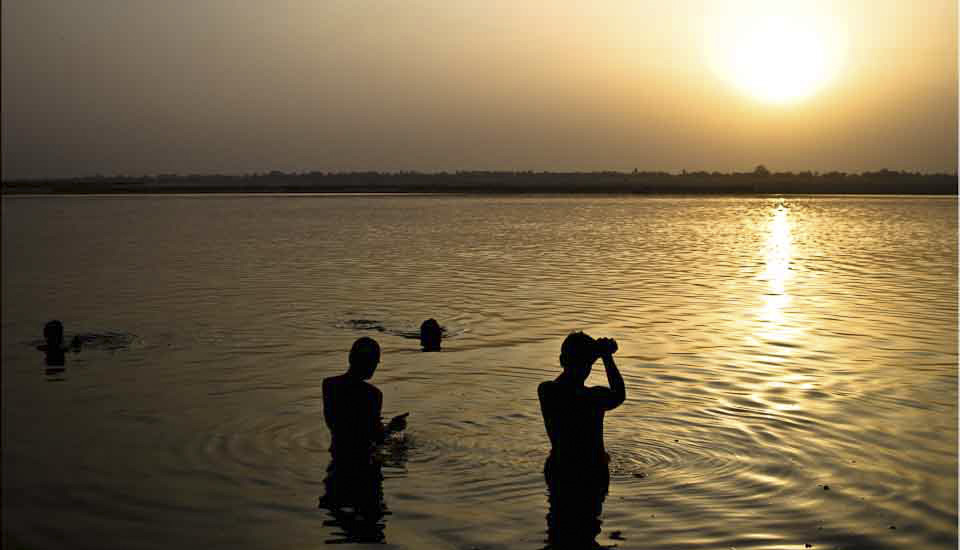
- Performing the Ganga Aarti from Dasaswamedh Ghat, Varanasi
- Buddha Head from Shwedagon Pagoda, Myanmar
- Harry Clarke Window from Dingle, Ireland
- Novice Monk Shwe Yan Pyay Monastery, Myanmar
Packets of 10 for $AU50.
Or - pick any photo from my Flickr or Wanders blog photos.


 Until next time,






 I loved the smell and the colour and the shape of tomatoes.