Woman with Water Pots A “simple” life is not necessarily an easy one.
The Thar Desert, or Great Indian Desert, is an arid region that forms a natural boundary between India and Pakistan. A relatively large area, it spreads across four Indian states (Gujarat, Haryana, Punjab, and Rajasthan) and two Pakistani states.
The Thar Desert is the most densely populated desert in the world, with 83 people per square km. This population lives in small villages, far apart from each other. The people are often nomadic: moving when their sparse water supply dries up.
In most villages, the familial generations live together in one complex, and any money earned by family members becomes the common property of the family as a whole. A walk around the small village of Khuri, within the boundaries of Desert National Park, and only 45 km from the World Heritage city of Jaisalmer, demonstrates how little people make do with.
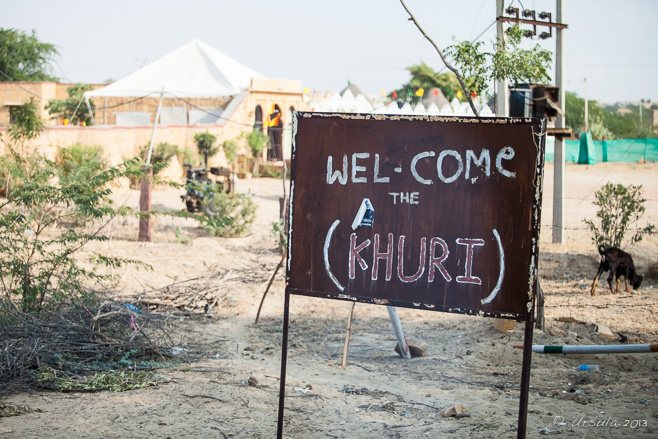
“Welcome Khuri” It’s a simple sign that welcomes visitors to a simple village.
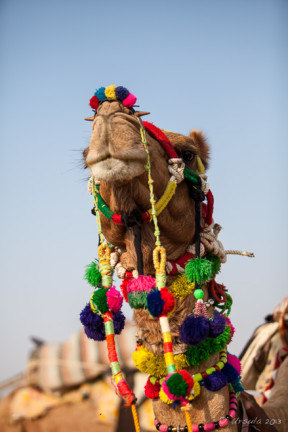
Camel – Camels – which provide rides for tourists – …
– in his Finery … are the village’s economic mainstay.
Skinny Calf and Fallen Laundry Most of the houses in the village are simple clay-and-dung walled huts with thatched roofs and packed-earth courtyards.
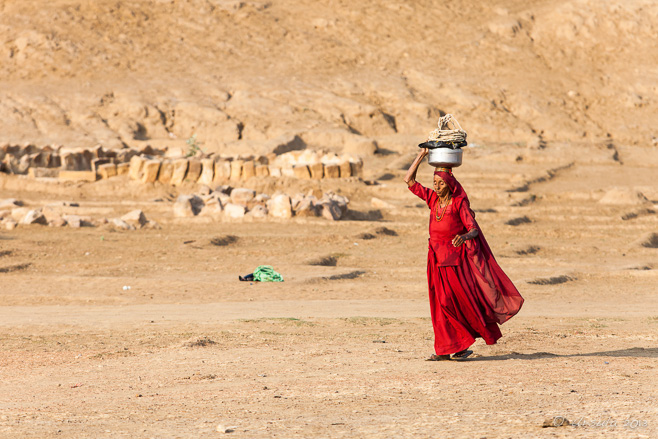
Water Pots Water is carried – not piped.
Family at the Gate Most houses have a fenced-off courtyard. Clearly, the lifestyle is simple, …
Woman at the Gate … but the smiles are generous.
Child at the Window
Rajasthani Girl Children, with their dark eyes rimmed with kohl, are everywhere, …
Rajasthani Boy … though it might take a little while for some of them to come out of the shadows.
Goat The presence of livestock – goats and cows – signals that this village is doing well.
Sweeping the Housefront Most tasks are performed manually, …
Machine-Worker … but there is some electricity, running off a generator.
Man on the Stoop
Woman and Children Firewood or clay pots are stored on flat roofs. There are surplus bricks scattered all around the place; …
Woman and Child … I can’t tell if they are from buildings going up or coming down.
“Washed” Pots I suspect these utensils have been sand-scrubbed. Water is at a real premium around the village; …
Women with Water Pots … as I ride into the dunes on one of the camels, local women are returning to the village with water pots on their heads.
Camels on the Sand Like most tourist who visit this part of Desert National Park, we are there to ride the camels into the dunes.
Dancing Boy In the falling afternoon light…
Dancing Boy … a young boy entertains us with dance …
Prayers on the Wind Dochula Pass, Bhutan, 3150 metres above sea level, is home to 108 chortens (stupas) and countless prayer flags.
Bhutan, that once-secretive, still-exotic, Himalayan Kingdom, is a sensory feast for the photographic enthusiast.
The story that tourist numbers are strictly limited is over-stated. But, they are self-limited by the fact that, other than Indian nationals, all foreigners need to arrive by air – and for a long time only Drukair flew in and out. Today Druk has five airplanes, but when I visited – back in September 2009 as part of a group with photographers Gavin Gough and Jackie Rado – they had only two A319 Airbuses.
This helps explain why our trip started with a long day inside Bangkok’s Suvarnabhumi Airport. We arrived for our group check-in at 4:20am, only to be told that our plane (one of the two at the time) had “technical problems” and there would be a “slight” delay as we waited for parts to come from France.
Flights into Paro, Bhutan’s only international airport, are by visual flight rules (VFR), meaning they are dependent on weather and daylight. Only a few aircraft, in the hands of skilled pilots, can fly through the angled mountain passes and land safely on the short runway. Landing or taking off in the dark is not an option.
So, as the “slight” delay extended past breakfast, and then past lunch, we sat in an airport coffee shop – eight photographers with over-sized carry-ons and laptop cables tangled towards every available wall outlet – waiting for word, and knowing that if we didn’t leave by early afternoon, we’d go nowhere until morning. Our plane finally left at 3:00pm.
The flight into the Paro Valley, with the Himalaya rising on all sides, was everything it was cracked up to be. Now that you no longer have to dip your wing to people eating dinner in their high-rise apartments in Hong Kong, there can’t be many international airports like Paro. We were blessed with sun and good visibility, and were therefore able to watch as the plane took two sharp turns through the tight valley and descended to the airport. The collective intake of breath as the left wing almost touched the mountainside was palpable, and the passengers burst into spontaneous applause when the wheels touched safely down on the runway.
Our first full day in the country was spent hiking to Tiger’s Nest, high over the Paro Valley. Then it was time to hop in a minibus, and cross some of the rugged countryside – under clear, sunny Autumn skies – in search of the famous Tibetan Buddhist festivals, or tsechus (Dzongkha: ཚེས་བཅུ།, literally “day ten”), where we would photograph the swirling and stomping dancers (e.g.: Wangduephodrang Dzongkhag Dzong Tshechu).
Getting there was part of the wonder. I absolutely loved the mountains, and I sat in the bus with my nose pressed to the glass for most of our journey from Paro to Wangduephodrang.
But it was the prayer flags that really entranced me: I couldn’t get enough of them.
Morning Mists in the Paro Valley You could be nowhere else! The architecture around Paro reflects Bhutan’s traditional architectural style – which is actually codified in official guidelines.
Paro International Airport Surrounded by magnificent mountains as high as 5,500 m (18,000 ft), Paro Airport (2,235 m / 7,332 ft) is considered one of the world’s most challenging.
Roadside Stop Our first stop on the road was at the Chuzom (or Chhuzom). A chu is a river; zom means join.
The Chuzom This is the place where Paro and Wong (Thimphu) Rivers meet. Traditional Bhutanese consider this an inauspicious union of a father and mother river, …
Three Stupas … so there are three stupas (chortens) here to ward off evil spirits. As if to cover all bases, the stupas are Bhutanese, Nepali, and Tibetan in style.
View from the MiniVan I watch out the windows of the van as we continue to climb over the Thimphu River.
Grandma on the Ridge Above the Ola Rong Chu, we stop on a ridge where I chat with a grandmother who is caring for some of her many grandchildren while their parents work.
Semtokha Dzong On the other side of the Ola Rong Chu Valley, Semtokha Temple nestles in the trees.
Grandma and the Kids
Border Guard Bhutan is partitioned into a number of divisions – so we go through several checkpoints on our drives.
Churpi or Chugui A popular Bhutanese snack, chhurpi (churpi) is a traditional dried and smoked cheese made from yak milk.
Prayers over the Mountains Our next stop is at the popular Dochu La Chorten, a 3150 metre-high mountain pass with 360° views over the Himalayan mountains.
Tangled Prayers and Dreams
Whispered Prayers
“Yellow is for the Earth” According to legend, prayer flags started from the battle flags used by the Gautama Buddha against the evil asuras. The five flag colors represent the five elements: blue for the sky and space, white for air and wind, red for fire, green for water, and yellow for the earth.
Forever Prayers
Faint Prayers
Druk Wangyal Chortens The Bhutanese Queen Mother commissioned 108 chortens at Dochula Pass in memory of Bhutanese soldiers killed in the 2003 war against Indian insurgents.
Stairs up Dochu La Chorten
Tradesman on the Roof
Mists on the Pass
Bhutanese Driver
“Oṃ maṇi padme hūṃ” Expresions of Buddhist worship are everywhere in Bhutan.
The ever-present prayer flags, the chorten and stupa dotted around the countryside, and the prayer texts; all around Bhutan there are reminders to honour Buddhist practice.
[…] by Indian mythology to be enemies of the gods. Ubiquitous in the Tibetan Buddhist world (e.g.: Prayers on the Wind: Bhutan), prayer flags come in different styles and shapes, but the most commonly seen are the Lungta […]ReplyCancel
Sing the Blues for Me! Vocal powerhouse Gail Page had the crowd on their feet at the recent Thredbo Blues festival. On her Facebook page, she, like many others, lamented the passing of the multi-talented David Bowie.
“Let’s dance! Put on your red shoes and dance the blues…”
David Bowie died earlier this month (January 10, 2016). There is no denying his influence over the zeitgeist of the era I grew up in, and the news of his death stunned me like a blow to the solar-plexis. All over the world, tributes have flowed for his musical ingenuity and his friendly, unassuming, behaviour. The people from the small, red-dirt outback Australian town of Carinda, NSW, where the “Let’s Dance” video clip was filmed in 1983, have joined to contribute their recollections of his time in their tiny town. As Rolling Stone wrote about that period: “In Australia, David Bowie was a man without masks. Open, jokey, very . . . warm is the only word.”
In a tangled web of tangental not-quite coincidences, I was at the Thredbo Blues festival with friends shortly after Bowie’s much-lamented passing; we were singing and dancing the blues in crisp mountain sunshine.
The Thredbo Blues is a small, unassuming, festival that is about much more than just world-class music (see: Summer Blues; Blues in Colour; Cool Blues – Hot Jazz). As usual, we also delighted in great company, excellent wine, and invigorating walks in the fresh alpine air.
Do come and enjoy the blues and sunshine with us.
The Hip Replacements We eased into our blues weekend with free drinks and classic Australian rock and blues with The Hip Replacements. The local legend and ARIA (Australian Recording Industry Association) Hall of Fame inductee Russell Morris later quipped: “They are fakes! They are not so old – they don’t have an actual hip replacement amongst them!”
Dan Dinnen Many of the venues – especially the restaurants – can only be described as “cozy”. Tucked into a corner of the Santé Churrasco Restaurant, with the afternoon sun streaming over his shoulders, Dan Dinnen serenades diners with his acoustic guitar, blues harp, and vocals.
Genevieve Chadwick Outside, the day turns to evening, as Genevieve Chadwick – who we’ve enjoyed at Thredbo and Byron Blues before – keeps the restaurant entertained.
Andrea Marr Band In the packed-out Schuss Bar, Andrea Marr and her band fill the room with sound and crowd the floor with dancers.
Richard Perso When we arrived before noon the next day, the sun was already high over the audience sitting Poolside at the Alpine Hotel. Richard Perso’s low voice rumbled through the summer air.
Richard Perso With his foot percussion pounding, his bass voice resonating, and didgeridoos thrumming, Perso brings a unique sound to roots and blues music.
Shane Pacey Trio In the Eagle’s Nest Restaurant, which sits at the top of the Crackenback Chairlift overlooking the town of Thredbo, Shane Pacey and his guitar, Paul Blasi on bass, and Dave Fester on drums, squeeze into a corner and delight the lunch crowd.
Shane Pacey Trio As soon as the lunch plates are cleared, the patrons are on their feet dancing in any available space.
Above Eagle’s Nest The music continues throughout the afternoon back in the village, but instead of riding the chairlift back down to Thredbo, we take the slower option and walk.
Silver Snow Daisy (Celmisia Asteliifolia) The ten kilometre Dead Horse Gap track starts with a climb through the alpine heath on the Rams Head Range.
Chamomile Cascade (Rhodanthe Anthemoides) The perennial chamomile sunray daisies still cover the hillside.
Rocks on the Mountain Piled boulders give an other-worldly feel to the landscape.
Alpine Mint (Prostanthera Cuneata) Alpine mint or “rough mint” bushes add to the scented air.
Daisies on the Rams Head In winter, this is ski country. This year, the silver snow daisies have peaked early and by mid-January they are starting to fade, even at this altitude (about 2000 metres).
Ghost Trees The track descends back below the tree line – but these snow gums died years ago and only their ghostly skeletons remain.
Thredbo River When we finally descend to the rushing river, we know the village is not too far away.
Andrea Marr Band The sounds of music are all around the village. We head back to the Lounge Bar where the Andrea Marr Band is performing.
Andrea Marr
Gail Page It is definitely a year of women with cheeky smiles and powerhouse vocals!
Jill Tweedie (nee Drury)
Andy Just and Darren Jack On the Sunday, American blues-harp player Andy Just joined guitarist Darren Jack from the Third Degree for an early afternoon Poolside performance.
Andy Just and Grant Cummerford
Hats A good hat is essential at any music festival.
“Old rockers never die – they just re-invent themselves …” Australian singer-songwriter Russell Morris and lead guitarist Peter Robinson play Morris’ old hits from the 60s and 70s, and his new hits from his recent Top 10 albums.
Russell Morris and Mitch Cairns Morris’ songwriting-storytelling continues to capture hearts and imaginations…
Peter Robinson Playing the Crowd … while lead guitar Peter Robinson is still a crowd-pleaser.
The Sound Guys But it’s the unsung sound-guys who keep it all happening.
Nick Charles and Pete Fidler Nick Charles is billed as “Australia’s virtuoso of acoustic blues and roots”; he and his guitar are beautifully melodic.
Dorothy-Jane and Richard Steele The wonderful vocals and harmonica of Dorothy-Jane, with Richard Steele on guitar …
Dorothy-Jane and Richard Steele … play us through dinner as the light falls on another festival.
During our time in the mountains, my friend bought a pair of red shoes – well, they were red hiking boots, really. It had nothing to do with Bowie: she wanted boots that would still look good when covered with the red soil of her outback property, but we still had to tip our hats to the passing of the musical master-chameleon and sing a few bars of “Let’s dance!” as she tried them on.
A lot of very special people have died this year and it is still only January; it’s like we are being given notice of the end of an era. So many of the musicians and artists I grew up with are no longer around …
[…] later we returned to the Snowy Mountains for the annual Thredbo Blues Festival (“Let’s Dance the Blues”) and a trek down the 10km Dead Horse Gap […]ReplyCancel
Morning Dog-Walk Frosty ground, bare trees and a tender pink sky: it’s a winter morning in Burghill, Herefordshire. (23January2015, iPhone5)
Winter in Britain…
What a wet, bone-chilling prospect!
This winter (2015-16), the northern part of Great Britain was inundated by floods after the pre-Christmas storms Eva and Desmond, and then had to brace for record cold temperatures and snowfalls. Two years ago (2013-14), Britain experienced the wettest winter on record: the south was battered by winter storms that ripped away beaches and made world headlines.
I’m not used to winter anymore after years of living in the warm-temperate zones of Australia and the tropics of Thailand. How lucky for me, then, that I was in Hereford in the West Midlands this time last year, during a season that was described as “relatively benign and quiet”.
The sun rose late mid-mornings, and set early-evenings after angling low with a weak warmth in the afternoons – a pattern that rather suits my nocturnal rhythms. For the most part, mornings were cold, crisp, and frosty, and days – as short as they were – were dry and clear.
Just as well, as I did a lot of walking.
Grab your winter woolies and join me!
Landscapes – Passing Like a Dream… Trains are a wonderful way to get around: the cold, bare winter fields and trees flew past as I travelled north-west from London. (22January2015, iPhone5)
Morning Frost Jet-lag had me up early on my first morning in Burghill: the frost was thick on the grass … (23January2015, iPhone5)
Fence Post … and made lacy patterns on the fences. (23January2015, iPhone5)
Winter Trees The morning sun – once it made an appearance – cast a golden light on the winter trees. (31January2015, iPhone5)
Holly Berries Nothing says “English Winter” quite like the bright red berries on the holly bushes along the roadway. (24January2015, iPhone5)
Over the River Wye Most days, my walks took me over the River Wye: always beautiful and ever-changing in the soft winter light; … (23January2015, iPhone5)
West over The Hills … on other days, I donned gumboots and ventured into the hills and countryside (see: Credenhill Wood). (08February2015, Canon EOS 5D MarkII)
Park-View Sunrise Another morning: another magnificent winter sunrise over the old St. Mary’s Hospital parklands. (02Feb2015, Canon EOS 5D MarkII)
Deer Park Founded in 1868, St. Mary’s Hospital at Burghill – or the Hereford County and City Lunatic Asylum, as it was originally known – was a psychiatric facility. It was later expanded to include patients with tuberculosis, before being closed in 1994. Today the grounds, which include parklands, a large duck pond, and a deer park, are home to a modern housing estate which incorporates some of the historical buildings. (03Feb2015, Canon EOS 5D MarkII)
West over Brecon Beacons The walk from Burghill down into Hereford gives views over the fields to the snow-topped Brecon Beacons, the popular mountain range in South Wales. (02Feb2015, Canon EOS 5D Mark II)
Hospital Farm Down hill from the site of the old St Mary’s Hospital is the wonderfully textured and rusty “Hospital Farm”. I can only surmise it once supplied the hospital kitchens. (04Feb2015, Canon EOS 6D)
Dead Leaves Last season’s dried out oak leaves cling to the trees. (04Feb2015, Canon EOS 6D)
Snowdrops In the leaf litter at the base of the trees, the snowdrops are already blooming. (06Ferbruary2015, iPhone5)
The Oxford Arms The Midlands is “Black and White” country (see: Medieval Ludlow), and a few of these distinctive half-timber buildings survive in Hereford itself. (04Feb2015, Canon EOS 5D Mark II)
Hereford Rooftops (04Feb2015, Canon EOS 5D Mark II)
Victoria Footbridge Built in 1898 to commemorate the Diamond Jubilee of Queen Victoria the previous year, the Victoria Footbridge is a three-span suspension bridge over the River Wye. (04Feb2015, Canon EOS 6D)
River Wye, Hereford The bell tower of Hereford Cathedral is an integral part of the city view from the footbridge. (04Feb2015, Canon EOS 5D Mark II)
Pigeon Pigeons rest on the footbridge stays. (04Feb2015, Canon EOS 5D Mark II)
Victoria Footbridge On the south side of the footbridge, Bishop’s Meadow and the King George V Playing Fields attract walkers and cyclists … (26February2015, iPhone5)
King George V Playing Fields … who make use of the pathways through the wet fields and leafless trees. (26February2015, iPhone5)
Pampas Grass Even at midday, the winter light angles steeply. (04Feb2015, Canon EOS 5D Mark II)
Afternoon on the River Wye (04Feb2015, Canon EOS 5D Mark II)
Under the Umbrella Of course, some rains did fall … (13February2015, iPhone5)
Fish and Chips … but a local pub with some typical British comfort food was never far away. (28January2015, iPhone5)
I hope the weather is treating you well – whatever season you are in.
Men’s Morning Circle It’s early morning. Bishnoi men, wrapped up against the cold, prepare their ritual opium tea.
There are countless deities in the Indian pantheon.
Sometimes it seems that the number of religions and cults is almost as high.
Scattered around the Western Thar Desert of India and Pakistan are villages of people calling themselves Bishnois. Followers of “Jambhaji”, as Guru Jambheshwar of Bikaner (b.1451) became known, these people are predominantly descended from Jat peasants and Rajput warriors from the north: Haryana, Punjab and Rajasthan.
The Bishnoi are known for their staunch environmentalism, and commemorate the martyrdom of the more than 360 people who died in 1730 trying to save the trees of Khejarli. Today, they mount strong protests against the killing of wild animals. They are strict vegetarians, and filter their water before boiling it to prevent any bugs being killed. They even bang their firewood before burning it to make sure any insects can escape.
The name “Bishnoi” comes from bis (twenty) and nai (nine), representing the 29 rules for living handed down from Guru Jambheshwar. It is ironic that rule 24 is to not use opium; on the tourist circuit, the Bishnoi are perhaps best known for their morning opium ceremony. For while opium is officially banned in India, it is not only used in Bishnoi villages, a drink made from it is freely offered to visitors.
I was travelling with a small group of photography enthusiasts, under the guidance of photographer Karl Grobl and local expert DV Singh. For the record, none of us tried the opium drink – though from what I have read, it is neither tasty, nor particularly potent.
Motorcycle Sunrise We started out early: the sun was low on the autumn horizon as we made our way to a Bishnoi village near Khejarla, Rajasthan.
Blackbuck – Antilope Cervicapra This is a dry region with sparse grazing; some people believe that the Bishnoi protection of all animals helps account for the larger numbers of deer and antelope in these Bishnoi-dominated areas.
Preparing Opium A ball of dried opium (or a quantity of seeds) is pounded in a vessel and small amounts of water are added.
Pouring the Juice The mixture, called amal, is then poured into a filter.
Drinking Opium … and the thin liquid is drunk from cupped hands. The process was repeated a number of times, until each man had had his share.
Filtering Opium The amal is filtered three times, prayers are said, …
Washing Dishes I wandered off to see what the other villagers were doing. In the semi-open courtyard of one of the homes, a woman was washing cups.
Tending the Hearth She tended the fire…
Pouring Chai … and made chai …
Pouring Chai … for the men to collect.
Bishnoi Woman
A Man and his Children
Bishnoi Man
Bishnoi Man … and their chai. (Rule 25 is against tobacco.)
Pouring the Amal The men continue to enjoy their opium and cigarettes, …
Old Bishnoi Woman Away from where the men gather around their opium and chat, the early-morning activities continue.
School Children Children in uniforms head to school…
Woman in Pink … and a young woman heads inside after sweeping her porch.
The Wood Pile Rule 10 requires that water, milk and firewood be filtered, so as to prevent damaging any living creatures when it is boiled or burned. Dried wood is collected for cooking fires: Bishnoi are not allowed to cut green trees.
Rolling out Chapati In another house, a woman is making capātī – from the Hindicapānā, meaning ‘flatten, roll out’.
Patting Capātī The unleavened bread is patted into an iron pan.
Sprinkling the Ghee Ghī, clarified butter, gives the chapatis their flavour and keeps them from sticking to the pan.
Off to School A young lad tucks his chapati – rolled in newspaper – into his school bag, and heads off.
Bishnoi Woman
A Place for Everything … Possessions are few, but everything is clean and tidy – especially by comparison with much of India!
Young Mother and Village Well The cows in the background are for milk; the Bishnoi eat no meat.
I was pleased to share the villagers’ morning – if not their opium! It was certainly an unusual experience.
- Performing the Ganga Aarti from Dasaswamedh Ghat, Varanasi
- Buddha Head from Shwedagon Pagoda, Myanmar
- Harry Clarke Window from Dingle, Ireland
- Novice Monk Shwe Yan Pyay Monastery, Myanmar
Packets of 10 for $AU50.
Or - pick any photo from my Flickr or Wanders blog photos.






.jpg)


 ‘Till next time –
.jpg)