Camel Thorn Trees in the Dunes Namibia, the driest country in sub-saharan Africa, is home to one of the worlds oldest and largest deserts. Camel thorn trees (vachellia erioloba) are among the few specialised types of vegetation able to survive the extremely arid conditions.
Namibia is big.
It doesn’t seem particularly big if you are looking at a map of continental Africa, but that is only because Africa is HUGE. Namibia is the 34th largest country in the world. And if your bottom is on a seat in a truck, and you are being driven almost 4000 kilometres in less than two weeks to take in the highlights, it feels really big.
I was travelling with photographer Ben McRae, Pedro Ferrão Patrício from Photoburst, Namibian guide Morne Griffiths, and four other photography enthusiasts across an amazing landscape.
Most of the roads we traversed were gravel: some well-graded, but others corrugated and potholed. The noise and jolting of a truck on a gravel road, especially in the heat, makes any distance feel longer. It was August, which might well be mid-winter, but the temperatures – which dropped to single digits overnight in the desert air – rose to over 30°C by mid-morning most days, baking our vehicle. The heat bounced off the sere landscape and the light angled into our windows. Any circulating air brought road dust and grit with it, sucking all the moisture out of one’s body. I hate to think what these roads must be like in summer!
Not only is Namibia large, it is the second (after Mongolia) least-densely populated country in the world. This has to be due to the desert climate: hot and dry with sparse and erratic rainfall. Only the very toughest plants and animals survive.
So, there is a lot of distance between towns; there are expansive tracts of empty space.
I tried to capture a “feel” for the countryside from my window – using my iPhone on those long stretches of road without stops – as we drove from the small, central capital city to a desert so expansive that it’s very name: “Namib”, means “vast place” in the local Khoekhoe or Nama language.
View from the Truck Not even an hour south of the capital Windhoek and we are already on a quiet road in the middle of an almost empty countryside. (iPhone6)
View from the Truck Less than two hours from the capital we leave the pavement behind. The empty landscape rolls and bumps past, alternating with small, barren-looking villages with their collections of kids and goats and cows. It’s not yet mid-day, and it’s the middle of winter, but the bright light and stifling heat bounce off the truck windows. (iPhone6)
“Private: No Entry” Large tracts of land are fenced off – often with not a house or outbuilding in sight. (iPhone6)
Tipped Truck The rough roads take their toll. This truck had passed us not long before. “They are driving too fast!” observed Morne, our guide and driver. Sure enough, they took a bend too fast and spun out. Fortunately, no one was seriously injured, but it took Morne and Ben some time to help the passengers out of their vehicle. We were a long way from anywhere: Morne climbed onto the cab to get a better phone signal so he could make the accident report for the unfortunate occupants. (iPhone6)
Dunes in the Distance Finally, after a long day in the vehicle, the dunes of Namib-Naukluft Park come into view in the distance. 10August2015 (iPhone6)
Jeep Driver Once inside the National Park, we transfer into jeeps for a 60km trip into the sand dunes…
Dead Trees … and then walk into the clay pans and the ancient sunburnt dead trees of Deadvlei (see: Portrait of a Tree).
The Dunes of Namib-Naukluft Park The next day, after an early-morning visit to Deadvlei (see: Dead Trees and Dunes) we are back in open-air jeeps bumping across the desert.
Pied Crow (Corvus Albus) As we wait for our truck, I admire the bird life; …
Cape Sparrow (Passer Melanurus) … it may not be exotic, …
Tractrac Chat (Cercomela Tractrac) … but it is full of character and entertaining to watch.
Roadway In the middle of the day, we head across the desert to set up our campsite for the night. The road through Namib-Naukluft Park stretches out before us.
Fairy Circles We stop for a look at the fairy circles that are common in the arid grasslands of the Namib desert. Until recently, these bare patches were thought to be endemic to the south west of Africa, but in 2004 similar rings were discovered in the Pilbara region, Western Australia.
Morne Our guide explains some of the theories about the as-yet unexplained circular barren patches.
Ostrich (Struthio Camelus) The dry landscape is home to giant ostriches, who lope off as soon as we take an interest in them.
Social Weavers (Philetairus Socius) The common social weavers, on the other hand, pretty much ignore us as they move around their massive communal nest constructed from stiff grasses.
Springbock (Antidorcas Marsupialis) Pretty little springboks wander around the Sessrium Gates Campsite as we set up. (iPhone6)
Dead Tree and Scrub Life is tough in the Namib Desert; it gets less than 10 mm (0.39 in) of rain annually – and even this falls unpredictably.
Sands and Bush The desert dunes have their own personalities in the changing afternoon light.
Golden Sands Small shrubs cling to the shifting sands.
Scrubby Bushes on the Dunes On the crusty white clay pans, more vegetation grows. What little water is available here flows underground.
Lines and Curves The sun drops behind the dunes and the sand changes from orange to pink and purple as the winter afternoon light quickly falls-off.
Sundown on the Dunes We are treated to a multi-coloured sunset as we make our way back to the truck to return to our campsite for dinner.
Long distances and bumpy roads, true…
But well worth it to access this unique and magnificent landscape.
Hereford Cathedral on the River Wye The old market city of Hereford was granted a town charter in 1189 by Richard I of England, but has been recognised as a city since time immemorial. (26January2015, iPhone5)
Everywhere you look in Hereford, in the British Midlands, you see history.
As a city it dates back to Saxon times, when the Bishop of Hereford was first installed some time between AD 676 and 688. But it has operated as a cross-roads market-town for as long as anyone can remember. Today, its historical buildings serve as reminders of those past eras.
Welcome to Hereford An old pub sign for the Saracens Head hangs over St Martin’s Street just south of the historic Wye Bridge.Built in 1490 and widened in 1826, the Grade I-listed river crossing takes local traffic north into downtown Hereford. A short distance up-river is the newer A49 highway bridge which is more of a thoroughfare; down-river is the Grade II-listedVictorian-built (1898) Victoria Footbridge.
The Black Lion On the other side of the Wye Bridge, we find the the Jacobean-fronted half-timber building that houses the Black Lion Pub. The Midlands is “Black and White” country (see: Medieval Ludlow), and a few of these distinctive buildings survive in Hereford itself.
The Left Bank Gate The old streets hide modern facilities like the newly re-conditioned Left Bank event venue.
Gwynne Street Narrow roadways lead into old Hereford city, …
Hereford Cathedral … past the gothic-style cathedral (built 1110-c.1250), and into the old town …
Hereford Bull … where Brian Alabaster’sbronze Hereford bull has taken pride of place in the square since 2012.
High Town The “Old House” on the town square was built in 1621 as part of what was once “Butchers’ Row”. This well-preserved timber-framed Jacobean building is surrounded by newer architecture.
Pigeon on the “Old House” Roof
Window into the Old House The box-framed building has been a museum to Jacobean times since 1929, but is not open every day. I had to be satisfied with peeping at the period furnishings inside through the windows.
Stained-Glass: All Saints, Church of England The original All Saints Church dates from around 1200AD, but was damaged – probably by an earthquake. The existing building was completed about 1330. Re-opened in July 1997 after extensive repairs, the building is today a centre of arts, good-works, and worship in the middle of town.
Entry to Hereford Cathedral There is no better example of Hereford’s long, rich history than the older, grander, Hereford Cathedral. The current building dates from 1079 and stands on a site – overlooking the Wye River – where cathedrals have been since Saxon times.
Magna Carta Exhibit One of only four 1217 Magna Carta to survive is housed in Hereford Cathedral’s Chained Library. In 2015, the Cathedral organised exhibitions, displays, lectures, and special services to celebrate the 800th anniversary of this charter of legal rights. Another precious treasure in the Cathedral is the Mappa Mundi, a medieval map of the world dating from the thirteenth century.
Tomb of Bishop James Atlay Largely reconstructed during Norman times (1110-c.1250,) the current gothic-style Cathedral contains a number of effigies, tombs and beautiful stained glass windows. The North Transept, for example, features a six-panel window designed around 1864 by Hardman and Co., leading manufacturers of stained glass windows at that time. The left half of the window depicts living Christians working towards their faith, while the right half shows those who are already in Heaven. The beautiful marble effigy on the Tomb of Bishop James Atlay (1868–1894) in the foreground was carved by James Forsyth (1827–1910).
Lady Chapel The five stained glass panels of the East Window (1852) over the altar in the Lady Chapel tell the story of the life of Jesus.
Pilgrims Prayers “Each candle represents a pilgrims prayer.”
The Mother Votive candles are everywhere in the dark interior. Another set sits outside Audley Chapel, where the painting reads: “The Mother of God who points the Way.”
Thomas Traherne Stained Glass Windows Four new stained glass windows were designed and created in 2007 by international stained-glass artist Thomas Denny (b.1956) for the newly restored Audley Chapel. They illustrate stories from the writings of Thomas Traherne,MA (1636 or 1637 – 1674), Hereford’s most celebrated poet, clergyman, theologian, and religious writer.
Eagle Lectern
Golden Globe From the lectern, you can see over the pews, through the arches and out into the light.
Looking through the Choir
Winter Window Outside Hereford Cathedral, the winter chill has left the trees bare.
Under the Hereford Corona As evening approaches, Peter Dyke, Assistant Director of Music at Hereford Cathedral, discusses plans for Evensong with members of laity and clergy in the North Transept. Above them, the silver-gilt “Corona” representing Jesus’ crown of thorns, hangs suspended over the main alter. Designed and made by acclaimed silversmith Simon Beer, it was installed under the tower in 1992.
Satin and Silk Evensong over, I reenter the quickly-darkening streets to make my way out of the old city…
… and back over the Wye River to the newer suburbs where the young families who link Hereford’s Saxon past and it’s modern future, live.
Vietnamese Dance of the Water Fairies Wooden water-puppets dance for their small audience, Yên Đức Village, Vietnam.
“What are water puppets?” asked one of our travel companions from Argentina. We were on a small bus from Hanoi to Halong, and had stopped in Yen Duc Village for a show and an early lunch.
“Ahhh, they are a unique local entertainment; you have to see them once.” I replied.
“But only once?” he responded, with a raised eyebrow. He was quick on the uptake.
My husband and I went to the Thang Long Water Puppetry Theatre in Hanoi many years ago – back when tickets were one American dollar for the hour-long program and a free CD of the music. We laughed and applauded wildly during the show, but I confess: I never listened to that CD again. For while the discordant clanging and banging is a perfect accompaniment to the humorous puppets, it is not the sort of thing I would listen to in the comfort of my own home!
Vietnamese water puppetry, or mua roi nuoc, dates back to the tenth or eleventh century when the folk stories were first performed in the communal ponds in the Red River Delta area of northern Vietnam. When the rice fields flooded, villagers entertained each with the puppet plays. Over time, the simple theatres of wood, bamboo and cloth developed into more permanent structures, the puppeteers became members of a special guild, and the character-puppets and their stories became codified.
Join me for some sights – I’ll spare you the sounds.
Tháp Rùa – Turtle Tower We arrived very late into Old Hanoi – with only enough time to walk around Hồ Hoàn Kiếm, or the “Lake of the Returned Sword”, in the historical centre of the city before bed. (iPhone6)
Chan Thien My Next morning, we set off early; only the vegetable venders were up in the still-dark streets of Old Hanoi. Mid-morning, our van stopped at Sao Đỏ, roughly half-way between Hanoi and Halong.
Chan Thien My This large building houses – in addition to the coffee shop, gift shop, and toilets – an extensive workshop where adults with various disabilities work on beautiful long-stitch embroidered pictures.
Hands at Work
Delicate Stitches Different embroidery stitches give the work texture.
Gallery The framed, finished products are quit beautiful.
Sewing Table The workshop also produces clothing – predominantly in silk – for sale to the passing tourists.
Cobra and Scorpion Whiskey Other local “specialities” are also for sale. Rice wine or whiskey bottled with snakes and scorpions is popular in Southeast Asia as an aphrodisiac and traditional medicine.
“Mr Thay” Outside in the carpark, the elderly security guard keeps an eye on our van and belongings.
Yên Đức Rice Fields Our next stop is just short of Halong, at the rural village of Yen Duc.
Water Puppet Theatre We seat ourselves on woven mats overlooking the small watery “stage”.
The Musicians The musicians enter, welcome us, and introduce themselves before the show starts.
“Dance of the Dragons” After the narrator, or Chu Teu, welcomes us, we are treated to a pair of frolicking dragons. Dragons or serpents feature repeatedly in Vietnamese lore: according to legend, the Viet people are descended from a dragon and a fairy!
Men Cultivating Rice The scenes or “stories” are quite short, and many depict activities from rural daily life. The narrator gives us an outline before each vignette.
Women Cultivating Rice We watch the whole rice-growing cycle, from plowing to planting and harvesting.
The Phoenix Dance This is another water-puppet standard: phoenixes symbolise noble love and fidelity. After an amorous courtship, an egg is produced – much to the audience’s amusement. This egg hatches as a little golden phoenix, and they all swim off together.
Farmers and their Ducks In another popular tale, a farming couple have to guard their precious ducks against marauding foxes. This “fox” looks more like a local civet, with his spots and his ability to climb trees! I’m not sure why Mrs Farmer has a cut-out top exposing her breasts.
Dance of the Vietnamese Water Fairies According to popular local legend, back in in 2800 BC, King Lac Long Quan, also known as the Dragon Father, married Au Co, the Fairy Mother. They gave birth to 100 eggs which hatched into 100 sons who became the ancestors of the “54 brotherly ethnic groups in Vietnam” and the Hung Vuong dynasty.
Fishing In another depiction of rural life, puppets show us the different baskets, nets, and rods that the Vietnamese people use to catch fish from the many rivers, ponds, and lakes.
Water Puppeteers At the end of the show, the puppet operators come out to take their bows. They have been standing behind the bamboo screen, operating their puppets with a pole-and-string apparatus hidden by the murky pond water.
Water Puppets Inside the Yen Duc Village Tour restaurant, we get a closer look at some examples of the water puppets: they are carved of wood from the ubiquitous fig tree, painted, and waterproofed with resin. The movable parts – in this case, head and the arms – are attached with cloth, strings, wires, or even twisted hair covered with a layer of wax.
Rice Paddies Looking at the landscape that surrounds the restaurant/theatre, you can understand why “water” is so central. In fact, nước – the word for “water” also means “country” in Vietnamese.
Enriched with our glimpses of Vietnamese fine-art and folk-art, and fortified with a good lunch (centred on rice and fish, of course) we continued on our journey to Halong to find our floating home.
I’ve missed these,the embroidery is amazing, I’ve not been one to do long stitch but the detail in their work is stunning. Thanks for sharing. I do hope to catch these more regularly.ReplyCancel
[…] Halong and protected Bai Tu Long Bay, after being picked up in Hanoi very early that morning (see: Yen Duc Rice Fields). I had visited Halong Bay on a two-day trip with my daughter some eight years before, and had […]ReplyCancel
Sólfar – The Sun Voyager What could be more Nordic than a dream-boat, facing out to sea? This striking stainless-steel work by Icelandic sculptor Jón Gunnar Árnason (1931 – 1989) overlooks the Sæbraut, the sea in the centre of Reykjavík, Iceland.
If you start typing “Reykjavík” into a Google search, the second thing that comes up – after “Reykjavík” itself – is “Reykjavík weather.”
No surprise, really. When I visited Iceland’s compact coastal capital city at the tail end of the nordic winter mid-March last year, he things that stood out to me most were the feeling f open landscape, the extraordinary light, and the constant threat of “weather”.
Reykjavík is Old Norse for “Smoke Cove” or “Bay of Smokes”, and was so named by Iceland’s first settler, the Norwegian VikingIngolfur Arnarson, because of the white “smoke” rising from the hot springs. He must have been glad of of those hot springs after reputedly spending three years on the wild south-east coast where he and his fellow settlers had first landed.
So, all things considered, we were rather lucky. Dark clouds loomed and threatened over our day around Reykjavik Harbour and the Old Town district, but the rains held off. The air was cold, but pleasant enough for walking, and the city’s public art almost made up for the lack of vegetation.
EasyJet over Iceland On the approach to Keflavík International Airport, I get a sense of Iceland’s cold open space. (iPhone6)
Spartan Accommodation Our room – walking distance from downtown Reykjavík – is barely functional, but what a view!
The Harpa Concert Hall The austere landscape only makes the architecture stand out more. (iPhone6)
Traffic Circle The public art close to and along the Reykjavík waterfront brightens the winter streets.
“Obtusa” The geometric “Obtusa”, created by Venezuelan Rafael Barrios, is built of flat sheets of brightly coloured metal. Installed in the traffic circle at the intersection of Katrínartún and Borgartún since 2013, the sculpture looks three dimensional, and changes in appearance as you walk or drive around it.
Höfði House Built in 1909 as the residence of the French Consul of the time, the historic Höfði House now belongs to the city and is used for functions. The sculpture in Fjörutún Park represents the high-seat pillars that the first settler, Norwegian Ingolfur Arnarson, threw overboard when he sighted Iceland so that the gods might tell him where to establish his community.
Walking the Baby The walkway along the Sæbraut, the Reykjavik Sea, is well used by tourists and locals alike.
Cairn on the Waterfront Some of the ‘sculptures’ along the waterfront are quite informal. Mount Esja across the bay provides a stunning snowy backdrop.
Islandsvarden A bronze abstract sculpture by Reykjavík-born artist Johann Eyfells evokes thoughts of volcanic rock.
Sólfar The best-known and most striking water-front sculpture is the Sun Voyager designed by Jón Gunnar Árnason to commemorate the 200th anniversary of the city. The circle of granite slabs it stands on reflects the afternoon light.
Ingólfur Arnarson The representation of Iceland’s first settler on the top of Arnarholl – a small hill near the harbour – by one of Iceland’s foremost sculptors, Einar Jónsson (1874 – 1954) has a mythical power to it.
Skúli Magnússon by Gudmundur Einarsson Other artworks around town, like the 1953 bronze sculpture of Skúli Magnússon (1711 – 1794), one of Iceland’s most powerful forefathers, are larger-than-life, but more literal.
Jón Sigurðsson Another bronze sculpture by Einar Jonsson sets Jón Sigurðsson (1811 – 1879), leader of the 19th century Icelandic independence movement, high on a stone plinth in the park opposite the Parliament House.
The Water Carrier Renowned Icelandic sculptor Ásmundur Sveinsson (1893-1982) believed that art was for everyone. This piece is now in central Reykjavik, in spite of once being called “ugly and weird”. Many of his other figurative sculptures can be found in the garden outside the Ásmundur Sveinsson Sculpture Museum.
Reflections of Christmas I love Christmas shops, and although Iceland lives up to its reputation of being extremely expensive, I couldn’t resist a few tree decorations.
Icelandic Colours The beautiful woollen products, however, were well out of reach of my pocketbook! (iPhone6)
Dómkirkjan í Reykjavík The elegantly simple Reykjavík Cathedral is an Evangelical Lutheran Church.
Dómkirkjan í Reykjaví Every session of parliament – which is conducted in the Parliament House next door – begins with a mass here at the cathedral.
Afternoon on Lake Tjörnin
Lake Tjörnin This small lake in central Reykjavík is home to many waterbirds, most notably the Whooper Swan(Cygnus cygnus).
Álft – Whooper Swan These large birds breed in Iceland, but usually winter in England and Scotland, so the presence of so many here on Lake Tjörnin signals that winter is pretty much over.
“Single Gloves – Speed Dating” Winter may be almost finished, but you still want both gloves – especially once the sun drops behind the Reykjavík buildings.
After a day well-spent and a rather pricy dinner (even simple meals in Reykjavík are expensive!), we managed to get back to our room with all our gloves still happily mated.
[…] Smokes) was named for the white “smoke” rising from the hot springs in the area (see: Public Art, Reykjavík). Geysers are so prototypically Icelandic that the word itself came into English in […]ReplyCancel
[…] Jet Nest In the cold morning light, we enjoyed another sculpture (see: Reykjavík): this one called The Jet Nest, by Magnús Tómasson. It shows a jet wing breaking out of an egg […]ReplyCancel
[…] Jet NestIn the cold morning light, we enjoyed another sculpture (see: Reykjavík): this one called The Jet Nest, by Magnús Tómasson. It shows a jet wing breaking out of an egg […]ReplyCancel
Black Eagles Aerobatic Team Lines, curves, and puffs of smoke: The Republic of Korea Air Force Aerobatic Team never fails to dazzle me.
The Singapore Airshow is on at the moment.
Billed as Asia’s largest airshow, the biennial event attracts defence and civil aviation experts and enthusiasts from around the world. The Changi Exhibition Centre is full of booths brimming with impressive examples of new technologies. Delegations in brass, braid, and crisp creases, snake through the maze of “pavilions” accompanied by minders with phones and clipboards. Everywhere inside, there are meetings taking place, with handshakes as business cards are exchanged. In the outdoor static displays, visitors examine military hardware and admire the corporate finery of the world’s newest, finest, fastest, and most luxurious airplanes and helicopters.
And then there is me – wandering around, cameras in hand, admiring all the shiny bits and chatting to the people, as I did here two years ago (Singapore Airshow 2014).
Join me in search of lines, curves, and gleaming reflections.
So Close… Dreams of flight carry us off into other worlds… The realities for most of us, however, are overpriced tickets, long haul flights wedged into cramped seats, mediocre food and uncomfortable lay-overs. Once we had almost arrived at the Airshow, we were stuck in more traffic jams and ticket queues… They do say that all good things come to those who wait… and wait.
The American Presence The Americans have a number of civil and military organisations participating this year, and were significant players in the opening speeches – after a rendition of the Star Spangled Banner!
Anti-Aircraft I guess where you have military and aircraft, you will also find weaponry and anti-aircraft equipment.
Renewing Old Relationships Exhibiters renew old acquaintances and get to put faces to people they generally have only phone or email contact with.
Military Visitors Personnel from the Philippines Military were one of many groups touring the building on opening day.
MTU Aero Engines I know almost nothing about engines, but this was, in my opinion, the best looking display stand.
“Project Zero” Outside in the bright sun and tropical heat, new and wonderful designs are on display.
Finmeccanica Reps The two Italian men on site are happy to explain how “Project Zero” is a ‘platform’ for ‘new technologies’.
Finmeccanica “Project Zero” The Tiltrotor VTOL is certainly like nothing I’ve seen before.
Danger – Hot Exhaust The STREIT Group’s Global 5000 Business Jet has clean polished lines, …
Global 5000 Tail … and catches the mid-day sun beautifully.
“Poised and Deadly” A young pilot, with the Republic of Singapore Air Force (RSAF) motto: “Poised and Deadly” on one of his badges, proudly shows off his F-16D+ Fighting Falcon.
Under the Gulfstream More RSAF personnel smile from behind their G550 – AEW Early Warning Aircraft.
“Integrate and Dominate” A smiling Rodger Ng offers to show me through his H-47 Chinook. Part of an integrated joint RSAF command, the utility helicopters and their crew play a vital role as coast guards.
A Very Shiny Nose… You can see a great expanse of runway in the nose cone of the Daher-Socata TBM 900 Single Turboprop.
Sparkly Chaff With a roar of powerful engines, the Republic of Singapore Air Force opens the flying display with an F‑15SG.
Airbus A350 XWB The elegant Airbus, by contrast, proceeds almost silently, …
Airbus A350 XWB Overhead … even when it circles over the Straits of Singapore and back over our heads.
Royal Malaysian Air Force Sukhoi Su-30MKM But, then the noise of jet fighter engines shakes the air.
Black Eagles Aerobatic Team My favourite is the Republic of Korea Air Force flying team.For a full 23 minutes, they loop and circle, drawing patterns in the sky over our heads.
Black Eagles Aerobatic Team The black, white, and gold KAI T-50B “Golden Eagle” jets are stunning, …
Black Eagles Aerobatic Team … and their manoeuvres are just breath-taking.
French Air Force Rafale The super-fast French Air Force Rafale signals the end of the day’s flying displays.
Moving Curves It’s good to get out of the noise and sun, and back into the trade centre and the quiet of a rotating Boeing motor.
“Child of the Nineties” In the performance area, USAF personnel entertain visitors needing a break.
Curves and Reflections Scoot, Singapore Airlines’ new low-cost carrier, opens up its Boeing B787-8 Dreamliner to visitors.
Lines and Light Even without baggage, the low-cost configuration inside the Boeing B787-8 Dreamliner feels ‘cozy’.
Leading Lines The USAF C-17 Transport on the other hand, has plenty of room – if not a lot of comfort.
The Burgundy Oryx The Qatar Airways Logo on an engine stands in contrast to the “No Man” sign. It shouldn’t really have to be said, should it?
I love all those shiny curving surfaces –
and even the two hour queue for a taxi at the end of the day couldn’t quite dampen my dreams of flying…
[…] February this year. My husband and I were already committed to attend the Singapore Air Show (see: Lines, Curves, and Dreams of Flight) when I saw a special deal for a new resort (Naman Retreat) near Danang in Vietnam. It gave me a […]ReplyCancel
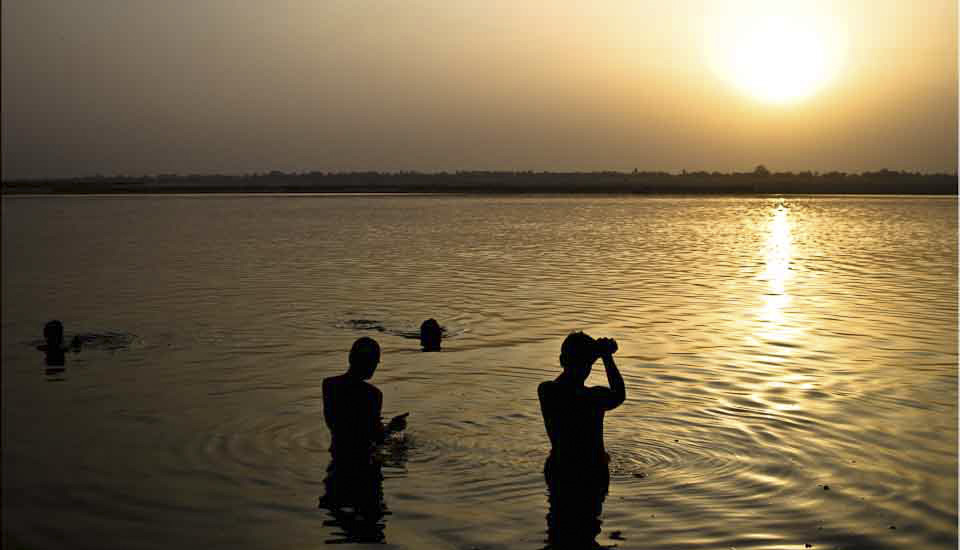
- Performing the Ganga Aarti from Dasaswamedh Ghat, Varanasi
- Buddha Head from Shwedagon Pagoda, Myanmar
- Harry Clarke Window from Dingle, Ireland
- Novice Monk Shwe Yan Pyay Monastery, Myanmar
Packets of 10 for $AU50.
Or - pick any photo from my Flickr or Wanders blog photos.

.jpg)
.jpg)
.jpg)




 … and back over the Wye River to the newer suburbs where the young families who link Hereford’s Saxon past and it’s modern future, live.


 More on that some other time.