According to Google Maps, it takes 4 hours and 42 minutes to drive the 309 kilometres through the heart of Stro gateway to Namibia’s northern border regions.
Google Maps doesn’t tell you that most of this distance is on what “Maps of Namibia” calls “Main-Gravel Roads”: dusty, corrugated, white-gravel, roads with potholes that leap out without notice and where on-coming or overtaking vehicles envelope you in blinding clouds of opaque dust.
I can’t even begin to imagine what these roads are like in summer! It was August – mid-winter – when we (photographer Ben McRae, Pedro Ferrão Patrício from Photoburst, Namibian guide Morne Griffiths, myself, and four other photography enthusiasts) traversed them. Even so, it was well over 30°C outside by mid-morning, and much hotter inside the truck. Mirages danced on the roads ahead as the heat pulsated all around. The wind from open truck-windows let in the dust and sucked all the moisture out of one’s body.
As they say, “It’s a dry heat.”
We passed miles apon miles of dry, rolling veld, covered in rocks and dry grass punctuated by thorn trees. Dust devils raced across the horizon and boys in donkey carts trotted along the verges. There were horses, goats, and herds of fat cattle; clearly the sere desert grasses provide more nutrients than you would think from looking at them. The odd homestead sat well back from the dusty roadside.
We were warned: in the towns, there were to be strictly no photos taken out of the truck windows. If we took pictures without prior negotiation, the tour company could be charged an exorbitant fee. So, the houses and shops and markets we passed went by unrecorded. I felt like I was watching the cast of characters from the “The No. 1 Ladies’ Detective Agency”: professionally dressed women with elaborately braided hair and over-sized glasses teetering across uneven sidewalks in their colourful high heels; “traditionally built” women in head cloths and wildly patterned dresses sashaying through the streets; men in dark suits and shiny, pointy shoes gathering on corners; men, woman and children in bangles and beads all jostling at shop fronts.
When we stopped for supplies in one of the towns, we were warned again: don’t buy anything from the Vambo (Aawambo or Ambo) people who were bound to crowd around us begging or trying to sell gems or bangles; if we engaged with them we’d never escape.
A simple trip to the supermarket was like walking into another world: shoppers in all manner of tribal dress – including Himba woman wearing only ochre paint and leather skirts – were gathering their groceries amid aisles of products I didn’t recognise. Although the uniformed shop-workers spoke English, Afrikaans and tribal languages flowed all around like a river of Babel.
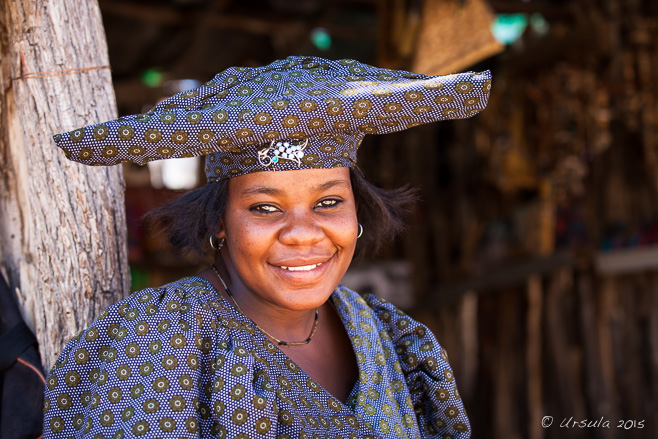
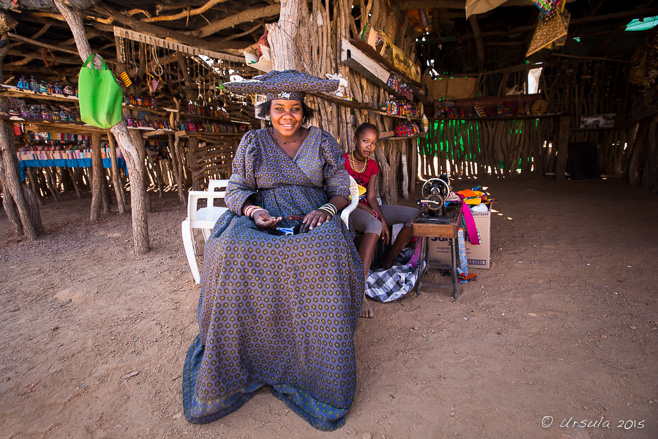
After what seemed like hours of sensory over-load, it was a relief to stop at the more relaxed roadside souvenir-stands run by Herero women. The Herero have a reputation as skilled seamstresses, and the stalls they run contain colourful patchwork cloth products. Many of the women still dress in a distinctively African adaptation of the Victorian costume foisted upon them by Germanmissionaries in the early 20th century: a voluminous floor-length dress that might comprise up to seven layers of cloth. The unique head-dress represents the horns of a cow, a particular status symbol in a culture where your wealth is measured by how many cows you own.
I admired the handiwork, made a few small purchases, and paid a small fee – well worth it to spend time making pictures and chatting with these lovely women.
Herero Woman in Blue Up until the end of the 19th century, Herero people dressed in traditional tribal fashion. However, during the days of German colonial rule, missionaries introduced Victorian style dress because they didn’t liked Herero women to be naked. Herero men started wearing German uniforms they took from soldiers killed during the conflict in the early 20th century, and may still wear uniforms on special occasions. From the time they are married, women were expected to make their own multi-layered dresses.
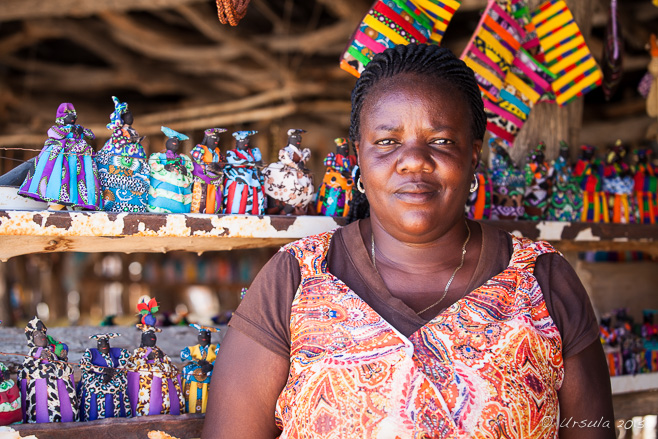
Woman with Herero Dolls Today, some women chose more “modern” Western dress.
Girl with Doll I loved how this girl’s balding doll has her hair so neatly braided.
Herero Dolls Herero dolls are painstaking handmade, with wire arms and hands and painted faces.
Herero Sisters Sisters in casual dress, were keen to be photographed: I could only oblige.
Smiling Woman in an Orange Headdress
Herero Woman in Brown This articulate young woman has just finished her Namibian tourism certificate, and hopes to become an official guide.
Young Girl in Black Without any coaching, young girls, like this 13 year old, demonstrate an effortless grace.
Young Herero with Patchwork
Herero Family The women’s elaborated clothes, and the crafts they sell, are carefully sewn using old manual Singer sewing machines and finished by hand.
Waterhole Our next stop, an hour and a half later, was at a small waterhole in the hot, dusty hills. Cattle have come in for a rest and a drink.
African Golden Weaver The thorn trees near the roadside are full of chattering finch and weavers.
Goats in the Dust A man guides a herd of goats though the heat of the afternoon.
We still had miles of hot, bumpy road to travel before we reached our stop for the night.
I had my Herero doll and fond memories of conversations with some interesting and engaging women who have found a way of making their traditions support their futures.
Snake Charmers The Pushkar Camel Fair is a festive affair – and not just about camels. Kalbeliya Gypsy snake-charmers are among the entertainers to be found around the extensive fair grounds.
I’ve been dreaming of camels lately…
That’s probably because the annual five-day Pushkar Camel Festival in Rajasthan, Northern India, finished earlier this week, and a number of my friends – including photographer Karl Grobl and local guide DV Singh – were there.
I couldn’t help but feel a little envious, as it has been two years since I visited India with them and enjoyed the Camel Fair myself.
Still, their return gave me a good excuse to revisit my photo-files from that trip.
Aagman Camp Hostess One of the joys India is how photogenic the people are.
Camel Carriage The Pushkar Fair attracts a fair number of international tourists and photographers in addition to the local traders.
Fair Grounds The Aravalli Mountain Range provides a backdrop for the fun-fair grounds, the livestock, and the camp grounds at Pushkar Fair. (iPhone4S)
Rajasthani Horse and Rider Pushkar Fair is not just about camels: Marwari horses – the distinctive Jodhpur-bred horses with the inward-turning ears – are a prominent feature. Horses with a white blaze and four white socks are considered lucky.
Running the Rajasthani Horse Theses horses were bred from native Indian ponies crossed with Arabian horses.
Putting the Horse through its Paces The Marwari is a natural “pacer”, with a lateral two-beat gait.
Tourists on Camels A Chinese tour group descends from their camels.
Fresh-Roasted Peanuts Food is never far away; a vendor stands ready next to his paper-cones and peanuts.
Rajasthani Colt The Marwari horses are beautiful animals, …
Afternoon Sun … bred since the 12th century for purity and hardiness.
Snake Charmers Entertainers are all around the fair grounds; the Kalbeliya Gypsy snake charmers fall outside the Indian caste system.
[…] from Pushkar’s dusty fair grounds. I have shared some pictures from the fair before (See: Scenes from a Fair and A Gypsy Portrait), but it has been a […]ReplyCancel
[…] some of the images I made there (see: A Gypsy Portrait, Faces at the Camel Fair, and Scenes from a Fair) – I still have a large body of work to […]ReplyCancel
Boats in the Gorge Flying the company flag, the city flag of Stadt Kelheim, and the blue and white Bavarian state flag, a tourist boat cruises up the scenic Danube Gorge.
Bavaria.
When I think of Bavaria, I think of buxom blond women in dirndls (traditional white blouses, laced bodices, full skirts and aprons), and moustached men in lederhosen (leather breeches). I think of medieval castles, charming villages, and beer in copious steins.
But, it is also home to expanses of dark forests that stretch from high up in the Bavarian Alps down to the fertile plains of the legendary Danube.
We were traveling on one of those wonderful, luxurious, floating hotel-rooms: a “Romantic Danube Cruise” from Nuremberg (see: Altered Views of History) to Budapest, and were docked in Regensburg, in the middle of Bavaria.
It was fitting, then, that after a morning of exploring the UNESCO-listed centre of Regensburg, one of Europe’s best-preserved medieval cities (see: Bavarian History and Charm), we set off on an optional afternoon trip to Kelheim, at the southernmost point of the Main-Danube Canal, for a visit to a typical Bavarian beer-garden, before cruising up the magnificent Danube Gorge, through cliffs and forests,to the medieval Weltenburg Abbey.
Children in the Playground In Kelheim, a little town the banks of the Danube, everyday life continues.
Sculpted Faces One of the first things that struck me on my first trip to Germany many years ago, was the quirky nature of the public art. This surreal tower of faces on the verge of a Kelheim street was in that vein.
Mariä Himmelfahrt Church The Assumption of Our Lady Church is one of the elegantly simple buildings on Kelheim’s town square.
Church Diorama A religious diorama is inset into the painted walls of the Mariä Himmelfahrt Church.
Kelheim Streets The town streets are clean and orderly. The Altmühltor (old mill gate) at the bottom of the road marks part of the old city walls.
Ludwig I (1173-1231) A statue of Ludwig Kelheim, who was responsible for many of the town’s monuments, stands in Lugwigsplatz.
Die Weißbierbrauerei Schneider We made a stop at the Schneider Brewery (founded in 1872), reputed to be the oldest brewery in the world. I’m not sure how this claim is supported, as the brewery at Weltenburg Abbey, just up the river and in operation since 1050, is said to be the “oldest monastery brewery in the world.”
Stained Glass Window It is quite lovely inside the Brauhaus, but as it is a beautiful sunny day, we are seated outside.
Inside the Brauhaus The beer is poured into glass beer-mugs …
Serving Beer … to be delivered to the beer garden …
Pretzels … where it is enjoyed with fresh pretzels…
Bavarian Barmaid … and more beer.
Furnace I love the old, elaborate, wood-burning room-heaters that you see all over Europe.
Clock Tower We walk back out into the town, where it is time to make our way to the Danube…
Man in a Bavarian Felt Hat … where we wait with local tourists …
Die Befreiungshalle from the Danube … to board one of the many cruise boats that ferry passengers up and down the Danube River. The round structure at the top of the hill is the Befreiungshalle (Liberty Hall), built between 1842 and 1863 by Ludwig I of Bavaria to commemorate the victory over Napoleon in the War for Liberation (1813-15).
Danube Gorge The imposing Befreiungshalle tower, sitting high on Mount Michelsberg, affords visitors views over Kelheim and the Danube River.
Danube Gorge Villages and churches are tucked between the chalk cliffs of the Gorge and the slow-moving river.
“Weltenburg Narrows” We are not the only boat travelling between Kelheim and the Weltenburg Abbey.
People in the Gorge Dwarfed by the cliffs – which rise as much as 122 metres (400 feet) around them – people use the gorge area for recreation.
Abbey in the Gorge As we round a bend in the river, the Weltenburg Abbey church, built between 1716 and 1739 on a peninsula in the “Weltenburg Narrows”, comes into view.
Weltenburg Abbey Church A monastery was established on this site by Irish or Scottish or of St. Columbanus in about 620, although the Baroque buildings around the perimeter are much more recent. As I said earlier, the monks have been brewing beer here since 1050, and today there are nine regular Weltenburger Beer varieties, plus seasonal specialties.
St George : Weltenburg Abbey The ornately baroque abbey church is dedicated to Saint George, patron saint of the monastery. The lofty columns are carved from local Weltenburg marble.
Guide Lisa Admission into the church is with a guided group. The guides are well versed in the church’s art and history.
St George and the Dragon At the front of the church is a full size marble and gold depiction of St. George killing the dragon and saving the king’s daughter.
Pipe Organ The church’s west niche contains an ornately decorated organ built in 1728 by Konrad Brandenstein, believed to be the only one of its kind surviving.
“Heavenly Jerusalem” In a cupola flooded with light, an oval painting in elaborate baroque style draws the eyes from the dark church and up to the heavens.
“Quis ut Deus?” The Archangel Michael is one of the gilded stucco relief illustrations encircling the cupola.
Weltenburg Shrine
Chatting with a Monk Only a few Benedictine monks still live at the abbey today.
Leaving Weltenburg Abbey The tour group makes its way back to the buses that will take them back to the boats on the canal.
Beautiful scenery, fascinating architecture, and world-class beer ~
it’s an enjoyable area to visit and one I’d love to go back to.
[…] night, and we spent our days exploring charming cities and historical features (e.g.: Regensburg; Kelheim to Weltenburg; Passau; Melk; and […]ReplyCancel
Sunburst over the Pontoks More than a 100 million years of wind erosion have acted on an ancient, collapsed volcano to carve out some extraordinary granite-rock shapes – shapes that rise high out of the surrounding flat expanse that is the Namib Desert.
The Spitzkoppe, meaning “pointed dome” in German, is a granite massif rising out of the flat Namib Desert – a plain of gravel and sand that extends to the Atlantic Ocean a hundred miles away on Namibia’s west coast. Part of the Erongo Mountains, Spitzkoppe is the remains of a gigantic volcano which collapsed more than a 100 million years ago when the ancient continent of Gondwana was splitting into the continents of Africa, South America and Australia.
In a process referred to as inselberg (German for “island mountain”) formation, erosion of the softer outer layers of rock result in an isolated rock hill, knob, ridge, or small mountain that rises abruptly from a gently sloping or virtually level surrounding plain. The resulting granite formations are abundant in southern and south-central Africa, where they are commonly called koppie, an Afrikaans word meaning “little head”, from the Dutch word kopje.
The sunrises and sunsets are meant to be especially beautiful in the summer months. Even though it was the wrong season, and as much as I don’t like mornings, having dragged my tripod across four continents to get to Namibia, I was determined to take in the morning light.
Spitzkoppe in the Pre-Dawn Light When my alarm went off, all around me was dark. With a cloudless sky and no moon, my head-lamp and torch were the only lights, and they found little purchase in the gravel paths and thorny bushes. Even though I had checked out locations the day before, I made several wrong turns into blind alleys in the rock formations before clambering, with cameras and a tripod, up to the Rock Bridge.
Granite Peaks The pre-dawn winter light over the plains and peaks in the Spitzkoppe area is clear and cold, affording slowly emerging views over the Pontoks as they rise out of the Namib Desert.
Spitzkoppe on the Plain Slowly, pink light creeps over the horizon.
Spitzkoppe through the Rocks Morning light warms the granite of Spitzkoppe – but most of the landscape remains in shadow.
Spitzkoppe through the Rocks Moment by moment, the light changes. I am glad to have the tripod, so that I can take the long exposures necessary to find subtle colours and details in the low light.
Spitzkoppe and Pontoks from the Rock Bridge As the sun rises higher in the sky, I climb up and under the Rock Bridge to get a better view.
Pontoks from the Rock Bridge Like specks on the rocky outcrop, two of my companion photographers stand with their tripods. (iPhone 6)
Spitzkoppe from the Rock Bridge
Behind the Rock Bridge Gradually, the light works over the surrounding mountains and starts to angle across the other granite rock formations.
Sunrise over Spitzkoppe and the Pontoks
Desert Bush An inselberg, or koppie, traps wind-blown soils and moisture, so many plants which can’t survive on the almost-barren plains grow there. Spitzkoppe’s desert vegetation clings to life, thorny and tough.
Creatures in the Morning Light Wind erosion over the millennia has given rise to a number of bizarre rock formations. I kept coming back to this grouping which made me think of rabbits and puppies.
African Mourning Dove (Streptopelia decipiens) Back at the campsite, a mourning dove sits in a thorn tree while we have breakfast.
Mother and Child Before long, the light is too strong for landscapes, and the day turns hot. We break camp, and stop at the “craft” stands before we leave the area.
Young Girl with Attitude Children from the local Damara community are on hand to talk to tourists and help sell the mobiles made from scrap tin, cloth bags sourced from elsewhere, and gems collected from the surrounding mountains.
Girl with Apples This area has very limited water resources …
Girl with Orange … so the children appreciate the fruit Ben has brought for them.
Damara Man This 47-year-old husband and grandfather cuts animal shapes for mobiles from bits of jagged tin.
Damara Woman His 44-year-old wife – who is wearing Himba ochre on her face as sunscreen – paints and strings them.
Damara Boy Their grandson watches the visitors solemnly. The lands here were expropriated (with compensation) from their Afrikaans owners in 1964 and resettled with Damara families in 1970. Recently – in addition to eking out a living livestock-farming and selling crafts to passing tourists – part of the community has taken over management of the campsite.
Mother and Child It is clearly not an easy livelihood…
Young Girl … but the kids are bright and sassy.
I always have mixed feelings chatting with the children at these remote outposts about their schooling and their dreams. They are lively and engaging, and clearly part of a larger community. But, their access to formal education and their ability to make choices is sorely compromised. Private investment in local resources can clash with traditional values, and communities can become divided over decision-making processes. The community here is facing issues over land and water management. Who knows how it will play out over time.
I can only wish these youngsters luck in the future ~
And hope someone continues to bring them bits of fresh fruit in the meantime.
[…] northerly part, with its clear skies (see: A Sky Full of Stars) and dramatic rocky outcrops (see: Morning over Spitzkoppe), leaving the ocean and the sand dunes behind […]ReplyCancel
the desert images are spectacular. the boulders’shapes and vegetation makes it look like huge prehistoric animals are still living there. Congratultions!!!
RutiReplyCancel
Fish Seller with a Cheroot The morning markets of Nyaung Shwe, Myanmar are a rich feast for the senses.
Burmese markets are a feast for the senses: the angled light sneaking in through slatted bamboo walls and streaming under tent canopies and corrugated tin roofs; the riotous colours of freshly picked vegetables; the rich smells of packed dirt floors, freshly cut meat, and frying spices. In the stillness of dark corners and oppressive tropical heat, vendors sit on low tables, surrounded by their wares, working and waiting.
It’s the waiting that amazes me: that ability to sit quietly, with no signs of impatience, when nothing is happening. This sense of time stretching endlessly alternates with periods of chaotic business, when jostling customers come in clumps, to pick through the goods and to haggle. Money changes hands, and people laugh and smile and gossip.
One of the (many) things I love about Asian markets is how people take for granted the stranger in their midst. Completely unselfconsciously, they either engage and allow themselves to be photographed, or they go about their business, paying the many interlopers no heed. For I was not alone in the morning market at Nyaung Shwe: somewhere amongst the crowds in the complex were at least nine other photography enthusiasts, photographer Karl Grobl and local guide Mr MM.
I love taking time in markets making portraits of people – and I love how the rich environment helps tell a story about the subjects’ lives.
Boy and his Grandma Morning markets are full of people willing to be photographed; …
Boy in Thanaka Powder … the biggest challenge is the light.
Vegetables The vegetable displays are a feast of colours and textures.
“Fast Food” Ready-prepared meals are available – rich and spicy, with lots of chilies.
Woman in the Vegetables
Fish Seller with a Cheroot The fish is freshly caught, and the smiles are free.
Portrait of a Fish Seller Thanaka powder, made from ground bark, is meant to highlight beauty and prevent sunburn, as well as to help cure acne and keep skin smooth.
Young Boy in Thanaka Children are especially pleased to smile for the stranger.
Hilltribe Woman The morning light pours between the buildings in the market complex …
Hilltribe Woman and Child … as a grower bundles her onions …
Boy in a Cap … and her handsome son watches quietly.
Woman with a Flower
Exit Doorway Walking out of the dim market buildings takes one “into the light”.
Young Man at the Coffee Shop Just across from the market buildings is a well-placed coffee shop.
Burmese “Barista”
Man with Coffee The coffee itself is rich with flavour, and the customers are full of character.
Two Men and their Coffee Most of the tables in the shop are occupied: breakfast is a serious business.
Two Men Against the bright light of the outside world, friends meet.
Man with Coffee
Sharing a Laugh
Two Women In the darker corners, there are stories to be told.
Morning Coffee I thoroughly enjoyed my coffee break before moving on to the rest of my day.
These are beautiful. You are correct, the lighting is wonderful. These images bring back sights and “smellls” of my experience with the same duo of Karl and MM. You captured the market scene so well.
RutiReplyCancel
- Performing the Ganga Aarti from Dasaswamedh Ghat, Varanasi
- Buddha Head from Shwedagon Pagoda, Myanmar
- Harry Clarke Window from Dingle, Ireland
- Novice Monk Shwe Yan Pyay Monastery, Myanmar
Packets of 10 for $AU50.
Or - pick any photo from my Flickr or Wanders blog photos.


 I hope they can continue to make their own way…