Salmonberry – Rubus Spectabilis Mid-June is salmonberry season. These brambles can slow down your walking progress: both by tangling over the trails and by tempting you with their fruit.
I loved just about every minute I stayed on Haida Gwaii, that archipelago off the coast of British Columbia (BC) in Canada’sNorth Pacific waters. I knew I would spend most of my time walking in the old-growth woods and exploring the Haida Nation’s cultural history; what I didn’t expect was to be wowed by the food.
Whether I was foraging berries everywhere I walked, eating a freshly cooked salmon burger with caesar salad on my lap al fresco (see: Birds and Boats around the Waterways), or sitting down to one of several casual fine dining options comprising fresh, locally-grown produce, I relished every meal.
So, I really had to walk or I’d no longer fit into my clothes!
Most days, I hopped in the rental car with my local tourist map to explore hikes in the far reaches of the islands. But, there were a few days when I stayed close to base in the principal town of Daajing Giids on northern Graham Island. Thanks to the AllTrails app, one day I found a walk which actually started in town.
Naturally, I needed lunch first – and enjoyed a fresh locally-inspired platter at a Mediterranean restaurant just a few blocks from the start of the Charlie Hartie South Lake Trail. Charlie Hartie was an early pioneer in what was then called Queen Charlotte.
I don’t know what South Lake looks like – the path splits in two part way in, and I followed the other track. This might have been a mistake: I didn’t see anything particularly impressive before the trail just fizzled out. Looking at the AllTrails reviews, I’m not alone in finding this hike underwhelming. But, at least the four km (2.5 mi) out-and-back track allowed me to get some fresh air, to forage for ripe berries, and to justify the glorious meals I’d eaten at lunch and the evening before!
Join me for some wonderful food and a short walk in the woods:
Salad Starter Who could resist this salad of locally-grown golden beets, tomatoes, goat cheese, and pea shoots? Delicious! (iPhone12Pro)
The Main The Blacktail menu is short – but it is all tempting. I had the homemade tagliatelle with a crimini mushroom duxelle, goat cheese, and truffle oil. (iPhone12Pro)
Men in the Kitchen These are the young men responsible for the fabulous food at Blacktail, one of a select number of restaurants in Daajing Giids. (iPhone12Pro)
Path Marker Thanks to a passing dog-walker, I found the trail-head and set off on the moderately-challenging Charlie Hartie South Lake Trail.
Salmonberries – Rubus Spectabilis The salmonberries slowed me down: both because the track was overgrown with them, and because they were so “more-ish”.
Through the Brambles Fortunately, salmonberries don’t snag nearly as badly as blackberries!
Clam Shells There are shells nestled in the damp, mossy ground marking the way. Unfortunately, I have no idea what they are telling me!
Pathway through the Ferns As I gain altitude, the path is less boggy underfoot and less choked with brambles.
Black Slug – Arion Ater These slugs are so common I thought they were indigenous. They are not! But they love this wet, shady ground.
Look Up! Haida Gwaii is home to a number of giants, especially sitka spruce, western hemlock, western red cedar, and yellow cedar – all growing straight and tall to chase the sun.
Bear’s Bread – Ganoderma Applanatum I was fascinated by these bracket fungi, which I first saw on Moresby Island (see: Mr Fungus).
New Growth
Nature’s Artworks : Tree Trunks Patterns are everywhere.
Spider’s Web
Trail Markers in the Tangle Almost an hour in, the rough tracks diverge. This probably explains why I never saw a lake! Both directions were similarly overgrown.
Another Bracket Fungus These mushrooms are very tough – making them suitable for scrimshaw and other carving, but less good for eating.
Nature’s Abstracts : Sitka Spruce Tree Bark The bark of the sitka spruce is patterned in thin, asymmetrical patches.
Water over Rocks Back towards the trail head, Hartie Creek tumbles over mossy rocks.
Hartie Creek As I almost never drag a tripod along with me, I love playing with the iPhone’s long exposure feature. (iPhone12Pro)
A Muddy Path The sun breaks through the brambles, where buttercups love the boggy ground.
The wet ground told me I was almost back at my car – ready find some more fabulous food, and to plan the next day’s explorations.
It Looks Like Paradise One of the things I learned living and travelling in Asia is that “eco resort” is often code for “no infrastructure”. Ora Beach Resort looked like bliss from a distance. From the comfort of our small ship, we visited this deserted, mostly derelict and rubbish-strewn “resort” on Pulau Seram – the largest of the islands in Indonesia’s Maluku province.
The best way to visit the Maluku’s (Malakas, Moluccas) in the eastern part of Indonesia is by ship.
These were once known as the Spice Islands. The nutmeg, mace, and cloves that grew here – and nowhere else – attracted the attention of 16th century European colonial powers. The Spice Wars of the 1500s were the result. Bloody battles between the Spanish, Portuguese, Dutch, and English lasted through to the mid-1600s, paying scant regard for the local populous. In 1652 the Dutch took total control – and held it for a hundred years. To this day, colonial buildings remain to bear witness to this period.
Those early mariners spent years at sea, travelling in wooden sailing vessels that were at the mercy of the winds. We were much more luxuriously accommodated on the Australian-registered Coral Geographer.
Even so, it wasn’t the smoothest trip that ever was, and we seemed to come up against a number of obstacles to going to the actual destinations in our original itinerary.
A long-malfunctioning port azipod – a mysterious part that usually provides half the propulsive power for the ship – had – after a protracted wait – been repaired in Sorong (see: On the Lands and Waters), and we were finally able to set off at normal speed. In the course of three days, we then made visits to four different islands in the Malukus.
Our first stop was Pulau Besar, a deserted island in the Ceram (Seram) Sea off the north coast of Pulau Seram-Sawai. There, we could wander a short stretch of beach or snorkel on the beautiful outer reefs.
In the afternoon, we were meant to visit Sawai Village, a traditional fishing village with a picturesque reputation on Pulau Seram-Sawai, the largest of the Maluku Islands. Unfortunately, we were told that a local dispute had flared into violence, and our visit would therefore be ill-advised. We were transported instead to a deserted and isolated resort further down the coast of the island.
After a day at sea around Pulau Seram-Sawai, we crossed from the Seram Sea into the Banda Sea. Once we finally stopped, we enjoyed for some snorkelling on the uninhabited private island of Pulau Molana (Maolana). That island is home to coconut crabs, the world’s largest land-dwelling arthropods. Unfortunately, the only ones I saw were tethered and ready for the cooking pot!
Following lunch, we had a visit to Saparua, one of 17 administrative villages on that eponymous island. We had a ceremony on the green which included a welcoming Lenso dance and vigorous Cakalele warrior dance. For me, the high point was a visit to the Dutch colonial Fort Duurstede, where I was able to interact with local visitors and the school children who had danced and sung for us.
Come for a visit to some pristine and beautiful tropical islands
On the Bridge From the bow of our small ship, the Australian-registered Coral Geographer, the tropical seas stretch out in front.
Snorkelers Our tenders took us on a morning run to Pulau Besar, “Big Island”, where we had clear skies and clearer waters. A stunning coral shelf ran parallel to the length of the beach.
Under the Waters I bought myself a silicone phone cover in preparation for this trip. It wasn’t perfect, and the colours don’t do the reality justice – but it was better than nothing!
Ora Beach Huts We were meant to be visiting Sawai Village on Pulau Seram, but a local dispute had apparently turned violent. So, our tenders transported us to a deserted resort on the island. Those huts over the water were new and unfinished – but the rest of the isolated resort was in complete disrepair.
Clear Waters and Impenetrable Jungle This island is traversed by a central mountain range and covered with dense rain forests. The area attracts birders: it is home to 117 species of birds on the island: 14 of which are endemic.
Overlooking the Waters The bulbs overhead suggest electricity, but nothing was operating when we were there.
Explorer Two Our flat-bottomed tenders could land us just about anywhere.
Old Boat in the Jungle Like the old accommodation cabins, most of the boats at the resort had seen better days.
Ora Beach Boat This was the transportation to-and-from the resort for the representatives that met us. Roads don’t penetrate these mountainous jungles.
The White Sands of Pulau Molana Two days later, we were snorkelling off another deserted beach – this time in the Banda Sea.
Ripples in the Waters and Rough Volcanic Rock Walking to the rough volcanic rock at the top of this Pulau Molana beach, you can then drift along in the current, over colourful fish and magnificent coral.
On the Ukulele At our next stop, the local Saparua school children played and sang for our entertainment.
Welcome Music
The Lenso (Handkerchief) Welcome Dance This is the courtyard of the local school.
Choir Girls
Cakalele Warrior Dance This traditional dance celebrates the Maluku people’s heroic spirit, resilience, and connection to ancestors.
Cakalele Warrior
Inside Benteng Duurstede From the Dutch fort, we have views over the village.
Three Friends The fort attracts visitors from nearby islands.
Young Musicians Many of the school children followed us up into the fort, and happily posed on the battlements.
“Right Twice a Day”
Warrior on the Fort The fort was built in 1676 – but has been heavily renovated since then.
Little Musicians
Little Cuties These children were adorable! Shells are a big part of the local cultures.
Local Hero Thomas Matulessy (1783 – 1817), also known as Kapitan Pattimura, or simply Pattimura, was born here in Saparua. He had a complicated military history, but became a symbol of the Indonesian struggle for independence.
King Neptune and Queen Salacia We had crossed the equator twice on this trip. As is customary, those who are crossing for the first time need to pay a sacrifice in an Equator Crossing Ceremony.
A Dramatic Sky No matter what our days held, we could almost always guarantee a glorious tropical sunset.
These were just four of the roughly thousand islands in the Maluku’s …
The Arch Of Caracalla Modern tourists walk along the 1st century Roman road through the ruins of Volubilis in Morocco.
The breadth and impact of the Roman Empire always amazes me.
And I marvel at the remarkable endurance of the artefacts left behind. Walking on roads that were laid over three thousand years ago never ceases to fill me with awe.
I was travelling around Morocco in a bus with a small group of seasoned travellers. We had spend our morning exploring the historic streets of Meknes (see: The UNESCO-listed City of Meknes) and were now driving across the northwest of the country en route to the mountain city of Chefchaouen.
After walking through the winding maze of narrow streets that make up the medina – the traditional old town – of Meknes, being chaffeured across a fertile agricultural plain dotted with olive trees and other crops was a delight. Stopping for lunch within site of the well-preserved and important Roman ruins of Volubilis was a bonus.
Although I felt as if I was a world away from Rome, I shouldn’t have been surprised that – so close to the other shore of the Mediterranean Sea – the Roman Empire was well established for over three centuries.
From the 3rd century BCE, Volubilis was a Berber settlement that grew in an area that had been inhabited since at least the Late Atlantic Neolithic age. For a time, it was the capital of the BerberKingdom of Mauretania, which became a Roman client-state in 146 BCE. From the first century through to the third, the city and the surrounds were under direct Roman control.
Under the Romans, the city was expanded considerably over time, and came to cover roughly 42 hectares (100 acres) surrounded by 2.6 km (1.6 mi) of walls. Most of the city’s public buildings were constructed in the original part of the city, while the grand houses for which Volubilis is famous are in the newer part. The Arch of Caracalla marks the point at which the old and new cities merge.
It was this very distance that led to the decline in Roman influence. The city fell to local tribes about 285 CE; Roman rule collapsed across much of Mauritania around the same time – in part, because of the region’s remoteness and indefensibility at the very south-western edge of the Empire.
The city continued to be inhabited long after the Romans left. Volubilis was probably deserted around the 11th century, when the seat of regional power moved to Fez.
Much of what we see today in Volubilis was excavated by the French during their rule over Morocco between 1912 and 1955, but French archaeologists had taken an interest in the site decades earlier.
Countryside from the Bus The almost-claustrophobic walls of the old medina give way to rolling hills and fertile plains as we drive north out of Meknes. (iPhone15Pro)
The Archaeological Site Of Volubilis in Mauretania A wide, gravelled walkway leads us from our lunch spot up to the Roman ruins on the hill. (iPhone15Pro)
The Basilica of Volubilis As we get closer to the ruins, the early afternoon light catches the columns of the partially-reconstructed basilica.
Local Guide Shaded against the strong afternoon sun, our guide is a personable wealth of knowledge.
Arched Remains
The Abduction of Hylas The mosaic floors that have been uncovered in the mansions of Volubilis are quite extraordinary. This one in the House of Venus – once the home of King Juba II – dates to the 3rd century, and tells the story of how Hercules’ companion Hylas was lured away by two beautiful nymphs.
Looking over the Volubilis Ruins The whole site is a bit wild and wonderful.
Dionysus and the Four Seasons In this house, we are looking over the triclinium, or dining room, towards the entry. In the central panels of the mosaic, we have representations of the four Seasons in female form.
Moulay Idriss or Moulay Idriss Zerhoun A short distance to the north, we can see what is considered the holiest city in Morocco: this is where Moulay Idriss I arrived in 789, bringing Islam with him.
“Follow The Roman Brick Road” Here, we are looking along Decumanus Maximus (Main Street), which runs south to the Arch Of Caracalla, bisecting the Roman-built parts of the city. Back in the day, the decumanus was paved, with footways on either side and an underground aqueduct running parallel. (iPhone15Pro)
Bacchus and Ariadne This beautiful mosaic in the House of the Knight shows the god Bacchus (Dionysus), the Roman god of wine, fertility, and celebration, as he discovers Ariadne asleep on the island where Theseus had abandoned her.
Stone Lintel
Explaining the Buildings Our guide does a great job of bringing the old buildings back to life.
Arch Of Caracalla The Triumphal Arch of Volubilis was built in marble in 217 CE as tribute to Emperor Caracalla and his mother. Largely destroyed by an 18th-century earthquake, it was restored some time in the early 1930s. The inscription at the top was reconstructed from the fragments of stone found in the viscinity.
Demonstrating the Communal Toilet Our guide sits in one of the communal toilets typical of Roman infrastructure. These public foricae are seats in long benches, with holes that let out into a channel of flowing water to carry waste into the nearby river.
Stones and Columns and Fields Outside the old boundary of the site, patterned fields stretch across the richly fertile plane to Mount Zerhoun on the horizon.
Head of a Column Many of the still-standing columns around the ruins are topped by elaborately-decorated Corinthian-style capitals.
Columns of the Capitoline Temple This elegant temple atop a raised podium was dedicated to the Capitoline Triad of Jupiter, Juno, and Minerva: the most important deities in ancient Rome. Some of these columns have been restored.
The Basilica Built in the early 3rd century, the basilica was a Roman administration building,
The Bones of the Basilica Marble from the basilica and other buildings around Volubilis was pillaged to build palaces in Meknes in the 18th century. It was – somewhat controversially – partially restored under the French during their rule in the 1900s.
Like A Dream Back in the bus after our visit, the countryside floats off into the distance as we continue north to Chefchaouen. (iPhone15Pro)
It was not the largest Roman ruin I have ever visited, but it was one of the nicest, and certainly well worth the stop.
And as these ruins always do, it made me think of Reg’s query in the Life of Brian:All right, but apart from the sanitation, the medicine, education, wine, public order, irrigation, roads, a fresh water system, and public health, what have the Romans ever done for us?
They certainly left a legacy, not just in history, but in stone.
Shikara in the Morning Flower Market Early on a Tuesday morning, I was in the back of a shikara full of locally-grown flowers gliding through the dreamlike waterscape of algae, lily pads, and lotus on Dal Lake in Srinagar, Kashmir India.
I’ve heard it described as a chocolate-box scene: you know, like those pastel-painted views of idealised or conventionally pretty locations that were on the front of old-fashioned chocolate or sweet tins.
They are not wrong!
Dal Lake, Srinagar, in India’s Kashmir, is impossibly beautiful.
The way the autumn light filtered through the willow trees at the water’s edge; the shades of green in the irregular patterns of the floating plants and algaes on the water’s surface; the colours of the blooming flowers; and the soft plonk of oars as wooden shikara boats make their way through the maze of channels – this all reminded me of Monet’s garden, and made me feel as if I’d wandered into one of his paintings.
I know I have said similar things before (see: Water, Dreams, and Woodwork), but never was this more true than on our second full day on the lake.
Our small group of photography enthusiasts was staying in houseboats in the middle of the lake. Long before sunrise, we were up and out on our floating porches to be collected by shikaras – the traditional Kashmirideodar cedar boats. Our drivers paddled us through the watery laneways to the location of the morning market. Apparently a daily occurance, this floating produce market starts very early: it was still pitch black when we were deposited on a section of elevated wooden walkway that seemed to go nowhere in both directions.
Then, before the sun broke the horizon, wooden boats were around us and engaged in trade. Many were laden with vegetables; many more were colourful with freshly-cut flowers.
After having a small cup of tea, we had the chance to ride behind one of the vendors as he plied his way through the still-dusky waters.
Join me on the waters of Dal Lake:
Houseboat on Dal Lake The sky was inky black and everything was quiet when we got up to wait for our transport.
Shikaras in the Morning The oars plonk rhythmically as we make our way through the network of interconnected water channels that run between the floating buildings and gardens.
Pre Dawn on the Lake Like the boats, most of the buildings around the lake are built of local water-resistant deodar cedar.
Watercolours It is almost six am and the sky is getting lighter. The waters are dotted with men transporting their vegetables.
Wooden Walkway Elevated walkways wind over the lotus leaves, connecting groups of buildings.
Flowers The flowers and vegetables on Dal Lake are grown in traditional floating plots made of matted vegetation and soil. The crops are tended, harvested, and transported for sale, by boat.
The Flower Seller Like Impressionist paintings, scenes on Dal Lake are characterized by broad brushstrokes of colour in ever-changing light.
Raptor on a Pole
On the Waters
Lotus on the Lake All around us, sacred lotus (Nelumbo nucifera) are growing on the waters – with their roots anchored in the soil of the lake-bottom, far below. These long-living perennials typically bloom from June to September.
Three Men in Discussion The shikaras clump together in groups, and their operators engage in gossip or trade.
Shikara Paddler It is my turn to ride with one of the flower-sellers. He looks around to check out his passengers.
Bucolic Colours Another group of men a deep in conversation.
Traders
Vegetable Seller
Lotus Flowering As the day gets lighter, the lotus raise their flowers high above the water.
Photographers on the Walkways Some of our group watch as the vegetable seller paddles away.
Greens
In a Dreamscape
Water Traffic For the people who live on and around the lake, boats are a part of everyday life.
The School Run
Egret I watch the bird life on the lake as we paddle back to our houseboats for breakfast.
Looking over the Bosphorus How lucky am I? A friend of mine was living and working in Istanbul, and I was able to spend a few days watching the ships in the busy Bosphorus Strait. The picture windows in her living room looked over the rooftops of Europe and across the waters to the Asian shores.
Istanbul is the heart of Türkiye – economically, culturally, and historically. It is quite literally at the crossroads of Europe and Asia – sitting, as it does, either side of the Bosphorus Strait: part of the imaginary divide between the two continents. Strategically located along the historic Silk Road, it commands the only sea route between the Black Sea and the Mediterranean.
I was feeling pretty lucky: a friend of mine, who had been living and working in Istanbul for some time, had a spare room. Her commodious apartment was located on a steep hill in Beşiktaş, a waterfront suburb on the European side of the Bosphorus, and I was able to spend a few days just watching the ships in the busy strait from a chair in her living room.
As much as it would have been nice to explore the city immediately, I was – in effect – between trips. I had landed in Istanbul after enjoying a wonderful month in Greece (see: Revelling in Santorini), and had plans to explore the Gökova Gulf by sailing vessel; old Lycian paths on foot; and much of the country on a small-group tour. I would return to Istanbul at the and hopefully see more of the city then.
In the meantime, I was quite happy to spend my days sitting in the living room, watching the ships on the busy Bosphorus while my cameras downloaded. The view over the waters was mesmerising, and I had to remind myself to break away long enough to catch up on laundry and other practicalities.
Then, I’d wander out into the streets in the afternoons to meet my friend at some pre-arranged location for dinner once she finished work. We never ended up very far from the water!
I left the cameras behind, and relied on my iPhone12Pro for this introductory taste of a very cosmopolitan city.
Location, Location! It is hard to imagine a more perfect quiet spot in this bustling city.
Turkish Naval Vessel on the Bosphorus There were always ships to watch on the busy artery between the Black Sea and the Sea of Marmara.
Caution! Dogs And Cats This city takes its domestic animals seriously.
Lines and Curves: Yahya Efendi Sokağı Once out of the apartment, I had no trouble getting my steps in on the steep and winding cobbled roads.
Over the Rooftops of Istanbul to the Sea of Marmara On my first evening, we met up at the stylish five-star Conrad Istanbul Bosphorus for rooftop cocktails and panoramic twilight views.
Istanbul from the Conrad Rooftop Bar The outlook over the city stretches in all directions and the sun goes down over my first day.
Ortaköy Square – Ortaköy Meydanı On my second evening, we meet near Ortaköy pier square, where locals gather along the waterfront for views over Ortaköy Mosque and Bosphorus Bridge.
Ortaköy Mosque (1844-1846) The colours are dramatic as the light drops over the small but iconic mosque formerly known as Büyük Mecidiye Camii.
Waterfront Restaurant, Ortaköy We were spoiled for choice by all the restaurants along the water’s edge.
The Ultimate Baked Potato Market Imagine! A whole section of street devoted to kumpir, a favourite street food of baked potato stuffed with the most outrageously coloured fillings.
“I’ve got the Kumpir for YOU!”
All the Beautiful People Our postprandial walk takes us past the historic Hüsrev Kethüda Hammam, which was commissioned in 1550 and used for 300 years as a traditional Turkish steam bath. In 2011, it was restored to its original form, and is now a venue for culture and arts events hosted by the Beşiktaş Municipality.
Afternoon in Tree-Lined Boulevards The streets of Istanbul felt very safe, and with the aid of GoogleMaps, I always found my way around.
Treasury Gate of the Dolmabahçe Palace I walk to the pier for a sunset cruise on the Bosphorus, past the ornate Saltanat Kapısı – Sultanate Gate – of a 19th century Ottoman palace that now houses a museum.
Dolmabahçe Palace Our cruise takes us past the front of the same palace. Built between 1843 and 1856, this Ottoman building with Western influences stands on reclaimed lands that, four hundred years ago, were a bay where the Admiralty anchored its ships.
Ortaköy Mosque – Büyük Mecidiye Mosque Here, from the water, is the same mosque we saw from the streets the day before.
Mosque on Çamlıca Hill On the Asian side of the strait, we can see the Grand Çamlıca Mosque perched high on Çamlıca Hill.
Rambling Buildings in Arnavutköy
Consulate General of the Arab Republic of Egypt This beautiful little art nouveau mini-palace was built in 1902 for Princess Amina Ilhamy.
Rumeli Hisar – Rumeli Fortress Evening shadows fall on this fortress complex, built between 1451 and 1452. In the nascent days of the Ottoman Empire, Sultan Mehmed II wanted the then-Byzantine city of Constantinople as his capital. So, to blockage the Bosphorus Strait, the Rumel Fortress was built opposite the older Anadoluhisari– Anatolian Fortress – on the other side of the water. Today, the fortress is a popular museum.
Anadoluhisarı – Anatolian Fortress (1393-4) At the Fatih Sultan Mehmet Bridge we turn around, and there – on the still-sunny Asian side of the waters – is the oldest surviving Turkish structure in Istanbul.
Küçüksu Pavilion – Küçüksu Kasrı – Littlewater Pavilion Completed in 1857, this little palace served as a short-stay summer pavilion for various Ottoman sultans. More recently, it has found its way into Hollywood and Bollywood films.
Asia from the Bosphorus Golden light colours the Vahdettin Pavilion, or Çengelköy Pavilion, on a hill in Üsküdar district. An inaccurate copy of an older palace, it is an official residence for the President of Türkiye, and is used as a state guest house.
Beylerbeyi Mosque
Beylerbeyi Palace Another summer residence for the Sultans and visiting dignitaries, this pretty structure was built between 1861-1865.
Sunset over Istanbul As we pass back under the Bosphorus Bridge, the sun is setting over the city.
Şemsi Ahmet Pasha Mosque
Fresh Fish at the Galata Bridge It is golden hour as we turn into the Golden Horn, the primary inlet into the Bosphorus. The lights are on at the fish markets and restaurants.
Watchers on the Galata Bridge We turn around to head back to our pier and people watch from the bridge, silhouetted against the darkening sky.
Naturally, the snacks aboard our cruise were insufficient to hold us; we stopped for gözleme, traditional Turkish flatbread stuffed with spinach and feta before continuing uphill to home.
It was a wonderful introduction to this amazing city – and I couldn’t wait to get back to explore more.
[…] had flown into Bodrum following a few wonderfully restful days in Istanbul (see: Bosphorus Dreaming), and had a free day before joining a gulet cruise into the Gulf of Gökova (watch this space!). I […]ReplyCancel
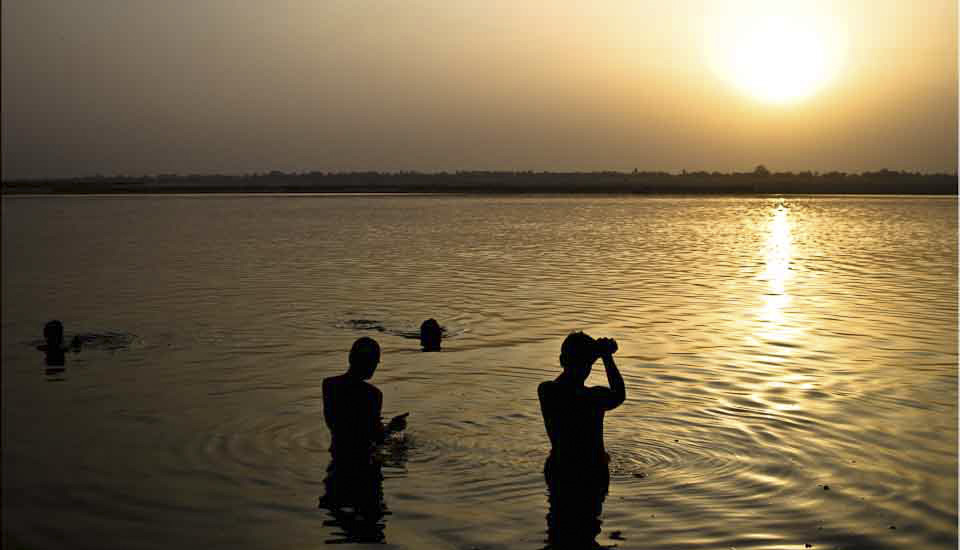
- Performing the Ganga Aarti from Dasaswamedh Ghat, Varanasi
- Buddha Head from Shwedagon Pagoda, Myanmar
- Harry Clarke Window from Dingle, Ireland
- Novice Monk Shwe Yan Pyay Monastery, Myanmar
Packets of 10 for $AU50.
Or - pick any photo from my Flickr or Wanders blog photos.

.jpg)
.jpg)
.jpg)




 These were just four of the roughly thousand islands in the Maluku’s …








 Until then,
.jpg)