Water Colours The tiny island of Banda Api in Indonesia’s Banda Sea, is home to a few people, the tiny mosque of Masjid Nur At Taqwa, and Gunung Api, a highly active volcano. (04April2025)
Imagine living in the shadow of an active volcano!
Gunung Api– or Fire Mountain – is a peak of about 640-650 m. (2100-2133 ft.) on the little island of Banda Api in the province of Maluku, Indonesia. The almost-circular island has a diameter only 3 kilometres (1.9 mi), and most of it rises steeply to the volcanic peak.
Banda Api is at the center of the Banda Islands, a volcanic group of ten small islands in the Banda Sea. Between 1586 and 1988 the volcano on Banda Api erupted over twenty times. The last eruption was on May 10, 1988: three people died, and the rest of the population of 1,800 islanders as well the majority of the residents of nearby Banda Neira were evacuated to Ambon, the capital and largest city in the province, some 200 kilometers away.
Today, the volcano is still classed as “highly active” and is subject to scrutiny (see: Global Volcanism Program. Smithsonian Institution). The scars on the land still show, only a small subset of the previous inhabitants have moved back, and trekking to the peak is not recommended.
My small ship, the Coral Geographer, was anchored for two days in the Zonnegat Channel, the narrow body of water that separates Banda Api from its much smaller, but more populated neighbour Banda Neira. I had made boat excursions to Banda Neira a couple of times (see: In the Historic Town of Banda Neira), and had snorkeled in the coral reef which had established itself on the lava flow (see: In and On the Banda Sea), but I had yet to visit the volcanic island itself.
Having had tantalising glimpses from the ship and from the tenders, I was really looking forward to exploring what I could of the island. Unfortunately, this was the sort of voyage where: if it could go wrong, it would. I got up early for a 0630am tender departure – but as soon as we landed on Banda Api and met our local guides, the skies opened up.
In spite of the heavy rain, I did manage to follow the narrow concrete path for a walk past typical simple houses, fine forests, tropical gardens, and the little mosque that I had been watching from my porthole. Somewhere along the way, I gave up on using the cameras, and the guides turned us back because they deemed the path ahead too slippery.
Ah well – a short visit is better than none!
Volcanic Landslip Evidence from the most recent eruption on Banda Api is still visible on the mountainside. (03April2025)
From My Window Is it a porthole if it is square? My view of the little mosque on Banda Api had me keen to visit the next day. (03April2025)
Gunung Api – Mount Api From Fort Belgica on Banda Neira on our first day, I had great views over the volcanic island next door. (03April2025)
Mosque on Banda Api It was still dark when I went out to board my tender for the morning’s excursion. (04April2025)
Morning Light on Banda Neira As we set off in the tenders, morning light breaks through the wet clouds. (04April2025)
Masjid Hatta-Syahrir With around 7,000 inhabitants, Banda Neira is much more populous than Banda Api, and is home to more than one mosque. We get views of the waterfront as we make our way across the channel to Banda Api. (04April2025)
Village Host When we arrive on Banda Api, the villagers greet us on the shore and make ready to walk us through the small village. (04April2025)
A Winding, Wobbly Path Volcanic stone is incorporated into the narrow path that winds through the village clinging to the shoreline. (04April2025)
Boats on the Shoreline Life on the island is dependant on the surrounding sea. Outboard motors are the community’s lifeblood. (04April2025)
Boats Reflected I love how the light bounces off the wet boats.
“Give Me Shelter” Like in much of the tropics, housing is simple and made from a combination of new and recycled materials.
Rose Apples – Syzygium Jambos Common across Asia, rose apples are a tropical fruit in the myrtle family. The rose apples we used to buy in Thai supermarkets were clearly a different variant, as they were about the size of a pear. These were tiny!
Papaya – Carica Papaya You will never go hungry in the tropics! Between the sun, the rain and humidity, and the fertile soil, fruit trees grow fast and tall.
Masjid Nur At Taqwa In spite of the rain, I managed to make it as far as the tidy little mosque.
Boats in the Rain
Our Ship from the Shore Our nearby vessel almost disappears into the tropical rainstorm.
A Tidy Porch We take refuge on the porches of kind residents.
Rain like Icicle LED Lights
In the Rear View Soaked to the skin, we reboarded the tenders and made our way back to the ship.
As I said, a short visit is better than none – and the hot shower in my cabin back on board was most welcome.
A Smiling Welcome We were only an hour outside Morocco’s northeastern city of Fes when we made a welcome stop at the Barrage Sidi Chahed, an artificial reserve surrounded by beautiful low mountains.
I was sorry to say goodbye to Chefchaouen in northwestern Morocco; it had to be one of my favourite places in the country so far (see: Weekly Wanders Chefchaouen).
But, my small group was heading south, driving the roughly 200 km (124 mi) to Fes.
We broke the three and a half hour journey at a roadside viewpoint overlooking the Barrage Sidi Chahed (Sidi Chahed Dam) on the Oued Mikkès. The reservoir, backed by beautiful iron and copper-colored mountains, is primarily a water supply dam, but it also serves as a recreational area.
Fes is called the spiritual and cultural heart of Morocco, and it quickly became my new favourite. My room in a sprawling riad-style “palace” inside the medina (old city) was large and comfortable – although the four-poster bed was almost as wide as the room, making entry a bit tricky! I quickly discovered I had access to the rooftop terrace, which afforded wonderful views over the Old City and historic fortifications.
Our evening meal was at a home-turned-restaurant, where we were treated to a traditional chicken pastilla – a sweet and savoury concoction of layered pastry and meat, cooked with eggs, caramelised onions, lemon and sugared almonds, spiced with cinnamon, ginger, and saffron, and then topped with powdered sugar and cinnamon.
Join me:
Local Agriculture This is clearly farming country! Much of the water supply comes from the artificial lake created by the nearby Sidi Chahed dam on the Oued (River or Wadi) Mikkès.
Lac (Lake) de Sidi Chahed Place names are ongoing evidence of the long years of French “protection” in Morocco – which finally ended in 1956.
Souvenir Stand Where there is a view, there WILL be a souvenir stand.
Souvenirs This one featured woven basketry and Moroccan patterned ceramics …
Traditional Handmade Keychains and Tassels … as well as colourful tassels on hamsa (Hand of Fatima) charms.
Barrage (Dam) Sidi Chahed It is a beautiful and tranquil spot; the colours are quite magnificent.
Making Juice Clearly a fair bit of effort goes into pressing the pomegranates.
Pomegranate Juice The October afternoon is quite warm, so the salesmen does good trade with our small group.
Mint Tea When we arrive at Riad Houyam, our home for the next three nights, we are treated to a traditional welcome of mint tea.
Outdoor Water Fountain Like so many buildings in Morocco, our riad (also called Palais Houyam) features copious ornate tiling and an outdoor water tap.
View over the Pool and Surrounds The flat-top construction means there are plenty of upstairs terraces to explore, …
View from the Rooftop … and I can see as far as the ancient city fortifications on the hill: the 16th-century fortress Borj Nord and the 14th century Merenid (Marinid) Tombs.
Our Host Later in the day, we walk the short distance to Riad El Yacout, where we find more pillars and tiles. Our host tells us the history of the restored 16th century private residence, which now operates as a hotel and ‘restaurant’.
First Course: Moroccan Salads Chopped and seasoned cooked carrots, beetroot and other vegetables, olives, and rice are among the entrées.
Moroccan Pastilla (Bastilla) Dusted with cinnamon and icing sugar, our main course is the celebrated chicken pie in filo pastry. My verdict: unusual!
Preparing More Tea Mama, the home-owner and pastilla-maker, comes out to be introduced, and to pour our mint tea.
Old Streets of Fes After dinner, we walk back to our riad …
Narrow Streets … through the dark streets of the old city.
Full Moon over Fes From the rooftop, I watch the moon rise over the old city.
Daybreak The next morning, I find a spot on the terrace to do my yoga.
I was ready to sample more of the city – and after a scrumptious breakfast, that’s just what we did.
Mountaintops and Icicles The views over the Mont Blanc massif from the Aiguille du Midi in the French Alps are just jaw-dropping.
Mont Blanc is more than just a mountain.
As the highest mountain in the Alps and Western Europe, it lends its name to a range of peaks – the Mont Blanc massif – which straddle France, Italy, and Switzerland.
I had taken the train from Paris (see: On and Around the Seine) to Geneva, Switzerland, where I was spending a few days catching up with friends in the evenings, and amusing myself in the daytime. I booked myself onto self-guided day trip to Chamonix-Mont-Blanc, the famous site of the first Winter Olympics, back in 1924.
I had to remember to pack my passport: Chamonix, as the little mountain-resort at the base of Mont Blanc is more commonly known, is close to Geneva – but is back across the border in France.
My trip included a trip up the mountain from Chamonix; not up Mont Blanc as I had thought, but up L’Aiguille du Midi (The Southern Needle), a neighbouring peak in the massif. From the top of this 3,842-metre-tall (12,605 ft) mountain, there are stunning views over a range of peaks, including Mont Blanc (4,808–meter-tall (15,774 ft)) itself.
Access to the top of the Aiguille du Midi is via cable car (see: Aiguille du Midi). Opened in 1955, this gondola held the title of world’s highest for about two decades. It still has the record for the highest vertical ascent, gaining over 2,800 m (9,200 ft) in its 20 minute trip from Chamonix to the peak.
Most of my trip up the mountain was shrouded in cloud, and I was starting to despair. But, as we approached the summit of Aiguille du Midi, we broke through into blue skies. The jagged, snow-dusted peaks of the Alps stretched out all around in breath-taking beauty.
View From The Bus My day starts on a bus, travelling south east from Geneva. The names on the highway signs thrill me as we head towards the Mont Blanc Tunnel under the Alps.
Chamonix Gondola It is noon, and the autumn sun sneaks over the top of Aiguille du Midi as we wait for the cars on the lower portion of our journey.
Waiting for the Second Cable Car Clouds have descended and there is not much of a view as we wait at the middle station of Plan de l’Aiguille.
View from the Cabin Via the curved perspex of the gondola car, blue sky and a first glimpse of snow appear.
View Interrupted Through the front of the cabin, we can see the top station on Aiguille du Midi.
Impossibly Steep The side of the mountain has an almost perpendicular drop as we climb to the top.
Almost Abstract : Portrait of a Gondola Operator
Just Wow! No Editing Required!! A couple of days later, a friend of mine living in Geneva asked me if the trip was worth it. I sent him a few shots – straight off the iPhone. The pictures speak for themselves.
Jagged Mountaintops Of course, photos from the mirrorless cameras have more depth – but, either way, the views are unbeatable!
Mont Blanc Massif and Icicles
Jagged Peaks and Climbers We can see the tracks of the climbers who are traversing the snow before dropping down over the ridge.
Perched over the Boulders The complex at the top of the Aiguille du Midi comprises several levels and accommodates 360° views. I certainly got my steps in!
Aiguille du Geant and Grand Jorasses These granite peaks are popular for high-altitude climbing – though I don’t see anyone there.
Now THAT is a Team Building Exercise! Closer to our peak, another group of climbers sets off.
Close Up of Climbers One of the attendants told me this was a pre-booked work group.
Master of the Climb An instructor puts alpine climbers through their rappelling / abseiling paces. They can then climb back up from the Cosmiques Ridge using a metal ladder.
Le Tube An enclosed tubular walkway completely circles the summit of the Aiguille du Midi. It is long enough that I didn’t feel as if I was going in spirals.
More Peaks But, I got so confused, I had no idea where I was or which way I was facing most of the time!
The Palier Hypoxie Exhibition We are at high altitude here, and therefore at risk of lightheadedness, dizziness, and even possibly serious altitude sickness.
Round Rock and Jagged Peaks
Like an Aerie or a Fortress
Through the Windows The views go on in all directions.
Nature’s Tapestry Having gone full-circle – at least twice – I head back to the gondola platform.
Hikers I ride back down in comfort – feeling a bit sorry for the hikers in the mist with their full packs!
What a truly magnificent place!
I was so glad to have had the experience – and I still had the town and nearby glacier to explore.
Where the Jungle Meets the Tea The bare stone of Anamudi Peak, the tallest mountain in the Western Ghats of South India, rises up from the jungles of Eravikulam National Park and the surrounding tea plantations.
When you think of India, what do you think of first?
I think of colour and culture and chaos and crowds.
Kerala, in the southwest is all that. But, it is also impossibly green hill stations in the foothills, countless rivers and waterways in the valleys, and the rugged mountains of the Western Ghats higher up.
Many of these wild landscapes are protected – even when people live within them, or next to them. Eravikulam National Park, home to leopards, tigers, and countless birds and other animals, was the first national park established in Kerala. The contiguous Chinnar Wildlife Sanctuary helps in the conservation and protection of forests and wildlife in the mountains. The town of Marayoor sits on the road that links the parks, and 11 traditional ethnic tribal settlements are scattered inside the boundaries of Chinnar.
I didn’t see any of the cats, elephants, or gaur that the region is known for on my park-ranger supervised trek through the grasslands, shrublands, and forests of Eravikulam National Park, or on my foray into the Chinnar Wildlife Sanctuary. I did find deer, chital, and monkeys around the settlements outside the park.
I was staying near the town of Munnar, in Kerala, South India, and – with the help of GoogleMaps and TripAdvisor – had lined up various excursions for myself and my driver (see: Water in the Valleys; Tea in the Mountains). On this particular day, we headed north out of the foothills and higher into the mountains, where every shade of green was represented in the sprawling vistas.
View over the Adjacent Tea Plantation It was only a short drive from my resort, which was surrounded by tea plantations, to the entry to Eravikulam National Park. There, more tea bushes stand between us and Anamudi: India’s tallest peak (2,695 metres – 8,842 ft) outside the Himalaya.
Orange Cymbidium Orchid Above the car park, a glasshouse contains a huge variety of beautiful orchids.
Pink Cymbidium Orchid I spend some time admiring the flowers before we set off into the park itself.
Nilgiri Tahr Statues Eravikulam National Park is a haven for Nilgiri tahr (Nilgiritragus hylocrius), a mountain goat endemic to the Western Ghats. The statues at the park entry were the only trace we saw of these endangered animals.
Trekking Route One is not allowed to set out into the park alone. For a small fee (plus extra for the cameras), I went on a walk with a forest ranger and a couple of young Indian newlyweds. We started on a path that follows the boundary between the park and the bordering Kallar Estate tea plantation.
Rocky Pool Before long, we turn in towards a pond, which was complete with a small waterfall.
Rocky Creekside Upstream from the rockpool, a trickle of water works its way through a tangle of trees in the moist deciduous forests.
Blue Corn-Lilies – Aristea Ecklonii Originally from Africa, these small evergreen perennials are now common in South India.
Anamudi Peak Rising from the Tea Anamudi means “elephant head,” which the bare peak sometimes resembles – although it looks different from every angle.
Slipper Flower – Calceolaria Two types of yellow slippers grow here; I can’t tell them apart.
Waterfall of Uncertain Name A short walk away, we come to a steep rock face. One name I’ve been given for this falls is Anamudi Peak Waterfall; another is Eravikulam National Park Waterfalls. My phone told me it was Nyayamakad Waterfall – but that is on the other side of the road.
Rocks and Reflections It is a dry season: there is not much water tumbling down the drop into the pond below.
People Along The Way The newlyweds dip their feet and pose on the rocks.
Park Guard Our guide is happy to face the camera in the bright sunshine.
Over the Hills of Munnar The views from the trekking path stretch out over the tea gardens of Munnar and the foothills of the Western Ghats.
Path through the Tea
Anamudi Peak behind the Tea
Rocky Creek through the Tea Textures are everywhere …
Munnar Tea and Mountains … and every shade of green is represented.
Indian Jungle Back in the car, we drive north through the Marayoor Sandalwood Forest …
Sambar Deer – Rusa Unicolor … where deer can be seen foraging behind the fence that keeps us out, and them off the road.
Chinnar Wildlife Sanctuary We continue north into the montane rain forest, where we fail to catch sight of any of the 28 mammal species that make their homes here. We did have nice views over the Western Ghats and Toovanam Waterfall.
Park Attendants Back in the town of Marayoor, we stop into the Rahjiv Gandhi Nature Park, where there are plenty of cheeky monkeys, and families with small children. I have a chat with the young women at the entry.
Tall Tree Trunks Starting from the original natural forest here, the State Forest Department runs a ‘Sandalwood Regeneration Experimental Plot’ in Marayoor. Sandalwood trees rely on other plants for nutrients during their first ten years, which might explain why there appear to be banyans in the grove.
Cooking Lunch Finally! My driver takes pity on me and finds a local restaurant for a very late lunch.
Food on a Banana Leaf Although lunch is whatever happens to be cooking on the day and is served on a banana leaf, they did take pity on me and find me a spoon.
Axis Deer – Axis Axis Daylight is falling. Finally some wildlife comes out! A number of chital – small spotted deer – cross the road skittishly in front of us.
Bonnet Macaque – Macaca Radiata The monkeys are far less timid, and go about their business.
Raising the Boom Gate Late in the afternoon, an attendant raises the barrier to let us out of the contiguous parks and villages within them.
I’m always amazed by the amount of bird and other wildlife to be found in India’s urban spaces.
I am equally impressed by the great swathes of land the country has managed to set aside and protect – even when that means most of the wildlife there stays hidden!
Born Together Clan Pole All around Haida Gwaii – a collection of islands in the North Pacific waters off the coast of British Columbia, Canada – tall, carved, and painted cedar poles tell the stories of the local people. This one in a waterfront park in Skidegate features an eagle – a symbol of one of the two primary matrilineal moieties (clans) – and is topped by three Watchmen: symbolic guardians of the land, sea, and sky.
After the trees arrived in Haida Gwaii, SGaanuwee (Supernatural Beings) showed Haidakuuníisi (ancestors) how to carve gyaa’ang (monumental poles). The Haida word for monumental pole is related to the word gyaa’aa: “stand up”. After Haida carve, dance, and raise them, gyaaGang or gyaa’aang become living community members.
Gyaagan.Ngaay – Monumental Poles of Haida Gwaii
Kaats’ii Hla | Ḵaats’a Hláa | This Is Haida Gwaii : Issue Five
(Click to start Have a Light Heart on Your New Journey by Terri-Lynn Williams-Davidson.)
Haida Gwaii is a magical place – abounding in natural beauty and creative talent. This remote archipelago of about 150 islands sits off the northern coast of British Columbia (BC) Canada. To reach it, long drives from the closest urban centres need to be augmented by plane, ferry, or other boat trips. On a clear day, you can see Alaska.
Somehow the Haida people who have lived on these islands and the waters around them for at least 13,000 years have managed to reclaim and revive their culture and some of their language. This is in spite of being almost completely wiped out by introduced illnesses in the 1800s, and in spite of losing the rights to customary traditions – like the Potlatch – until as late as 1951.
Fortunately, the Haida are fighters and willing to stand up for themselves.
For many years, the BC provincial and Canadian federal governments allowed the lands and waters to be plundered by mining, logging, and excessive fishing. In spite of their low numbers, the Haida pushed back: in 1985, dozens gathered on Athlii Gwaii(Lyell Island) to blockade against the heavy logging machinery. After years of tense negotiations between the Haida and the Canadian government, the Gwaii Haanas Agreement was formalised in 1993.
Carving massive cedar logs into monumental poles is part of this customary practice.
Although they are often all referred to as ‘totem poles’, these ubiquitous examples of Haida art and skill are often crest, potlatch, or memorial poles. The stylised creatures carved and painted on the red cedar poles tell stories of a person, a clan, or a particular event (eg: Gwaii Hanaas; Stories in the Rocks and Trees).
As beautiful and artistic as they are, the poles are an expression of shared cultural experience – not ‘art’ for consumption. Many poles are on private property and listed as “not intended for public viewing”. Naturally, I have not included them here.
Let’s have a final look around Graham Island, Haida Gwaii:
Isabel Creek Store My accommodation – like much of the Haida Gwaii tourist accommodation – was in Daajing Giids, formerly known as Queen Charlotte. Its narrow streets and charming buildings make it a pleasure to walk around.
Islands in Skidegate Inlet The air is clean and the views are magic. One is never far from the ever-changing waterways.
Haida Gwaii Hospital The Skidegate Inlet Healing House Pole was raised in front of the hospital and health centre in 2018.
Pink Hawthorn Blossoms Around town the salmonberries are starting and the hawthorn is in full bloom.
Hummingbird Mural Art is everywhere – like this colourful mural by Thomas Arnatt on Funk It, the Daajing Giids furniture and home decor store.
View from my Room This far north, the spring daylight stretches well into the evening. I have a beautiful view over the Queen Charlotte Small Craft Harbour, Skidegate Inlet, and typical British Columbia wooden buildings with cedar-shake roofs on the street below.
Official Flag of the Council of the Haida Nation In Skidegate, the next village along Skidegate Inlet, the Haida flag flies. The stylized raven and eagle depicted on the flag represent the two principle matrilineal clans of the Haida people.
Still Life Found : a Rusty Planter
Look Up! The Born Together Clan Pole stands tall in the Skidegate waterfront park.
The Eyes of the Beaver Beaver were introduced to Haida Gwaii in the mid-20th century; even though they are not native, they often feature in Haida art.
Beaver at the Base
Living Culture A young child and his grandfather run around the green where the Born Together Clan Pole stands tall.
The Haida Gwaii Museum and Haida Heritage Centre Historically, this was the site of a major village known for its many poles and longhouses. The cultural center is designed to resemble that village, with its many totem poles facing the ocean. Front and centre is the T’aanuu pole by Gitkinjuuwas Ronald Wilson, which depicts a killer whale, a raven, a wolf, a dogfish, and an eagle.
Inside the Haida Gwaii Museum The centrepiece in the lobby in the Haida Heritage Centre is a beautiful carving – about which I could find no information.
Traditional Haida Dugout Canoes In a shelter outside the Haida Gwaii Museum, three long, dugout canoes are housed. These boats are traditionally constructed by carving and steaming a single large cedar log into shape.
Traditional Haida Dugout Canoe These canoes are central to the cultural identity of the Haida. Used for fishing, war, and trade, they feature stylized art, often representing sea creatures.
Nature’s Artworks: Driftwood Inspiration for Haida art is all around.
Beach at Halibut Bite Rest Area Days ebb and flow with the tides; life moves with the seasons.
Nature’s Sculpture : Seaweed on a Boulder
Almost Abstract : Stones on the Beach Beauty and patterns are everywhere.
Haida House at Tllaal After a planned walk to the Pesuta Shipwreck (see: Pesuta Shipwreck Trail), I had a dinner reservation at the dining room in Haida House at Tllaal.
The Wonderful Terri Lynn Davidson I arrived early, so I wandered the halls of the building. One of the many paintings adorning the walls was this beautiful piece by Chris Hopkins. Terri Lynn Davidson is the voice behind the music attached to this post.
Duck & Blackberry My tide- and farm-to-table dinner was – as I expected – fresh and fabulous. It was a fitting finale to my Haida Gwaii stay.
Another Day – Another Ferry Far too soon I was on the ferry and crossing the Hecate Strait back to Prince Rupert on the mainland.
At least this time I didn’t have to drive onto the ferry backwards!
Haida Gwaii made a real impression on me, and I was sad to leave this magical and beautiful place behind.
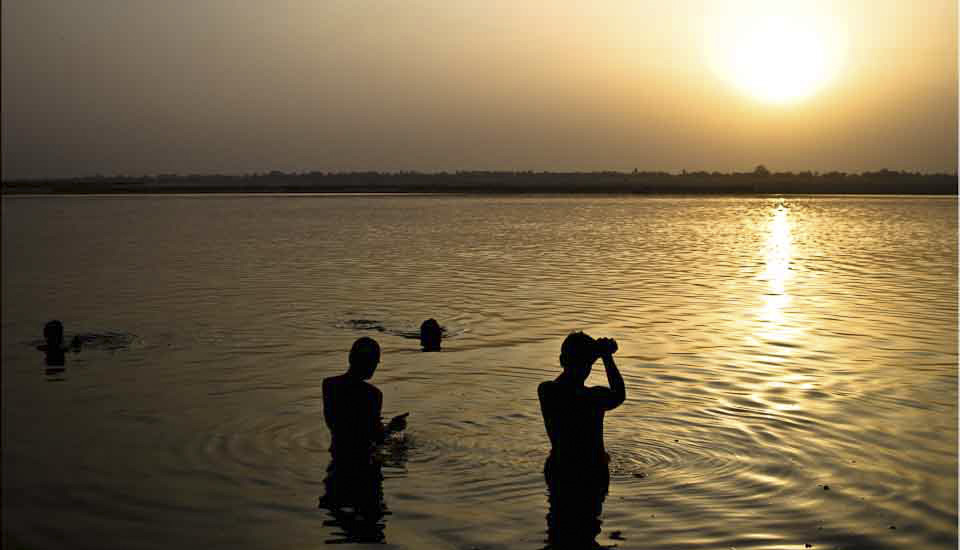
- Performing the Ganga Aarti from Dasaswamedh Ghat, Varanasi
- Buddha Head from Shwedagon Pagoda, Myanmar
- Harry Clarke Window from Dingle, Ireland
- Novice Monk Shwe Yan Pyay Monastery, Myanmar
Packets of 10 for $AU50.
Or - pick any photo from my Flickr or Wanders blog photos.

.jpg)
.jpg)
.jpg)






 Until next time,


 Until then,