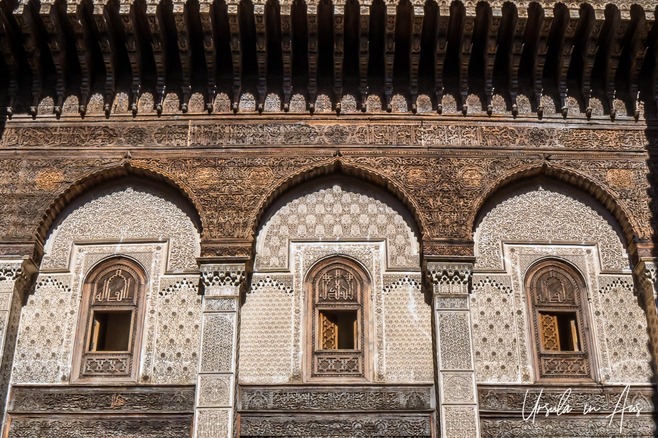
Delicate Woodwork Windows
Madrasa Al-Attarine – the school of the perfumers – was built in between 1323 and 1325. Stunningly beautiful with its fine cedarwood carvings, intricate stucco, and zellige tilework, it sits in the heart of the Fes el-Bali medina, Morocco.
Fes (Fès, Fez) is often considered the spiritual and cultural heart of Morocco.
It is fitting, then that the oldest section of the city, the Fes el-Bali, is home to artisans practicing traditional crafts, and the oldest continuously functioning institute of higher education in the world.
This UNESCO-listed medina (old walled city) is one of the largest and oldest urban pedestrian zones (car-free areas) in the world. It comprises a mind-boggling tangle of small laneways and dead ends – and I was very glad that the small group I was travelling with had a knowledgeable local guide who was tall enough to be seen over the crowds (see: Wandering the Labyrinth)!
Morocco had been on my wish-list forever: as much for the food and culture, as for the crafts and colours. I was determined to go home with a small tribal carpet – which I found while I was trekking in the Atlas Mountains (see: Over the Tizi Oudid). I wanted to source some pottery, and I had ordered a tagine with plates and bowls from artisans that morning (see: Traditional Moroccan Pottery and Ceramics). I have always had my eye out for some sumptuous Moroccan leather, so I was excited that we were visiting the Chouara Tannery, one of the oldest tanneries in the world, first established the 11th century.
Chouara (Chouwara) Tannery is one of three tanneries in Fes. While the dye pots are at street-level, the building itself rises four floors, housing a full range of leather goods, all connected by narrow stairs. At the door, we were met by a man with a plate of mint sprigs to help us cope with the overwhelmingly pungent smell of ammonia, rotting flesh, and animal waste, as the hides are softened then coloured in the open vats.
Today, the tanning industry is considered one of the main tourist attractions in the city. I did my bit: I bought a small cross-body bag and a larger handbag. The quality of both is sublime!
The rest of our afternoon was spent admiring the wonderful, ornate, medieval architecture in the old quarter.
Do join me in marveling at the craftsmanship:
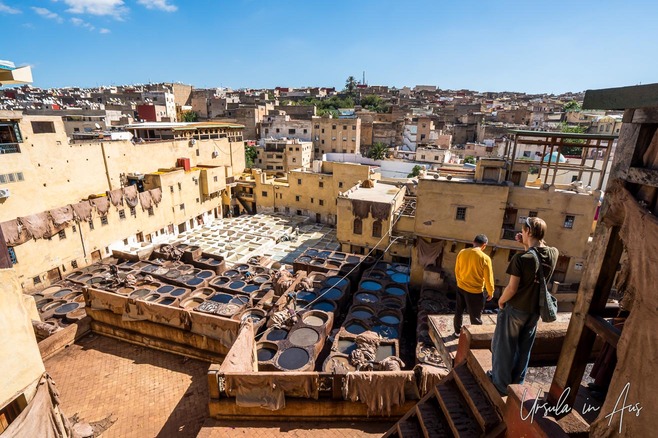
Tannery Vats
Workers – who look tiny from up here – soak cow, sheep, goat, and camel hides in stone vats filled with a mixture of water, salt, quicklime, cow urine, and pigeon droppings. The ammonia in this concoction helps break down tough animal fibers and hair, but the smell is eye watering!
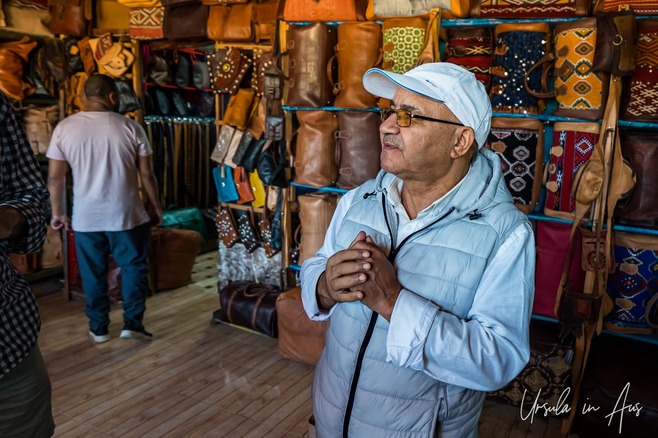
Tannery Guide
Our guide explains the history, the processes, and the products. The production methods remain unchanged since medieval times: no modern machinery is used.

Round Die Pots
After three days of cleaning, leathers are soaked in the dyeing solutions. Even though the dying process uses only natural colorants – like poppy for red, indigo for blue, and henna for orange – the tanneries produce considerable pollution which ends up in the soil and waterways.
Courtyard to a Madrasa
Around a corner sits a religious school. Often named for the neighbourhood they are in, this one is Al-Attarine Madrasa, the ‘school of the perfumers’.
Delicate Woodwork
As I said above, this madrasa was built in between 1323 and 1325. The carving is so beautiful that I couldn’t stop taking pictures!
Same – Same
Every set of windows is different, but I got rather overwhelmed and had trouble telling them apart.
Mihrab
The mihrab (prayer niche) looks like marble but is intricately carved and decorated stucco.
Arabic Calligraphy
This, too, is carved stucco.
Faces in the Window
Those eyes!
A Traditional Moroccan Scalloped Archway
Fes has always been a city of travellers and traders. This wooden gate and horseshoe arch leads into Funduq Barka, a historic 14th-century caravanserai – or hostel.
Zaouia of Moulay Idriss II
Our next stop was at the holy shrine and mausoleum dedicated to the patron saint and founder of Fes. The slot in this portal is for giving alms.
Inside
The interior of the Zawiya of Moulay Idris II is wildly colourful.
Detailed Carving
Back outside the historic mausoleum, I pause to admire the wooden decorations. Called tazouaqt, this traditional Moroccan art form involves intricate hand-painted geometric and floral designs on wood.
Funduq al-Najjarin
The Inn of the Carpenters is another historic funduq – a caravanserai or traditional inn. In 1998 it was reopened as a private museum for wood arts and crafts. It is now known as le Musée Nejjarine des Arts et Métiers du Bois.
Entry Detail
Moorish Arch – Horseshoe Arch
Inside the museum, there are examples of traditional windows with lattice looking out over the courtyard.
A More Modern Chaos
Windows in the other direction show the effects of modernisation and the building next door.
Lamp in the Medina
There are treasures on every narrow street and around every corner.
Ramshackle Canopy
Some of the weathered streets are shaded by tarps, stretched across the narrow walkways.
Handcrafted Brass Lamps
Back in the market streets, Moroccan craft is on display.
University of al-Qarawiyyin
We take a look into the University of al-Qarawiyyin (Al Karueein). Founded in 857, this university holds the Guinness World Record as the world’s oldest continuously operating institution of higher learning.
Zellige Tile Work and a Central Fountain
Inside the university courtyard, I admire the classic Moorish design elements: horseshoe arches, intricate stucco carvings, and geometric zellige tilework.
Fabulous Fabrics
Our last stop in the medina was at one of the many fabric stores, where all types of fabrics were available.
Weaver
Under fluorescent lighting, a weaver shows us how it is done.
We returned to our riad overwhelmed with images and impressions.

Oh! And purchases.
I just love my Moroccan leather – purchased at the source!
Photos: 18October2024