Tony Joe White Who doesn’t know “Polk Salad Annie”? Tony Joe White was part of the first Bluesfest I attended, several Bluesfests since, and a big part of my youth. I had tears in my eyes while watching him this year; although he performed as powerfully as ever, he seemed frail. We are all getting older …
Isn’t it wonderful how a particular song can take you right back?
Back to the time and place you were when you first heard it? Music makes connections – across people, across continents, and across time.
The first time I attended the Byron Bay Bluesfest, back in 1999 when it was still called the East Coast Blues & Roots Festival, I felt as if the 25-odd years that had intervened between myself and the music concerts of my teens had simply fallen away. While listening to Taj Mahal, Jimmy Webb, Dr John, Tony Joe White, and other sounds from my adolescence, I remembered all the best things about those years. Even the songs associated with teenaged heartbreak felt sweet.
Every time I’ve returned to Bluesfest since then, I’ve had moments like that: moments of nostalgia, where old memories are as sharp as if it was yesterday – where I can remember the person I was as clearly as if there have been no changes in the many years intervening, while still retaining some of the perspective that comes from “growing up”.
This year was no different: mixed in with the cutting edge new performers were some of the “big names” from my youth. Truth be told, none excited me quite as much as the appearance of Robert Plant – from my beloved Led Zeppelin – whom we enjoyed in 2013 (see: Singing the Blues), but I was keen to hear the other contributors to the soundtrack of my adolescence who were on this year’s lineup.
They did not disappoint.
Waiting for the Doobie Brothers – The Mojo Tent The “big” names tend to be in the big tents. Even though those tents are jam-packed with people as keen to hear the old favourites as I am, the atmosphere makes it worth it to just be there. (iPhone6)
Camera and Lights The big tents are equiped with spot lights and cameras, so even without a direct view of the stage, you can still watch the screens either side of the stage, or outside.
Doobie Brothers (2014) I managed to get reasonably close to the wonderful Doobie Brothers when they performed in 2014 (see: Full Blast and Full Colour), and I was hoping for a repeat this year.
Doobie Brothers (2017) With members all well into their 60s, the band continues to tour regularly. I (and the rest of the packed-in audience) enjoyed them as much as ever!
Tom Johnston A multi-instrumentalist, Tom Johnston was a founder of The Doobie Brothers, and has been a contributing guitarist, lead vocalist and songwriter, off and on, over the band’s almost-40-year existence.
The Doobie Brothers Bass guitar player John Cowan and Patrick Simmons on acoustic guitar.
Marc Russo – The Doobie Brothers
Tom Johnston and John McFee – The Doobie Brothers
Mavis Staples American rhythm, blues, and gospel singer; actress; and civil rights activist, Mavis Staples scored her first hit in 1956, and has continued to influence music to the present (see: Blues Women Rock!).
Patti Smith I’ve mentioned Patricia Lee “Patti” Smith before in Blues Women Rock! An American singer-songwriter, poet, and visual artist, she became a “punk poet laureate” with the album Horses in the mid 70s.
Rickie Lee Jones Another woman who was part of the soundscape of my youth, Rickie Lee Joneslooked tiny next to her big guitar – but her personality and sound commanded attention (see: Blues Women Rock).
Jimmy Buffet On the second day of this year’s Bluesfest, the older festival-goers were all decked out in their Key West – Margaritaville-inspired flowery clothing, ready for the escapist, feel-good music of Jimmy Buffett and his band. I’m not sure who had more fun during the performance: Jimmy, or the “Parrotheads” in the audience!
Bonnie Raitt With a career spanning from the 1970s, blues singer-songwriter, musician, and activist, Bonnie Raitt was part of the zeitgeist of my era.
Buddy Guy It is clear that 80-year-old Buddy Guy loves what he does. We’ve enjoyed him before and caught him twice this year: he’s a virtuoso musician and consummate performer. As Jimi Hendrix once said: “Heaven is lying at Buddy Guy’s feet while listening to him play the guitar.”
Waiting for Jethro Tull Another day, another packed-out tent: this time waiting for Jethro Tull, the legendary British group dating back to the late 1960s.
Ian Anderson and Florian Opahle The lead vocalist and flautist for Jethro Tull, Ian Anderson, is the driving force behind the progressive rock band. German rock guitarist Florian Opahle is the youngest regular musician to work with the group.
Santana on the Screen People take pictures of the backdrop as they wait for the next big name to make it out onto the Crossroads stage.
Santana under Lights I have loved the music of Mexican-American guitarist Carlos Santana since my days of high school “Sock-Hops” – the pre-cursers to Discos, before “discs” were even invented.
Santana on Guitar His distinctive guitar melodies set against Latin and African rhythms have seen him listed as number 20 on the 2003 Rolling Stone magazine list of the 100 Greatest Guitarists of All Time.
Cindy Blackman Percussion has always been an important part of Santana’s music. The featured drum solo went to the jazz percussionist, Cindy Blackman-Santana.
Madness Graham “Suggs” McPherson has been the lead vocalist of the English ska band Madness (formed in 1976) since 1977. Most of their songs that we recognised dated to the 80s and later.
Tony Joe White “Swamp Music” is a genre all it’s own, and Tony Joe White is the epitome.In spite of being born eons away from swamps, I connect – immediately!
Hearing again those songs that were played daily on the radio, or that I listened to in a friend’s room via 45’s or albums, I was taken straight back into the past –
– not the real past, of course;
the remembered past, filtered by the lived years in between.
I SO love that I can enjoy the music and the memories without really going back to the world that was when I was that age!
[…] Some are big names that take me back to my youth (see, for example: Bring on the Big Names; The Soundtrack of my Youth; Musical Name-Dropping; The Sound of Sunshine); others are more contemporary favourites that I […]ReplyCancel
A Man and his Goods There are so many nuts and spices for sale in Old Delhi’s Chandni Chowk that they extend beyond the shops and into the streets.
India is a sensory feast: a multilayered tapestry of sights and sounds in colours that pulsate, wrapped in a rich weave of smells, where the aromas of flowers and cardamon battle with the stink of dust and refuse and the unwashed. Even the air has tangible depth.
Nowhere is this better epitomised than in Chandni Chowk, one of the oldest and busiest markets in Old Delhi.
Designed by the favourite daughter of the ruling Emperor Shah Jahan in 1650, the bazaar originally featured a central pool – long since gone – which shimmered in the moonlight, leading to the name: Chandni Chowk or “Moonlight Square”. The area is still home to historic mansions and the ageing homes of tradesmen and craftsmen; old mosques, churches, temples and shrines; and shops and restaurants selling all manners of goods and foods. Said to be the largest wholesale market in Asia, the goods and services spill out of the myriad of shops and into the rabbit warren of streets already packed with boxes, people, stray dogs, and the odd car. Some of the winding laneways are positively claustrophobic, with unbroken rows of four-story shophouses closing out the sunlight, and a hot, muggy sky, tangled with electrical wires and the odd bits of tinsel overhead.
And, like everywhere else in India, it is almost as if the colour and the chaos is putting on a cultural show especially for the passing tourists. I’ve spent time in Chandni Chowk on a few occasions over the years: twice with organised photography groups, and once on my own. On each visit, I’ve discovered something different. And, each time, people have either posed for portraits, or actively invited me and my camera to play “voyeur” as they go about their daily lives.
Truly a photographer’s paradise!
Street in Chandni Chowk The streets that make up Chandni Chowk are always crowded: full of pedestrians and people on cycle-rickshaws clutching their purchases.
Crowded Laneway From turbaned Sikhs …
Chandni Chowk Shoppers … to beaded and pony-tailed Hindu priests – …
Shop Fronts … there is something for everyone.
Old Woman Selling Flowers Not everyone has their own shop. A simple burlap tent is one way of demarcating territory. Marigolds are always in demand as temple offerings.
Melons My favourite part of any market is the fresh produce…
Vegetable Grocer … and the characters who sell it.
Man Selling Vegetables
Juice Wallah I’ll settle for a smile!
Pouring Juice You can buy freshly squeezed juice on the street.
School Kids There is a new sight around every corner. These children were piled into their pedicab to go to school. It always amazes me how crisp and clean they always look!
Men on a Stoop
Muslim Shopkeeper
More Marigolds There are temples and shrines throughout the market, so flower sellers do a good business.
Chandni Chowk Gateway There are the odd quiet corners, …
A Heavy Load … but most laneways are a hive of activity.
Spice Shop Khari Baoli Street in Chandni Chowk is the spice market …
Spice Seller … where all kinds of spices, nuts, herbs and other dried food products are available.
Dried Foods in Khari Baoli Dried fruits, nuts, spices and pulses are priced and on display.
Men Playing Cards All kinds of activities are conducted in the streets; …
Street Barber … the local barbers have customers lined up …
Close Shave …for shaves and haircuts.
Pappadum Shop The shops are crammed full …
Pappadums … with their colourful goods.
Pappadum Shopkeeper
Religious Paraphernalia
Khari Baoli Road Shophouses and their billboards, wooden carts, pedicabs, piles of rubbish, and traffic: the wholesale spice market is a busy place.
Dog in Chandni Chowk Street dogs just watch the scene.
Young Man at a Shopfront
I love Chandni Chowk – but I have to limit my time there. In this network of crowded streets full of shops and people, “sensory feast” can easily tip into “sensory overload”.
Like an overly-rich meal, a little can go a long way!
Until next time,
Happy travels!
Pictures: 12April2008, 08April2010, and 04November 2013
Nomad on the Horseback The lifestyle of Mongolian nomads is firmly rooted in the past – but they in no way eschew modern comforts. Herding sheep and cattle may be easier on horseback, but a shiny new bike is handy for the trips to the nearest (distant) town.
Think of Mongolia, and you think of nomads.
Nomads on horseback, driving their herds of goats, sheep, cattle and horses across the vast, rugged expanses of Central Asia, are still an important feature of the Mongolian landscape. In spite of a 2.78% annual rate of urbanisation (according to the CIA World Factbook), Mongolia still has one of the smallest urban populations in the region, and the nomadic idea is an integral part of the national psyche.
About 30% of Mongolians are nomadic or semi-nomadic, spending at least their summers in their portable ger housing close to their animals’ grazing lands, and living much as they have for hundreds of years. The herds live off the land, and the nomads live off the milk, meat and skins of their livestock. Fermented mare’s milk – airag – is popular, and milking the horses is one of the many daily activities (see: From Kharkhorin To Tariat).
This is not to say that nothing has changed.
Thanks to the advent of solar panels, between 60 and 70 percent of the nomadic population now has access to electricity for their mobile phones, radios, televisions, and electric lights. Children generally study in the cities, many at boarding schools, returning to their families’ ger camps during the summer. While horse culture is still central to nomadic life (Mongolia is home to more horses than people), reliance on horseback is reduced by motorcycles and trucks.
I was crossing the Mongolian steppes with a small group of photographic enthusiasts, under the leadership of local guides G and Segi, and photographers Jeffrey Chapman and Winslow Lockhart from Within the Frame. We had spent most of the long day before bumping along in our Russian UAZ (Ulyanovsky Avtomobilny Zavod) four-wheel-drive vehicles (see: Tosontsengel to Har Termes Uul), so it was a great relief when on this – our fifth day on the steppes – we pulled in to visit a family of nomads.
Do come along!
Hut on the Lakefront We started our day across the road from the popular summer destination, Khyargas Lake – deserted in the late-September low-season.
Unbelievably Rustic! To call our hotel rustic is to give it too much credit! I’m not sure what the outdoor ‘pool’ is about; there are no toilets or running water inside. (iNstagram)
Cabins on Khyargas Lake The cabins across the road – presumably also without plumbing – have far more charm. (iNstagram)
Mountains in the Distance Snow-capped mountains float in the distance as we continue our drive west, …
Gatekeepers Cottage … stopping at the boom gate …
Ulaangom .. before driving into Ulaangom (Улаангом: Red Valley), the local provincial capital, just 120 kilometres (70 m) south of the Russian border. We stopped for supplies – including sweets for the family of nomads we were about to visit. (iPhone6)
Nomad’s Ger A traditional ger (Mongolian; yurt in Turkic languages) is a round tent covered with skins and felt used as a portable home by nomads in the steppes of Central Asia. Today their construction might include plastic tarps, and their transport from one place to another is more likely to be by truck rather than by ox cart.
Children of the Ger It was unclear to me how many families were gathered in the ger, …
Child of the Ger … but there were three or four young children in the group.
Inside the Ger Inside the home is remarkably spacious. The central stove for heating and cooking has warm fermented mare’s milk, or airag, on it. This is served with yak butter in it. Not my favourite drink – it tastes a bit like warm yogurt.
Sewing Circle A group of women has gathered in the ger to sew pelts together.
Hands at Work With their leather thimbles, the women work quickly …
Sewing Skins … putting together a patchwork of beautifully soft cashmere (otherwise called pashmina) goat pelts.
Nomadic Woman
Mother and Son Mum, in traditional clothing, sits in front of a very-modern power-storage system.
Mum and Toddler This little urchin already has a mouthful of the candies we have brought with us on our guide’s advice.
Nomadic Man and Child
Nomadic Man Back outside, a man in his traditional deel overcoat and heavy boots …
Nomadic Man … poses for pictures.
Mongolian Nomad
Mongolian Ponies “A Mongol without a horse is like a bird without the wings.” The rugged local horses are central to Mongolian nomadic culture.
A Man and his Horse Every member of the family is likely to have their own favourite animal.
We said our farewells, returned to our trucks and continued across the open plains westward …
… day-dreaming about almost-wild Mongolian ponies.
Wet Mountain Road The paved roads slip away quickly in the Thai hills of Mae Hong SonProvince.
I love driving into Thailand’s green, jungle-draped mountains, where the clouds hang so low they look like snow patches, and the sun traces the outlines of dark post-afternoon rainclouds and glints off the golden Buddhas and bejewelled temple rooftops.
If you turn off the highways, however, it is not long before the ornate temples – and even the paved roads themselves – disappear.
This is the territory of the Thai “Hill Tribes”; ethnic minority groups who are often Animist, sometimes Christian or Buddhist, but seldom rich enough to guild their places of worship. Some of the remote villages in these hills host trekking ethnographic-tourism, but mostly the people farm hill-rice for themselves on the steep mountain slopes, and eke a meagre living out of the market produce they grow. When I first visited the region, it was all cabbages; today they have branched out into corn, tomatoes, and soybean. But, what they get payed for the product of their labour, compared to what the consumers in the valleys pays for the produce, is a pittance.
It’s a hard life in this land beyond the reach of electrical poles and telephone service! But, the people are invariably welcoming – as I have discovered on all my previous trips into the region.
This last May (see: The Faces of THEP), I was travelling with a small group of educators who manage the Thailand Hilltribe Education Projects (THEP), which I’ve written about several times before (see: Ursula’s Weekly Wanders: THEP). It was day three of our travel with the indefatigable Susan Race, the driving force behind THEP, and we set off early in the hopes of getting up the steep roads before rains washed them away. Unlike the locals who navigate the treacherously slippery and rutted muddy tracks on motorcycles, we had the luxury of travelling in four-wheel drive utility trucks. Even so, there were some hair-raising moments!
We were off to visit a school high in the hills at Ban Huay Mae Gok – a village so small that it is invisible to my Google Maps. As remote as this village school might be, the children who attend it live in even more inaccessible locations: hence the new dormitory project that THEP was supervising. For without somewhere on-site to live, hill tribe children from these far-flung mountain hamlets cannot attend school at all.
Join me on a school visit beyond the guide-books.
Rudraksha (ไคร้ย้อย) Tree The dainty flowers on a rudraksha (Elaeocarpus grandiflorus) tree are known as fairy petticoats. An hour or so out of Mae Sariang, we pulled in at a rest stop for a break, before turning our trucks off the main road for a second hour of driving. Everything is a long way away in “The Hills”.
Champak (จำปา) Tree The morning rain had washed everything clean, and the flowers on the champak (Magnolia champaca) tree smelled gorgeous.
Wet Muddy Road The quality of the roads drops off pretty quickly as you leave the highway, and drive onto the dirt and into the rainclouds. (iPhone6)
No Electricity When we reached Ban Huay Mae Gok School, we found the children gathered in dark classrooms. I looked at the solar panels around the grounds, and asked the principal why they had no power. He shook his head and shrugged: the school is beyond the reach of centralised electricity, and their storage batteries have expired and died. While their solar panels work in good weather, rainy season lasts a long time… When we visited, the school had been without power for about five weeks.
Karen Kids in the Classroom The young Karen Hill Tribe children, many in their traditional shirts woven from purple cotton, …
Girls Learning their Letters … practice their Thai writing on the floor of a dim classroom.
Girls Writing Thai is their second language: these children speak Karen with each other and at home with their families.
TV Receiver out the Window We walked up a slippery hill to the newly-built and as-yet empty dormitory. Looking out the window, I could only reflect on the irony of having phones, television, and internet; all pretty useless when you have no power supply!
Workers out the Window A couple of local men watch …
Checking the Toilet Block … as Susan documents the progress of the building. She keeps meticulous records for reports to project funders.
Project Worker THEP won’t pay for labour on building projects: schools need to find the money themselves, or persuade people to donate their time and skills.
Measuring for Bunkbeds Susan and Khru Apichart – another driver behind THEP – measure the new dormitory for bunkbeds.
Giving Thanks before Lunch Back at the canteen, the children are waiting for permission to start their lunch.
Focussed on Lunch It is simple fare: white rice, fresh tomato, a cabbage and pork mixture, and a biscuit for desert.
An Imp and her Lunch Some of the children are enjoying our company as much as their meals, …
Smiling Girls at Lunch … while others are busy socialising with friends.
Lunch
Little Girl – Big Plate The tiniest girl in the room was also the slowest eater.
Time’s Up! We were not sure if she was full, or had just run out of time, when she returned her dish to the washing-up area.
Karen Girls on the Steps A couple of girls wave us off, as we head back to the school’s offices for our own lunch.
Food and Laughter A trip into the hills with Susan Race to check on THEP projects is never short on good, fresh, local food – or on laughter.
At the Shelter Just outside in a sheltered rest area, a Karen grandmother and girl, both in traditional, age-appropriate dress, wait for their transport home. The principal of this school is enthusiastic about promoting English – even though that is the third language for Karen-speaking communities who have to learn Thai to get by. All around the school grounds, there are signs in English, with the corresponding pronunciation and meaning in Thai.
Karen Grandmother and Girl Grandma, who is wearing a beautiful mountain-coral necklace and a traditional head-wrap, has a mouth full of chewing tobacco. Betel nut has fallen out of favour.
Karen Kids in the Rain It may be Saturday, and they may have had their lunch, but the children have not yet been released to go home; …
Toothbrushes … Khru Usa and the school principal have some donated toothbrushes to distribute.
Outside the Classrooms
The Work Party Meanwhile, representatives from the the school, the village, THEP, and the Department of Education finish up their discussions outside the office.
Susan and the Village Headman Working with community leaders helps ensure more successful projects.
Rutted Mountain Roads What drives up must go down again: soon it is time to get back into the trucks and navigate the mountain roads down the hill, …
Humbling and inspiring. The image of the children in silent prayers is haunting. I am happy to see that these little dolls are healthy and happy.ReplyCancel
Hi Sidran,
Happy and healthy, they are indeed! No shortage of beautiful, fresh food. They have to work extra hard to get their educations, though.ReplyCancel
[…] On the third day, we drove high into the mountains to look at a new school dormitory (see: Roads Less Travelled), and then to an old canteen and dormitories in need of repairs and sprucing up. On the last day, […]ReplyCancel
Chris Eaton and Chris Brooker Billed as “5 Musicians + lots of different instruments = Great music!”, the Round Mountain Girls are local crowd-pleasers.
Support your local musicians!
In Australia, this is easy, for in the world of music – as with just about every other creative endeavour – the country is extraordinarily well represented, per capita, with talented individuals who work hard at their craft.
Although I love getting to see the international “big names” whenever I attend the annual Easter-weekend Byron Bay Bluesfest, I also enjoy indulging in the wealth of local talent – whether that be from old favourites, or from performers who are new to me. One of the many beauties of Bluesfest is the consistent quality of the music – wherever it hails from and whatever the style.
And so it was at this year’s festival last April. We studied our schedules with highlighters in hand, marking the people we had to see and groups we wanted to catch, and then filled in any gaps with whomever else was playing.
Not once were we disappointed!
Whether they were performers I’d listened to many times before, or new (to me) discoveries, the local musicians that I managed to hear were in fine form. This year, it just happened that every local performance I attended was centred on guitars and strings.
For me, it is almost as much fun trying to capture some kind of “essence” of the performers in digital portraits taken from the crowded audience spaces in dark tents – usually with the ISO turned up high on my “noisy” old Canon 5D Mark II to cope with the lack of light, and my second-hand 2.8 70-200mm lens (without image stabilisation) to deal with the distance.
Enjoy some of our local talent!
Jeff Lang Australian singer/songwriter Jeff Lang is known for his guitar skills. He has played at Bluesfest before, and we’ve seen him there – and at the Thredbo Blues Festival (see: Summer Blues and The Blues in Colour) – and enjoyed him every time.
Jeff Lang Jeff started out playing clarinet at a young age, and now plays slide and standard guitars, banjo, mandolin, Chumbush and drums.
The Drummer On this occasion, however, Jeff left the drumming to one of Australia’s finest percussionists: Greg Sheehan.
Ray Beadle Award-winning Australian blues guitarist Ray Beadle was in fine, toe-tapping form.
Ray Beadle He’s played at Bluesfest before – he’s also spent time playing at B.B King’s Club in Memphis and Buddy Guy’s Club in Chicago. Impressive!
Emily Wurramara Emily Wurramara, the infectiously cheerful singer, songwriter and musician from Groote Eylandt in the Gulf of Carpentaria, was one of the local performers at the Boomerang Indigenous Arts Festival, which ran concurrently for three of the five festival days. Her sweet voice and sunny disposition was an absolute treat (see: Blues Women Rock).
Women Dancing There is always plenty of entertainment and activity outside the tents.
Mother and Daughter Dancing The gypsy dancers start young!
Young Girl Dancing With her feet moving and her skirts swirling, …
Young Dancer … it is clear that this youngster was born to perform!
Chris Eaton – Round Mountain Girls The band is known for their wonderfully frenetic live performances, but their recorded music is also a joy.
Chris Brooker – Round Mountain Girls
Chris Willoughby – Round Mountain Girls
Rabbit Robinson – Round Mountain Girls Leaping around the stage like a leprechaun, award-winning fiddle player Rabbit Robinson is a joy to watch and listen to.
Lucas Proudfoot – Didgeridoo Lucas Proudfoot, a member of the Tweed Coast Aboriginal and Islander Community, brought his extraordinary talents on the didgeridoo to part of the Round Mountain Girls’ set.
Lloyd Spiegel The sounds of a classic bluesy guitar enticed me into the Jambalaya tent on the second-last day of the festival when I was on my way to hear someone else. I stayed to listen to a couple of original songs and some story-telling before vowing to check Lloyd Spiegel out further the next day.
Lloyd Spiegel I absolutely loved him! And not just his guitar style: his stories about working in Japan demonstrating guitars, about his personal life, and about life as a musician, were all self-depreciating and very funny. “The only thing worse [for a guitarist] than playing after Ray Beadle,” Lloyd told us, “is playing before Jeff Lang!” There he was on the program, wedged between two of Australia’s great guitarists. “Jeff’s never heard another guitarist play at their best,” he continued. “As soon as they find out that Jeff is in the building, they sh#t themselves!”
Jeff Lang Back Stage And sure enough, there was Jeff, checking his equipment before his set. As far as I could tell, however, Lloyd didn’t miss a finger-picking beat.
Mojo Tent at Sundown
As the sun lowered over the tents on the last day, we became aware that another festival was soon coming to a close.
We still had the last of the international big names to take in, but we were already dancing and singing, well “warmed up” by our excellent local performers.
[…] I always sample some of the music and dance (eg: Boomerang 2016; Back to the Roots; Australian Guitars and Strings; Blues Women Rock; Songs of Joy and […]ReplyCancel
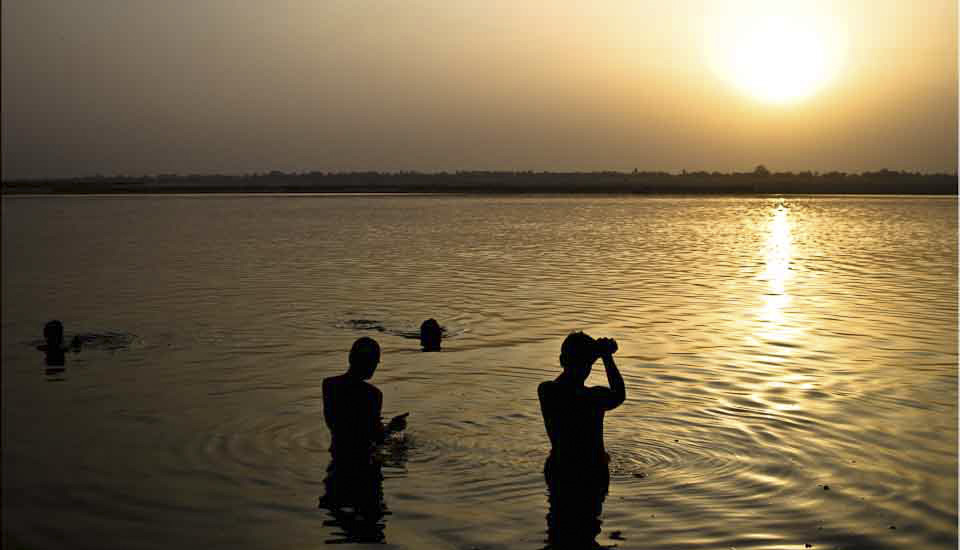
- Performing the Ganga Aarti from Dasaswamedh Ghat, Varanasi
- Buddha Head from Shwedagon Pagoda, Myanmar
- Harry Clarke Window from Dingle, Ireland
- Novice Monk Shwe Yan Pyay Monastery, Myanmar
Packets of 10 for $AU50.
Or - pick any photo from my Flickr or Wanders blog photos.

.jpg)
.jpg)
.jpg)








[…] Some are big names that take me back to my youth (see, for example: Bring on the Big Names; The Soundtrack of my Youth; Musical Name-Dropping; The Sound of Sunshine); others are more contemporary favourites that I […]