Red Pigface on Tabarca A native to South Africa, the Ice Plant (carpobrotus edulis) is a colourful – if invasive – addition to the rocky coastal views over the islet of Tabarca in the Mediterranean Sea.
Is there anything that says “Mediterranean” more than bright sun bouncing off blue waters and old white-washed walls? Add fresh seafood and salads bathed in rich olive oil, and the picture is complete.
The tiny islet of Tabarca, just off the coast of Alicante in Southern Spain, is the real deal.
The island was originally known as Illa de Sant Pau – Saint Paul’s Island – because it was believed that Paul the Apostle had disembarked there, or Illa Plana – Flat Island – because of its level surface.
Originally uninhabited, the islet, which is just 5 nautical miles (9 km) off the SpanishMediterranean coast from Santa Pola, was a refuge for Barbary pirates on their raids from North Africa. In 1760, to protect against these raids, Charles III of Spain ordered that the islet be fortified and populated. A Spanish garrison, and a number of Genoese sailors who had been shipwrecked near the coast of Tunisia, were settled on the island. The sailors named it Nueva Tabarca (‘New Tabarca’), after their original home near the Tunisian town of Tabarka, which was a part of the Republic of Genoa until 1741.
Today, Tabarca is the smallest permanently-inhabited islet in Spain, with about 60 year-round residents. The islet incorporates a marine reserve (Reserva marina de la Isla de Tabarca), and tourism – especially in summer – is the main source of income.
My husband and I were staying in nearby Albir, and decided to visit Tabarca as part of day-long boat trip from Benidorm.
Do join us!
Taxi Service to Tabarca The islet is just 8 nautical miles (15 km) from Alicante and 5 nautical miles (9 km) from Santa Pola, and relies on a number of boat services. Looking rather plain from the sea, the Church of St Peter and St Paul was finished in 1779.
Boatman on the Deck We travelled to the islet on a large tourist boat from Benidorm: about a two-hour cruise along the Costa Blanca.
Tourist Boats at Tabarca Once we finally arrive, we have to wait as a queue of tourist boats in front of us move in and out of Tabarca’s small dock.
Boatman and Tourists It is nearly high-noon, and the sun bounces off the deck of the boat where tourists wait to disembark. One of the staff members watches on.
Boatman Our boatman watches carefully, still waiting for our turn at the dock.
Southeast to the Lighthouse Our first stop, once we are off the boat, is an outdoor restaurant with a view. We were ready for a fresh seafood lunch of local specialities. It is mid-May: weeks away from the height of tourist season, …
Southeast to the Lighthouse … so the beach is quiet as we look southeast, over the neatly stacked and empty chairs, to the Faro de Tabarca, the island’s lighthouse.
Rugged Coast In the other direction, we can see southwest to the fortified walls designed in the mid-1700s by military engineer Fernando Méndez Ras.
Cova del Llop Marí – Sea Lion Caves With the crystal clear waters around the island, stunning volcanic rock and limestone cliffs, and a glorious Mediterranean climate, it is no surprise that Tabarca is popular with tourists. In summer, the villas in town are full.
Portal on the Mediterranean Most of the residences on the islet are empty when we visit; in 2013, Tabarca had only 59 year-round inhabitants. Ten-times this number stay here in summer.
Cala del Llop Marí As we walk around the island, we have views east, back across Sea Lion Cove, …
Lilies on the Cliff … west across the Cala del Francés, …
La Cantera and the Old Fortifications … and across the low-lying rocks of the neighbouring island to the mainland.
Platja de Birros Sun-bakers take advantage of the beautiful weather.
Jesus on a White Wall The light bounces off the white stucco walls of the quiet houses.
Light and Shadows and Murals Painted murals add to the tidy charm of the orderly streets, while birds fill the blue sky over our heads with sound.
Wall Plaque
Doorway
Herring Gull
Nou Collonet The streets are hot and quiet. You can tell how important tourism is by the number of restaurants nestled into every corner.
It was a unique and enjoyable – albeit quiet – place to wander and lunch.
Gardener A elderly Burmese woman gives me a gap-toothed beetle-nut grin as she pulls weeds in a public park in Yangon. So many people still perform hard, physical labour with no early-retirement, but are never-the-less ready with a smile! (11September2012)
It was a “simpler” time …
I visited Myanmar late in 2012, with photographer Karl Grobl from Jim Cline Photo Tours and local guide Mr MM. The country had just opened its doors to international tourists, and was on the brink of change. Aung San Suu Kyi was still under house arrest, and was still locally and internationally revered.
But not all the current troubles are “recent”: when I visited, our planned trip to the Rakhine State was aborted following the violent conflicts (8 June 2012) between Rohingya Muslims and ethnic Rakhines.
Even without that portion of our tour, the two weeks we spent in Myanmar was a richly rewarding experience, about which I have posted many times (see: Ursula’s Weekly Wanders: Myanmar).
When I first arrived in Yangon, it was raining – the kind of relentless, unremitting tropical rain that W. Somerset Maugham described so well in his stories of Southeast Asia. The pounding on the roof was deafening as the waters streamed down the colonial iron lattice-work on the windows of my hotel and bounced back from the pavement below.
At the first available break in the weather, I ventured out and met my first smiles.
Golden Statue Washed clean by the tropical rains, a golden statue rises out of the parks around Kandawgyi Lake, near my hotel. (11September2012)
Karaweik Hall Myanmar’s ornate architecture is unique and distinctive. One of Yangon’s newer landmarks (completed in 1974), the gilded Karaweik Palace, is modelled after the Royal Barge used in the past by the Burmese Kings. Shaped like the mythical Karaweik bird, the restaurant complex looks like it is floating on Kandawgyi Lake. (11September2012)
Writing a Letter We visited the Kyakhatwine Monastery, Bago, to watch the monks line up for their last meal of the day (Lining up for Lunch). The lay people around the monastery were as interesting as the monks themselves: this elderly woman was hunched over her work when I approached her. (12September2012)
Total Focus Her total focus as she painstakingly copied the text she was writing was palpable.
For “The Lady” The old woman proudly told me that her work was for “The Lady”. Everywhere I went, I saw revered representations of Aung San Suu Kyi. In spite of the current ambivalence about her outside Myanmar, I doubt very much that her image is at all diminished among every-day Burmese. (12September2012)
Flowers of the Cannonball Tree – Couroupita Guianensis These unusual flowers are usually only seen in Hindu and Buddhist temples. (13September2012)
Cannonball Flowers – Couroupita Guianensis The hooded flowers are said to look like the sacred snake, or nāga, and the tree resembles the one (Shorea robusta) that Maya was holding onto while she was giving birth to the Lord Buddha.
Lady at the Loom In a hot, dark room in Mandalay, women sit working large looms. (14September2012)
Concentration
Hands at Work The silk lace that the women are making is complex: requiring different coloured threads and a great deal of concentration. (14September2012)
Silk Shuttle
Novice on a Bench Monks and novices are everywhere in Myanmar; …
Burmese Novice … this particular novice is sitting outside a barber shop in Heho. (20September2012)
The Haircut Inside the small shop, a man is getting his hair cut.
The Cut The barber pays attention to his work …
Monk in the Mirror … while the novice watches.
Clippers
Reflection
Study The men are a study in concentration …
Barber and his Client … until the cut is finished, …
The Happy Customer … and they show off the finished product. (20September2012)
Making Dough You are never far from freshly-made food in Myanmar! (23September2012)
Sticky Dough on the Griddle
Young Boy and his Mother It is the people that make travel special; the open face of a young boy on Yangon’s Ring Train brings my trip full circle – pardon the pun!
As I said: when I visited, the country was on the brink of change following the 2010 election of a nominally civilian government. Clearly, however, not all the anticipated transformations have worked out as positively as some of us had hoped. The election of Aung San Suu Kyi’s party in 2015 has not eased the ongoing ethnic conflicts.
The generous, gentle people that I met all over the country belie the current news headlines. I can only hope they can work out a positive way forward.
The Three Sisters Back in the Dreaming, there were seven sisters who lived in the Jamison Valley in Australia …
Stories abound.
Sitting high above the Jamison Valley, in theUNESCO World Heritage-listed Blue Mountains of Eastern Australia, three unusual rock formations stand out. Collectively known as the Three Sisters, Meehni, Wimlah, and Gunnedoo were formed by the ongoing erosion of wind and rain against the soft Narrabeen sandstone of these mountains.
According to locally-told tales, these three sisters – who were members of the Gundungurra people living in the Jamison Valley – were turned to stone by their father, an Elder named Tyawan. In one version of the story (q.v.: Myths and Legends), he is protecting his daughters from an evil bunyip – a locally feared creature with a terrible voice and a penchant for eating young girls and women. The bunyip, angry at being woken and deprived of his meal, chased and cornered Tyawan, who used his magic bone to change himself into a lyre bird and escape. Unfortunately, in the process, he dropped the bone! To this day, lyre birds scrabble in the undergrowth looking for the bone, and the stone sisters wait to be changed back into the beautiful young women they once were.
Another version of the story is more like the classic tale of Romeo and Juliet: the three sisters fell in love with three brothers from the neighbouring Nepean tribe, but marriage between these groups was forbidden by tribal law. The brothers decided to capture the young women by force; Tyawan turned the girls to stone to protect them, but was killed in the ensuing battle and could never change them back. It has been suggested that this popular narrative is likely to be the recent invention of a non-Aboriginal Katoomba local, Mel Ward, rather than a genuine Indigenous Australian Dreamtime legend.
Whatever their stories, these outcrops are amazing in their own rights, especially as their moods and colours change in the shifting light. They are also extremely accessible:just 110 km (68 mi) west of Sydney, they are visited by busloads of tourists – mostly foreign – daily.
Rather than wrestle with parking at the popular Echo Point Lookout, my husband and I chose to walk the 2.3 km down the hill from our charming 1930s guesthouse in Katoomba, the chief town in the Blue Mountains.
Come join us!
Rhododendrons on the Street Katoomba, with its elevation of 1040 metres above sea level, has a subtropical highland climate. On our visit in October, the spring flowers were in full bloom.
Petals on the Ground
Spring Blooms in the Trees
Flowers on a Wall The town of Katoomba came into its own in the late 1800s with the start of ‘Crushers’, a commercial metal crushing plant, the opening of the Katoomba Coal Mine, and the development of health and recreation facilities. Some of the buildings and infrastructure date back to this time.
‘Kapsalie’ Built between 1915-1916, this lovely federation bungalow is typical of houses in the Katoomba area.
The Jamison Valley As we cross from Lurline Street to Echo Point Road, we start to get views through the trees …
The Jamison Valley … and over the valley.
Echo Point Lookout Services Just before we reach the Echo Point lookout itself, we stop to have a peek into the very modern shopping and food centre, …
Coffee Shop with a View … where customers sit with panoramic views over the valley.
“Katoomba” The viewing area at Echo Point lookout is perched overlooking the Jamison Valley and the iconic Three Sisters. I always enjoy visiting the Echo Point Visitor Centre – which has added a roof of solar panels since my last visit. What was more surprising was the lack of crowds! In spite of the beautiful spring weather, there were not the usual hordes of tourists.
Walkway to the Three Sisters Echo Point is the gateway to a number of walks: along the clifftops or into the valley below. We settled for the easy 500 metre pathway to the Three Sisters themselves.
Flowers and Roots In contrast with the non-native flora of Katoomba, the Australian bush features delicate flowers and subtle colours.
Blue Tongue Lizard Australian fauna can be skittish and hard to spot. These delightful life-size sculptures along the pathway represent those animals hiding in the bush.
Track to the Three Sisters The concrete pathway winds along the cliff edge …
Taking in the Views … with overlooks giving access to panoramic views.
Moss in the Crannies The porous sandstone in the cliff-side walls along the walkway are home to mosses and small plants.
Echidna A life-size sculpture of one of Australia’s unique monotremes.
Sister! We catch our first glimpse of one of the sisters from the walkway. Until 2000, the Sisters were popular with hang-gliders and rock climbers; these activities were stopped on on environmental grounds and out of respect for the Gundungarra and Darug people.
Archway to the Sisters The Giant Stairway down to the valley floor and the Honeymoon Bridge across to the first Sister were officially opened to the public in 1932.
Stairs down to the Honeymoon Bridge
Honeymoon Bridge People take photos on the steps to Meehni, the first of the Sisters – and the only one that visitors are now allowed on.
Grass on the Sister A closer view of the rock formation shows off the strong vertical jointing properties of the Narrabeen sandstone, interspersed with erosion-resistant ironstone.
A Quiet Moment A man checks the photos on his phone at a Jamison Valley overlook.
The Three Sisters Ironically, the best view of the Three Sisters is from the Echo Point lookout – back where we started from! The coloured striations show the effects of erosion: with the lighter orange and yellow sections being the freshly exposed rock.
The Three Sisters are a unique Australian icon and a symbol of the Blue Mountains. I was very impressed with how much Echo Point and the pathway to the Three Sisters had been improved since my last visit; the whole area was enjoyable and easy to explore.
Of course, we still had a long walk back up the hill to town centre, to a well-earned lunch, and to our hotel.
Stone Buddha The Marble Mountains, just outside Danang in Vietnam, are a honey-comb of niches, many with a shrine or deity inside.
The Marble Mountains: I kept calling them “Magic Mountains” by mistake.
But they are a bit magical!
Near Non Nuoc Beach, nine kilometres south of Danang in Central Vietnam, five marble and limestone outcrops rise up dramatically from the flat plains around them. According to legend, a dragon climbed out of the East Vietnam Sea onto the beach and laid an egg. After a thousand days and a thousand nights, the egg hatched, and a beautiful girl emerged. The broken pieces of shell that were left on the beach eventually grew into the five mystical Marble Mountains. (Story paraphrased from Hotels.com; I want to know what happened to the girl!!)
Craggy and steep, these impossible-looking mountains are topped with Buddhist pagodas, and riddled with tunnels and caves. Alcoves and crannies are filled with Buddhist and Hindu temples and shrines, many many of them more than 300 years old. More recently, the tunnels provided hiding places for the Vietcong, very near the military air base maintained by the Americans during the Vietnam War.
It is not just me who finds these peaks magical. They are a popular tourist attraction and well-known pilgrimage site.
Their name in Vietnamese is Ngũ Hành Sơn, or “five elements mountains”: referring to the five elements that, according to ancient Asian philosophy, make up everything in nature. The individual outcrops are named for – and said to represent – one of these elements: Thuy Son (water); Moc Son – (wood); Hoa Son (fire); Kim Son (metal); and Tho Son (earth)).
My husband and I were staying at a coastal resort nearby (see: Resort Living) and it was an easy cycle to Non Nuoc Village at the foot of Marble Mountains. The village is famous for its stone sculptures and handicrafts – although, these days the marble used by the local craftsmen comes from nearby provinces or China, so that the precious mountains here are not destroyed.
We had a look through the shops before heading to the entry to Thuy Son or Water Mountain. We bought our modestly-priced tickets and started up the 150+ stone steps that rise and wind through the caves and alcoves to the lookouts at the top.
Vietnamese Fishermen Non Nuoc Village is crowded with outlet shops selling marble carvings: from the smallest jewellery, through souvenir knickknacks, to the largest religious and decorative objects for public spaces.
Bright Lights and Crafts The shops carry a range of local handicrafts; the teapots come in all shapes and sizes.
Stairs up the Mountain There are said to be 156 steps up to the viewpoint at the top of Thuy Son, …
Kwan Yin (Quan Am) in a Niche … but there are plenty of things to look at along the way.
Marble Bodhisattvas and Nagas Around every corner, the visitor is met with Buddhist imagery.
Buddha over a Reflecting Pond The rising steps are broken by landings …
Buddha in the Garden … where visitors stop to rest and pose for pictures.
Tam Thai Pagoda
Inside Tam Thai Pagoda Some of the shrines are wildly colourful and garishly decorated.
Shrine in an Alcove Others are more subdued: carved from stone and aged with a patina of moss.
Prince Siddhartha on Horseback Buddhism has strong ties to it’s Hindu roots: the Kshatriya Warrior Prince Siddhartha, was the ninth incarnation of the Lord Vishnu, the second god in the Hindu triumvirate. After his enlightenment, he was known as Siddhārtha Gautama, or the Gautama Buddha.
Buddha in an Alcove As we follow the tunnels through the limestone caves, we come across more altars, …
Standing Buddha … and more Buddhas.
Buddha Teaching Images of deer are often found in Buddhist gardens. They remind us of the first sermon Buddha gave after his enlightenment: to five beggars in Sarnath, a deer park in what is now Uttar Pradesh, India.
Pagodas in the Garden
Danang From our first vantage point, we can see north west to Danang …
Marble Mountains and Prickly Pear … and west over the outcrops towards the mountains.
Coconut Seller Coconut is a refreshing energiser after a long hard climb!
The Bodhisattva of Compassion All over Vietnam, you will see statues of Quan Am, the Bodhisattva of Mercy or Compassion.
Quan Am Local Buddhists pray to her for guidance, fertility and protection.
Stairs into the Caves In most places, the stairs up and down through the caves are well formed.
Look up through the Limestone In other sections, we were literally climbing through rough gaps in the craggy limestone rock.
Shrine in a Cave Another cave: another shrine; …
Buddha in a Niche … another alcove: another Buddha.
Tháp Xá Lợi We come back out into the open behind the Xa Loi Tower.
Heaven’s Gate We make our way through Heaven’s Gate …
View over Non Nuoc Village … and up to another lookout.
Marble Carvings Back at the bottom of the mountain, we admire the sculptures awaiting packaging and transport …
Giant Kwan Yin in Marble … as we pass under the blessings of a giant Quan Am …
Bố Đại … and past a Laughing Buddha who looks as though he’s been abandoned.
Before finding our bicycles and pedalling back to the resort, we stopped into the shops for another look around. We found a small piece of marble to take home with us; the stone might have its origins in China, but the carvers live right here – in the shadow of these magic Marble Mountains.
Twin Upper Falls, Linville Falls It’s a short walk through a lovely wood to the upper falls at Linville Falls, North Carolina.
We had started planning the year before …
My husband and I had been driving, in our usual hurry, from a friend’s house in North Carolina to an airplane in Nashville, Tennessee. Not far from Asheville, NC, we pulled a short way off the highway to visit the Blue Ridge Parkway Visitor Center. A working wifi, a clean toilet, a few interactive displays, and I was hooked!
I picked up numerous pamphlets and maps, and started dreaming…
Dreams Start Here! The Blue Ridge Parkway Visitor Center just outside of Asheville, North Carolina, has just about everything a Blue Ridge trip-planner needs.
So, when I was mapping out our trip to visit family in Tennessee and Ohio the next year, I expanded the loop with a drive down the Skyline Drive through the Shenandoah National Park and then into the Blue Ridge Mountains via the Blue Ridge Parkway (see: Blue Ridge Parkway, Part 1 and Stepping into the Past, Part 2). Naturally, the days we had originally allotted to the drive had long-since eroded, and here we were: after two days of driving down the Blue Ridge Parkway, we had a fast-approaching deadline, but a lot more road to enjoy.
In the car, I alternated between thumbing through the maps and guide books and watching the road and scenery, while my husband drove. I had to try and pick the highlights as time slipped through our fingers like sands through the hourglass…
Morning View It is hard to believe that people get up to this glorious view every day! Skyline Village Inn, Spruce Pine, NC.
That is how, on our third morning on the Blue Ridge Parkway, we came to be driving backwards.
Because I had booked our overnight accommodation based on where I thought we would/should be, we ended up backtracking from the tiny hamlet of Spruce Pine (Mile 330.8), north to Linville Falls (Mile 316.3). The waterfall looked too good to miss.
As it turned out, the town of Linville Falls wasn’t too bad either!
“Turkey in the Straw” The wild turkeys at the side of the road were a morning treat as we drove north. Unfortunately for me and my camera, they move pretty quickly for a heavy bird!
Fishing in the Linville River The river is quiet near the car park and National Park’s Visitor’s Center – clearly it is a good spot for fly fishing.
Into the Linville Woods There are many short trails leading to waterfall over-looks; all of them are well maintained.
Tree Roots The extensive roots of the trees form an intricate webbing underfoot.
Hikers on the Trail
Linville Falls Our first breath-taking view of Linville Falls as it plunges down through Linville Gorge, was from an upper over-look. The river drops a total of 46 metres (150 ft) down several tiers.
Flowers on the Edge Wildflowers cling to the steep drop-off next to our viewing platform. The canyon floor seems a long way down!
Upper Linville Falls Just a short walk away, there is a completely different perspective over a different section of the falls.
Fungus The walking paths are full of colour and beauty, from the fungus at our feet…
Mountain Laurel (Kalmia Latifolia) … to the spring flowers on the trees.
Rocky Fall Base At every turn, there is a new view of the racing water.
One of the Twin Upper Falls
Rhododendrons at the Linn Cove Viaduct Visitor Center After completing our morning’s walk, we drove back further, to the Linn Cove Viaduct (Mile 304.4). We had driven over the 379 metre (1243 ft) concrete bridge in the dark the night before, and were determined to get a better look.
Growth under the Linn Cove Viaduct The Viaduct was the last section of Blue Ridge Parkway completed – designed to protect the ecology of Grandfather Mountain,one of the world’s oldest mountains. It’s hard to get a good look while you are one it, and there is nowhere to stop, so we decided to take a walk that was meant to take us to a viewing platform.
Under the Linn Cove Viaduct We clambered through greenery, …
Path under the Linn Cove Viaduct … and over rocks and roots, …
Car on the Linn Cove Viaduct … but we never found a clear and unobstructed view.
Grandfather Mountain Completed in 1987, the bridge comprises 153 concrete segments, only one of which is straight. It snakes around the slopes of Grandfather Mountain.
Stack Rock Creek (Mile 305)
Linville Falls Post Office (Mile 317.5) Heading south once again, we stopped in at the charming town of Linville Falls for lunch – and even made use of their quaint Post Office. (iPhone6)
Road Tunnels Here are two of the vehicle tunnels along the Blue Ridge Parkway; 25 of the 26 Parkway tunnels are in North Carolina.
Green Knob Overlook (Mile 350.5) After our long morning, we were fast running out of time, so stopped only briefly at overlooks that appeared interesting.
Craggy Dome The weather turned, …
Into the Rain Clouds … and we drove up into the clouds …
Looking Glass Mountain from Log Hollow Overlook (Mile 416.3) … and out the other side.
Storm Clouds over Graveyard Fields ( Mile 418) It seemed fitting that black clouds should roll over Graveyard Fields when we stopped there; no one is sure where the name comes from, but all the proposed explanations are gloomy! (Phone6)
Visitors on the Highest Point (Mile 431) Like any good tourist, we had to stop at the highest point on the Parkway: the Richland Balsam Overlook (6,047 ft/1843 m).
Thomas Divide Overlook (Mile 463.9) After over-nighting in Cherokee, we were back on the Parkway just so we could say: … (iPhone6)
The Final Marker: Oconalute River (Mile 469) … “We finished it!”
It was a beautiful drive, and we can’t wait to do it again –
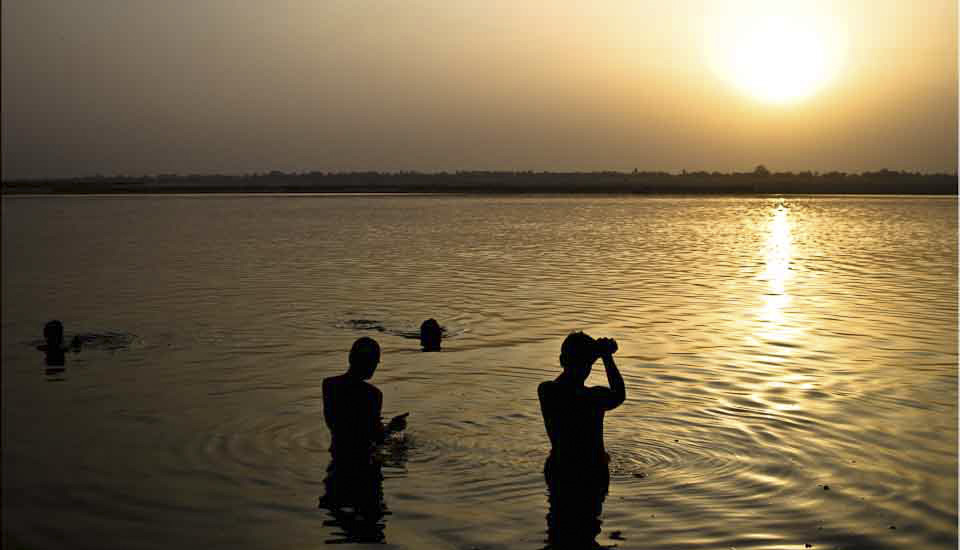
- Performing the Ganga Aarti from Dasaswamedh Ghat, Varanasi
- Buddha Head from Shwedagon Pagoda, Myanmar
- Harry Clarke Window from Dingle, Ireland
- Novice Monk Shwe Yan Pyay Monastery, Myanmar
Packets of 10 for $AU50.
Or - pick any photo from my Flickr or Wanders blog photos.

.jpg)
.jpg)
.jpg)

 It was a unique and enjoyable – albeit quiet – place to wander and lunch.














It was a very nice day out cruising on the water and visiting points of interest on the Spanish coast line. Highly recommend it