Ships that Pass … The locks on the Danube in Central Europe are an engineering marvel.
Charlemagne (c.742-814), the medieval emperor who ruled much of Western Europe from 768 to 814, dreamed of traversing the European continent, from the North Sea to the Black Sea by water. All that was needed, in theory, was a trench around 3,000 metres (9,843 ft) long, connecting the Rhine River and the Danube.
In the absence of pumps, his medieval engineers faced problems with incessant rain, poor soil, and the consequential riverbank slippage. Remnants of the ponds and dams – attesting to the skills of medieval water engineers – can be seen today near the village of Graben in Bavaria, but no one is sure if the 2-metre (6.57 ft) deep ditch, now referred to as Charlemagne’s“Fossa Carolina”, was ever completed.
Napoleon Bonaparte “Napoleon I” (1769-1821) also hoped to connect the Main and Danube rivers, but met his Waterloo before he could implement any plans. King Ludwig I of Bavaria (1786-1868), inspired by canals in France and England, built a system of 101 canal locks – the Ludwig-Danube-Main Canal – which operated from the mid-1800s until its damage during WW II and closure in 1950.
The current Rhine–Main–Danube Canal, connecting the Main and the Danube rivers across the European Watershed, was constructed – after a long and controversial planning process – from 1960 to 1992. It runs 172 kilometres (106.25 m) between Bamberg on the Main River and Kelheim on the Danube.
Almost 20 percent of the €250,000,000 overall cost of canal construction went to environmental protection projects. So, it’s not surprising that I found it hard to recognise when we were on the canal, or on the Danube itself. What I did notice was the locks: there are 16 locks on the canal – 13 of which are designed to conserve water – with an elevation rise of 175 metres (574 ft), and drop of 68 metres (223 ft). The Danube end of the canal is 107.3 metres (352 ft) higher than the Main end. There are a further 18 locks on the Danube itself, each a part of a hydro-electric dam generating power.
It is fascinating watching the whole lock-passage process. My husband and I were on one of the new boats that act as floating hotel rooms for tourists, travelling from Nuremberg (see: Altered views of History) to Budapest (see: Buda Castle Hill). With the exception of our cruise down the magnificent UNESCO-listed Wachau Valley (see: “Picturesque” Personified), much of our sailing happened over night, and we spent our days exploring charming cities and historical features (e.g.: Regensburg; Kelheim to Weltenburg; Passau; Melk; and Vienna).
So, when we were transiting some of the many locks in daylight, we got out onto the boat-decks to watch with interest.
On the Rhine-Main-Danube Canal As our canal-boat leaves Nuremburg, a lock comes into view.
Into the Lock The door to the lock is open as our vessel approaches: use of the locks is carefully scheduled, and we have our appointed time. It is a quiet day: there is no one on the viewing platform. (iPhone5)
In the Lock The locks are 12 metres (39.37 ft) wide, which limits the size of the boats on the waterways.
Wet Walls The walls of the lock are so close we could touch them as our boat rises on the filling waters.
On top of the Lock Once the waters reach their new level, the gate opens and we cruise through to the next section of canal. (iPhone5)
Scheitelhaltung – The Continental Divide Just before dinner time the same day, we passed the highest point on the Main-Danube Canal – 406 meters above sea level. The European Watershed or “Continental Divide” is marked by a concrete monument.
Passau Two days later, we have left the canal far behind. While our boat is docked in Passau, we climb the 200 steps of the Oberhausleiten-Stiege – the Upper House Stairs – and watch the traffic on the Danube below. The waterways are important goods-transport channels.
Statue of Bavarian Folk Poet Emerenz Meier (1874 – 1928), Danube River Tourism is becoming more economically important, and the countless canal boats docked on the Danube in Passau are a testament to this.
Altenwörth Lock The Danube can be far from “blue”. The next afternoon – after cruising through the picturesque Wachou Valley – we came back into the open on muddy-looking waters under an overcast sky. Downstream, the green light gave us the go-ahead at the approach to Altenwörth Lock, above Vienna.
Altenwörth Lock Altenwörth Lock is one of the many canal- and river-locks that have two chambers, allowing two boats to traverse at the same time. Our side of the lock is full of water already.
Altenwörth Lock Mechanism As we get closer to the gate, we have a view of the mechanics which allows the gates to open and close.
Altenwörth Lock Once we are fully inside the lock, the doors will shut behind us, the valve will be opened, and water will be drained from the chamber.
Altenwörth Lock Another boat comes in behind us on the approach channel.
Porthole in Ships that Pass … Heading into the lock, we are so close to the TUI Allegra that we can see into her portholes.
Reflections in the Radar From the bow of the boat, we can look into the bridge – and back at our own reflections.
Captain Peter As we wait for our final go-ahead, our ship’s captain shows us around the pilot house.
Captain Peter in the Pilot House There are plenty of bells and whistles, …
Controls in the Pilot House … knobs, handles and dials.
The Gates Open The water-tight lock chamber seems to close in around us as our boat lowers on the ebbing water. Once we are level with the downstream waters, the giant gates open.
Guiding the Boat out of the Lock Our radar is no use to us here! Once the doors are fully open, Captain Peter has no more time to chat. He monitors the vessel’s progress closely as we exit the narrow lock.
Captain Peter When we are clear of the lock doors and heading towards the open Danube, our captain relaxes.
Exiting the Lock Behind us, the TUI Allegra exits the Altenwörth Lock.
I loved the old European cities we visited, and the views of the villages and landscapes as we glided down the canal and river.
But, I also found traversing the locks a fascinating insight into the mechanisms of a busy, working waterway.
Enriching and relaxing at the same time, isn’t it, Mary. We loved it.ReplyCancel
Mary -July 17, 2019 - 12:01 am
Have just read your wonderful blog on locks. I did the Danube last year, and yes, why did I wait so long to do a river cruise. I must do another.ReplyCancel
Thanks for the nice pictoral view of the trip. We hope to take the Budapest-North Sea Donau/Main/Rhein tour in 2022 if/when COVID/variants are no longer an existential danger to all of the planet’s inhabitants.
Nice job indeed. I see now in the footings of this pate that you and I have planted footsteps on many of the same continents. I will read more later. I was only attracted initially to this blog because of this entry and our current registration for a “Viking Cruise”.ReplyCancel
Hi Douglas,
Thanks for your visit and kind words.
I don’t think you will be disappointed! I can’t praise Viking highly enough; even before Covid, their food service and hygiene standards were top-notch. The river cruises are a great way to get an overview of an area.
Cheers, UrsulaReplyCancel
Milne Bay Dancer Festivals of music and dance are a great means of expressing and sharing cultural traditions. Here, a proud dancer from Milne Bay Province is ready to perform at a special Alotau Cultural Day in Port Moresby.
How can one talk about “the people” or “the culture” of Papua New Guinea?
Papua New Guinea is one of the most culturally diverse nations in the world. Comprising the eastern half of the world’s second-largest island, it is home to hundreds of different ethnic groups and 852 known languages. And, who knows how many pockets of uncontacted peoples – with as yet unknown culture and languages – are still hidden in the interior jungles?
The coastal provinces of Oro and Milne Bay are home to people of Motu and Polynesian descent. In Milne Bay alone, the roughly 276,000 inhabitants speak about 48 different languages: mostly from the Eastern Malayo-Polynesian branch of the Austronesian language family. In other words, most of these various groups are distinct, but have similarities to one other.
What little I knew about the coastal people of Papua New Guinea and their customs before I arrived in the country, I learned from Drusilla Mojeska’s wonderful 2012 novel: The Mountain.
Giving the reader a feel for the country’s tumultuous background, much of this book takes place across the five years leading up to Papua New Guinea‘s declaration of self-governance in 1973 after years of Australian administration and British rule. Although the characters are fictional, the story and the settings are firmly grounded in history and the author’s experience of having lived in the country during that time.
It seemed to me, when I visited last year in August, that little had changed. The figurative road to democracy was still bumpy and fraught: results from the recently-held election were being fiercely (and sometimes, bloodily) contested. And the real roads outside the few urban centres continued to be predominantly unnavigable. The majority (over 85%) of people in the nation live a rural agrarian lifestyle outside the city.
A festival of music, dance and food is one way that groups can share their distinctive cultures with each other. On my second day in Port Moresby on a Jim Cline tour with photographer Karl Grobl and a small group of photo-enthusiasts, I was treated to the Alotau Cultural Day.
This was the first of several sing-sings – or annual get-togethers of a few tribes or villages – that I attended while I was in PNG, and in some ways it was the most genuine. For while this gathering of performers from the Milne Bay area was not as polished or flashy as others I later attended in the Sepic River and Mount Hagen regions, it was aimed at the “city-folk” in Port Moresby in general, rather than us tourists in particular. As such, it felt like a authentic attempt to share and communicate one’s culture, rather than just a pitch for the tourist dollar.
Because of the relatively informal nature of the day, I had the opportunity to speak with many of the dancers and other participants at the festival. Some of the people I talked to were university students, happy to chat about how important it was to them to keep the traditional practices alive, and to talk about how involvement in music and dance added meaning to their lives, and helped keep young people focused and out of trouble.
Join me on a dusty sporting ground in the heat of a tropicalsummer day and meet just a small sampling of Papua New Guinea’s many different peoples.
Tattooed Mother with Child Everywhere I went in Papua New Guinea, people were happy to make eye contact with me, smile, and implicitly allow me to make pictures.
Portrait: Male Dancer Around the sporting field, young musicians and dancers wait in their costumes and body paint for their turn to perform.
“Support Crew” Friends and family are in attendance to support the performers and to give them an audience. Tattoos – traditional and modern – are in evidence everywhere.
Dancers Meanwhile, with their drums and music as a backdrop, other groups take their turn on the “stage” – the stage being a grassy corner of the field.
Feathers and Leaves Performers’ costumes feature local natural materials: bird of paradise feathers, seeds, leaves and grasses.
Female Dancer Some groups also feature face paint in traditional, stylised patterns. In this troupe, the men and women’s faces are painted on opposite sides.
Children at the Stalls Children at the stalls that skirt the field wear colourful face paint in different traditionally-inspired designs.
Stall Holder Evidence of the effects of chewing the seeds of the Areca catechu palm tree – the ubiquitous betel nut – is in many of the smiles that greet me.
Skewers on the BBQ A lot of the food on offer around the the perimeters of the field looks beautifully healthy and fresh.
Motorcycle- or Motor-Dance Anyone who has spent any time in a developing country knows how important small two-stroke motors are. I couldn’t understand the voice-over on the PA system, so I’m not sure exactly what type of motor the young man was pulling the starting chain on – but I was impressed to see the traditional dance-forms being used to tell modern stories.
On the Outside There was a small entry fee to the grounds; clearly not everyone could pay it.
War Dance Every community has its own version of a war dance, and the various groups entered into these dances with gusto.
War Dance
Warrior in the Wings
Heads Together
Untangling the Seeds With their heads together, two young women try to disentangle their necklaces.
Faces in the Group
Man in a Feathered Headdress Feathers, bone, coral, shells, leaves and grasses are everywhere.
Young Girl The dancers start young!
Hair and Feathers As the hot sun climbs overhead, it bounces of curls …
Young Woman in Feathers … and feathers.
War Dance Another group of warriors in grass skirts and boar teeth …
Warrior … take to the “stage” with their spears.
Another Warrior The young men put a lot of energy into their threatening advances. Meanwhile, the young women behind have mouths full of betel.
All the people I spoke to were eager to invite me share their beautiful corner of the country. A couple of young men even told me where to find the birds of paradise: just follow the path around the bay, then turn left. The birds are right there!
Towards the end of my trip, I did enjoy a blissful couple of days in their native Milne Bay Province (see: Innocent Eyes and Head Hunters), and – even though I never found the birds – I can concur: it is a most beautiful place.
I hope these young people continue to maintain the best things from their rich traditions.
Oh Ursula, you never cease to amaze me. Thank you thank you for your most recent trip down memory lane, this lane and memory of PNG. I love your history lesson and narrative, and of course, the great pics too. you are truly an inspiration. Hope you and Gabe are well and having yet more fun and adventures. We are good here in Florida and soon off on our 3-month Utah adventure. Hugs and thanks, JanReplyCancel
Hi Jan,
Many thanks for your lovely comments! We are road-tripping a lot at the moment, but off on a European adventure soooooon …
Have a wonderful time in Utah – Love to you both! xReplyCancel
[…] main locations: Port Moresby (see: A Slice of Life and Life on the Edge); Milne Bay (see: Portraits from the Dance and Innocent Eyes and Head Hunters); the Middle Sepik (see: Ursula’s Weekly Wanders Sepik […]ReplyCancel
andrew -February 9, 2026 - 9:37 am
Do you have a mobile or whatsapp we can contact you.ReplyCancel
Women in the Window Four women laugh together as they watch our passing along the road below.
The smiles from the windows and doorways along the trekking trail between Panauti and Namo Buddha in Nepal’s Kathmandu Valley, are as warm as the bright sun overhead.
I was walking with a friend and local guide Angfula Sherpa (our porter had long since left us behind!) towards the sacred pilgrimage site of Namo Buddha, where we were to stay overnight at the Thrangu Tashi Yangtse Monastery.
We had spent the morning – after driving from Lazimpat – sampling food and chatting to people (see: Dirt Music and Sunshine). We weren’t moving very fast: every step was a visual feast, so we were stopping and taking copious pictures – and pretending that these stops were not an excuse to rest our ageing lungs and aching joints!
Contrasts of light and dark shimmered all around us, as the sun angled into the narrow lanes of the tiny hamlets and bounced off the brickwork, highlighting the resilience of the people and the rough edges of the damage from the 2015 earthquake.
Join me as we slowly make our way up the hills out of the Kathmandu Valley:
Corn Drying and Cracks in the Mortar Following the devastating earthquake in 2015, life goes on: corn for seed and animal feed is stacked in windows and attic spaces to dry in preparation for the long winter. Everywhere we walk, we see reminders of buildings that have come down completely, and neighbouring buildings that have suffered very little.
Cat on a Stoop
Light and Shade A “shopkeeper” sets up his goods in a shady corner on a dusty street.
Doing Laundry In another corner, a woman does her laundry.
A Man and his Dog
Shrine in the Fields The textured, terraced fields are punctuated with small shrines.
Minding the Baby Everywhere, the windows and door-frames are graced by locals.
Yoga Master in the Window As we walk down the narrow dusty street, a man leans out of a window overhead; a sign on the shaded building advertises yoga. Much as we’d have loved to have joined him, we still had a long way to walk before our final stop for the day.
Women in the Road Two women stand chatting in a patch of light at the end of the village.
Newari Woman One of them pauses to have her picture taken in the bright sunlight before she heads back up to her home – high on the hill above the village we have just passed through.
Dusty Tracks As we head out of the little hamlet, the road once again reduces to a dusty track …
Mustard Fields … rising through the terraces of blooming mustard plants. Farmers here alternate their crops of potato, mustard, and seasonal vegetables to use their limited agricultural land to the absolute maximum.
Minding the Grandchild At the top of one rise, we come across an elderly man looking after his grandchild.
Dusty Street Less than twenty minutes later, we are entering another row of homes …
Corn Drying … with more corn hung out to dry.
Making Momos A little further along the way, we came across a “restaurant”: a dark hut with rickety benches outside. Inside – in the gloom – a husband and wife team were making over-sized momos, or Nepali-Tibetan-style dumplings.
Dumpling Maker The man engages in an earnest conversation with our guide.
Pots I absolutely love momos! So naturally, we had to wait for a fresh batch to be steamed, …
Steaming Dumplings … dished up, …
The Momos are Ready! … and served with a rich, spicy sauce. Just delicious! Fortified, we continue on our way.
Woman in a Window
Laundry
Houses on the Hillside The terraced hills rise around us …
Flags on the Hill … as we climb up to our first collection of Buddhist prayer flags.
Signs of Spring
A Heavy Load I marvel as I watch petite women with overwhelming loads walk up the steep hill, …
Heavy Loads … overtaking us easily.
Rhododendron We are thrilled to see Nepal’s national flower: Lali Gurans, or Red Rhododendron, blooming in the tall forest over our heads.
Thrangu Tashi Yangtse Monastery Finally! We get our first sighting of the monastery – which we will explore more fully in the morning.
View from my Room This evening, I will bed down on a simple bed with this marvellous view back down the hillside. What a treat!
After finding our simple rooms in the Thrangu Tashi Yangtse Monastery Guesthouse, and taking quick, well-earned showers, we joined the monks and novices in evening prayers, and ate a simple meal of dahl and sticky buns.
It was a perfect ending to my first glorious day of walking in the clean, Nepali mountain air.
Rocking the Blues in the Fresh Air This is the music of my youth: it would be at home in a dark, smoky bar. But we are all older and wiser now, and can enjoy our festival sounds in the crisp fresh air of Thredbo, in Australia’s Snowy Mountains. The Sydney-based Finn Blues Band centres around drummer, singer, and song-writer Jim Finn, and has been performing internationally since 1999. Looking at the members, I have a feeling they had ‘other lives’ before becoming rocking-blues stars!
“Music washes away from the soul the dust of everyday life.”
~Berthold Auerbach
I count my many blessings daily –
But, some days are still harder than others.
I always experience post-holiday (Christmas-New Year-Birthday) blues: a greater-than-usual melancholy that is at least in part the consequence of too much food and alcohol and too many late nights.
This was more the case than ever this year. My husband and I had a wonderful – but exhausting – holiday season hosting children and grand-children, and then, before they had all even left to return to their respective homes, he went into hospital for a major operation, and stayed for ten days. The hospital was quite a distance, so I “lived” in a hotel room for the duration. We finally returned, injured and enervated, in mid-January to our home and our Christmas decorations, which were looking forlorn and out of place in the record-breaking heat-wave that was washing over Australia.
Under the circumstances, we very nearly forfeited our pre-paid Thredbo Bluesfest tickets.
I’m so glad we didn’t!
We might have both been exhausted, but after a mere three days on the coast, we packed a bag, crawled back into the car, and drove into the mountains. There, thanks to a weekend of good food and great music, we started smiling again.
Roshani Thredbo Bluesfest utilises many of the restaurants and bars in the tiny village as venues. This presents unique challenges for the the performers – and the audience – as the venues are not all particularly well-configured for sound. Lighting is also extremely challenging – with over-lit walls and under-lit performers. Sri Lankan-born Australian-raised singer-musician-songwriter Roshanimet the challenge, and kept us well entertained over dinner.
Steel Guitar
Guitarist Tim
Roshani and Tim Partners in music – and in life – Roshani and Tim check sound levels before moving on to the next song.
Roshani Billed as “a harmonica wielding songstress”, Roshani grew up immersed in music.
Roshani’s Smile The multi-talented Roshani was an X-Factor participant and a finalist in the International Songwriting Competition. She also has a killer smile.
Lachy Doley We didn’t stay for all the late-night bands, but we did manage to enjoy Hammond Organ and Whammy Clavinet maestro, Lachlan Doley, as he put his modified Hohner Clavinet through its paces.
Lachy Doley Dubbed the Jimi Hendrix of the Hammond Organ, Lachy has released his own albums and played with some of the country’s greats.
Mary Jane Guiney We started our next day with fresh air, sunshine, and Irish-born, Sydney-based, New Orleans-rooted singer-songwriter Mary Jane Guiney.
Rory Ellis with Andrew Toner We rode to the top of the Kosciuszko Express Chairlift to have lunch at Eagle’s Nest Restaurant where one of our favourites, Rory Ellis, was performing. We enjoyed him at Thredbo Bluesfest several years ago (see: Cool Blues, Hot Jazz) and were thrilled when we heard he was back – and especially excited when he replayed one of my favourites: The Woodstore. It is so melancholy in live performance: I cry every time! The recording is less poignant, so I’ve uploaded a title track instead: Twisted Willow.
(Double click for: Twisted Willow by Rory Ellis)
Andrew Toner Guitarist Andrew Toner has great skills – frontwards and backwards.
Jim Finn This is the blues-rock I grew up on! Even Jim’s original tracks felt like old friends.
Michael Vdelli More of the music of my youth: VdelliROCKED!
Sound Mixing Of course, the performers don’t do it alone.
Michael Vdelli – Guitar
Michael Vdelli – Voice
Hussy Hicks Killer combo! We saw Hussy Hicks at Byron Bluesfest in 2016 (Back to the Roots) – not once, but twice! They were as good as I remembered.
Tracy Bassy It’s the quiet achievers in the background that let the stars shine.
Mike Elrington We shared our dinner with Mike Elrington; …
Mike Elrington … he was fantastic – …
Abstract (Mike Elrington) … – but the acoustics weren’t! Between the people talking behind me and the bounce off the walls, I had to go outside, where both the view and the temperature were cooler.
Mike Elrington Mike is a wild man on the guitar – …
Mike Elrington from the Outside … and on the tables!
Miss Whiskey Sunday morning saw us back at House of Ullr, on the lawn, with Miss Whiskey, a Melbourne duo …
Miss Whiskey … who represented the city in 2016 in Memphis, Tennessee at the International Blues Challenge.
Tats and Hats
Marji Curran Band
Sound Mixing for Blues Preachers
Dancing Feet
“Did I Hear you Say you Love Me?” Back poolside, we found the keyboard and vocal stylings of the Soul Roots Revival Band.
Kerrie Sweeney with Jim Finn We finished as we started: with the Finn Blues Band, this time with vocalist Kerrie Sweeney helping them out, and rounding out our long weekend.
It was a lovely time out, a temporary refuge from everyday realities.
“Music was my refuge. I could crawl into the space between the notes and curl my back to loneliness.”
“Zebra Crossing” Sorry! I couldn’t avoid the obvious pun. 😉
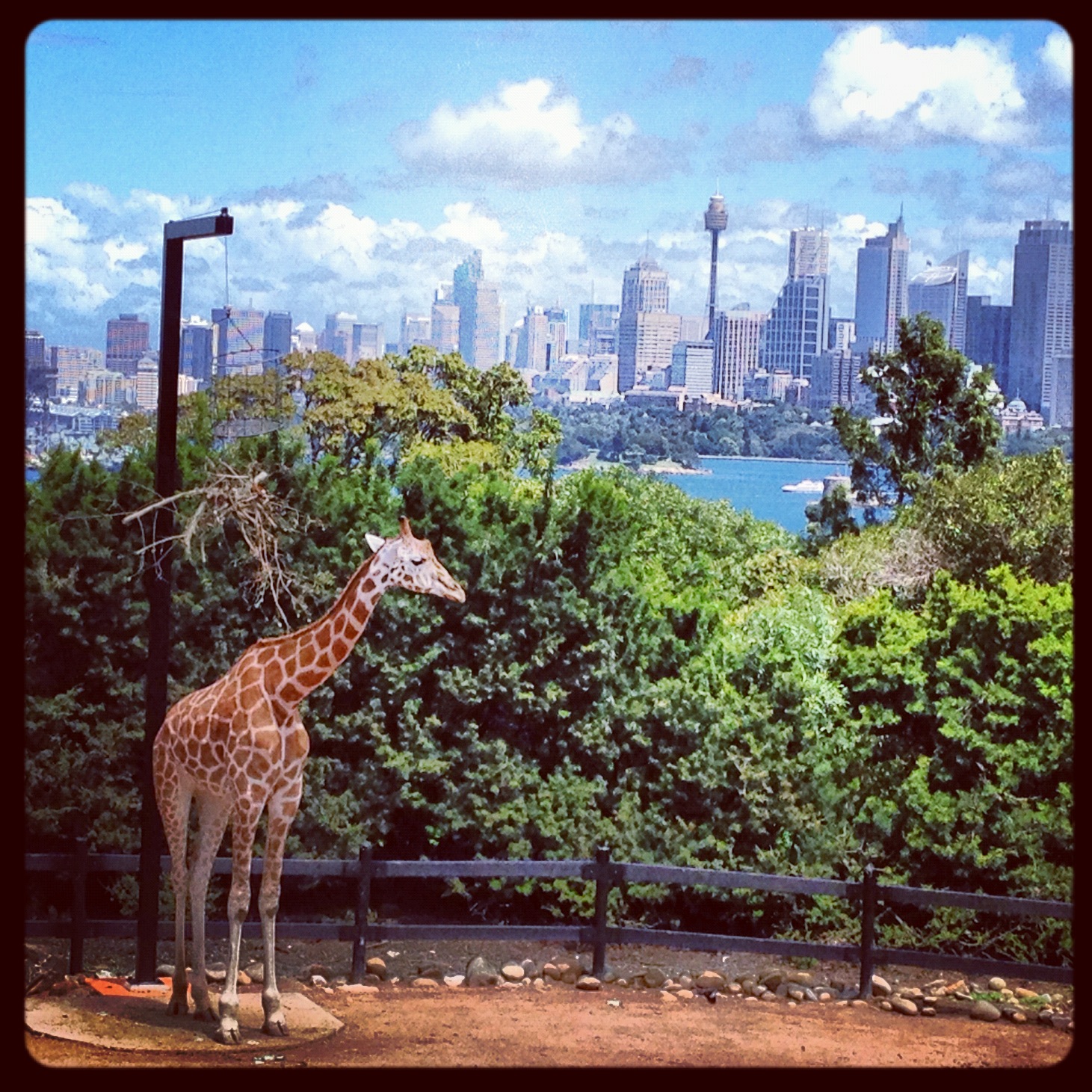
There is an irony in being able to see animals better in the wild than you can at a zoo.
My husband and I had grandchildren visiting over the Christmas break, so we took the opportunity to spend a day at Sydney’s beautiful Taronga Zoo. Now, I love this particular zoo (see: A Tale of Two Tarongas): you get plenty of exercise walking up and down its hilly terrain and the views over Sydney Harbour are magnificent. But, the animals can be a bit shy. As we walked around, trying to spot the zebras and lions, I couldn’t help but remember the wonderful days I spent in Etosha National Park in Namibia (see: Birds and Beasts; At the Waterhole; and Elephant Waltz).
Wildlife watching in Etosha is almost cheating, the animals are so prolific. From the minute we rode out in our pop-top trucks, we would catch sight of beasts on the veld, or around the various waterholes, or in the scrub, or even crossing the roads in front of us. We camped on the eastern side of this huge national park, near the King Nehale Waterhole, and all manner of animals literally came to us. I found it all so exciting I could hardly sleep at night – well, excitement, plus the yelping of jackals in the tent next door, as they fought over jerky some unwise person had left behind, and the vibrating roar of the male lions in the distance …
As yet I’d only heard those lions, but as we drove out of camp before the sun was up on our third day in the park, the guides were buzzing: Lions had been seen!
They – and all the other animals Etosha has to offer – were magnificent!
View from the Truck Mornings are early on photo tours: it was six thirty, and we were already in the truck looking for game.
“Ostrich Crossing” It is not long before a wild animal crosses our path – quite literally!
Lion Hiding Lions don’t seem so well disguised in a zoo, even when they manage to hide. But, in Namibia, the morning sun bounces off the young male’s mane in exactly the same way as it bounces off the leaves on the almost-bare trees.
Three Young Male Lions Lions are the most social of the wild cats. Male lions are expelled from their maternal pride around age two or three, when they reach maturity. These three are probably siblings or cousins who have grouped together for companionship and to improve their ability to hunt.
Young Male Lion The lion’s mane starts growing when he is about one year old, and darkens with age. This male looks to be the eldest of the trio, and wears battle scars on his back.
The Male Gaze As I aim my camera from the open roof of our jeep, I feel like one of the males is making direct eye contact: it is a breathtaking moment.
Sun in the Lion’s Mane In mythology, lions are associated with the sun: because of their strength, their golden-brown colour, and the male’s ray-like mane.
Lion on the Road These magnificent creatures are kings of the park! They stride across the road knowing full well that they are at no risk.
Red Hartebeest at a Waterhole The morning sun casts these African antelopes in the same shades as the scrub behind them.
Male Kudu The striped pelts of the kudu help keep them camouflaged in the scrub, but with their long, magnificent twisting horns, the solitary males stand out at the waterhole.
Waterhole Tableau
Black-Faced Impala – Aepyceros Melampus Petersi
Lines and Curves I grew up thinking zebras were black and white, but the Burchell’s zebras, which are the most numerous in Namibia, feature brown shading between their black stripes. The stripping makes them less visible to predators, especially in the half-light of dawn and twilight, and protects them from tsetse flies, which apparently don’t like contrasting colours.
Here’s Looking at You! Zebras might be one of the most common animals in Africa, but they are also one of my favourites. With their strong, stocky equine bodies, zebras are compact beasts. Did you spot the male kudu in the scrub behind them?
Zebra Portrait I love their punky manes and quizzical expressions. Despite their obvious appeal, zebras have resisted domestication – unlike their closest relatives, horses and donkeys.
Kudu Crossing A group of kudus stop us in our tracks; young ones first, a large male in the middle, and the smaller adult female bringing up the rear.
“Look Both Ways!”
Zebra on the Verge
Warthogs The common warthog (Phacochoerus africanus) is hardly the best-looking of creatures, but at least we can say we have seen them! They’ve seen us too, and run away with their tails in the air.
Springboks Later in the morning, at another waterhole, we find another of my favourites: dainty springboks (Antidorcas marsupialis).
Elephants A group of elephants bathes and splashes in a nearby pond. I could watch these beautiful creatures forever!
Elephants In the heat of the late morning, we watch as a mother and calf slosh away through the mud …
Elephants Wallowing … and others stay behind to wade, splash and play in the water.
An “Implausibility of Gnus” Wildebeests (Connochaetes) are, as James Lipton suggested when he coined the phrase an “implausibility of gnus” in 1968, truly implausible beasts! I can’t look at their big shaggy heads and skinny legs without smiling – and humming the chorus of Flanders and Swann’s comical song, “I’m a g-gnu, spelled g-n-u. You really ought to k-know w-who’s w-who!”
“Confusion of Wildebeests” Of course, a “confusion” is just as apt a collective – even when it is not migration season!
Giraffe As we leave the waterhole in search of our own lunch, a giraffe watches us go.
I hardly needed food: I was so full of the morning’s experience: so many different animals – in plain sight, in spite of their attempts at camouflage!
But, we were going back in search of lions after lunch – so I ate. 😉 And out we went …
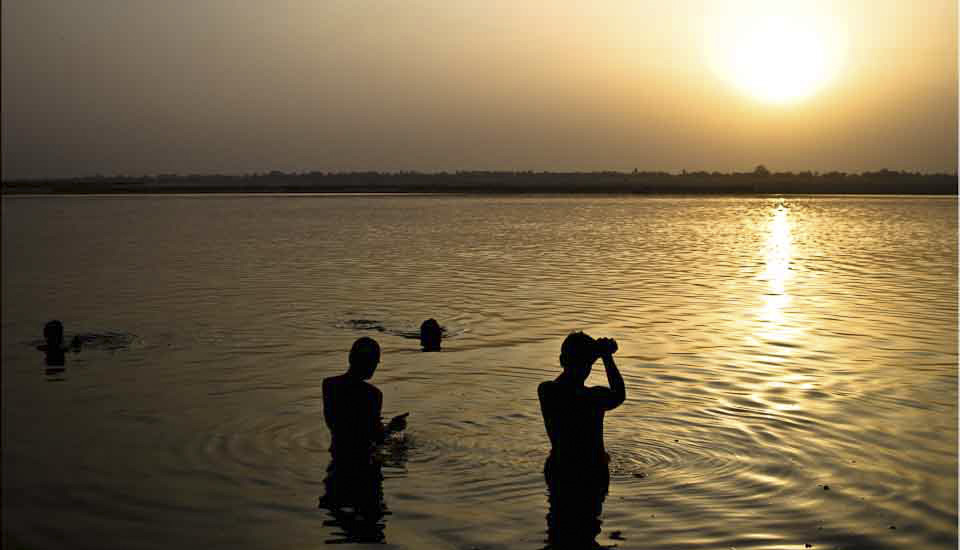
- Performing the Ganga Aarti from Dasaswamedh Ghat, Varanasi
- Buddha Head from Shwedagon Pagoda, Myanmar
- Harry Clarke Window from Dingle, Ireland
- Novice Monk Shwe Yan Pyay Monastery, Myanmar
Packets of 10 for $AU50.
Or - pick any photo from my Flickr or Wanders blog photos.

.jpg)
.jpg)
.jpg)

 But, I also found traversing the locks a fascinating insight into the mechanisms of a busy, working waterway.







 It was a perfect ending to my first glorious day of walking in the clean, Nepali mountain air.



A river cruise that should be on everyone’s bucket list.
It was certainly a wonderful experience! 😀
I have just completed my first river cruise. Why did I wait so long to experience an awesome holiday. Mary 16th July 2018
Enriching and relaxing at the same time, isn’t it, Mary. We loved it.
Have just read your wonderful blog on locks. I did the Danube last year, and yes, why did I wait so long to do a river cruise. I must do another.
Me too! 😀
Thanks for the nice pictoral view of the trip. We hope to take the Budapest-North Sea Donau/Main/Rhein tour in 2022 if/when COVID/variants are no longer an existential danger to all of the planet’s inhabitants.
Nice job indeed. I see now in the footings of this pate that you and I have planted footsteps on many of the same continents. I will read more later. I was only attracted initially to this blog because of this entry and our current registration for a “Viking Cruise”.
Hi Douglas,
Thanks for your visit and kind words.
I don’t think you will be disappointed! I can’t praise Viking highly enough; even before Covid, their food service and hygiene standards were top-notch. The river cruises are a great way to get an overview of an area.
Cheers, Ursula