Spirit House What could be more Thai? A garlanded spirit house sits in an auspicious corner of a Bang Khun Thien seafood restaurant overlooking the Bay of Thailand.
As cosmopolitan a city as Bangkok is, there are still spaces where one feels as though one has been transported into the distant past.
The old community of Bang Khun Thian – established around 1867 – is one of the 50 districts (เขต – khed) that the huge and sprawling city is divided into. Tucked into the five kilometre strip between the Chao Phraya River to the east and the Tha Chin River to the west, it is criss-crossed by canals and boasts Bangkok’s only seashore. This is not an area of sandy beaches however: the district’s five-kilometre coastline along the Bay of Thailand is the muddy home to mangrove forests and shrimp farms.
The region was first settled by Mon people from the Irrawaddy basin in Myanmar in the 16th century and Khmers from Cambodia some time before the mid-1700s, followed by Chinese immigrants after 1810. Rice, fruit and poultry agriculture, and shrimp aquaculture, have always been the mainstays.
Today, the Bang Khun Thien Museum – situated in the grounds of a local school – gives school groups and other visitors an insight into the economic and ecological significance of the region, with an emphasis on the vital importance that mangroves play in protecting the environment.
It was many years ago that I was there: on a day-trip out of Bangkok with an expat-women’s group. Like other visitors, we were there to relax along the khlongs (คลอง) and waterways, to learn about the mangroves and to enjoy lunch. Food is always central to any excursion in Thailand, and Bang Khun Thian is known for it’s seafood restaurants.
Looking back – way back – at my photos from that tour in order to process them, I can’t help but be disappointed in the lack of quality in many of them. But, I loved the area, and I found a few I’m willing to share.
Enjoy!
Schoolgirl in a Recycle Hat In Thailand, hats made out of sheets of aluminium used to make beer cans, or cardboard for packaging, are actually a “thing”.
School Children Making Hats The children at Klong Phitayalongkorn School craft these hats and other products for sale to visitors.
Shy Smile As is the case everywhere in rural Thailand (even when “rural’ is part of the city), the children are sweet, and polite to their elders.
Schoolgirls The small Bang Khun Thien Museum is in the Klong Phitayalongkorn School grounds. The children are happy to show us around.
Hammock It is hard to believe that bustling, chaotic Bangkok is just a short boat-ride away!
Into the Mangroves Walkways lead us …
School Boy …and visiting school groups on excursions …
School Girl … out over the mangrove swamp …
Pergolas in the Mangroves … to the huts on stilts along the boardwalk that act as outdoor classrooms and house explanatory displays about life in the mangroves.
Fiddler Crab – Chiromanthes Eumolpe The displays are simple – and in Thai.
Mudskipper I first knew this creature by its Thai name of “foot-fish”. Mudskippers are amphibious fish which contribute to the complex mangrove ecology.
Tour Boat Just outside the museum/school area, simple wooden boats wait to take visitors on tours of the rivers, klongs, and the Bay of Thailand – and to transport them to the seafood restaurants.
Hazel in the Light Hazel, the trip organiser, gives the group a brief rundown about the area …
Our Boatman … while our boat operator keeps a careful lookout for traffic and obstacles.
Boat on the River The rivers and canals are the lifeblood of the community. Like many Thai who work outdoors, these fishermen wear full skin-covering clothing.
House on the River The houses along waterways are simple bamboo structures on stilts to protect against tides and flooding.
Boundary Marker A concrete pillar in the bay designates the boundary between Bangkok and Samut Prakan provinces.
Shellfish Farm Aquafarmers drive stakes into the seabed and seed them with clams. The clams cling to these stakes and grow until they are picked off at harvest.
Seafood Restaurant Built on pylons over the waterways, the Bangkok Seaview Restaurant is only accessible by boat.
Cook in the Kitchen Seafood and produce fresh from the local farms is all prepared on the premises by smiling staff.
Javan Pond Heron – Ardeola Speciosa Fish-loving birds hang around the restaurant, hoping for scraps.
Restaurant Walkway After a fresh, tasty lunch, we work our way back along the extensive walkway …
Reloading the Boats … to get back into our boat.
Bamboo and Grass Buildings Motoring through the waterways …
Concrete Pylons … gives us a glimpse into a different world.
Egret in the Mangroves
Feel the Splash! Over sections of the route, our boat can pick up speed, …
Bridge over an Intersection … but in many places, a no-wake rule applies.
Man and Girl Child People come out of their houses to watch us pass by.
It was a wonderful day out!
Maybe one day I’ll get back to these waters – I’m pretty sure the area won’t have changed much.
Intimacy The blocky figures in the Vigeland installation in Frogner Park, Oslo, have a commanding immediacy.
When I think of Oslo, Norway, I think of sculpture: sculptured spaces and sculptured figures and objects. I had seen pictures of the famous Vigeland installation of Frogner Park, Oslo in an inflight magazine years ago, and this had coloured my expectations before my visit to the city in May.
I didn’t arrive under the best of circumstances: my husband – who was meant to be travelling with me – had been called back to Australia prematurely, and my phone had died. I’m used to travelling alone – and often have no phone or internet coverage, but still …
A friend laughed at me when she heard I was without my phone, but these days it is my lifeline – especially when I’m on the road: it is my map, my walking guide, and my direction finder; it is my appointment book, my diary and my alarm clock; it is my address book and my mini-camera. I use it to work out exchange rates and to translate problematic language. It keeps me connected to people at home and around the world, and allows me to book the next accommodation.
So, I was adrift in a strange city.
Fortunately, the people of Oslo were helpful and accommodating, and most of them spoke good English. The desk clerk at the budget hotel where I was staying was more than happy to look up the closest Apple store and mark it out on a paper map. With this map in hand and my cameras in tow, I set off across the inner city to said shop, only to be redirected back across town to a repair centre that no-one in the vicinity had heard of! When I finally found it, took a number, and came to my turn at the desk, they agreed with me: the phone would not charge. Very insightful. I was told they had no replacement batteries in stock.
I gave up, and decided to walk across town again: this time to Frogner Park and it’s renowned Vigeland sculptures. Along the way, I found many other sculptures dotted along my route.
Even more exciting, though: I accidentally found a generic battery shop! After 15 minutes and the exchange of a small amount of Norwegiankrone, my phone had a new battery and I was back on the grid.
It was with a much lighter heart that I finished my day, enjoying some of Oslo’s unique public art.
“Smart Room” Talk about a sculpted space! My room was barely larger than a walk-in wardrobe, but managed to contain all the basic necessities. (ISO 3200 16mm f/6.3 1/60 sec)
Slottsparken – The Palace Park Oslo is dotted with green spaces. Kindergarten children in their hi-vis vests explore one of the ponds in the architecturally-designed Palace Park. Sprinkled with tall, wintery trees, the park is ringed by elegant old multi-story buildings.
Oslo Rooftops and Flags Like many other of the old buildings around central Oslo, the Grand Hotel at Karl Johans Gate has an intriguing roofline.
Crocus Signs of spring are at my feet. (iPhone6)
Norwegian Parliament Building Built between 1860 and 1866 the Stortingsbygningen – the Norwegian Parliament Building – was designed by the Swede Emil Victor Langlet in a variety of styles influenced by French and Italian architecture.
Christian Michelsen In front of the Norwegian Parliament Building, there is an dignified bust by the Danish-Norwegian artist Per Palle Storm of Christian Michelsen (1857 – 1925), first prime minister – from 1905 to 1907 – of the newly independent Norway.
King Christian Frederik The statue of King Christian Frederik (1786-1848) by Kristian Blystad is a relatively modern (May 2014) addition to the park in front of the parliament buildings.
King Haakon VII Standing tall at the top of a staircase in June Seventh Square is a stylised statue by Nils Aas of the once-exiled King Haakon VII (1872 – 1957), first king of independent Norway.
Henrik Ibsen Statue Outside the Ibsen Museum, a charming likeness of the playwright Henrik Ibsen (1828 – 1906) perches on a high stool. One story I heard/read was that he and his wife were both very short. He told the local children that they were trolls – who feature prominently in Nordic myths and Ibsen’s plays – so that the children would leave them alone.
Birch Tree Bark The boulevard leading through Frogner Park to the Vigeland sculptures is lined with birch trees with their beautiful, textured bark.
Gustav Vigeland A statue of Gustav Vigeland (1869 – 1943), revered Norwegian sculptor, creator of the Vigeland installation, and designer of the Nobel Peace Prize medal, stands outside a coffee shop in Frogner Park. This sculpture of himself is the only one in the park with clothing: he wanted all his forms to be timeless, whereas he was vey much a part of the era in which he lived.
Mother and Child The cycle of life, from the cradle to the grave, is a common theme among Vigeland’s works. With more than 200 depictions of people engaged in everyday activities, the Vigeland installation is the world’s largest sculpture park with works by a single artist.
People on the Bridge A 100 metre- (328 ft) long, 15 metre- (49 ft) wide bridge leads into the sculpture park. It features 58 bronze models of people of all ages.
The Ring With the circle of life as a central them, wheels feature repeatedly. Vigeland was in charge of the design and layout of the whole installation area – which was completed between 1939 and 1949.
Young Woman Dancing Although the statue of the angry baby is reputedly the most popular, this one one of a young woman dancing on the bridge is my favourite.
The Fountain Surrounded by 20 bronze tree clumps with people of all ages woven through them, this fountain was originally commissioned for the square in front of the Parliament.
Bodies in the Fountain The fountain features six giants supporting a large basin of cascading water.
Up to the Monolith High up the steps to the Monolith plateau ….
Gate to the Monolith … and through one of the eight wrought iron gates (designed between 1933 and 1937 and installed in 1943 after Vigeland died) …
The Monolith … sits the park’s central feature: The Monolith, towering 14.12 metres (46.32 ft) into the sky.
The Monolith – Detail As the name implies, this massive column of 121 human figures was carved from a single piece of granite.
The Men There are 36 granite sculptures on the Monolith plateau – each telling a story about human relationships.
A Man and his Phone Frogner Park attracts between 1 and 2 million visitors every year, making it the most popular tourist attraction in Norway.
While I was researching the names of some of the statues I came across, I discovered several websites devoted to the city’s quirky artworks, illustrating how many more there are that I didn’t see around the city. One blogger (Alisa Kennedy) visited the Vigeland sculptures in winter, and produced images with a very different feel to those that I experienced.
It makes me want to go back and revisit this extraordinary place!
Afro Celt Sound System It doesn’t get much more international than this! Guinean musician N’Faly Kouyate, British Indian dhol drummer Johnny Kalsi and Armagh- (Northern Ireland) born flautist Ríoghnach Connolly perform on stage with Afro Celt Sound System at this year’s Bluesfest Byron Bay.
(Double click for: Afro Celtic Sound System – Big Cat )
Perhaps it was my imagination – or maybe it was just the nature of the groups that I happened upon from the full smorgasbord available – but it seemed to me that there were even more unusual and interesting international musicians on offer than ever.
Come and meet some of the international artists from the stages of Bluesfest Byron Bay 2018:
Juanes As we waited for the next performer in the Crossroads tent, I realised we were surrounded by people who were not speaking English. “How do you pronounce this?” I asked a neighbour, pointing to the next name in my program. “You-an-ez,” said the gorgeous young man with dark brown eyes. “He is from Colombia! He is a Spanish-singing superstar!” (30March2018)
Juanes Born Juan Estebán Aristizábal Vásquez, but known professionally as Juanes, this guitarist, singer, songwriter, and activist is considered (alongside Shakira) to be one of Colombia’s biggest musical names.
Juanes Who knew there were so many people familiar with Spanish-pop-music in Byron Bay? The audience was in raptures.
Ásgeir We were clearly in the international tent! The accents around us changed and we were soon surrounded by blond heads. Ásgeir Trausti Einarsson is a rising star in Iceland, …
Ásgeir … performing his sweetly-voiced poetic songs in Icelandic and English. (30March2018)
Youssou N’Dour On what was becoming a culturally rich afternoon, we changed continents again, and were treated to energetic and passionate Senegalese singer, songwriter, composer, occasional actor, businessman, and politician Youssou N’Dour.(30March2018)
Youssou N’Dour N’Dour is known for introducing international audiences to mbalax – a Senegalese popular music form that blends local traditions with Cuban and other Latin American popular styles – and for his incredible vocal range.
Youssou N’Dour N’Dour and his band were joined on stage by the most amazing dancer/acrobat …
Drummer with Youssou N’Dour … and a player of the the tama (talking drum), all of which made the set even more infectious.
Jimmy Cliff Grammy Award Winner and Rock and Roll Hall of Fame InducteeJimmy Cliff lays down some reggae rhythms. (30March2018)
Jimmy Cliff With almost 50 years on the world stage, this Jamaican master of ska and reggae has had a number of hits on mainstream pop charts. It was impossible not to sing along.
Jimmy Cliff He and his musicians were just as fresh and infectious when we saw part of their set on the festival’s last day. (02April2018)
Sound Mixing for Ryan McMullen Early afternoon on day three, I could appreciate some of the technical people who help the tents fill with glorious sound.
Ryan McMullen The sweet vocals and beautifully crafted songs of young Irish performer Ryan McMullen soared over our heads.
Harry Manx and Jeff Lang I could listen to Harry Manx’sIndian-folk inspired slide-guitar blues and husky vocals forever! Because I first saw Manx at The Basement in Sydney many years ago, I didn’t realise he actually lives in Canada. Backed on the Bluesfest stage by Jeff Lang, one of Australia’s premier guitarists, Manx has studied and performed music extensively in Japan and India.
Afro Celt Sound System Guinean N’Faly Kouyate, Celtic Robbie Harris and British Sikh Johnny Kalsi blend percussion instruments from three continents into high-energy, joyful music that you can’t help but dance to: Afro Celt Sound System were one of my festival highlights.
Robbie Harris on Bodhrán
Afro Celt Sound System The artists in Afro Celt Sound System are multi-instrumantalists. Here we have Robbie Harris on bodhrán, producer Simon Emmerson on guitar and N’Faly Kouyate on kora.
Ríoghnach Connolly Add Ríoghnach Connolly on flute and you have pure magic.
Seu Jorge Brazilian musician, singer/songwriter and actor Seu Jorge looked small on stage, alone with his guitar as he performed his acoustic renditions of David Bowie classics in Portuguese for an enthralled audience.
Seu Jorge Many of the audience were also wearing red hats in tribute to Pelé dos Santos, the fictional character Jorge played in the Wes Anderson film The Life Aquatic.
Rag ‘n’ Bone Man With his deep, bass-baritone voice and his urban hip-hop beats and funky lyrics, London-based Rory Charles Graham – better known as Rag’n’Bone Man – is a musical force to be reckoned with.
The Wailers The Wailers and their Jamaican reggae sounds are always popular at Bluesfest.
Bali Blues Brothers Just more proof that they play blues all over the world: in their traditional Balineseudeng head-dresses and sarongs, these young men from Bali, Indonesia …
Bali Blues Brothers … gave a credible performance of classic blues numbers.
I’m never sure which I enjoy most: the range of musical styles on offer, or a return to timeless blues classics.
Either way, the performers are world class, and the music is wonderful.
Crocodile Men With their unique clan scarification running down their backs (and fronts) into their trousers, the crocodile men of the Middle Sepik in Papua New Guinea can often be found inside the spirit house: carving, drumming, telling stories; or just sitting chatting and smoking or chewing betel nut.
What is “culture”?
That was the question for our first assigned essay in “Culture Myth and Symbolism”, an upper-level anthropology course I took at university, many, many years ago. Deceptively simple, the “answer” – if there is one – became increasingly layered and complex the more I delved into tomes written by the notable ‘modern’ anthropologists of the 20th century. As the course outline puts it:
It is one thing to witness the artefacts of culture; quite another thing to understand them. Another essay I researched at the time was about body art and adornment: because clothing, makeup, tattooing, scarification, and even posture, can tell us something about the culture we embody.
Memories of this course – one of my favourites during my university days – came back to me when I was in Papua New Guinea last year. This was especially true in the Middle Sepik region, where initiated men in the Crocodile Clanembody the crocodile: their totem and symbol of strength and power. They believe that humans are the offspring of migrating ancestral crocodiles; their initiation ceremony (for males only!) takes boys and moves them through androgyny and into manhood – albeit with a crocodile spirit.
Men of the crocodile clan are heavily scarified to look like the reptiles they epitomise. Circles of scar tissue surrounding their nipples mimic crocodile eyes; nostrils are carved near the abdomen. Their backs are scarred in the form of the powerful animal’s rear legs and tail.
American anthropologist Nancy Sullivan, who lived and worked in Papua New Guinea for many years, was present during a crocodile-clan initiation ceremony. The young men were taken, under the protection of their mothers’ brothers, to the haus tambaran (spirit house), where hundreds of cuts were incised: symbolically bleeding out their mothers’ postpartum blood to make them ‘men’ of their father’s lineage. Tigaso tree oil and clay were applied to the open wounds. Then the boys lay down by a smoky fire to infect the wounds so that keloid scar tissue was produced. During the whole process, flutes and hour-glass shaped kundu drums played to ‘confuse the women’.
Other sources talk about the two months that the young men are sequestered in the spirit houses, learning their clan genealogies, the significance of every clan song and ceremony, and the origins and spiritual purpose of every image or object in the haus tambaran. (For a much more detailed – and somewhat graphic – account of the whole process, have a look at the fascinating article by ‘tattoo anthropologist’ Lars Krutak.)
I was in the village of Kanganaman in the Middle Sepik with photographer Karl Grobl from Jim Cline Photo Tours, not for an initiation (which only happens every two or more years) but for the much more enjoyable experience of watching a sing-sing – a festival of culture, dance and music by a gathering of tribes, villages or clans (more about that soon).
Clan culture is strong here: crocodiles (pukpuk) are not the only clan spirits or totems. Eagles (taragau), snakes, cassowary (muruk), pigs, birds of paradise, and other animals, can each represent a spirit clan, and each village usually has several clans and sub-clans. The inter-relationship of these totems is complex, and although one man tried to explain his attachments (separately through his mother and his father) to two spirit symbols, I can’t begin to understand how it all works. It is said, however, that the more diverse clans and spirits a village has, the stronger the village will be – especially in protecting against black magic. Sorcery still looms large in the regional psyche.
The people along the Sepik River had almost no contact with Westerners until the 19th century, and the region is still relatively remote and difficult to access (see: Welcome to the Spirit House!). Life here has changed little here for thousands of years. There is no electricity (except by generator for the few hardy tourists) and no running water. What there is is unremitting heat that envelopes one like a wet blanket, and the constant buzz of insects – including hordes of mosquitos, which may or may not be carrying malaria, dengue fever, or Japanese encephalitis.
No wonder the locals almost all chew the ubiquitous betal (areca) nut!
Still, I would do it again. It was still fascinating to meet the crocodile men, to listen to their stories, and to see some of their extraordinary body markings.
Kanganaman Village House The village we stayed in is a modest place. Most of the houses are like this one: simple rooms with bamboo floors, and woven walls and roof, raised up on stilts to protect against river floods.
Kids at a Tree Kanganaman Village is small, but PNG has a young population (more than 33% are under 14 years old), so it is no surprise that there are plenty of children to hang around and watch us every time we go anywhere.
Kids in the Green
Inside the Spirit House The Kanganaman spirit house is lofty and large. Local women (and young men who are not initiated) are not allowed inside, but we are permitted – as long as we take our hats off and don’t touch anything without checking. Many of the objects – including the wicker cone-shaped tumbuan dance costumes on the left, are sacred.
Drummer Inside the haus tambaran – the spirit house – the village elders set up drum rhythms. Garamut (slit drums) like this one, are carved from a tree trunk, and engraved and painted in stages. They are kept in the men’s spirit houses and pounded with poles during special ceremonies.
Crocodile Man’s Shoulder When the men take a break from their drumming, they sit on the bench that runs along one side inside the spirit house.
Crocodile Men The patterns of scarification are all somewhat different – depending on the cutter who has done them and the design within the father’s family. But, they are all impressive!
Smiling Drummer
Smiling Crocodile Man You can just barely see the scarification on this man’s chest.
Crocodile Man’s Back The men are all quite happy to pose briefly for us.
Decorated Crocodile Skull Like all the art and artefacts inside the spirit house, this crocodile skull has significance: we were told very clearly not to touch it. Shells are central to PNG culture, and were once used as currency. So, this skull has monetary worth as well as artistic and spiritual value.
Crocodile Elder
The Eagle, the Fish and the Woman All of the wonderful carvings in the spirit house have a story – some of which their creators gladly explain to us.
Crocodile The crocodile motif shows up in various forms.
Drums, Painted Masks, Story Carvings and Stools Even objects that have inhabited been by spirits get replaced and recycled – so many of the colourful objects in the spirit house can be purchased. The whole Sepik region is very popular with collectors of artefacts.
Cassowary Eyes? Soon it is time for the men of the village we are staying in to apply their face paint for the sing-sing their are hosting.
Face Painting The face painting is a long, delicate process, but because the designs follow a prescribed village pattern, the men can take turns working in the stifling spirit-house heat.
Crocodile Man Dancing The dancers at the sing-sing illustrate that idea of villages having representatives of different clans: …
“Wild Duck” … each village comes with its own ancestral story-dance and their unique face-paint representing their spirit totem.
Crocodile Man in a Shell Pectoral Adornment While each village has a ‘set’ costume, the men add on their own personal touches. This old kina shell pectoral adornment is very valuable and has probably been passed down for generations.
Firelight on the Scars When the dancers from neighbouring villages have all gone home, we gather in the spirit house …
Firelight on the Sacred Carvings … where the light from the fire turns the spirit-infused carvings quite atmospheric!
It truly is a different world and a foreign – but fascinating – culture.
[…] getting their face-paint ready for their dance performance (see: A Black and White View and Crocodile Men). But, Kanganaman has not one, but two spirit houses (see: Welcome to the Spirit House). The […]ReplyCancel
[…] stay in the little village of Kanganaman in the Middle Sepik (see: Welcome to the Spirit House and Crocodile Men), most of us were looking forward to our boutique accommodation in Wewak, with hot showers in the […]ReplyCancel
[…] village nearby. Each village in the Sepik region has several clans and sub-clans (see: Crocodile Men), with complex inter-relationships of the corresponding totems. It is said that the more diverse […]ReplyCancel
Jakslak and his Eagle Jakslak, one of four sons in a family of semi-nomadic Kazakh eagle hunters, bears the scars of hunts gone wrong.
“A fast horse and a soaring eagle are the wings of a nomad.”
–Kazakh proverb
The animals in Western Mongolia are as wild as the landscape: the horses are unruly and the hunting eagles are never fully tame. I suspect that the ethnic Kazakhs who live there prefer it that way.
The Kazakhs are descendants of medieval Turkic and Mongol tribes who formed a unique identity between 1456 and 1465. They were always semi-nomadic wanderers on the steppes, reliant on their livestock: sheep, Bactrian camels and horses; for transportation, clothing and food.
Over the years – and for various reasons (see: At Home with the Kazakhs; Nurguli, Eagle Huntress) – large numbers of Kazakhs crossed the Altai Mountains from Kazakhstan into Bayan-Ölgii Province in the western corner of Mongolia. High in the mountain plateaus that nestle along the borders of China and Russia, the customs and traditions of the 90,000-or-so ethnic Kazakhs that live here have changed little in hundreds of years. Nominally Sunni Muslims, they also pay reverence to the sky, ancestors, fire and supernatural good- and evil-spirits. Although Mongolian is taught at school, it is a second language for most people in the province who speak their own Turkic Kazakh at home. They rely on their clan and their herds, living a pastoral-nomadic lifestyle, complete with their age-old tradition of hunting with eagles.
Training a golden eagle (or, more rarely, another raptor) in the timeless Kazakh traditions is passed down through generations. In the family where I was staying – with Mongolian guides G and Segi of Shaman Tours, photographers Jeffrey Chapman and Winslow Lockhart from Within the Frame, and several other travellers – the patriarch Sarkhad was an award-winning eagle hunter. Two of his four sons had followed in his footsteps, and these three men were guiding Sarkhad’s young granddaughter in the art of eagle hunting (see: Nurguli, Eagle Huntress).
Becoming a burkitshi, a Kazakh eagle hunter, takes strength, endurance, patience, and of course, a love of these beautiful raptors. Commentators who have spent time with these burkitshi remark on the affinity they have with their birds. The hunters find an eagle nest – high in the mountains – and capture a young female bird from under her parents’ watchful eyes. The bird is then hooded, tethered and hand reared: “The first rule in training an eagle to hunt is to treat it with respect and gentleness like it is a baby.” The trainer talks, sings, and croons to the hooded bird to get it used to his or her voice, and to keep it calm and happy. Although the birds are restrained between hunts, they could easily fly away when released, or attack their handlers.
Once the birds are old enough, the hunters – on foot or on specially trained horses – take the eagles high onto a ridge or hill and teach them to come when called and to catch prey and give it to their masters. The key here is repetition. Lots and lots of repetition.
The Kazakhs hunt in winter when the pelts of the furred animals they are seeking – rabbits, marmots, foxes, and even wolves – are lusher. Eagle hunting provides the furs and meat necessary to survive the harsh winters, and animal furs, felts and pelts are an integral part of traditional Kazakh clothing.
The eagles take four to five years to train fully, and are only ever semi-tamed. After about ten years of captivity, they are returned to the wild: the hunter leaves a sheep carcass deep in the mountains, releases the bird and leaves her to fend for herself, find a mate and reproduce.
We were able to tag along as Sarkhad and his two eagle-hunting sons helped 13-year old Nurguli learn how to handle and train her young bird.
It was a learning experience for us as well!
Kazakh Homestead In summer, our Kazakh hosts follow the herds with their portable ger camps; this is their permanent base and winter home: a complex of flat-roofed white-washed mud-brick rooms set behind rocky fences.
Burkitshi – Kazakh Eagle Hunter Called burkitshi in Kazakh, eagle hunters wear traditionally embroidered clothing and fox fur hats.
Razdak and his Eagle Kazakhs usually choose female eagles because they are much larger and therefore able to catch heavier animals. The eagles are hooded to keep them calm until they are released to catch prey.
Razdak and his Eagle During training, eagle hunters hum, sing, and speak to their birds to imprint their voices on them. They develop an affinity with their eagles, and continue to communicate with them, especially when the birds are hooded.
Jakslak and his Eagle The eagle’s hood – tomaga – is removed in preparation for hunting.
Jakslak’s Eagle Those eyes! That beak! These powerful birds have a wingspan of 2.5 meters (8ft) and weigh up to 7 kg (15lbs) when fully grown.
Golden Eagle in Flight Soaring at speeds of around 45–52 kilometres per hour (28–32 mph), and diving after prey at around 240 to 320 kilometres per hour (150 to 200 mph), golden eagles are perhaps the best fliers among all raptors.
Sarkhad and the Incoming Eagle It takes balance, strength and a lot of practice to land a seven-kilo (14 lb) incoming eagle.
The Eagle has Landed! The birds are rewarded immediately when they have performed their tasks.
Razdak and his Horse Mongolian ponies are small and feisty; …
Razdak Catching his Eagle … they are also well trained – allowing their rider to catch the incoming eagle.
Razdak and his Eagle The praise and reward is immediate, and then the bird is hooded again.
Jakslak Waiting for his Eagle Lots of repetition is the key to good training, and the brothers take turns calling their birds …
Jakslak and his Eagle … and catching them on the fly.
Sarkhad on Horseback Patriarch of the family, Sarkhad wears the traditional long, richly embroidered chapan overcoat …
Sarkhad Horseback … and malakhai – a very warm winter hat with ear-flaps made out of fox fur.
Horse and Eagle Moving Another training exercise involves dragging a fox carcass behind the cantering pony for the eagle to catch. (ISO100 70mm f/22 1/30sec)
Eagle and Fox Again, the bird will be rewarded with fresh meat once she releases the fox. It is said that some birds can bring down prey with no damage to the precious fur.
Sarkhad and his Eagle Sarkhad is indeed master of his eagle and his domain.
Taking the Eagles Uphill The next day we head out with the hunters again, as they climb the hills with their eagles – and with a trussed fox that one of the more experienced eagles has just captured.
Kazakh Family The family poses briefly on the rocky hillside before going back to training.
Rugged Ground The vegetation is sparse on the rugged slopes.
Hunters on the Hill It is a starkly beautiful landscape, with an unforgiving climate, …
Grandfather and Granddaughter on the Hill … and it gives rise to tough people with some harsh customs.
The Fox The terrified fox is muzzled and set loose so that the youngest eagle can practice hunting.
As I said – some harsh customs.
It used to be that the annual Ölgii Eagle Festival included live prey, but tourists found it too distressing, so only pelts are used in competition. There is nothing “romantic” about the traditional lives of the Kazakh nomads!
But, it is clear how well they understand their environment, and how much they respect and value the magnificent birds of prey that they have persuaded to help them clothe and feed their families.
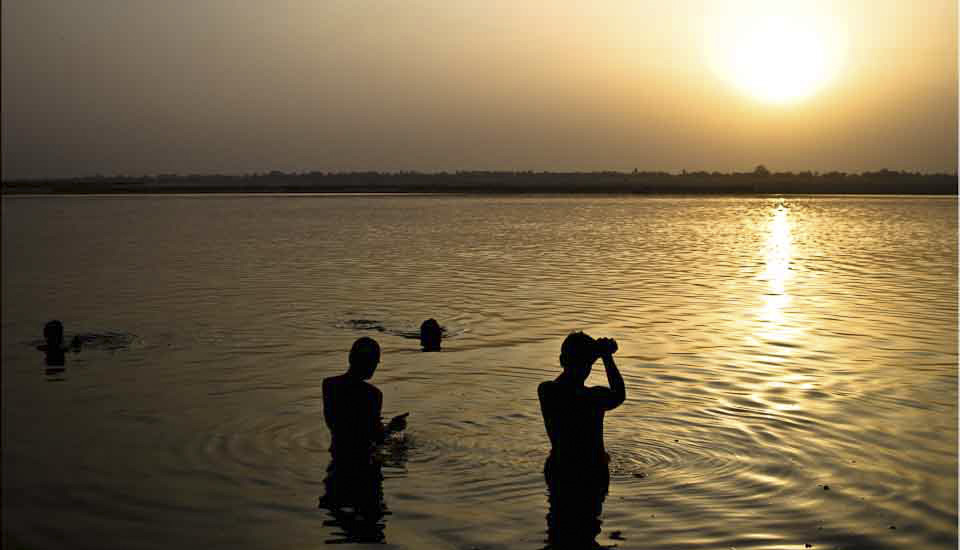
- Performing the Ganga Aarti from Dasaswamedh Ghat, Varanasi
- Buddha Head from Shwedagon Pagoda, Myanmar
- Harry Clarke Window from Dingle, Ireland
- Novice Monk Shwe Yan Pyay Monastery, Myanmar
Packets of 10 for $AU50.
Or - pick any photo from my Flickr or Wanders blog photos.

.jpg)
.jpg)
.jpg)

 Maybe one day I’ll get back to these waters – I’m pretty sure the area won’t have changed much.