.jpg) Dreams and Reflections
Being on a boat on the Ganges is soporific: the air hums like a high-tension electrical wire in the heat; the smells of incense and pollution envelope you; the oars dip quietly; and the pressing crowd of buildings along the ghats float off into the haze. From time immemorial, the Ganges has been the holy river of Hinduism.
And, of all the spots on this long river – which rises in the western Himalaya and flows 2,510 km (1560 mi) through India and Bangladesh and into the the Bay of Bengal – the ghats, the steps leading down to the water’s edge, at Varanasi are the most sacred. If you bathe in the goddess Ganga Ma or “Mother Ganges” here at Varanasi, you wash away all your sins. Even better: if you die here, you escape the cycle of reincarnation and achieve instant salvation (see: Life and Death on the Ghats). From pre-dawn until after dark, ritual fires burn in Varanasi to offer prayers and pay tribute to this sacred river.
Even as a non-Hindu, I was captivated by the spirit of the place.
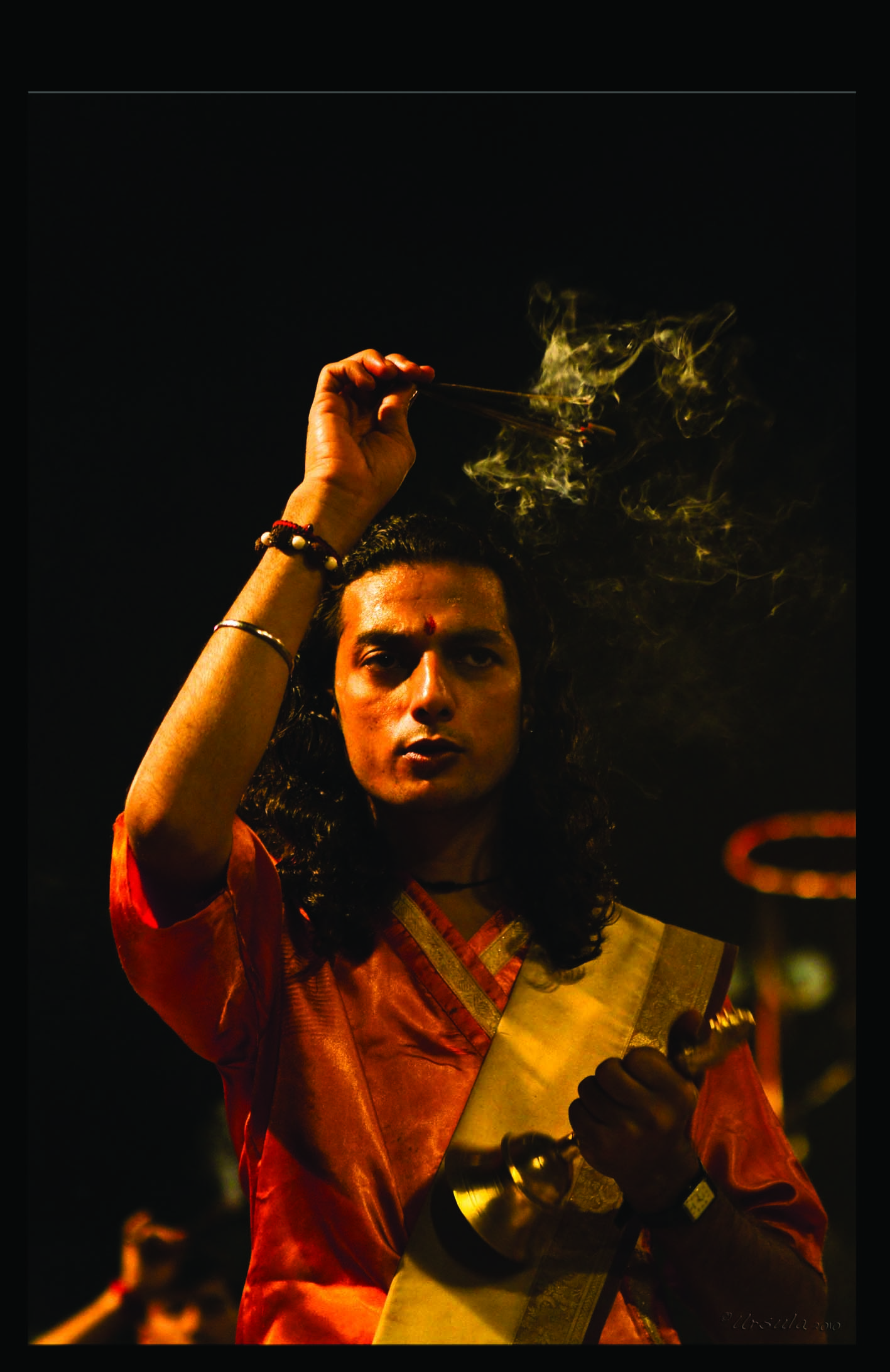
I was travelling with photographers Gavin Gough and Matt Brandon, and because it was a photographic trip, I had plenty of time to wander, soak up the atmosphere, and contemplate life and photographic projects. I had spent the very early hours watching the Hindu priests prepare and conduct their morning aarti – a devotional ritual that uses fire as an offering – for the Goddess Ganga (see: Light the Darkness).
It was still early, but the ghats were already humming with activity. I met my group at Assi Ghat, and we divided up into wooden rowboats for a sedate look at the riverbanks from the water.
It is an experience not to be missed!
.jpg) Boats off Assi Ghat
We get into our boats near Assi Ghat … .jpg) Along the Ghats
… at the very southern end of the Varanasi ghats.  Jain Ghat
 or Bachraj Ghat has three Jain Temples. In Hinduism, the right-facing swastika (卐) symbolises surya, the sun, and brings prosperity and good luck. Men Bathing
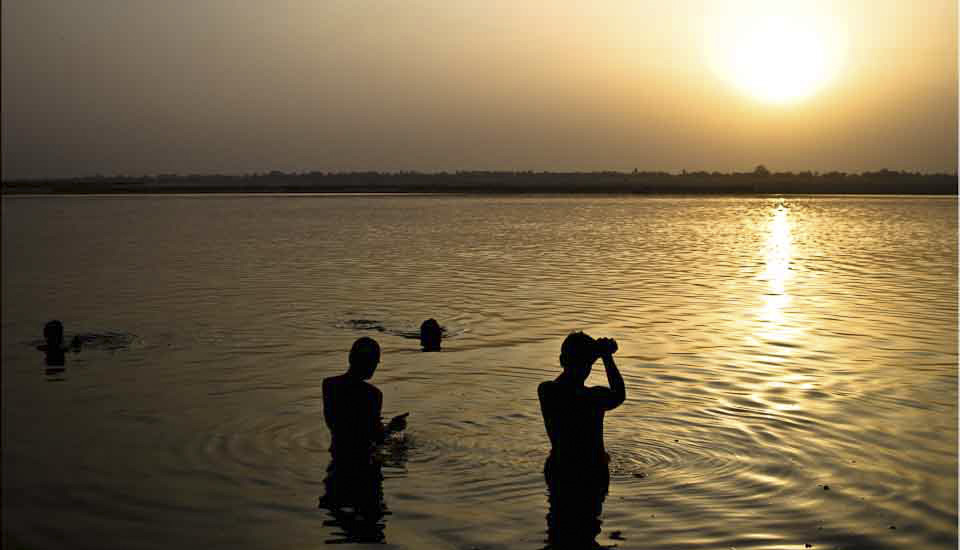
Every day, thousands of people bathe in the Ganges: a ritual dip in the holy waters at Varanasi is said to purify the soul. Rowboats
The wooden boats are kept busy … Boats on the Ganges
… with pilgrims and tourists alike. Washing in the Ganges
You can see some of the rubbish in the background here; it is said that pollution levels in the waters of the Ganges … Water Colours
… are 3000 times higher than the limits prescribed as safe by the World Health Organization. Untouchable Kids
Further up the river, near Harishchandra Ghat, the children of the men who manage the cremation pyres hunt for objects in the remains of the fires. In theory, the caste system is no longer legal in India – but the evidence of ongoing practice is everywhere. The Desolate East Bank
The story goes that if you die on the eastern bank of the Ganges, you will be reborn as a donkey. Certainly, most of the life of the city concentrates on the western side of the river. Mansarovar Ghat
A bright red guest house makes a colourful landmark atop the steps built by Raja Man Singh of Amber (Jaipur) in 1585. Boatman
Our boatman was taciturn, and mostly rowed in silence – unlike that of my companions. He kept pointing out bundles bobbing in the water: ‘Sadhu body’. Sadhus are revered as next to the supreme being, and are therefore in the small group of Hindus who do not need fire for purification at death. Instead, they are wrapped in banana leaves and weighted down in the river. They do not always stay down – and can be seen floating away. Meditation
Time marches differently here; people meditating along the river sit in absolute stillness for long periods. Candy-Coloured Boats
I love the colours and textures of the boats – especially against the dreamy heat haze of the ghats in the background. The Eyes of the Boats Prayag Ghat
This is one of the busiest sections of the ghats – being just left of Dashaswamedh Ghat, … Boats off Dashashwamedh Ghat
… which the most important section of river in Varanasi. One of the oldest and holiest of the ghats, the famous Ganga aarti takes place here every evening (see: Life and Death). Yellow Row Boat Women in the Ghat
While a ritual dip is a spiritual experience, it is also communal – and fun: people are happy to smile at us as we pass in our boat. More Boats on the Ganges
The rich red sandstone of Maharaja Chet Singh Fort, built by the Raja of Benares in the 1770s, stands out in the background. Laundry on the Ghat
Long cloths are stretched out along the ghats to dry – hopefully after washing, not dyeing: chemical dyes are only one of the many things polluting this mighty river. The irony, of course, is that these sacred waters which can save you from eternal rebirth are so polluted that they might also be what kills you. Experts link the pollution in India’s rivers to the country’s high rate of waterborne illnesses, which kill an estimated 1.5 million children every year (e.g.: PBS Ganga River; SMH Holy River from Hell).
While there is a push to clean the river, dropping water levels, the demands of industry and farming, and just the sheer press of humanity, make this an uphill battle.
And, there is a deep belief that as well as being able to cleanse us of our sins, Mother Ganga can look after herself.
Personally, I wouldn’t be surprised if she is feeling rather overwhelmed!
ॐ
Photos: 10April2010
Posted in India,Landscapes,TravelTags: boats,Ganges,hindu,hinduism,India,Photo Blog,temple,travel,Travel Blog,Ursula Wall,Varanasi
Market Women at Tambomachay
High in the Peruvian Andes, at the heart of the ancient Inca Empire, Quechua people knit while waiting for tourists. I was breathless with excitement!
Or maybe it was just the altitude? Or the psychoactive effects of the coca tea we’d been drinking?
Flying into Cusco (previously Cuzco) felt like flying into another world. And it was: it was a world away, and a long time ago.
My husband and I were planning to walk the Inca Trail, and Cusco is the jumping off point for most trekkers. This is the UNESCO-listed capital of the ancient Inca Empire and the more modern home of Coca Cola: even though real coca (from which cocaine is extracted) was removed from the soft drink back in 1930s, the giant Coca Cola sign welcoming us to the city was the first thing I noticed from the airplane.
We were greeted at our lodgings with cups of coca tea, which is supposed to help with any altitude sickness. Sitting high in the Central Peruvian Andes, at 3350 metres (2 miles) above sea level, Cusco is a good place to acclimatise in preparation for the even higher passes on the trail. The tea must work, because aside from fatigue and headaches, none of our group of seven intrepid travelers suffered too badly. A couple, however, did have panic attacks when they thought about what might happen if they were drug-tested when they went back to work – even though the leaves are relatively low in psychoactive alkaloid.
Cusco is an intriguing mix of time and culture. Located in a fertile alluvial valley fed by several rivers, it was occupied for well over 3,000 years by non-Inca ethnic Quechua people. After the rise of the Inca civilisation sometime in the early 13th century, the city was conquered by Manco Cápac and became the centre of a small city-state: the Kingdom of Cusco. It is said that in the mid 1400’s, the city was redesigned and remodelled to look like a puma, the Inca representative of the earthly plane.
The invading Spaniards reached Inca territory by 1526 and overtook Cusco by 1533. They did their best to stamp out the native customs and beliefs, building awe-inspiring churches and monasteries on top of the original Inca buildings. Fortunately, the original structures were stronger than the Spaniards imagined, and the granite walls of the Coricancha / Qorikancha (and other original architectural sites) resurfaced after surviving an earthquake in 1950.
The customs have also survived and integrated themselves into the local version of Catholicism. For example, modern versions of ancient coca-leaf healing rituals involve a ‘priest or healer’ saying three Hail Marys and reciting a prayer to the traditional Quechua Gods of the underworld, the land, and the heavens.
I really enjoyed exploring Cusco – even though most of the time the historical explanations our guide was giving us went straight over my head. The different Spanish and Quechua (the most widely spoken indigenous language in Peru) names, and the accent – Peruvians speak their Spanish very quickly, and they speak English the same way: “j” sounds like an aspirated /h/, while “h” and “g” disappear somewhere down the back of the throat – made understanding difficult. I hit information overload very quickly, and contented myself with taking pictures and talking in sign-language to the villagers.
Of course, those pictures that I took were on my very first little digital camera and with a fairly underdeveloped-eye! Sometimes I can’t even crop these old offerings into a more modern 2×3 format without completely losing any semblance of composition.
But, they represent some good memories of a very special time and place. I hope you, too, enjoy them.
Over the Andes
It is a short flight from Lima (see: Postcards from Lima) to Cusco; as we get closer to the old capital of the Inca empire, I marvel at the mountains we will later be walking through. Welcome Band
You could be nowhere else! The Peruvian band playing their pan flutes next to the baggage carousel made me feel as if we had truly arrived in another time and place. Qorikancha : Santo Domingo del Cusco
Any exploration of Cusco takes in the Coricancha (Koricancha, Qoricancha or Qorikancha), the Golden Temple. Originally called Intikancha or Intiwasi, the Inca stone building included astrological elements, and was dedicated to Inti, the Sun God. Looking Back over Cusco
The Spaniards destroyed most of the temple and built the Convent of Santo Domingo on the original foundations. Inside Qorickancha
Much of the first convent building – finished in 1610 – collapsed in the 1650 earthquake … Inside the Convent of Santo Domingo
… and the building standing here now was built between 1680 and the early 1700s. INRI
Today a museum operates inside the convent – but there is still plenty of Catholic symbolism. Hammered Gold
This whole building was once coated in gold. This gold plate is thought to depict the original altar, Mother Earth and the cosmos. The Valley below Q’enqo
A short drive up out of Cusco, we come to the archaeological site of Q’enqo. Guide in Q’enqo
Q’enqo (Qenko, Kenko, or Quenco) is from the Quechua for labyrinth or zig-zag. Like other huacas (holy places) this site was carved into naturally occurring rock formations. Stones at Q’enqo
Although no one is sure, it is thought that this is a place where death rituals, including sacrifices and/or mummification, took place. Sun God Picnic
A modern ‘Sun God’ lounges with his friends while we explore – and is on hand for tourist pictures before we leave! Rocks and Ruins around Q’enqo Puca Pucara
Our next stop is at what is called the Red Fort, thought to have been an Inca fortress. Rocks at Tambomachay
At nearby Tambomachay, you get an appreciation of the intricacies of the construction: the blocks nest into their surrounds perfectly. Tambomachay Fountain
This site consists of a series of aqueducts and canals that channel waters from nearby springs through the terraced rocks. Trinkets and Souvenirs A Girl and her Llama Peruvian Child with a Chuckie Doll
OK – so it isn’t Chucky, but you can see a resemblance! Saksaywaman / Sacsayhuamán
Our next stop is at an incredible site on the northern outskirts of the city: spelled many ways, sections of this citadel were first built about 1100 CE by the Killke people who lived here from 900 CE, and added to by the Inca. No one has been able to explain how the ancient builders achieved this: the massive asymmetrical limestone blocks are so precisely cut and fitted that a single piece of paper won’t fit between them. The White Christ behind Saksaywaman
On the top of Pukamoqo Hill, an eight metre (26 foot) granite, marble, and plaster statue of Jesus Christ overlooks Cusco. It was donated in 1945 by Cusco’s Palestinian Arab colony. Under the Rainbow
It’s hard to refuse a ‘tourist shot’ when Nature puts on a show like this! Cusco from Saksaywaman Iglesia de la Compañía de Jesús – Church of the Society of Jesus
Back in Cusco, we walk around the colonial buildings in the Plaza de Armas – Weapons Square. Built on the remains of one the Inca’s most important gathering spots, it is surrounded by arcades and colonial architecture – including the basilica, built between 1560 and 1654, and this Baroque church started in 1576 and finished in 1668. Iglesia del Triunfo
Built in 1538 and attached to the Cathedral Basilica of the Assumption of the Virgin, … Doors to the Church
… the Church of Triumph was the first Christian church built in Cusco. Guinea Pig
Our day finished with dinner – which included the Peruvian delicacy: roasted guinea pig. This was a challenge for vegetarians like me and my husband, but sampling strange foods is part of the experience. Sometimes you have to not think about what you are eating!

It was certainly a full and interesting day – and whether it was the excitement, the altitude, or all the stimulant tea, I thought about it long into the night.
Until next time,
Happy Travels!
Pictures: 05April2006
Posted in Architecture,History,Peru,TravelTags: archaeology,architecture,environmental portrait,history,Peru,Photo Blog,ruins,travel,Travel Blog,UNESCO
Bournda Island Across the Tombolo
The colours! Even with an old phone, the colours pop: the sapphire sky and emerald waters; the golden sand and rusty rocks. It is not for nothing this is called the Sapphire Coast. (iPhone6) We are very lucky here on the Far South Coast of New South Wales in Australia’s east.
It is called the Sapphire Coast for the intense blue of the waters and sky against the iron-oxide red of the coastal cliffs and gold of the sandy beaches. Sitting on the windward side Great Dividing Range, the region is temperate and moist, allowing rural properties to stretch out lush and green to the east. If you ignore the regular cycles of bushfires and inundating floods – which have been made worse in recent years by the observable changes in climate – it is pretty glorious.
Although about 85% of Australians live within 50 kilometres of the country’s coastline, about the same proportion live in the urban centres. Here – a very long drive from the major cities of Sydney and Melbourne – people are clustered into small coastal towns. Thanks to the efforts of generations of passionate eco-warriors, much of the coastline is now protected under a network of National Parks.
One of these is Bournda National Park.
This 2,655-hectare (6561-acre) sanctuary is home to ocean beaches, creeks, and three large bodies of very different waters: the brackish ICOLL (Intermittently Closed and Open Lake or Lagoon) Bournda Lagoon in the southern portion of the park; the fresh water Bondi Lake; and the much larger salt Wallagoot Lake. The park stretches along about 13 kilometres (8 miles) of coastline – much of which is covered by good walking tracks, making it an attractive place to revisit.
And, over the years, I have revisited several times – always with the walking group of my local branch of the National Parks Association of NSW (eg: Once Upon a Time and The Kangarutha Track). Going through various photo files, I re-discovered three more sets from short walks in different seasons and different sections of this park.
The first was a short Spring walk in the south of the park, from the Hobart Beach Campground, along Bournda Beach to Bournda Island – which was inaccessible to us in the high tide. I really can’t remember why I didn’t take my cameras, but I had to rely on my old iPhone!
The next walk, some eight months later in Autumn, started in the same place but headed north instead of south – first around Hobart Beach and then along Bournda Beach towards Wallagoot Beach, where we were blocked because Moncks Creek was open – which hasn’t happened in many years (Wikipedia will tell you it last opened up to the ocean in June 2008).
For our Summer walk, eight months later again, we started at Wallagoot Gap and walked part of the Kangarutha Track north to Games Bay.
Join me for a sampling of Bournda’s coastal walks:
Walkers in the Tea Trees
The first part of our walk from Hobart Beach takes us through heath and melaleuca; we call the native melaleuca ‘tea trees’, but they are members of the myrtle family. (iPhone6) Walkers on the Beach
We descend from the wooded path and walk across Bournda Beach, with Bournda Lagoon on our right, and the South Pacific Ocean to our left. (iPhone6) Sandy Beach
Sandy Beach Creek feeds into Bournda Lagoon behind us, as we approach the rocky outcrops that separate us from North Tura Beach further south. (iPhone6) Nature’s Sculptures
I love the shapes made by the rocks on the beach … (iPhone6) Nature’s Artworks
… especially with the patterns left by waters on the sand. (iPhone6) Photos on the Rocks
Everyone wants pictures from the headland; it’s where I took the lead photo of Bournda Island. (iPhone6) Roos at Hobart Beach
Back at the Hobart Beach Campsite, a pod of eastern grey kangaroos (Macropus giganteus) watch us warily. (iPhone6) Bush Walkers on Hobart Beach
Our Autumn walk starts at the same carpark, not far from the salty waters of Wallagoot Lake, which are rusty brown with organic matter. (iPhone6) Tea Trees on Hobart Beach
We head east, along the white sandy shores of the lake. Clump of Grass on Hobart Beach Banksia – Banksia Serrata
At the end of Wallagoot Lake we continue through the bush … Pittosporum – Pittosporum Undulatum
… towards the sound of the ocean. Sea Grass
Once we are over the erosion-control steps on the dunes, the beach stretches out in all both directions. To the south, the little coastal suburb of Tura Beach floats near the horizon. Sunshine on Bournda Beach
We, however, are heading north, into the sun which is still shy of it’s autumn zenith. Walkers on the Beach Waves of Sand
Erosion has carved patterns into the sandbank. Rolling Waves Moncks Creek
To our surprise, Moncks Creek had opened Wallagoot Lake to the ocean, and was running deep and quick. Rocks on the Headland
So, instead of crossing over to Wallagoot Gap, we admired the rock formations jutting into the ocean. Rock Formation
These lumps of rock were formed by sandstone deposits and a lava flow a million years ago, and carved out by weather and sea-water over time. As impressive as they are, they are so common along this coastline that these don’t seem to have a name. Tura Beach
As we return the way we came, the houses of Tura Beach are in view – behind Bournda Island, with the tidal tombolo that prevented our crossing on our earlier walk in the park. Tangled Wood
The organic mix of dirt and dead plants colours the waters around the tea trees on the path back to the carpark. Overlooking Moncks Creek and Wallagoot Beach
On our next walk in Bournda National Park, we leave our cars on the other side of Wallagoot Lake. Before picking up the Kangarutha Track, we take the short detour to a lookout over the bottom of lake on the right, and the South Pacific Ocean on the left. Stairs Down
We also stop to admire the beach inside Wallagoot Gap. Wallagoot Gap
The gap is created by two headlands which rise out of the sand. Walkers in the Tea Trees
Leaving the lookout behind, we head north through the melaleuca forest, … Gorge
… going off the trail to clamber through the scrub to admire one of the dramatic gorges in the coastal cliffs. Summer Wildflowers Overlooking Games Bay
We follow the cliffs high above the ocean and Games Bay comes into view below. Games Bay
This small rocky inlet has plenty of vegetation where a creek is flowing down to meet the ocean. Orange Fungus
The colours of the growths on the rocks around the bay are unbelievable! Waiting for the Tidal Wave
We stopped for lunch here – sitting well back, and keeping our ears open, as there was a tsunami warning in effect because of a volcanic eruption in the Tongan Islands the day before.
Luckily, the tidal wave never came.
After lunch and a chat, we walked back the way we had come – and it felt like a whole new walk!
That’s part of the beauty of our coastal parks – the walks are lovely in any direction, and any season.
And, always worth repeating!
Photos: 20September2020, 16May2021 and 16January2022
Posted in Australia,Nature,TravelTags: Australia,landscape,National Park,nature,Photo Blog,travel,Travel Blog,Ursula Wall,walk
Modern Architecture on an Ancient Port
Santander might be a small city, with ancient maritime traditions, but it is also a modern and cosmopolitan one. The Centro Botín, designed by Italian architect Renzo Piano, is a contemporary arts exhibition space built on stilts and centrally positioned between Santander’s Pereda Gardens and the waterfront. Solo travel is not always seamless. There can be long gaps between connections. Finding a way to fill these gaps is not always easy!
But, in Santander, on the north coast of Spain, I found filling a day simple and enjoyable: replete with magnificent landscapes, intriguing public art, modern and historic architecture, and wonderful food.
After a week spent studying Spanish (see: Peak Me Language School) in Panes – a tiny town at the edges of the Picos de Europa National Park – and going for walks in the surrounding wilds (eg: Shepherd Huts and Mountain Villages), I needed to get back to England. As beautiful as this part of Northern Spain is, it doesn’t have the same tourist-traffic as the southern beaches. So, flights in and out are few, and tend to be with the low-cost carriers which fly at rather inhospitable times of day.
So, I had an early checkout from my room and a late check-in for my flight!
Fortunately, the Santander bus station is centrally located, with clean toilets and large luggage lockers. Divested of my travel bags, and in possession of a ticket for an airport transfer later in the day, my Google-maps and I were able to go for a long and satisfying walk.
Santander is a coastal city, with wonderful views over the Cantabrian Sea and I was lucky with the Autumn weather. Join me for Part 1 of a long city-walk:
Story Board
My first stop – after having a chat at the Information Centre – is at a coffee shop to make a plan. (iPhone6) Tunnel in Calle Atilano Rodríguez
Art seems to play a role all across the city. Here, the approach to a road-tunnel outside the railway station is elaborately decorated. The tunnel itself is an exhibition space. Selfie in the Street
I love the fish-eye view you get of city in the convex street mirrors. La Estación Marítima de Santander
Designed by Cantabrian architect Ricardo Lorenzo García, the elegant glass-walled ferry terminal with its waving roofline was opened in 1971. The Monument to the Fire of Santander and Reconstruction
The Great Santander Fire of 1941 burned for two days, and destroyed much of the historic centre of the city. This stone work by Cantabrian sculptor José Cobo Calderón, … In the Pereda Gardens
… and the seven bronze figures of solemn adults and children close by, form a Monumento al Incendio de Santander, a Monument to the Fire in Santander. Centro Botín Staircase
Opened in 2017, the Centro Botín art gallery is all lines and curves and industrial shine. Part of an extensive project to expand the Pereda Gardens and overhaul the docks, the space is now accessible, multi-purpose, and inviting. Paseo de Pereda – The Perada Walkway
Some Santander city roads have been diverted into tunnels, allowing more pedestrian space. A waterfront promenade leads under the floating Centro Botín and around the Bay of Santander. Tourist Boat on the Bay of Santander
The beautiful bay is a hive of activity, … Bicycles on the Promenade
… and is clearly a recreational hub. Palacete del Embarcadero
Designed in 1920 as a passenger terminal by Santander-born architect Javier González de Riancho (1881-1953), this small waterfront building was opened in 1932. Today, it is a cultural exhibition space. Santander Waterfront Puerto Deportivo – Leisure Port
Boats of all sizes are moored on the waterfront … Sailing Dinghies
… and little dinghies are ready to launch. Palacio de Festivales de Cantabria
Across the road, the Cantabria Festival Palace is a commanding presence. Santander Festival Palace
The marble and copper-clad building designed by Spanish architect Francisco Javier Sáenz de Oiza (1918 – 2000), was/is controversial because of it’s size, cost over-runs, lack of natural light inside, and other interior design problems. SPS Centinela (P 72)
It is only fitting that a city with a long maritime history would play host to the Navy. Serviola-class patrol boats were built in 1990 for the Spanish Navy, and patrol this northern coastline. One of these was in town, and open for visitors. Lat and Long
You know you are in a city full of boaters when the geographic coordinates are prominently displayed! Playa Los Peligros -‘Beach of Dangers’
It is Autumn, and this is the north – bordering the dangerous Bay of Biscay – but the beaches are beautiful and popular even so. Overlooking the Harbour
My path takes me higher up, where I get views of the breakwater and Isla de la Torre (Tower Island). Roca del Camello – Camel Rock
From some angles, at the right tide, this does look look like a camel. José del Río Sainz (1884 – 1964)
A chunky bronze statue by Cantabrian sculptor Jose Villalobos Miñor (1908 – 1967) commemorates José del Río, Spanish navigator, journalist, and poet. Enrique Gran (1928 – 1999)
Nearby, high above Playa del Camello – Camel Beach, a sheet-metal sculpture by Colombian artist Enrique Grau (1920 – 2004) depicts a notable local painter. A Quiet Bench Primera Playa del Sardinero
‘The Sardinero’s First Beach’, the next beach along – where people are enjoying the water, or flying remote-controlled airplanes – is rated one of Cantabria’s best beaches. It is named for the sardine fishermen who used to work from here. Primera Playa del Sardinero – The Sardinero’s First Beach
With views stretching in both directions, it made a great place to stop for lunch. Plaza de Italia
In the city across the road from the beaches, Santander’s Gran Casino sits under a popcorn sky. It was designed by Santander architect Eloy Martínez del Valle (1870 – 1939) and opened in 1916. The plaza is named to commemorate the help of Italian legionaries in the Spanish Civil War. The Quinta Los Pinares
Also known as Casa Santos, this neo-baroque mansion was designed in 1916 by another Santander architect, Valentín Ramón Lavín Casalís (1863-1939), as a family summer vacation home. It currently houses a collection of contemporary sculpture for the Santos Foundation. I was a fair way from my starting point, and thought it wise to walk back.

The return walk was equally rich in culture, art and history.
Stay Tuned!
Photos: 29September2019
Posted in Landscapes,Spain,TravelTags: architecture,landscape,Photo Blog,Santander,sculpture,Spain,travel,Travel Blog,Ursula Wall
Campsite in Wadi Rum
I’m not a morning person – but when you go to sleep in a Bedouin tent in the shadows of the towering red rocks of Wadi Rum, getting up early to explore is the only option! Everyone I know who had ever visited Wadi Rum in the south of Jordan has come away awestruck.
As did I.
It is the most extraordinary landscape: steep sandstone cliffs rising tall and textured out of a flat sandy valley with colours changing every moment from warm yellows and rusty browns through to the more striking and dominant pinks and reds. Petroglyphs, inscriptions, and archaeological ruins give witness to 12,000 years of human occupation, and today the area is scattered with goat-hair tents, corrugated iron structures, and small villages of concrete houses. The 74,180 hectares (183,300 acres) of unique, UNESCO-World Heritage listed desert landforms comprising the Wadi Rum Protected Area (WRPA), is dotted with Bedouins, dressed in thoab – long flowing cotton robes, wearing red-and-white checkered keffiyeh scarves on their heads, and riding or leading their dromedary camels.
This was where British Army Colonel T. E. Lawrence – later known to the world as Lawrence of Arabia – was based during the First World War and the Arab Revolt of 1916–1918. The descriptions of this landscape in his book the Seven Pillars of Wisdom verge on poetry. The movie Lawrence of Arabia (1962) is drawn from that autobiographical book, and filmed in this very place. Who can forget those stunning visuals! The desert itself is alive with character. Remnants of Lawrence’s time here remain across the landscape – adding to the rich and complex history of the region.
Wadi Rum is one of Jordan’s most popular tourist attractions, and I was thrilled to be able to visit. Like many, I had been entranced by the desert as a child. I was mesmerised by the flowing sands and the expanses of space and sky depicted in the movie – which I was allowed to watch with my parents at a drive-in as a youngster when it first came out because were were learning about ‘Arabia’ in school. While I certainly didn’t understand the plot details or the subtleties of character, I was captivated enough to later read a biography of T. E. Lawrence’s life, and to watch the movie many more times.
I was travelling with a small group, and our base was one of the several semi-permanent tent and bubble-pod campsites nestled into the bottom of the escarpments and managed by the local Zalabieh Bedouins. The timing of my trip was exceptionally lucky: on the day of our arrival into the wadi – a valley, ravine, or channel that is dry except during heavy rains – we experienced a rain- and hail-shower, which made the red sands even more dramatic (see: Desert Rains and the Seven Pillars of Wisdom). Given that Wadi Rum receives only 14 days of rain each year, this was a real treat!
I was certainly looking forward to exploring further.
A Waning Gibbous Moon over Wadi Rum
When I peaked out of my tent at 0630 in the morning, an almost-full moon was still over the mountains opposite my campsite. Morning over Wadi Rum
I climbed up the escarpment behind my tent and the autumn sky got lighter very quickly. Wet patches still sat on the sandy ground from the rains the afternoon before. Rough Rocks in the Wadi
Wadi Rum is sometimes called the Valley of the Moon because of its rugged landscape. It has been the setting for a number of movies – especially for science fiction films purportedly set on Mars. Personal Bubble
Accommodation domes inspired by The Martian – which was one of many movies filmed here – allow views of the surrounding mountains and the normally clear, starry night skies. Camels Waiting
Dromedaries are so ubiquitous in this region … Camels in the Wadi
… that they are commonly known as Arabian camels. These are waiting for tourists. Smoke Break
The word bedouin comes from the Arabic badawī, meaning “desert dweller”. There are six Bedouin tribes that still live around here: many operate a variety of tourism ventures. Desert Transport
The wadi seems to go on forever, and there are no set roads. Bedouin 4x4s are on hand to make their own tracks and ferry tourists around. Bedouin Drivers
I couldn’t resist a quick picture of our drivers … Camels in the Wadi
… when we arrived at another camp … Camel Rides
… where camel wait and groups of tourists come and go. Young Men in a Big Landscape
That sky! And, the dramatic mountains of the wadi stretch out forever. Young Camel Handlers
The red keffiyeh scarf is traditional to many parts of the Southern Arabian Peninsula. It has historically been worn by Bedouins to represent the red of the Arabian deserts. Tourists in the Wadi
Finally, it is our turn! It might be a bit kitsch and touristy, but I do love a camel ride. (iPhone6) A Group of Riders in the Wadi
There is fair gap between us and the group of tourists in front of us. Camel Tracks
It is actually not that easy handling bulky digital SLR cameras from camelback! Morning Sun on the Sands
The colours change every minute in the shifting light. This landscape is so large, it dwarfs us all. Coming into Town
After a short while, Wadi Rum Village comes into view in the distance. Taking Camels Back to the Camps
As we approach the small town, other camels are led back into the protected area. In some spots, the granite rock shows through the sandstone cliffs. Camels and Handler
I always find the hardest part of a camel ride is the dismount! Camel Portrait
I get one last close up of my camel before getting back into the air-conditioned bus that has been waiting for us here, just outside the WRPA. Wadi Rum Village Train Engine
Our last stop before leaving this magnificent area was along the Ottoman-built Hejaz Railway, where a refurbished locomotive harks back to the origins of the modern Middle East: … Inside Wadi Rum Railway Station
… the year was 1916, and T. E. Lawrence was assisting his Bedouin allies stage the Arab Revolt against the Ottoman Empire.
It was a sublime experience – taking me back to memories of childhood, and magical desert dreams.
No wonder everyone is in awe of this magnificent landscape!
Photos: 15October2019
Posted in Jordan,Landscapes,TravelTags: animals,environmental portrait,environmental portraits,Jordan,landscape,nature,Photo Blog,Travel Blog,UNESCO,Ursula Wall,Wadi Rum
« Older posts
Newer posts »
|