Selling Wood Carvings In the historic Newari village of Bungamati, Nepal, people have lived as woodcarvers for generations.
Historically, the medieval Newar (Newari) village of Bungamati was known for its woodcarvers, its ancient temples, and its views of the surrounding mountains.
Bungamati is a tiny town of about 6,000 residents, sitting on a spur of land overlooking the Bagmati River at the southern edge of the Kathmandu Valley. When I visited, almost two years after the April 2015 Nepal earthquake, the main street of the village was still like a construction zone, with piles of rubble and buildings in states of disrepair everywhere (see: Manual Labour and Smiles).
I was in Nepal on a workshop with photographers Jack Kurtz (sadly, now deceased) and Gavin Gough, and was visiting some of the historic Newar villages in the region (see: Making Mustard Oil). We had the places we visited much to ourselves, as at that time the tourism industry had not really recovered.
Bungamati is celebrated as Kathmandu Valley’s long-established centre of wood carving, where skills and patterns have been passed down through the generations. Although the earthquake created a need to replicate traditional and elaborate doors, windows, and frames – especially on local temples and museums – people have been understandably preoccupied with clearing the debris and making their homes liveable again.
Even with these challenges, the people of Bungamati are still smiling, and many have picked up their hammers and chisels again to carve small items for sale to tourists (e.g.: Nepali Times: Reviving Woodcarving).
I was happy to walk among them, admiring their skills and handicrafts.
Carver in her Doorway Carvers work in the street,with carvings of all types on display.
Carved Door Old carvings, rich in religious symbolism, are all around, …
Old Bell … as are intricately patterned temple ornaments.
Bungamati Buildings After the earthquake of April 2015, buildings remain in states of partial ruin or repair. Stupas line the skyline.
Rubble Hindu worship is central to daily life here, and the ruination of so many temples was as heartbreaking as the damage to homes.
Woman with a Picture Life goes on on the front stoops of houses.
Shrine in the Ruins
Buddha in a Shop Religious iconography and handicrafts …
Wall Carvings … are available in the shops that line the street.
Grandma and Grandchild I have found that having photos of my grandchildren handy on my phone is a great conversation-starter – …
Kohled Eyes and Smiles … even though we have no language in common.
Bungamati Street Rubble and ruins are everywhere I look.
Lions in a Courtyard Bungarati is the birthplace of Rato Machhendranath, and the deity lived here six months out of the year. While the mythical-lion temple guards survived the earthquake, the Rato Machhendranath Temple and the Shikara-style pavilion that housed the deity were ruined.
Schoolgirl There is always something happening in the streets, with students off to school …
Man in a Woolen Cap … and people in their doorways.
Silver and Stones for Sale
Deities in Niches
Woodwork Design in Chalk A police officer sketches out a design for carving into a wooden panel.
Planning the Woodworks Design is a collaborative process.
Carving and Drawing Nearby, more artisans are at work, …
Drawing on Wood … carefully drawing …
Designing Patterns … intricate patterns …
Chiselling with a Carving Gouge … that will later be chiselled out.
Big Sister – Little Sister With grownups busy at work, children are often left in the care of older siblings.
Woman in the Street
Woman Weaving Everyone is busy with something; …
Hands at Work … floor mats made from the local grasses need to be replaced periodically.
Man Working Almost every household here is connected to woodcarving, …
Wooden Buddhas … and the products of their labours are on display.
Naturally, I couldn’t resist, and went home with a beautifully carved little Buddha for myself.
It’s a win-win really!
I get a beautiful souvenir from the source, and the village gets a small boost to its suffering tourist trade.
Woman and an Apple Crete is a rich and layered place: fertile, sunny, and possessed of singular history. For example, the unique wooden windmills that irrigate the orchards of the Lasithi Plateau were originally built by Venetian engineers from 1464, during their tenure on the island.
Crete, Greece’s largest, most populous, and southernmost island, is a rugged place of mountains and gorges. Every day-trip I took while I was there was a test of fitness!
A day after descending a punishing cliff-slope to Preveli Beach (see: Preveli Beach and Palm Forest) and exploring the historic capital of the Rethymno (Rethymnon) prefecture to the west of where I was staying (see: Mountains, Gorges, and History), I discovered that the tour I had booked with Orange to Lasithi (Lassithi), the regional unit to the east of me, involved an arduous uphill walk up of about 45 minutes to a cave held sacred by the ancient Minoans.
The climb was up to the birthplace of Zeus, the god of the sky in ancient Greek mythology. According to the story, Cronus/Kronos became the supreme ruler of the cosmos after castrating his father Uranus. He wed his sister Rhea, and they had five children before Zeus. But, because it was prophesied that one of his children would overthrow him as he had overthrown his own father, he swallowed all the babies at birth. Rhea, after consulting with her parents, gave birth to her sixth child in Crete, in what is now known as the Diktaion Andron, Psychro Cave, or the Cave of Zeus. She gave the newborn Zeus to her mother Gaia to raise, and tricked Cronus into swallowing a rock in swaddling instead of his son.
The climb to the cave was about a kilometre in direct sun, with a 118 metre elevation gain, followed by a wet and slippery descent down concrete steps into the cave itself. But it was worth it! The climb affords wonderful views over the Lasithi Plateau, and the cave itself features some rather beautiful stalactite formations.
And, of course, the walk down the hill is a breeze!
The history and landscape of Crete is incredibly rich, layered, and complex. On this same morning, I also visited the Church of Panagia Kera, a Byzantine chapel and monastery, originally built between 961 – 1204 CE, and still home to a small order of nuns. We then visited a local pottery atelier on the Lasithi Plateau amid the orchards and wooden Venetian-style windmills. The hike up to the Cave of Zeus was followed by a wonderful lunch at a typical home-style taverna on the plateau next to more windmills. I think they served the best potatoes I’ve ever eaten! And the dolmades wrapped in vine leaves and zucchini flowers were superb.
I can’t share the food, but hopefully I can give you a taste of the experience.
The Aposelemis Dam far Below At our first stop, the Monastery of Kera Kardiotissa, we are 630 meters (2067 feet) above sea level and have great views across the olive-covered mountains.
Virgin Mary’s Shrine The Monastery of Kera Kardiotissa is also known as the Church of Panagia Kera; in fact, there are so many names attached, I wasn’t sure I was researching the right place! It is an Orthodox complex dedicated to the Virgin Mary.
Another Maria Our guide gives us a lengthy history of the small complex before letting us loose.
Symbols over the Doorway No founding date for the church of has been established, but it is believed that the oldest parts were constructed and painted in the 13th century.
Into the Chapel No photos are allowed inside the chapel, where priceless ancient wall paintings date back to the second decade of the 14th century.
Bells The much-more-modern bell-frame is dated to 1864.
Orthodox Shrine to the Virgin Mary Stories of miracles here have led to the monastery being known locally as Little Lourdes. The faithful make pilgrimages and light candles. Every year, Mary’s birthday is celebrated on September 8th.
Southern Magnolia – Magnolia Grandiflora The grounds are beautifully maintained – presumably by the six nuns living in what is now a nunnery.
Windmills of the Lasithi Plateau The nearby plateau is known for its white-sailed windmills, made to the local Venetian design. They have been back in use to pump water for irrigation since the 1920s.
Potter on a Wheel A Cretan potter working clay on a wheel in a family-owned ceramic workshop …
Working the Clay … is using traditional pottery skills …
Pots for Sale … to create pieces for visiting tourists.
Thistles on the Path The sun is high when we reach the start of the walk to the Cave of Zeus.
Walkers on a Rough Slope Some walkers choose the shorter, steep climb up the rocky scree …
Walkers on the Path … while others – like me – take the longer, more gradual, paved path.
Lasithi Plateau The views over the plateau give me a good excuse to pause on the climb to the cave.
Waiting Donkey Donkeys are available for those who don’t fancy the walk. A signpost in seven European languages says that donkeys in Greece are endangered, and that riding them helps with their upkeep and ensures their survival.
Cave Entry Once I finally reach the top of the trail, I have to wait my turn, as the ticket office works to limit overcrowding.
Down into Psychro Cave Once inside the cave, it is easy to see why they made us wait! A narrow staircase leads down (and up!) into the beautiful, sacred cave with its the limestone stalactites and stalagmites. (iPhone12Pro)
Limestone Formations … so the best shots I have are from my phone! (iPhone12Pro)
Stalagmites My poor old cameras don’t handle low light very well … (iPhone12Pro)
Looking Back Up As well as being naturally beautiful, the caves have enormous archaeological significance. Evidence suggests their religious use began even before the Early Minoan period (2800-2300 BC) and extended as late as the Roman period (from 67 BC). (iPhone12Pro)
Spiderweb and Berries The walk back down from the cave was very quick and easy!
Donkey Rider
Ancient Windmills In addition to the wooden windmills built to pump water for irrigation, the plateau is also home to later stone mills, first constructed during the 1800s, that were designed to grind grains.
Bicycle at the Taverna Our last stop of the morning was at a charmingly typical taverna, where the food was fast and fabulous.
It was a delightful and varied morning – and I still had the afternoon to look forward to!
Northeast to the Mainland The British Columbia mainland drifts off into the clouds … It feels like you are miles from anywhere – but you’re not. The wonderfully peaceful Saysutshun is only a short ferry ride from the Vancouver Island city of Nanaimo.
There is something magical about being in a place that is accessible only by boat!
Saysutshun is a small island (3.63 km2, 1.40 sq mi) with a long and colourful history. For thousands of years, it was a seasonal fishing site for the local Coast Salishpeople. Because they only built temporary housing on the island, early European explorers assumed the island was deserted, and establishing their own herring industry there.
In the 1800s, coal was a necessary fuel for transport: for early steamships and later railroads. High-quality coal was discovered on Saysutshun in 1849, and by the late-nineteenth century, coal mining had become the primary industry around the whole Nanaimo area. The Hudson’s Bay Company named the island ‘Newcastle’ after Newcastle upon Tyne, the hub of coal production in England. While mining for coal, however, it was discovered that the island was also home to sandstone of exceptional quality. After some 20 years of coal production, the island was principally quarried for stone – some of which can still be seen in historic buildings from the period, most notably the old (1874) United States Mint in San Francisco.
The island underwent a number of further transformations – including hosting a shipyard and a leisure retreat – before it was sold back to the City of Nanaimo, and later the BCProvincial Department of Recreation and Conservation. It was established as a Provincial Marine Park in October 17, 1961, and later ceded as Snuneymuxw First Nation Traditional Territory. The island, with its reclaimed name, is still a Provincial Park, but is now jointly managed with the Traditional Owners (see: Tourism Nanaimo)
Today, the park is a wonderful recreational area just a short distance from Nanaimo. On occasion (eg: Newcastle Island), I have accessed it by kayak or by dinghy. On my last stay in Nanaimo I decided not to test my ability to read the tides and currents, and instead, I finally made use of the First Nation-operated ferry service to the island.
Ferry Captain Our Transport Canada-licenced ferry operator was a delight to talk to.
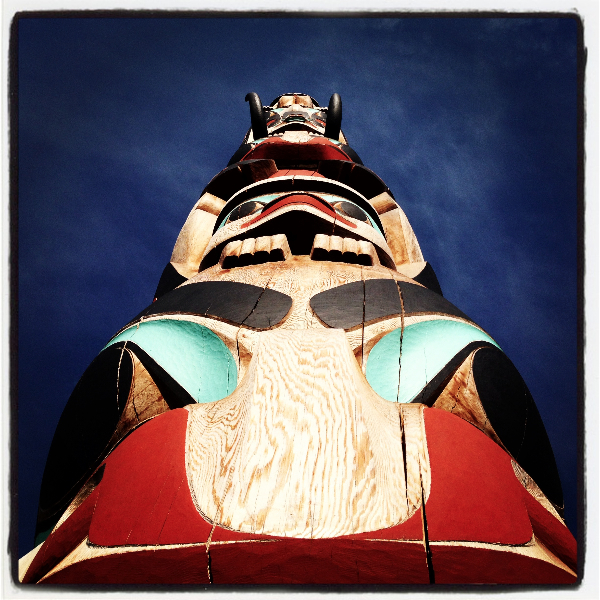
The Old and the New This is a scene I remember from my previous visits to the park: a Saysutshun totem pole welcomes visitors to this timeless refuge, while the shipping lanes on the Strait of Georgia in the background are always busy.
A BC Ferry off Gabriola Island Regular ferry services run on and around the larger islands near here.
Garry Oak Leaves Once upon a time, quercus garryana was a significant part of the extensive hardwood forest across British Columbia, but its range has diminished in the current wet and cool climate, and with the pressure of development. The Coastal Salish peoples managed the forests and used oak wood and nuts.
A Sweep of Beach The island is criss-crossed by a network of trails; I followed the Shoreline Trail anti-clockwise – and saw very few other people.
Impossible Greens This is temperate rainforest – and the spring weather has been even rainier than usual; everything is fresh and bright green, including the new shoots on the Douglas fir (Pseudotsuga menziesii).
Bigleaf Maple – Acer Macrophyllum Afternoon light works its way through the tall canopy to the maples over my head …
Light Falling on Cedars … and onto the western red cedar branches (Thuja plicata) in my line of sight.
Kanaka Bay The woods open out onto the next bay, named for Peter Kakua, the Kanaka (Hawaiian immigrant labourer), who was reputedly buried here after being hung. He confessed to and was convicted of four counts of murder after killing his estranged family in a drunken rage.
Path out of Kanaka Bay I walk back into the woods …
Salal – Gaultheria Shallon … where tough, but delicate-looking plants hide in the moist shadows.
Mallard Lake I don’t want to miss the last afternoon ferry back to Nanaimo, so I cut across the island south of Mallard Lake.
Logs on the Lake The lake was created when an earthen dam was built at the eastern end of a low valley some time after 1890.
A Natural Hide Today, the lake is an ideal spot for watching birds, beaver, and muskrat.
Common Pincushion – Dicranoweisia Cirrata
More Bigleaf Maple
Old Quarry Stones The sandstone quarried here was of superior quality, with a high proportion of quartz. Today, leftover pieces still hold their shape under the advances of moss and undergrowth.
I ♡ a Knotty Tree
Rocks on the Western Shore This is where we would tie up when we’d dinghy across from the boat moorings in Nanaimo.
American Red Squirrel – Tamiasciurus Hudsonicus I get excited when I can capture any wildlife, …
Dark-Eyed Junco – Junco Hyemalis … even when it is just little-brown-birds the size of sparrows.
People on the Ferry Dock I’ve circumnavigated the island at a fair clip, and make it back to the ferry in time to watch the campers unload for the night.
The Ferry A larger ferry operates here in periods of high demand; the Stuywut is a sweet little boat that takes only 12 passengers.
Nanaimo from the Ferry The Beacon, a 26-story condominium complex, stands out on the foreshore as we make the short trip back to the main island.
Harbour Air Incoming I love watching the seaplanes coming in and out of Newcastle Channel. On the left is Saysutshun Island where I have just been.
Pink Dogwood – Cornus Florida I have a two kilometre walk back along the Queen Elizabeth II Promenade to my end-point, but the gardens give me something to look at. (iPhone12Pro)
As well as being a base from which the Snuneymuxw people harvested the annual herring run, Saysutshun Island has always been associated with physical and spiritual healing.
I certainly feel better when I have spent time there.
Petra Theater The monumental theater at Petra is a semicircular auditorium carved directly into the rosy rock. Stonemasons’ marks date the original theatre to the early first century AD, but it was then expanded after the Roman annexation in 106 AD. Older tombs, the remains of which can be seen on the smoothed back wall, were sliced into to make more space.
It was not yet 7:30am. I’m not a morning person, but I was excited!
Our bus was already in the car park outside the Petra Visitor Centre. In an attempt to beat the heat and the crowds, my fellow travellers and I were making our way into this magical ancient city early. We had gone on a walk as far as The Treasury with our guide the afternoon before (see: Petra: Nabataean Marvel), and had our tickets and our maps in hand for a day of independent exploration.
It is hard to know which is more beautiful: the colourful, variegated rocks themselves, or the magnificent Hellenistic architecture that is half-built, half-carved into the surrounding mountains and gorges. The city of Petra was both a necropolis and a busy, lived-in space: the Nabateans(Nabataeans) buried their dead in intricate tombs that were cut out of the rock, but they were also active traders, living onsite and growing wealthy through hosting passing caravans laden with frankincense, myrrh, and exotic spices. After the Roman annexation, the city’s temples and theater were further expanded; during the later Byzantine period, a colonnaded street and churches were added.
Petra was already an established city and the capital of the Nabatean empire before the 1st century BC. The Nabateans were masters at managing water: they built dams to slow flash-flooding; cisterns to store water though long droughts; and conduit systems to manage the flow around the network. The city – particularly this ingenious water management system – was significantly damaged by the Galalea earthquakes in 363 AD, making it unable to support its previous population. Mostly deserted by the 7th century, this once prosperous site was almost forgotten until a Swiss explorer – posing as an Arab – persuaded a Bedouin guide to take him to the ‘lost city’.
Of course, the city was not lost to those Bedouin who continued to live there until they were forcibly removed in 1985 – in time for UNESCO to list Petra and its Bedouin heritage for “Outstanding Universal Value”. Today, a few traders, souvenir sales-people, and pony-ride operators, still camp out in the area.
Almost 50,000 foreigners visit each year. Some years ago, I was happy to finally be one of them! Do join me for some exploration:
Walking into Petra It is an almost two-kilometre walk through some of the more-than-a-thousand tombs in Petra to the start of the Siq – the kilometre long gorge – to the heart of the city.
Bedouin Selling Silver Inside the Siq, Bedouin hawkers have local products for sale.
In the Siq The Siq is stunningly beautiful a natural geological phenomenon.
Textured Canyon Walls All around Petra, the rocks are endlessly intriguing.
Cleaners In the Siq The colours and patterns of the canyon walls change at every turn.
Greenery in the Siq
Caravan Relief These larger-than-life camel feet are part of what was a camel caravan relief sculptured in sandstone.
Lines and Curves On both sides of the passage, there are rock-cut water channels from the original Nabatean water conduit system.
Another bend in the Siq
The Gorge Narrows In places, the Siq is only 3–4 m (10–13 ft) wide.
In the Street of Façades
Tomb BD 69 in the Street of Façades Considering these tombs were probably built between the last third of the 1st century BC and the middle of the 1st century AD, the carving is remarkably detailed.
Colours and Textures on Tomb BD 70
The Theatre I love the rose colour of the seats in the cavea and the colourful striations in the rock face in the back around the ‘windows’ into the old tombs that were sliced open when the theater’s auditorium was enlarged.
Camels and Caves
Royal Tombs High on the western slope of the Jabal al-Khubtha, the impressive façades of some large mausoleums are carved into the rock.
The Urn Tomb – Tomb BD 772 These elaborate tombs are believed to be royal, but there is insufficient archaeological evidence to tie them to particular rulers.
Jabal al-Khubtha The Urn Tomb is flanked to the left by the Silk or Streaked Tomb (BD 770). On the left of that is the Corinthian Tomb (BD 776), so called because of its capitals. The Palace Tomb (BD 765) rounds the hill.
Colonnaded Street Beautifully carved capitals lie tumbled on the old street that was refurbished by the Romans.
Temenos Gate and the Qasr al-Bint Dedicated to the Nabataean God Dushara, the 1st century square building beyond the gate was the city’s most important temple.
Donkeys and the Qasr al-Bint Tourists are not allowed in the Cella – The Cult Chamber of the Qasr al-Bint – and it is fenced off.
Back Exit As I hike up the hill to The Church, I have good views over the Petra hills and the back exit to the Archaeological Park.
Byzantine Church This Byzantine-era Petra Church was built in 5th Century AD after the destruction of previous buildings.
Early 6th Century Mosaics These mosaics in the northern aisle depict a wide variety of everyday things including animals, people, pottery, seasons, plants, etc.
Capital The south aisle contains intricately carved capitals as well as mosaics.
Path from The Church On my return to the main walkway, I pause to look back to the dramatic rocks on the hills around the church.
It was time for a break and a Jordanian coffee before starting out on the steep Ad-Deir Trail towards the Monastery – but that’s for another time.
Working Together A husband and wife have their hands full rebuilding the wreckage of their home in Bungamati, Nepal, almost two years after the devastating earthquake in April, 2015.
In the traditional town of Bungamati – or Amarapur – in the fertile Kathmandu Valley about nine kilometres to the south of Kathmandu, people live and farm simply, much as they have for generations. These are the Newars (Newari): the historical inhabitants of the region.
This settlement site has probably existed since at least the Kirati period (800 BC–300 AD), with concrete evidence dated to 605 AD, in the form of a stele dedicated to King Amshuverma who reigned during the Licchavi Kingdom (400 to 750 CE).
This traditional antiquity comes at a price. Most of the houses were made of traditional mud and brick, so the April 2015 Nepal earthquake (also known as the Gorkha earthquake) caused massive damage – including the destruction of the Machhindranath Temple, which was the central ritual focus of town. According to one site: Machindranath … before modern-day Hinduism and Buddhism, was the most revered God in this part of the world.
I was on a workshop with photographers Jack Kurtz (sadly, now deceased) and Gavin Gough and was visiting some of the historic Newar villages in the region (see: Making Mustard Oil). At that time, almost two years after the earthquake, Bungamati’s residential homes and historic monuments remained in ruins.
All the restoration work that I could see was being done manually, and much of it seemed to be undertaken by the property holders themselves. Although touted as a centre for traditional Nepali woodcarving (more on that some other time), the town had clearly not received the support necessary to rebuild, and many people were still living in damaged buildings or temporary housing.
And yet, life goes on and people keep smiling. Join me for a walk in the ruins.
Bungamati Street We entered the historic little centre via a dusty road flanked by piles of construction materials and buildings in disrepair.
Shells of their Former Selves It is hard to believe people have had to winter here for two seasons already.
Building Materials The whole main street is still a construction site.
Cement and Sand
Woman in a Window Even surrounded by cracking walls and damaged, but beautiful carved timberwork, people still have time to smile at the stranger.
Door Lock
Brick Pile Even the making of the bricks that have been delivered here is a labour-intensive local industry.
Rebuilding Home I love the details that have gone into these buildings! Although small government grants were promised to families in the town, they were slow to be delivered.
Damaged Multi-Story Home
The Card Game Still, people are making the best of it – gathering to play cards and socialise.
Hands at Cards
Winner Takes All I never figured out quite what they were playing, but they were clearly enjoying themselves.
Wall Shrines Hindu worship is a cornerstone of everyday life.
Grandpa and Baby Everywhere in the streets the life of extended families goes on …;
Doing Laundry … as do everyday chores!
The Laundress
Generations on the Stoop
Angle Grinding in the Street Workplace Occupational Health and Safety has a whole different meaning here!
Another Woman in a Another Window
Sitting on the Stoop
Drying Corn The lands around here are fertile, …
Fresh Vegetables … so at least there is no shortage of wholesome food!
Quonset Hut and Propane As charming as these makeshift shelters are, I have difficulty imaging surviving a Nepali winter in one!
Laundry outside a Quonset Hut But, people are clearly making the best of a bad situation.
Unloading Bricks Meanwhile, the work goes on …
Moving Bricks … without gloves …
Bricklayer … or proper footwear.
Portrait of Bricklayers
Couple on the Roof Everywhere I look, work is going on.
Workers at the Brick Piles At another work site, a lot of people are hard at work.
Women at Work As much work as there is to do, the women are happy take a break and smile.
Woman at the Brick Pile
Puppies in the Ruins
I can’t help but admire the resilience of these people as they rebuild their homes and lives.
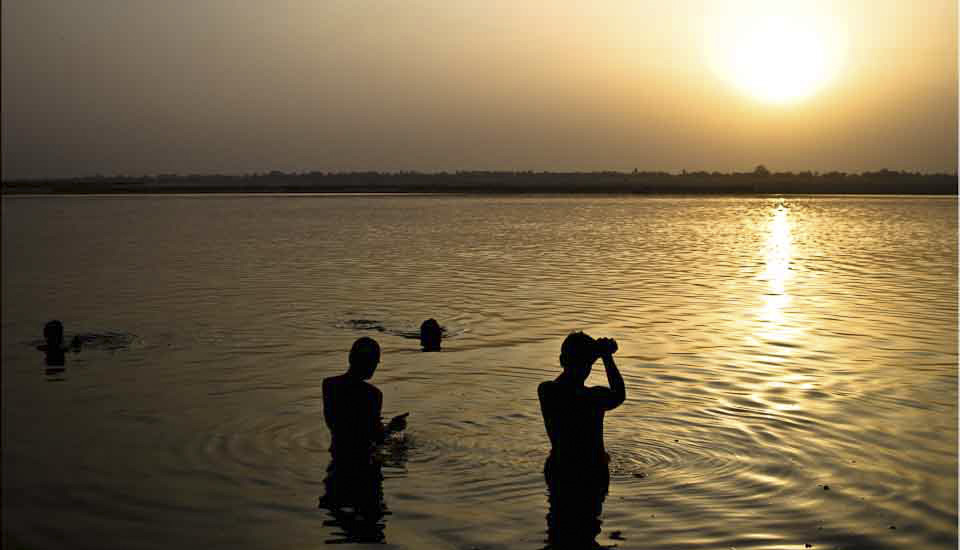
- Performing the Ganga Aarti from Dasaswamedh Ghat, Varanasi
- Buddha Head from Shwedagon Pagoda, Myanmar
- Harry Clarke Window from Dingle, Ireland
- Novice Monk Shwe Yan Pyay Monastery, Myanmar
Packets of 10 for $AU50.
Or - pick any photo from my Flickr or Wanders blog photos.

.jpg)
.jpg)
.jpg)


.jpg)







 Until then,


 I can’t help but admire the resilience of these people as they rebuild their homes and lives.