.jpg) Warrior in Feathers
The tropical rain didn’t dampen the fighting spirit of the fearsome dancers who welcomed us to the village of Mansinam in Western Papua, Indonesia. It is remote. And rugged.
We were met with a mock war-dance: warriors sporting black body paint and carrying bamboo spears and arrows charged at us, while other villagers crowned in feathers danced and sang.
Welcome to West Papua!
The island of New Guinea has been populated for tens of thousands of years – mostly by unique, semi-isolated tribal groups of ethnic Papuans. Little was known about the eastern half of what is the world’s second-largest island until the 19th century, when it was split between German New Guinea in the north, and the British Territory of Papua in the south. Those eastern territories were later governed by Australia before becoming the Independent State of Papua New Guinea (see: Innocent Eyes and Headhunters) in 1975.
The western portion of the island, on the other hand, was visited regularly by European sailors from the late 1500s. Those merchant-sailors were searching for exotic spices – particularly nutmeg – which were only available in this region. The Dutch claimed dominance of the spice wars, and annexed the western part of New Guinea into the colony of Dutch East Indies (for a history of the Spice Wars, see: Nathaniel’s Nutmeg).
The Dutch governed the region until 1962, after which it was granted to Indonesia.
Pulau Mansinam – Mansinam Island – is a small island in Doreri Bay, just east of Manokwari City, West Papua. It marks the entry-point of Christianity into Papua. In 1855, three German-born missionaries of a Dutch Lutheran denomination, landed in Mansinam. Linguists and Bible translators, the two men – Carl Williem Ottow and Johan Gottlod Geissler – are credited with the growth of Christianity in the region. (The wife of Ottow, who was also a missionary, seems to be mostly forgotten.) They are still celebrated on the island every year on February 5th, the anniversary of their arrival.
A giant Jesus figure – which Lonely Planet calls a wannabe Rio de Janeiro statue – dominates a hill as the island’s centrepiece and a tribute to this heritage.
That very-white statue, and the newly built modern Christian church nearby, stand in bold contrast to the tribal welcome that had greeted us.
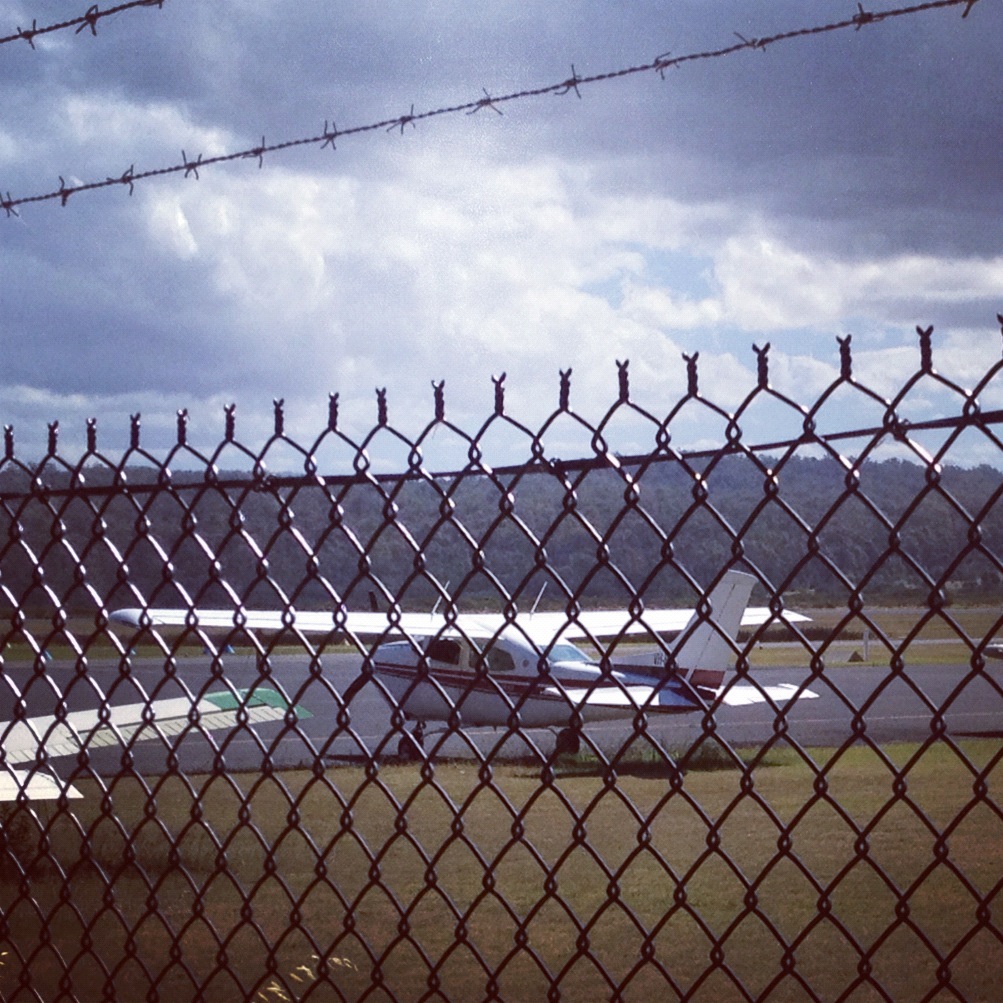
.jpg) Morning on the Darwin Tarmac
My trip started early, with a charter Boeing 737-800 flight from Darwin, Northern Territory, Australia. .jpg) Flying the Flag
The ship I joined, the Coral Geographer, is registered under a Australian maritime flag.  Home for the Duration
We sail out of the Port of Sorong in West Papua, Indonesia in the afternoon … Through the Portal
… and the next morning finds us on the Pacific Ocean above the Doberai Peninsula. From my Room
In the waters off Manokwari Barat, I can see the sun shining over the jungled shores, beaches, and small villages at water’s edge. The First Snorkel
Inside its protective waterproof casing, my iPhone struggled to focus on the abundant fish and corals, but I salvaged the odd shot as a record of my first underwater experience. Warriors Welcome
Our ship docks in Mansinam, and we are treated to a traditional welcome … Warrior in Paint
… with singers and dancers – and warriors in black paint and beads, brandishing weapons. Girls on the Rail
I think everyone in the community has come out to watch us watching them! West Papuan Girls
Many are happy to pose for the camera. Friends Posing Two Girls Welcome
Warriors, dancers, drummers, and singers continue their welcome performance. Blowing the Shell
The blowing of the conch signals the official welcome, … Nixon
… and a local guide describes events for us. Dancing in the Rain
We move under cover, and are introduced to another local dance. Girls Dancing
The performers in traditional dress seem unconcerned by the warm, but drenching, tropical rains. Dancing in a Row
A jumping up-and-down dance performed to song reminded me of one I’d seen the Huli Wigmen perform in the Highlands of Papua New Guinea – to the east on this lage island (see: A Sing Sing, a Mumu and some Cautionary Tales). Feathers in the Rain Singing in the Rain Meet Jesus
Once we are duly welcomed, we are able to walk up the hill to a locally popular Christian pilgrimage site. Little Frog
We stop to admire the fauna. Jesus on the Hill
The statue at the top of the hill is certainly a commanding presence. Like Versailles
The surrounding gardens are full of Western influences. Young Girls
Back at the statue, a couple of local girls are not troubled by the rain and pose happily. Girls with Local Berries
A friend joins them, and they all enjoy berries they have picked from a local tree. On the Path Downhill Supplication
The local guide told me this statue represented people looking for food and help; I could find no further information online. Church in the Rain
Further down the hill, I stop to admire the new church. Apparently, the Indonesian Government contributed to this building, which replaces an older one that has become too small for the growing Christian population. Craft Seller
Everywhere I look, I see the red and damaged gums that are evidence of chewing areca nut (Areca catechu) wrapped in betel leaves (Piperaceae). Warrior in the Rain Warrior in Betel
The man who welcomed us with a bow and arrow has divested himself of his feathered headdress. He gives me a big betel-stained smile as I head back to my ship. Truly a study in cultural contrasts!
 Until next time, Until next time,
Happy Travels!
Pictures: 20-22March2025
Posted in Indonesia,Travel,West PapuaTags: architecture,christianity,environmental portrait,environmental portraits,Indonesia,people,performance,Religious Practice,sculpture,travel,Travel Blog,Ursula Wall,West Papua
Over the Rooftops
How lucky am I? This is the view from the room I was staying in the historic centre of medieval Cahors in the south of France. I love how European cities have protected their historic centres.
And, I love how one doesn’t have to forgo any modern creature comforts to enjoy these old quarters!
Cahors, near Toulouse in the Occitan Region of Southern France, features an old-town centre of half-timbered houses, Renaissance windows, and narrow alleyways.
I had never heard of Cahors – although I’d been in the general region many times before (eg: Weekly Wanders Southern France). On this trip, I took the train south from Paris to visit a friend; one of the beauties of having been an Expat is having friends who live in some less-travelled corners of the world.
Cahors truly was a delight! I’ve posted before about Pont Valentré, the fortified bridge from the middle ages that has become the symbol of the city (see: A Pilgrim Pathway and a Medieval Bridge) and about the beautiful St. Étienne Cathedral (see: The Heart of Cahors), which – like the bridge – is UNESCO-Heritage Listed as part of the French portion of the pilgrim paths to Santiago de Compostela.
I was staying right in the midst of it!
I was lodging in a beautifully modern, retrofitted apartment in a preserved, period-building in the medieval quarter of town. The one bedroom apartment (Bel Appartement), which is usually rented out, belongs to my friend and her partner, and is a short walk from their place.
I was impressed with the whole of the historic town, and marvelled at how all the modern conveniences were nestled into priceless old building of great heritage value.
It was autumn, and so it rained. A lot. But It was still a pleasure walking the cobbled streets among buildings that date back centuries. Join me:
Pont Valentré
First port-of-call on any walk around Cahors is the beautifully preserved bridge that pilgrims have crossed since it was opened in 1350 (see: A Pilgrim Pathway and a Medieval Bridge). Lycée Gambetta Clock Tower
I started my wet-weather explorations early – following my interests rather than the map. The clock tower from the Gambetta boys’ high school caught my eye. I don’t know when it was built, but the building operated as a Jesuit school between 1604 and 1762 – and currently houses a mixed high school. Place François Mitterrand
A walk to the Tourist Office (in the building in the background) takes me through the square named for France’s longest-serving president. Léon Gambetta (1838 – 1882)
The statue of in the centre of the square is of a Cahors-born lawyer and republican politician. Autumn Leaves Jean-Baptiste Bessières, Duc d’Istrie (1768 – 1813)
In the park west of the square, I find another statue: this one honouring a French military leader during the French Revolutionary Wars and the Napoleonic Wars. Southern Magnolia – Magnolia Grandiflora Fallen Leaves Street Art
Keeping a medieval city vibrant and relevant is a balancing act! Medieval Street
The original building fronts hide modern interiors. (iPhone15Pro) Rooftops
The Roman Catholic Saint-Etienne Cathedral (see: The Heart of Cahors) is the centrepiece of the old town, and visible from all around. Cathédrale Saint-Étienne de Cahors
It dominates the narrow streets … Inside Saint Stephen’s Cloisters
… and is well worth exploring. Another Medieval Street (iPhone15Pro) The Dog Fountain
You never know what you will find! In the centre of Place Alain-de-Solminihac is a fountain made in 1992 by Jean-Luc Bertrand, a stonemason in Cahors. Square Olivier de Magny (1529 – 1561)
The town is known for its heritage half-timber houses; several face the square named for a French poet born in Cahors. 12 Rue Daurade
Possibly the most noteworthy is this one from the late 13th century. L’Ange du Lazaretin – the Angel of the Lazaret
In nearby Place Clément-Marot, almost on the doorstep of the north portal of the cathedral, this mournful bronze sculpture by Marc Petit (1961 – ) seems to be crying in the rain for those souls sequestered in quarantine hospitals for people with infectious diseases. Place Clément-Marot
Meanwhile, life in the rain goes on. Arched Doorway (iPhone15Pro) The Little Train of Cahors
A tourist train makes regular circuits with live commentary around town. Building and renovation work – under strictly monitored guidelines – goes on all around in the Rue du Château du Roi. Worn Windows
Renovations are costly – and not every façade is like new. Scooter in a Laneway Renaissance Windows Mail Delivery  The town truly was a delight, and I hope to be able to get back there one day! The town truly was a delight, and I hope to be able to get back there one day!
Until then,
Bon Voyage!
Pictures: 25-28September2024
A Well-Weathered Wooden Boat
Called shikara in Kashmir, spade shaped wooden paddle-boats – with or without canopies – are essential to life on Dal Lake in Srinagar, India. The first day I was on Dal Lake – the centrepiece of Srinagar in the North Indian territory of Jammu and Kashmir (J&K), I felt like I was in a dream – or a Monet painting (see: Floating in a Dream).
The air is hot and thick. The stillness is punctuated by the plunk of boat oars in the water, the soft chattering of waterbirds in the floating vegetation, the distant talking of people on the wooden walkways or in their own boats, and the occasional rumble of a outboard motor.
The lake itself is nutrient-rich, so there is green all around: weeds and water plants float on the surface and tall willows and poplars line the edges and filter the blazing light of an afternoon sun.
I was being lulled into an otherworldly state as I lounged on the cushions inside a covered shikara enroute to a wood-carving workshop, operated by one family for generations: even the crafts in Srinagar are timeless.
The famous traditional shikara boats, used for fishing and transport, and the houseboats that originated in the 19th century so that Europeans – who weren’t permitted to buy land – had somewhere to live, are both generally carved from local cedar-wood. Cedrus deodara, deodar or Himalayan cedar, is a local tree that is remarkably durable and rot-resistant, with a fine, close grain, capable of taking a high polish.
Despite its durability, deodar is not a strong timber, and its brittle nature makes it unsuitable for delicate work where strength is required, such as chair-making. On the other hand, Juglans regia, the common walnut or Persian walnut is a species of walnut prized by fine woodworkers for its durability and lustre. J&K is the only place in India where you find walnut trees, making it the preferred timber for delicate carving and wooden furniture.
The Kashmiri traditions of walnut carving date back to at least the 15th century – variously attributed to Sheikh Hamza Makhdoom (c. 1494 – c. 1576), or Zayn al-Abidin the Great (1395 – 1470). Today, a decline in demand, thanks to competition from mass-produced products, and a reduced interest by young people in becoming skilled artisans (see: Artisans seek revival of dying walnut wood carving), is putting the centuries-old craft at risk.
Join me and a small group of photography enthusiasts in a classic deodar shikara, as we weave through the waterways in search of a walnut-carving workshop:
Man on a Walkway
With the strong Indian autumn light filtering through the willow trees at the water’s edge, and the plants on the surface of the water breaking up the reflections, I feel as if I’m wandering through a Monet painting. Woman Walking Tall
I can’t help but admire the wonderfully regal way with which the local women carry themselves. Busy Waterway
It is a busy afternoon, and there are other shikaras everywhere on the water. Empty Shikara
The wonderfully decorated boats come in all colours. Green Waterways and Tall Buildings Indian Pond Heron – Ardeola Grayii
In a dark corner, a common paddy bird looks for its dinner. Tall Buildings and Narrow Waterways
The waterways continue. Reflections of Wood and Bricks
The buildings seem to be a mix of up-market dwellings and businesses and boarded-up empty premises. Shadows on the Porch
It seems we have reached our destination! The Wood Carver
The master craftsman welcomes us. A Carved Door
We are given a rundown of the history of the business … A Master Carver and his Table Top
… and shown some of the finished products. In the Showroom
The work is detailed and intricate. Choosing a Piece Chiselling a Design
The time-consuming work on that unfinished door continues. Chiselling Detail Himalayan Buzzard – Buteo Refectus
Thanks to distance and low light, this is not a great shot; I include it because I am always impressed by how much wildlife there is everywhere in India. The Woodcarver’s Mother
As is the practice across much of India, this family lives in a multi-generational household. The Matriarch
In a living room completely panelled in walnut veneer, she posed for us near a window. Man and Woman in a Boat
Back on the waterways, life goes on. Young Man Watching
From the walkways across the water, people watch us pass. Vegetable Sellers
The waterways are a hive of activity. Trading Vegetables Women on the Water
As evening falls, the light on waterways lowers, but activity continues. A Quiet Corner Another Paddy Bird
Usually solitary, Indian pond herons (Ardeola Grayii) are very common across the subcontinent. Evening on Dal Lake
When we arrive back at our luxurious cedar houseboats, the sun is setting over the lake, and the world is quiet. I wandered back to my room, still dreamy from the light on the waterways – but I could smell food, and I heard the call to dinner.

Truly, a wonderful first day on the incomparable Dal Lake of Kashmir.
Until next time,
Keep Smiling!
Pictures: 10September2023
Posted in India,TravelTags: architecture,arts and crafts,blog,boats,Dal Lake,environmental portrait,environmental portraits,India,Kashmir,landscape,on the water,Photo Blog,travel,Travel Blog,Ursula Wall,waterways
Wangi Falls
One of the most popular attractions in Litchfield National Park in Australia’s Northern Territory, these magnificent falls are just one of several double-plunge waterfalls in the area. Litchfield National Park is an ancient landscape shaped by water. It features numerous stunning waterfalls that cascade from the sandstone plateau of the Tabletop Range.
So says the official Northern Territory (NT) Fact Sheet.
I hadn’t been in Australia’s expansive – and sparsely populated – central-northern regions for a long time (see: Colours in the Heart of Australia), and it had been even longer since I’d been to the country’s “Top End”. So, I was looking forward to a short stay in Darwin, the region’s capital and main population centre.
But, as much as I enjoyed walking around the city in “wet season”, I made sure to get out into one of the magnificent National Parks nearby. With only a short amount of time available to me, a day-trip to Litchfield – where I’d never been – seemed like the best option.
The park is about 120 km (75 mi) south-west of Darwin, and the bonus is that the roads there are mostly paved. Myself, and two younger visitors from Germany, were picked up from our hotel early, and set off with a driver/guide in a small van.
No thinking required!
Our guide told us that the massive property was willed back to the Northern Territory government as a National Park by the owner, who didn’t want the pristine beauty of the area exploited by his offspring. I can’t corroborate that, but it was originally part of several pastoral leases in the region, and became a park in 1986. It was named for a Territory pioneer: pastoralist, gold miner, and explorer, Frederick Henry Litchfield.
However the Park happened, we can be very thankful that it was formed! It truly is a stunning area – and so accessible to Darwin.
Sunrise from my Room
Darwin has grown since I was last here 20 years ago, but the wet season skies are still dramatic and beautiful. Scenes from the Bus : Water Buffalo (Bubalus Bubalis)
Our guide (who also farms) called these Indonesian water buffalo; their horns are shorter than those I’m used to seeing across Southeast Asia. Water buffalo were originally imported into the NT in the 19th century as working animals and for their meat. Today, they are often farmed for live export. Cathedral Termite Mound
We made a couple of stops at convenience stores to allow us to buy our lunches; our first tourist stop was at a termite mound. Home to a colony of cathedral termites (Nasutitermes triodiae), this feat of architectural engineering – built from mud, plant parts, and termite saliva and feces – is over 50 years old. St Andrews Cross Spider – Argiope Spp
The ripples on the termite mound are host to a few rather decorative spiders. Florence Falls
Breathtakingly beautiful, the segmented falls on Florence Creek tumble down 64 metres (210 ft) from the sandstone Tabletop Plateau into a popular plunge-pool below. On the Metal Walkway
Our guide took us along the Shady Creek Walk, which comprises a metal walkway and a lot of stairs. Blue Spiderwort – Commelina Tuberosa
There were plenty of wildflowers to admire … Under the Canopy
… as we worked our way through the woods … Florence Creek
… and along the creek. Grey-Headed Flying Foxes – Pteropus Poliocephalus
High in the palms overhead, nocturnal flying foxes roost: chattering and jostling continuously. Around the Falls
The falls themselves – when we come to them – are beautiful. Women in the Falls
My travel companions take full advantage of the pleasantly warm waters in the plunge pools. Wet Walls
All around us, the sandstone walls rise steeply … Fern on the Rock Face
… and plants cling to any crevices they find. Rocks in the Creek
Running away from the rock pools, the creek tumbles over boulders … Green Reflected
… and collects in small reflective pools. Almost Abstract : Clear Waters in the Woods Nature’s Artworks : Palm Tree Camouflage
I was told this is a Florence Falls palm (Hydriastele wendlandiana). Into the Grass
The change from Monsoon Forest into Savanna Woodland along our walk away from the falls is as dramatic as it is surprising. A Quiet Corner
And then – back into the woods! Buley Rockhole – Upper Pools
A short drive away, we stop at the Buley Rockholes: beautifully clear, interconnected pools suitable for a plunge. Over the Rocks
Being spring-fed, the Buley Rockhole waters are much cooler than those at the bathing spots under Florence Falls. Buley Rockhole
A short while later as we leave the pools, we could see the dark clouds rolling in – carrying plenty of tropical rain. Elephant Creeper – Argyreia Nervosa Palms and Grasses
Our last stop within the park allows us a short walk along Wangi Creek … Wangi Falls
… to another beautiful segmented waterfall. Crocodile Trap
Wangi Falls is a popular recreation spot, but crocodiles are a very real risk factor, and the area is closed to swimmers after high rains. Golden Orb Web Spider – Nephila Philipes
I love these beautiful, big, spiders. Blue-Winged Kookaburra – Dacelo Leachii
I’m used to seeing laughing kookaburras (Dacelo novaeguineae), but watching a pair of these large kingfishers – native to northern Australia and southern New Guinea – chattering in the trees overhead, was a real treat. Common Crow Butterfly – Euploea Core
It is always a joy for me to capture any wildlife – even these more common types!
Aside from a small freshwater crocodile in a tank at the pub we stopped at on our way out of the park, we didn’t see any crocs – which is fine with me! Dangerous – often fatal attacks – are not uncommon in the north of Australia.
Overall, it was a great day out, and I’d certainly put Litchfield National Park on a list of ‘must sees’ in Australia’s Top End.
Photos: 18March2025
Bricks and Stones
Thirteen months after the devastating earthquake on September 8, 2023, the mud-brick houses of Aït Aïssa in the Azzaden Valley, Morocco, still show the scars. Back in September of 2023, Morocco was rocked by an earthquake – with devastating consequences.
More than 2,900 people were killed and a further 5,500 injured (see: The Centre for Disaster Recovery). Over two million dwellings were damaged – displacing at least 500,000 people.
Although the effects of the 6.8-magnitude quake were felt in the popular tourist destination of Marrakesh, it was nearer the epicentre – 71km (44 miles) to the southwest in Al Haouz Province – where the majority of deaths and injuries occurred. This is a predominantly rural and mountainous area, with tiny villages of mud-brick houses – many of them only accessible by donkey or motor bike.
What shocks me most is how little news of this disastrous event crossed my feeds and into my awareness – even though I had plans to travel to that very region.
Just over a year later, I was staying in the Azzaden Valley, less 50 km (30 mi) from the epicentre of the quake. I had undertaken the rugged 12 kilometer- (7 mile-) trek into the tiny village of Aït Aïssa from Imlil the day before (see: Over the Tedli Saddle), and could fully appreciate how difficult rescue and restoration efforts must have been. (Later in my travels, I was in nearby Ouirgane, where a whole community was still living in tents.)
The Azzaden Trekking Lodge in Aït Aïssa where I was staying calls itself luxury accommodation; it is not as luxurious as the Kasbah Tamadot, the boutique 4.5-star hotel built by Richard Branson in nearby Asni, mind you, but it had everything I needed – including a spa bath in my ensuite! – and certainly was much more comfortable than the damaged houses all around.
After the bone-jarring, muscle-testing hike the day before, I was looking forward to a relatively easy day walking around the Azzaden Valley. Of course, nothing in the High Atlas is easy! The six-and-a-bit kilometre (3.8 mi) circuit was up and down and over and up again – following rough water channels, narrow laneways between broken buildings, and donkey paths into the unknown.
Join me for a walk:
Setting Out
My local trekking guide heads off through Aït Aïssa, past a newly rebuilt building of stone and brick – hopefully reinforced this time! Morning in the Ruins
The morning sun catches the edges of earthquake-damaged buildings. Metal Door
The sun can’t reach all the way into the narrow lanes between the multi-story buildings. Herding his Sheep
Like the many other tiny villages around the Azzaden Valley, Aït Aïssa clings to the side of the mountain. The Azzaden Valley
The valley is green and fertile in the lower reaches, terraced with orchards and market gardens. Apple Crates
This part of the valley is home to apple orchards, … Apples
… and autumn is harvest season. Guide on the “Path”
Some of the “walking paths” follow rough watercourses; without my guide, I’d never have found the way! Into the Sunshine
The water travels downhill; our path flanks the mountainside. I’m still tired from the day before, and my guide has to stop and wait for me at regular intervals. Common Leadwort – Plumbago Europaea Village on the Other Side
Small villages are dotted all around the valley. Apples in the Atlas
Apples are everywhere! My guide got me one from a tree: it was sweet, crisp, and delicious. Red and Green
The steep mountain trail continues winding and dropping, and we end up overlooking an apple sorting and packing operation. Apple Packhouse
The yard is busy with activity, … Worker at the Packhouse
… but the local Berber men working there are happy to stop and have their pictures made. Berber Man at the Packhouse Mosque in the Middle
Every small village is centred around its mosque, with its distinctive square minaret tower. Metal Door and Rubble
Spots of colour contrast with the piles of rubble waiting to be rebuilt. Woman on the Stairs
People in these mountains get their stair-stepping in just going about their daily lives. Woman at Home
Where sections of the buildings have fallen away, you can see how the old adobe structures were reinforced only with straw. Half-Housing
The rebuilding process is slow – but at least it includes steel reinforcement. Girls Snacking
Local girls share a giggle and a snack – possibly walnuts, which also grow in the valley. Girls on their Phone
Some things are the same all over the world. Back in my lodge, two young girls attached to the household were watching videos on their phone … View from the Azzaden Trekking Lodge
… while outside, the afternoon sun shines over the valley. Roads are being build, and houses are being repaired, but it’s a slow recovery in this remote valley of relatively low economic wealth.
I couldn’t help but feel extremely fortunate as I luxuriated in my spa-bath, soaking away some of the aches and pains in preparation for the next day’s early start: around the other side of the mountain and back to Imlil in the neighbouring Ait Mizane Valley.
 Until next time, Until next time,
Stay Safe!
Pictures: 11October2024
Posted in Africa,Morocco,TravelTags: architecture,blog,environmental portrait,environmental portraits,High Atlas,landscape,Morocco,mountains,nature,people,Photo Blog,travel,Travel Blog,Ursula Wall,walk
« Older posts
Newer posts »
|





.jpg)