The other week, someone tried to explain to me how time goes backwards…. (I sometimes lunch with Mathematicians, so this kind of theoretical abstraction is a regular topic at the table.) I confess: I really didn’t get it. As I get older, I swear that time is going faster and I have enough trouble trying to pause it or slow it down!
So, if I don’t understand how time can go backwards, why should I expect that I can travel back through it? If there is one thing I’ve learned living in Thailand, it is that having anything resembling an ‘expectation’ is just asking the universe to throw things at you.
But, none the less, a couple of weeks ago, I thought I could go back in time, and that nothing would have changed. In mid-2009, I took part in a very rushed trip to one of the very edges of Thailand: the exotically named but rather ordinary Three Pagodas Pass, Vajiralongkorn Lake (Khao Laem reservoir), and the remote Ban Wangka, the Mon village across the river from Sangkhlaburi. I’ve always wanted to go back. Sangkhlaburi is an enchanting small town of typical Thai houses and wats (temples) mixed in with guesthouses and back-packer lodging; it is the last stop before Myanmar. It is, however, a very long drive from Bangkok, so you need time (there is that nebulous concept again) and a good reason to go there.
Built in 1993, the longest wooden bridge (400m) in Thailand separates a Mon village from the rest of Sangkhlaburi. (2009)
On the break between Christmas and New Year’s, I thought we had both: time and good reason. We had family visiting from both Canada and Australia, so a visit to the Allied war memorials at Kanchanaburi (more about that some other time) and beyond, seemed like a good idea. I had failed to take “time” into account: the time it takes on winding Thai roads to drive the 200 km from Sai Yok to Sangkhlaburi, and the time that had passed since my last visit.
Change, even change for the better, is considered a stressor. Expectations, realistic or otherwise, can blind one to ‘what is’. So it was, when I arrived in Sangkhlaburi, with (again) too little time, only to discover that they were in the process of renovating THAT bridge, that I almost lost sight of what is still there.
What is still there is a traditional community of Mon people, displaced from Myanmar (not to be confused with Hmong, from China). The community of Ban-Wangka was first established by the Theravada Buddhist monk Reverend Uttama, who escaped to Thailand from Burmese persecution in 1949, after the Second World War. Although he died in 2006, his practices live on. Every morning at 6:00 am the monks from his temple (Wat Wangwiwekaram – วัดวังก์วิเวการาม) do their morning rounds, and the people of the village line up to give alms.
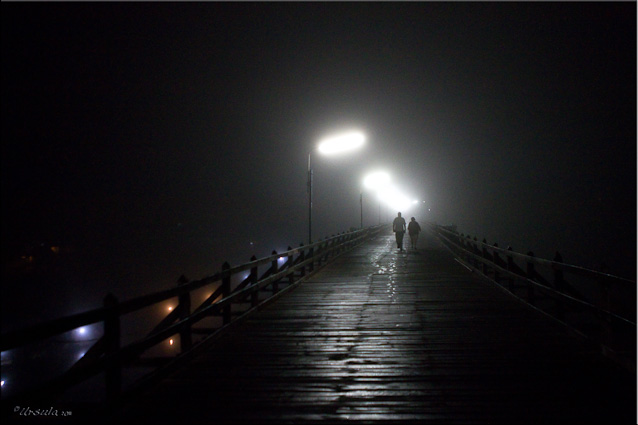
Morning on the New Wooden Bridge (2010)
Monk Offerings: Then (2009)
Monk Offerings: Now (2010)
Slip off your Shoes and Bow your Head: Here Come the Monks!
Who Knew they Could Move so Fast! Here Come the Monks! (2009)
Patiently Waiting
Offerings Ready (2009)
Temple Offerings (2009)
Giving (2009) and Receiving (2010)
Daily Serving of Rice
Giving Alms (Sai Baht ~ ใส่บาตร) is a Solemn Affair without Eye Contact
Monk Receiving Alms (2009)
Monk Receiving Alms ~ Now
Some Things Don't Change! Little Nehn (เณร) ~ Then and Now
By 7:00am the gong sounds, setting all the dogs howling pitifully, and the food is dished up for all the monks in the temple. The rest of the villagers go back to their daily routines...
Monks Heading Home
Little Angel with Flower Offerings
Quiet Afternoon: The Mon Houses of Baan Wangka
Boys on the Bridge: What does the Future Hold?
While theoretical time might reverse, here on planet earth you can never quite go back. For better or worse, things change, times change, we change. I looked at the young men sitting on the bridge and wondered what time would hold for them. How would they bridge the transition from a simple traditional past and the future?
I guess only time will tell, but I can’t help but hope that somehow these people will determine a positive future for themselves, harmoniously incorporating the values of the past. Certainly, time will not stand still.
Just lovely Ursula, nice touch with the before and after photo’s. Time moves so quickly I have to agree… January is half gone, where is the new year going…
love to you bothReplyCancel
The Chao Phraya River (แม่น้ำเจ้าพระยา), which collects the Nan and Ping Rivers in Central Thailand and runs 372 kilometres south to empty into the Gulf of Thailand, is the life-blood of the City of Angels. When Bangkok was established as the Capital of Thailand in 1782, most activity was conducted along the Chao Phraya River and the network of canals that intersected the city. Many of these canals are still in use as transportation routes today, and warehouses and shophouses (which seem old enough to date from those early times!) often open onto the canals or the river rather than the streets. Day or night, there is no better way to see the life of the city than by boat.
I love being on the river. The regular ferry system joins neatly with our SkyTrain and provides convenient, fast and cheap access to points all along the river. Tourists can explore the klongs (canals) or travel up- or down-river by basic long-tail boat or fancy tour boat. Dinner cruises, whether on large ships or converted wooden rice barges, are a great way to enjoy the night lights of the city.
So, there could be no better way to ring in the New Year than by cruising in style on the “River of Kings” – where ancient shophouses rub shoulders with modern executive apartments; where modest boat piers and markets vie for space amongst the high-rise hotels and luxury shopping centres; where the gridlocked traffic is kept at bay, at an elegant distance, on one of the many bridges spanning the water.
The Elegance of the Dance
Chinese Temple Lights
Wat Arun ~ Temple of the Dawn ~ Magnificent by Night
The Grand Palace: Built in 1782, During the Reign of King Rama I
The Rama VIII is my Favourite Bridge
Rama VIII Cable-Stay Pattern
Rama VIII Lights and Strings
Chao Phraya Night Life
Rice-Barge with Faerie-Lights
Fireworks on the Chao Phraya
So Close we can Touch Them!
An Impressive DIsplay
"Bangkok We Love You" ~ Happy New Year ~ สวัสดีปีใหม่
Strictly speaking, “Chao Phraya” means “Noble General of High Rank”, but the river has been dubbed the “River of Kings”, and that has a much better ring to it! Certainly, it is a river fit for kings and all the Kings of the current Chakri dynasty have made extensive use of it, often via the ceremonial Royal Barges. Our somewhat more mundane transport was still a great place to launch 2011.
The New Year’s period is a time of celebration around the world. Although Songkran in April is the ‘traditional’ New Year in Thailand and is still celebrated in its own inimitable fashion, the transition from December 31st to January 1st is formally recognised as the start of the new year and is cause for parties, fireworks and gift-giving.
For me, New Year’s is usually a time of quiet contemplation; the time when I reflect on the past year, trying to use the lessons from it to build a plan for the year ahead – like the lotus, rooted in the mud and reaching for the heavens.
The Christmas Tree is Ready at the Mandarin Oriental Hotel
This is a wonderful time of year in Bangkok. It is officially “Cool Season” [ฤดูหนาว], which means that most days you can walk around without breaking into an immediate sweat. It is also the season of lights and decorations. Some festive decorations go up for The King’s birthday on Dec 5th – then, although 94.6% of Thais are Buddhist, the city adopts Christmas as if it was born to it… any excuse to dress up and party!
Traditional Christmas Trees at Q-House Lumpini
Non-Traditional Christmas Trees at Q-House Lumpini
Even the Girlie Bars on Patpong (พัฒน์พงษ์) get into the Christmas Spirit
How Many Mixed Cultural Symbols Can You Find in One Picture?
Christmas Lights: The Perfect Backdrop
The Perfect Backdrop for Holiday Photos
Candles on the Peninsula Stairs…
… Another Photo Op!
Reflections of The Peninsula
Christmas is for Kids: Battle of the Toys
Christmas Shopping ~ Paragon Shopping Centre
Pink Bells ~ Paragon Shopping Centre
For a few weeks, just as in any Western country, Christmas songs and carols can be heard everywhere. They are blasted from loudspeakers in the shopping centres and train stations. They are played on the radio and in elevators. They are performed on the streets and at the various parties and luncheons. At one lunch I attended, we had not one, but two groups of orphans singing in return for their visit with Santa. Christmas in Bangkok is not only about bright lights, parties and shopping; it is also a timely reminder of those less fortunate.
Singing for Her Supper ~ one of the many AIDs orphans of Klong Toey.
Thais are happy to “celebrate” Christmas, in terms of the trees, and the lights, and the gifts, and all the other trappings. As I said earlier, any excuse for a party! But, the spiritual practice of most Thais is grounded in the Hindu/Brahmin/Buddhist traditions, and is very much a part of daily life, every day of the year. The evidence is everywhere: every house and business has either an animist spirit-house or a Chinese shrine, or both. People routinely get up early to give rice and other food to the monks walking their morning alms rounds. Buddhist ceremonies are an integral part of all major life-events like births, deaths, and marriages, and blessings are sought for most other changes, like new houses or new cars. In the course of their daily lives, Thais wai or ‘pay respect’ to statues of Kings or Buddhist Abbots, Buddha images and shrines for Hindu or Brahmin deities.
The Erawan Shrine, One of Bangkok’s Most Important Hindu Shrines, is Busy Every Day of the Year
Candles and Incense
Anyone Can Say a Prayer… Any Day of the Year
May the Spirit of the Season be with You.
May the spirit of the season be with you! Happy Holidays.
[…] But, even though December 25th is a normal working day in Thailand, the country goes all out to decorate for the season. Aside from a rather tacky Nativity scene at our local shopping centre, the neighbourhood around […]ReplyCancel
[…] But, even though December 25th is a normal working day in Thailand, the country goes all out to decorate for the season. Aside from a rather tacky Nativity scene at our local shopping centre, the neighbourhood around […]ReplyCancel
“All objects, all phases of culture are alive. They have voices. They speak of their history and interrelatedness. And they are all talking at once!” Camille Paglia
The Roof of the World? Pha Taem National Park, Ubon Ratchathani
I grew up in North America where the artefacts of culture are relatively modern. By contrast, Asian cultural objects speak of time… endless time… with it’s ebb and flow of history and change. I know that this is so, but being able to traverse from prehistoric artefacts, to ancient temples, and then to modern arts and crafts in the space of hours and kilometres, still surprises me.
The fertile Mekong river valley between Ubon and Laos was home to an agrarian people thousands of years ago. They left their mark in red paints made of soil, tree gum and fat, on a 200 meter stretch of cliffs at Pha Taem. These paintings, depicting scenes of rice cultivation, as well as elephants and enormous fish traps, are thought to be between 3000 and 4000 years old.
Overlooking the Mekong and Laos: Pha Taem National Park, Ubon Ratchathani
Modern Markers: Cairns under the Cliffs of Pha Taem
Under the Cliffs: Pha Taem National Park, Ubon Ratchathani
Ancient Rock Art : Pha Taem Cliff Paintings
Visiting Monks: Pha Taem Cliff Paintings
Thai Guide and his Protective Stones ~ Amulets and Ruesi, the Hermit Sage
Home, not just to the Mekong, but also two of it’s major tributaries, the Mun and the Chi, this area has been at the crossroads of competing cultures and warring empires for centuries. As I mentioned last week, Khmer influence is seen in the local silk designs. It is also evident in artefacts housed in local museums and the many temple ruins that dot the landscape.
Khmer Head, 11th Century, Surin National Museum
Krishna's Battle with the Beasts: Angkor Wat Style, Surin National Museum
Hindu Sanctuaries: Prasat Ban Phluang (11th -12th C Baphoun Khmer Art)
Religious Crossroads: Living Bodhi Tree and Ancient Stone, Prasat Ban Phluang
Ancient Sandstone Carvings, Prasat Ban Phluang
For all their monuments to civilisations past, these are living, breathing communities. In the out-of-the-way rural village of Ban Chok, we found a woman fashioning ‘Prakueam’, or round metal beads of silver or gold made into jewellery. The daughter of a man who makes large silver ornaments for public buildings, she uses a centuries-old Khmer tradition to make delicate pieces with a surprisingly modern appeal.
Jewellers Workspace ~ Turquoise Flower
Finished 'Prakuem' Silver
Silver Beads ~ Jeweller's Workspace
Jeweller Working on Silver
Fine Work ~ Prakueam Silver
As the ultimate tribute in stone, it is hard to go past Ubon’s 22 meter-high ‘candle’ in an ornamental boat, guarded by a mythical garuda. The sculpture, which was completed in 2000 to honour the current King, the ninth king of the Chakri dynasty, pays tribute to the giant bees-wax sculptures which are carved in Ubon every year and paraded through the streets during Phansa (Buddhist Lent).
Tying the Ancient and the Modern: Candles in Stone
Truly symbols of Thai culture’s‘history and interrelatedness’!
- Performing the Ganga Aarti from Dasaswamedh Ghat, Varanasi
- Buddha Head from Shwedagon Pagoda, Myanmar
- Harry Clarke Window from Dingle, Ireland
- Novice Monk Shwe Yan Pyay Monastery, Myanmar
Packets of 10 for $AU50.
Or - pick any photo from my Flickr or Wanders blog photos.


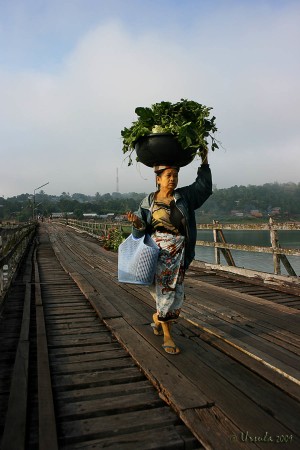 Mon Woman on the Sangkhlaburi Bridge (2009)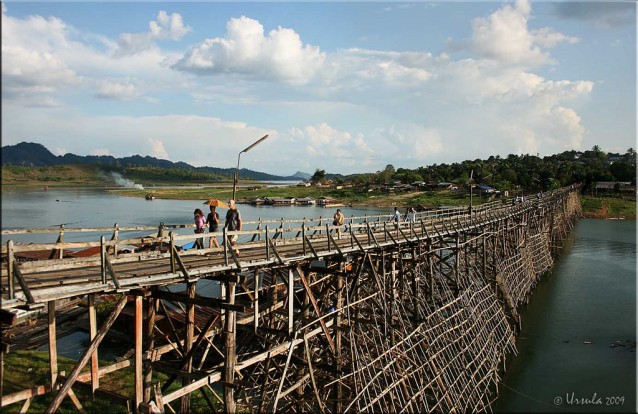











Just lovely Ursula, nice touch with the before and after photo’s. Time moves so quickly I have to agree… January is half gone, where is the new year going…
love to you both
Thanks, Signe! Stay well. 🙂
beautiful linkage 🙂
Some great portrait shots Ursula!