If you have very little to start with, it takes very little to make a big difference.
Attapeu province in the southernmost part of Laos provides access to the infamous Ho Chi Minh Trail and two National Diversity Conservation Areas – and very little else. During the French administration it was a base for Nation Liberation and, as a consequence, was totally destroyed during the war against imperialism. It is still relatively undeveloped and is home to at least 14 ethnic groups living in traditional communities. As of 2003, the average income was less than $200 per head per annum.
Laos as a whole is still predominantly rural, with a high birth rate (3.22 children per woman; ranked 56th out of 223 countries, as reported in the CIA World Factbook, 2010) and a high infant mortality rate (61.19 deaths/1,000 live births; 35th in the world). In remoter areas like Attapeu, these figures are likely to be higher, and the burden of care falls upon the women. I mentioned last week how Khun Napat Sirisambhand, an enthusiastic Thai working with a small World Bank grant, was helping the Attapeu Lao Women’s Union support local cottage industries – in particular, basketry, pottery and weaving.
So it was that in January of this year (2011), Khun Napat took a number of members of the Thai Textile Society to visit the Taliang people of Ban Sivalai, to see how these village weavers have succeeded, in a small way at least, in turning their traditional cotton ‘belt-loom’ or ‘back-strap’ weaving into a cottage industry that produces something marketable in the twenty-first century, generating income for their community.
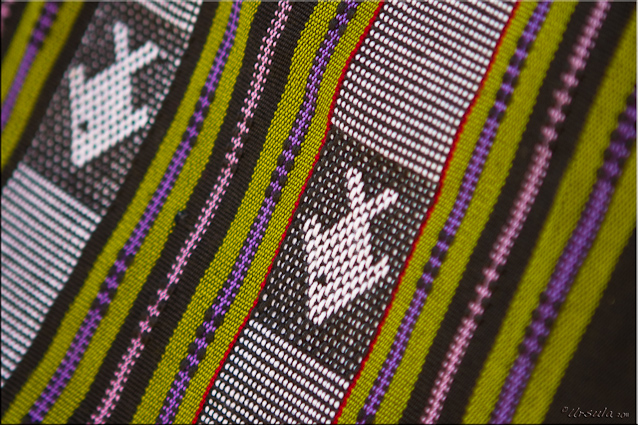
Taliang Cotton Fish
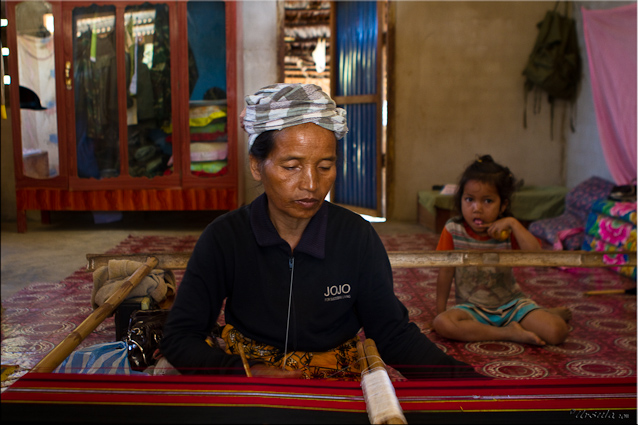
Everyone Works: Granny Reeling while Orphaned Grandchild Sits Behind
Belt-Loom Weavers on the Porch
What are They Looking at?
Support Worker from the Attapeu Lao Women's Union
Back Strap or Belt Loom Weaving
Close Work
Pieces produced by Back-Strap or Belt-Loom weaving are limited by the width of the strap and the length of the weaver’s legs. For traditional clothing, finished pieces were often sewn together. Khun Napat found Lao cottons to be of inferior grade for commercial purposes and so takes Thai cotton and Thai cotton-silk blends into Attapeu for the women to turn into colourful table-runners and place-settings for international sale.
Traditional Patterns in New Textiles with Natural Dyes
Inside the Community House
I watched a woman finish an olive green runner with white frogs patterned into it and couldn’t resist! She charged me 50,000 Kip – roughly US$6.20 – for something that had taken her a couple of days to make, and we both went away happy.
Olive Green and Mine!
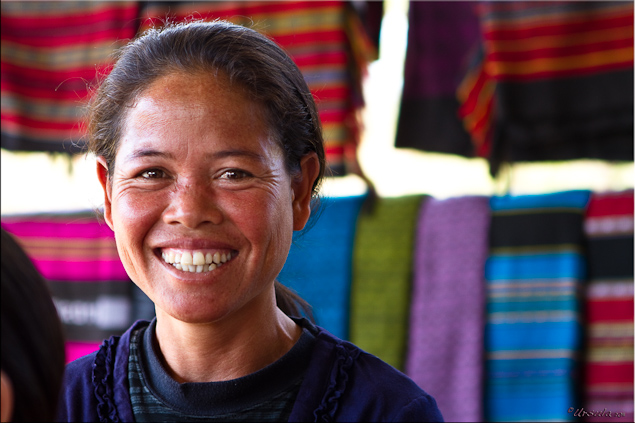
My Weaver ~ a 32 year old mother of two with a third child arriving shortly. I have no idea why she was wearing a shower cap!
Communal Kitchen ~ Ban Sivilai, Taliang Village, Laos
Still-Life Found : Ban Sivilai, Laos
New Wooden Home, Under Construction, Ban Sivilai, Laos
Unusual toys: A Tin Can, a Lump of Dung and a Rock
Bits of Bread and a Bike
Taliang Baby with Bread
I watched the children playing in the dirt, as one hammered an aluminium can into submission and another pounded a plastic bag of cow dung with a rock. I watched the determination with which all the children greeted the bits of bread rolls we had left over from our breakfast. Solemn and unsmiling.
Certainly, some of the women we met here have energy, intelligence and enthusiasm. These are the ones who go outside the community to attend workshops to learn how to develop their methods and improve their products. These are the ones who keep these marginalised communities moving forward. Over time, small projects like this one have make a big difference. I shake my head at what conditions must have been like some twelve years ago.
Amazing the simplicity in which they live, we have children here that more is not enough and yet these children sit and play contently with very, very little… amazing people, wonderful pictures and i agree what must it have been like before it this is how it is now…
[…] reminded me how much I love Laos: the songs, dances and smiles of the people, the brilliant hand-woven fabrics, the colourful markets, the ethnic villages, the beautiful countryside… I’m less fond […]ReplyCancel
Lawae Woman with Traditional Face Tattoos and Elephant Tusk Ear Plugs
Bong! Bong! Bong!
The sound of gongs reverberate in my head; deep, surprisingly melodic tones that almost transport me back to Bhutanese monasteries… But in this image there are no tall, ornately carved and painted wooden buildings; in fact we are outdoors on dusty ground, surrounded by dry trees, old people and children, with few buildings at all.
Lawae Elders Welcome us with Gongs
A Lawae Woman Beats a Gong while Others Sing and Clap
I’ve heard of writer’s block. What I had didn’t feel like a block – more like a maelstrom. Images, sentence fragments and half-formed ideas were swirling around my head at dizzying speed. I felt like I was caught in a twister; no – a dust storm.
It was late January, and I had just returned from Attapeu, one of the southern-most provinces in Laos. I was supposed to be writing a nicely-structured one-thousand word photo essay about the textile weavers there. That may sound easy enough, but I had come home with an over-packed suitcase, hundreds of photos, dust in every pore of my body, impressions in every cell of my brain and no idea where to start. My thoughts were as jangled as my bones and nerves after four days of bouncing over the patchy tarmac highways and dusty dirt-pack backroads of southeastern Laos in a van as one of a group of nine individuals – individuals with experiences and dispositions as different as their own cultural backgrounds and nationalities. In fact, as diverse as those communities we were travelling to visit! It is so easy to forget that one of the joys (and challenges) of travel, especially in remoter regions, is the journey itself and the people one shares it with.
It always takes me a while to sort through and digest my impressions of a trip, especially one as rich with experience as this one had been. The journey we had embarked on was a Thai Textile Society trip, involving a one hour flight from Bangkok to Ubon Ratchatani in Northeastern Thailand and a 385 kilometre drive. This doesn’t sound like much, until you factor in nine personalities, assorted stops, and the vagaries of an overland border crossing at the small town of Chong Mek. I left my home before light and reached the hotel after dark, following what was an interesting but extremely long day.
Attapeu is not one of the more frequented tourist destinations in Laos. We were there principally because our group leader, Khun Napat Sirisambhand, has been working with the local women’s organization, the Attapeu Lao Women’s Union, for the last eleven years. With the initial support of a small World Bank grant, they are working together to help develop the quality and promote the marketing of indigenous crafts, in particular: basketry, pottery and weaving. I was there because it was an opportunity to travel ‘off-piste’ and because I see this sort of small community development project as a perfect way to support local self-determination. My travel companions were there to learn about the local weaving methods and to buy textiles.
Our first morning out, we travelled 45 kilometres south of Attapeu, much of it on dirt roads, to the small Lawae village of Pu Wong. Laos is a relatively small country with a population of only about seven million people. In spite of this, according to official government documents there are 47 recognized ethnicities – with over 160 minor ethnic groups speaking 82 distinct living languages. Attapeu has only about 115,000 people, but they comprise of 14 ethnic groups, many of whom cross the southern borders into neighbouring Cambodia.
Traditional Beads and Welcome Songs
Elephant Ivory Ear Plugs and Beads
The Lawae (or Lavae, Brao or Brow, but not to be confused with the Lave or Lavi!) come from the Mon-Kmer language tradition. Traditionally, the women have worn earring plugs made from elephant tusks, with the size determining social status, and have cut the middle of their front teeth and had their faces tattooed for beauty. While these customs are dying out, the older women in the community we visited were living examples. What is not dying out is the pipe: small tobacco pipes were an almost permanent fixture in the mouths of many of the women! These villages have no weaving tradition; in the past, the Lawae have made clothing from tree bark fibre. These days, they tend to opt for fabrics from the local markets.
The whole village turned out to greet us with those musical gongs, singing and dancing. The dances, as is the case in most of the region, pay tribute to rice and its place in the cycle of life. Some of the songs were accompanied by what looked like a bamboo pole. It is quite amazing that comes out this simple length of bamboo when it is clapped with a cupped hand at one end by one person while someone else claps their hands rhythmically at the other end.
Singing Children
Singer and His Fan - He had a terrific voice, but what amazed me was his 'Mike Technique' in a village with no electricity!
Playing the Pipes
Magic Smile!
Looking to the Future
This community seems to comprise far more then the national average of 41% of population between newborn and 14 years… children were everywhere! Houses are simple bamboo structures with cooking and food preparation done out doors. Although there was electricity nearby, it didn’t reach most of the homes, and of course, running water was a pipe dream. While we were there, the elders punctuated their pipe-tobacco smoking with drinking with straws from the communal rice wine pot.
Hanging with His Sister
Smoking Gran ~ Notice the Tattoo Remnants and the Elongated Ear Lobes
Around the Rice Wine Pot
Straw in the Rice Wine
"Me and My Gran"
Just Chilling
Smiles all Around ~ Notice the Filed Front Teeth on the Older Woman.
Smiling Elder ~ This Woman was a Great Character and Clearly a Village Leader!
Open-Air Kitchen - Preparing Chicken for Dinner
Lawae Child at Home
Lawae Grass Homes, Pu Wong District Town
It's a Long Way Home! Pu Wong District Town
So, I’ll keep the weavers for next week, and leave you in the mean time with the rich earthy smells of dust, tobacco and rice wine, and the sounds of gongs and laughter.
still think you should be compiling a book of your travels… these are amazing and mostly unheard of – fabulous as always and look forward to the next installment, certainly a pleasant diversion from electioneering ;-DReplyCancel
Ursula -February 11, 2011 - 5:02 am
Thanks, Signe! I’m impressed you had time to look in with your busy schedule. Council meetings sound like my idea of hell.
If they come to my door with a book deal, I’ll let you know!ReplyCancel
Nice job! I think these are some of your most compelling images and make for a lovely set. Love the boy with the imaginary microphone and there are some really delightful portraits in this collection. Good on you.
[…] particular trip, to Attapeu and to the Lawae and Taliang villages in the region, was rich with cultural experiences. But, I find it is often […]ReplyCancel
[…] reminded me how much I love Laos: the songs, dances and smiles of the people, the brilliant hand-woven fabrics, the colourful markets, the ethnic villages, the […]ReplyCancel
very nice photos, here is the music that goes with it
KINK GONG MUSIC CATALOGUE
IS A COLLECTION OF ETHNIC MINORITY MUSIC YOU HAVE PROBABLY NEVER HEARD BEFORE : 142 CDs
2 LP 12″ GONGS OF CAMBODIA & LAOS on TIGER GONG PARIS F 2013 https://soundcloud.com/gongs-of-cambodia-laos
Have you ever wondered where your salt comes from? No – I haven’t either! Salt is one of those many things we tend to take for granted.
Salt Pans, Samut Sakhon
In Thailand, most of the salt used comes from brine salt-farms, and the largest number of these brine salt farms are close to Bangkok, along Highway 35 in Samut Sakhorn. We’ve driven past these large square fields that resemble rice patties – except for the obvious absence of rice – many times, and I’ve often commented that they’d be worth photographing, but we’ve always been in a hurry to get somewhere else. This week, driving home from the delightful beach town of Hua Hin, we stopped for coffee at a petrol station right next to one of the many salt farms. Well, the temptation was irresistible and I wandered into one of the all-but-vacant lots.
Entry to the Salt Pans: Planks and Steps off the Highway
Wooden Roller
Rolling Machine at the Salt Pans
Equipment and People at Rest
Briny Wicker Basket
Like the Outdoor Ice-Rinks of my Childhood!
Tropical Zamboni?
It wasn’t long before people came out to chat to us. I did my best to ask intelligent questions about the salt pans: “How long does it take to produce the salt?” “One month.” “This one,” I asked, pointing to the piles of salt, beautifully dotted around the paddock. “Ready,” I was told. “This one?” I indicated the the smooth surface with the wooden rake lying in it. “ยัง – Not yet,” was the answer. That just about exhausted my Thai for the day, so we had to satisfy ourselves with smiling a lot. My companion looked at his watch: “Three-thirty!” he exclaimed, as if that was important.
Sure enough, as if by magic, people appeared from everywhere and the salt pan which was ready became a hive of activity: men and women in socks, boots or bare feet, walked out to the piles and set to work. For the most part, the women shovelled the salt into bamboo carry-baskets, and the men, balancing a basket at each end of a long carry pole, carried the salt back to the store room.
To make the salt, the prepared fields are flooded with sea water pumped in from the near-by Gulf of Thailand, dammed, and left to dry naturally in the sun. When the water has evaporated, the salt is piled and taken away to be cleaned and bagged for sale: on the roadside, in local shops and internationally. According to a web-blog source (and I could find no other reliable data), Thailand produces a million tonnes of salt each year. From what I saw, each pound is labour intensive!
Working in Concert
Moving Baskets
A Moment’s Pause
That Thai Smile is Never Far Away!
Working the Salt Fields
Elders Continue Working…
Raking Piles into Baskets
Salt Foot Scrub?
Levelling the Salt with Nonchalance
Socks in the Salt
Salty Reflections
Keeping the Salt Farms Tidy
Somehow, Spilt Salt Seems More Serious when You See How Much Work Goes into Each Bag!
Buy it From the Source! Salt and Salted Fish (ปลาสลิด) for Sale. The Woman is Waving her Hand to Ask Passers-By to Stop, While her Dog Sleeps in the Shade.
Food for thought when you next salt your eggs! Happy Travels.
Hi Ursula many thanks for the link to my photoblog. The stats came from a Bangkok Post article and Wikipedia, as you say they are difficult to come by.
I have relatives in Samut Sakhon, so I usually stop near the farms if we are visiting.
BTW did you know that production ceases during the rainy season(probably obvious why)?
You have a very nice blog and I think the photos are great.
Hi Mike! You obviously had more luck with Wiki than I did. I tried the Bangkok Post link, and they sent me to the front page. I thought your page was great – and daily!! My gosh, weekly is killing me! 😉 Oh well. And, yes, I know all about rainy season! 🙂
Greetings Cathy and Signe! Nice to see you both. 🙂ReplyCancel
Paul -September 14, 2011 - 9:09 am
Hello Ursula, a wonderful set and comments. I travelled along this road from Hua Hin last year but I do not remember seeing the salt fields. But now I have seen these photos I may try and visit this area when I next visit Krung Thep.
Thanks for visiting, Paul!
We’ve driven past so many times – always in a hurry to somewhere else! This visit we were lucky – we stopped mid afternoon on our way back to Bangkok and wandered into the salt pans while it was quiet… not a soul around… Within half an hour, the place came to life, and everyone set to work! The workers were mostly happy to have me hanging around, which was nice. 🙂ReplyCancel
janice -March 25, 2012 - 2:32 am
I was vacationing in thailand in january. I did see these salt fields on are way from Hua Hin to Pattaya. They were very interesting……ReplyCancel
[…] Para conocer más acerca de la recolección de la sal marina visitar el fotoblog: Sal de Samut Sakhon, Tailandia https://www.ursulasweeklywanders.com/travel/salt-samut-sakhon-thailand/ (Inglés). […]ReplyCancel
Tan Beng Kiat -June 28, 2018 - 7:00 am
Dear Sir ,
I would like to know this salt manufacture company as I ‘m interested to buy direct form them . Contact No 0832933838 Khun Tan
Hello Ursula, for a long time I have been dealing with salt ponds or the production of white gold by solar evaporation. Now I found these beautiful shots of the salt mountains and the people doing their hard work on the salt fields. This impresses me a lot and also your photos, which captured everything. I send you best regards from autumn Germany and wish you a lot of fun with your photo projects.
Hans-Joachim EngelhardtReplyCancel
Hi Hans-Joachim!
Thanks for your lovely greeting. I’m so sorry to be so slow in replying: I have been travelling in lands with no internet. Enjoy your autumn!ReplyCancel
Tallwahl -December 3, 2018 - 7:37 am
Read the book “Salt”. It’s very interesting on the subject we all probably take from granted.ReplyCancel
Morning markets in Asia are a jumble of surprises – people and products rubbing shoulders in unexpected combinations. The morning market in Attapeu, southeastern Laos is a great example: a treasure trove where the nails are next to the make-up and crayons; where you can buy live catfish or invest in the nets to catch your own; where the weak fluorescent lamps can neither illuminate the dark interior corridors nor compete with the brightly angled early sunshine outdoors.
Who said money doesn't grow on trees? These money trees are to offer the local Buddhist temple.
I love morning markets – except for the fact that they are so very early in the morning! I am really not a morning person… but the morning markets in Attapeu, southeastern Laos, start early – very early. By the time I was up and out at 5:30am, this small frontier town at the confluence of the Xe Kong and Xe Kaman rivers was already coming to life. Crossing the rivers on precarious little ferries that look like grass huts on pontoons, vendors and buyers from outlying areas were already arriving in town with their motorcycles, their shopping baskets and their trussed pigs and chickens. Shop keepers with permanent places at the outer edges of the large shelter that comprises part of the market were rolling up their metal doors and organising displays of hanging baskets, clothing and fishing nets.
Coming into Attapeu
Heading from the Ferry to Market
Morning has Broken: Motorcycle coming into Attapeu
As much as I love markets, I do find them challenging – both personally and photographically. I’m not petite, and once I have my ThinkTank around my waist and a camera or two around my neck, I take up a lot of room! Under-cover markets can be dark and crowded, with narrow aisles and a lot of people. They are wet underfoot in places, with boxes, uneven surfaces and other obstructions in others. When it comes to taking pictures, I have difficulty with the low light and high contrasts; as well with the tight spaces. Sometimes, sights and smells can be confronting.
Local Butcher
Food is central to the markets: raw, cooked or still wriggling – everything is right here!
Kitchen Fires
Chicken Little
Portable Take-Away "Food on a Stick" is Everywhere!
Making Banana Fritters for Breakfast
Banana Fritters: Delicious!
Catfish Wriggling
Buffalo Hide for Jerky?
The best part of local markets for me is the insight it gives me into people’s lives, and the opportunity to interact with ‘true’ locals. Laos must be one of the most ethnically diverse countries in the region: Attapeu province alone, with it’s meagre population of 114,000, is home to fifteen ethnic groups, and the local market plays host to many of these. Although there are numerous local languages, most people speak Lao, and between their Lao and my Thai, I can generally have small conversations. The people were engaging, willing to chat and mostly happy to be photographed.
Lao Smiles
Chiildren of Vendors Have to Make Fun Where they Can Find It!
Lao Woman Selling Clothes from Thailand
Local Lao Silk Weaves
Lawee Child
Lao Man
Not Everyone is Happy to be at the Market!
If You Have no Customers, Use the Products Yourself!
Markets can give you a real sense of what is important in people’s lives. My travel companions were in search of woven baskets and silks; the two products that most got my attention were fishing supplies (river fishing is critical to livelihood here) and lumps of white stuff, which I finally worked out were brewers yeast, for making the ubiquitous rice wine!
Wicker and Broom on Main Street, Attapeu
Tiny Metal Weights hang like Tear Drops on the New Nylon Fishnets
Brewers Yeast by the Bag Full - For Rice Wine by the Bucket-Full!
Meat and Fish: Waiting for Customers... (The red face on the woman at the left is a relatively common local condition. We were told it is the consequence of the excessive use of skin-whitening products.)
Mattresses and Motor Oil For Sale in the French Colonial Shop-Houses
Heading to the Ferry With a Supply of Aluminium Pots: Heading Home, or to the Next Market?
Great interesting report again, nice reportage style of photographs developing too 🙂
Are you sponsored by Thinktank? (lol joking) I use Thinktank stuff too and absolutely love their solutions for travel/street work.
Funny about the language thing, you seem to agree with my findings; that if you are able to speak a reasonable degree of Thai, combined with some words and phrases in Lao/Isaan you pretty much have no problem communicating.
The Colours of the Wind Welcome Visitors to the Jim Thompson Farm
Some people are larger than life. James Harrison Wilson Thompson, more commonly know as Jim, or even ‘Lord Jim’, is one such person. He is, amongst other things, credited with single-handedly revitalizing the commercial Thai silk trade. An Office of Strategic Services (OSS; precursor to the CIA) operative during the second World War, he resettled in Thailand where he was involved in a number of artistic and business ventures. At the time, Thai silk was produced in the countryside for local consumption, and was dying out because of cheap synthetic and cotton clothing imports from China. Thompson saw a potential niche, and with his natural flair for style and colour created designs which he promoted to high-end over-seas markets, gaining international recognition for his success and for the product.“Simply put, the name Jim Thompson is Thai silk, and the man has become one of the most famous foreigners to have ever lived in Thailand if not the whole of Southeast Asia.”
Then, on Easter Day 1967, at the age of 61, he took a walk in the Cameron Highlands, Malaysia, and was never seen again. Theories explaining his disappearance abound, but none has any reasonable evidence to support it, and no trace of him was ever found. He did, however, leave a legacy as rich and colourful as his life. The house he rebuilt in Bangkok from multiple traditional Thai teak homes and filled with precious artefacts from all over Asia, is registered as a national museum and is well worth a visit. This, together with some of his other properties, is now operated by a foundation in his name. Under Royal patronage, the James H. W. Thompson Foundation is dedicated to supporting Thai arts and artists; and the preservation and conservation of Thailand’s rich cultural heritage, especially with regards to textiles. A company bearing his name grows, cooks and serves organic produce and still manufactures, markets and sells high-quality silk products.
One of the properties, the Jim Thompson Farm, is open to the public just three weeks a year, over the December-January holiday. Art installations are on display across the farm: the work of eleven invited artists-in-residence who have studied the farm, the nearby silk factory, and the surrounding Isaan community.
Art on the Farm
Art on the Farm: Artists in Residence Interpret the Farm and Nearby Silk Factory
Art on the Farm: Bales and Pumpkin
Art on the Farm: Pumpkin
Nature's Art: Cosmos Field
Nature's Art: Rice on it's Element
Patterns: Rice on the Farm
Art on the Farm: Altar To the Rice Goddess, Mae Phosop (แม่โพสพ)
Silk Bobbins at 'The Market'
Isaan Musicians with Traditional Instruments
Local Flowers in Sun Hats
Rice Threshing
Smiling Isaan Rice Farmer
Making a Pot Without a Wheel Means Walking Around the Pot!
Elderly, but Still Spry! The Potter
Young Farmer
Miniature Pumpkins for Sale
Photo Op Amongst the Pumpkins
Chilies of Another Colour
Immature Sunflower
Say Good-Bye to the Farm ~ For Another Year...
Art and nature: a winning combination for a great day out. We enjoyed the sun and the silk and the colour… Still, I couldn’t help but wonder about Jim… It’s been over 40 years now since his disappearance and the legacy and legend are as big as ever. We may never know what happened that day, but we are unlikely to forget him.
Wonderful post and photos. You’re absolutely right – the colors are amazing and you captured them perfectly. Looking at your pictures, I can definitely see that you enjoyed the day at the farm. Well done, Ursula! 🙂 Cheers!ReplyCancel
Ursula -June 11, 2011 - 11:55 am
Hi Paula,
Welcome back to ‘civilisation’. Glad you like the post!
I’m still looking to get together for a night shoot – I’ll sms you. 🙂ReplyCancel
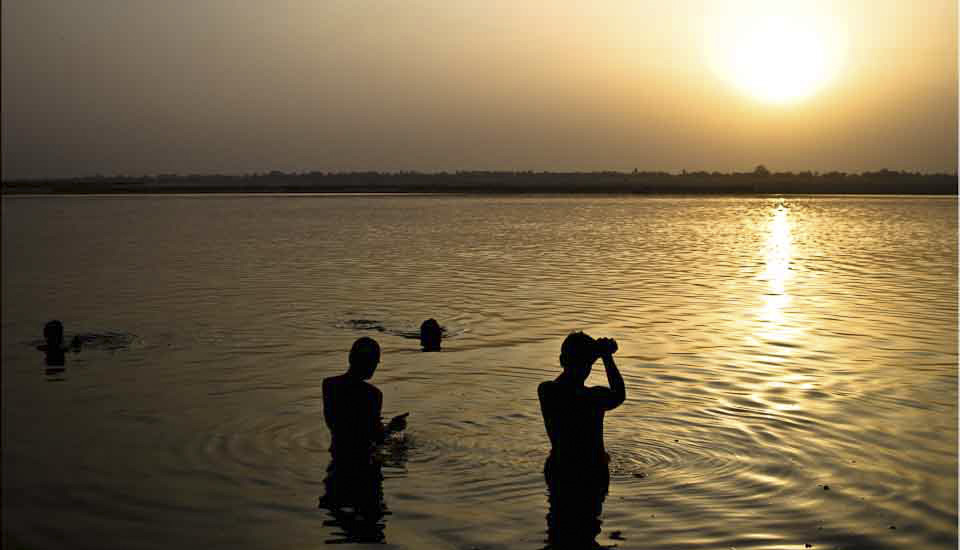
- Performing the Ganga Aarti from Dasaswamedh Ghat, Varanasi
- Buddha Head from Shwedagon Pagoda, Myanmar
- Harry Clarke Window from Dingle, Ireland
- Novice Monk Shwe Yan Pyay Monastery, Myanmar
Packets of 10 for $AU50.
Or - pick any photo from my Flickr or Wanders blog photos.


 this one have make a big difference. I shake my head at what conditions must have been like some twelve years ago.
.jpg)













Amazing the simplicity in which they live, we have children here that more is not enough and yet these children sit and play contently with very, very little… amazing people, wonderful pictures and i agree what must it have been like before it this is how it is now…
What an fabulous experience…
love to you both… Signe
Hey Signe! True, isn’t – we could all learn a thing or two about downsizing our ‘needs’. 🙂
Interesting series of photos Ursula.
Thanks for visiting Kevin! It was a bit hard to get an angle on the place… or in the place…
[…] reminded me how much I love Laos: the songs, dances and smiles of the people, the brilliant hand-woven fabrics, the colourful markets, the ethnic villages, the beautiful countryside… I’m less fond […]