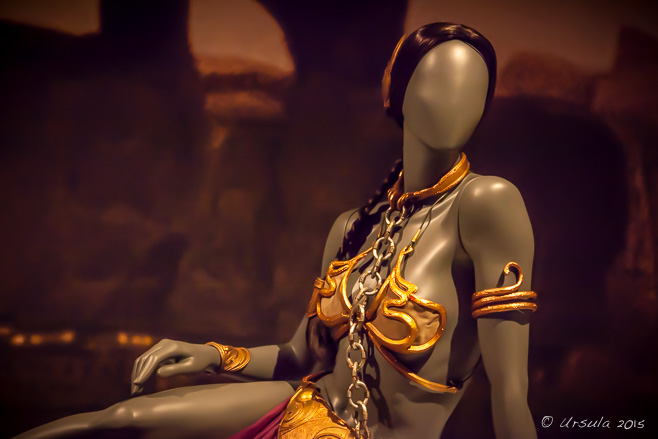
Princess Leia’s Slave Costume It is an iconic costume: the metal bikini worn by Princess Leia when, in Star Wars: Episode VI, Return of the Jedi, she is captured and forced to become Jabba the Hutt’s slave and trophy.
“A long time ago in a galaxy far, far away….”
I saw on the news this week that Princess Leia’s iconic gold bikini from Return of the Jedi going to auction shortly, and is expected to fetch between $80,000 and $120,000 USD.
I was a keen fan of those original Star Wars movies: not such a big fan that I’d invest in a metal costume – even assuming I could afford it, but a fan none the less. The first movie, released in 1977, came at a time when my world was on the brink of change, and it felt as if I was riding a new-age wave. I was not alone, and the series became a considerable pop-culture phenomenon.
Of course, like many emerging trends, it failed to live up to my expectations in the long term, but it is still fun to go back and revisit those days when fantasy and science fiction seemed to promise a hope for change in the real world.
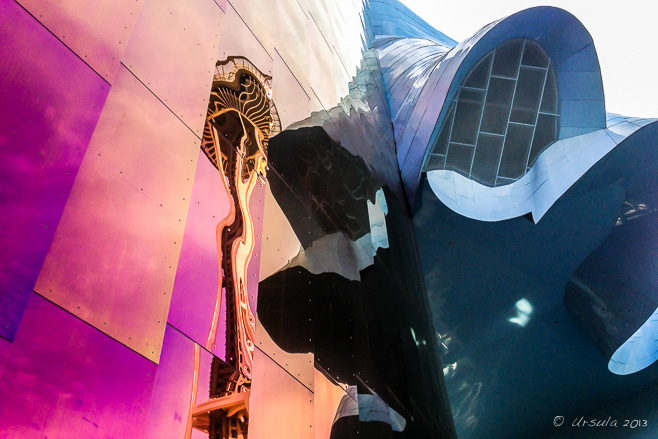
On my previous visits to Seattle I’ve always admired the EMP (Experience Music Project) Museum. The building is all metal curves, and from sunrise to sunset reflects the city’s distinctive skyline in vibrant colours. On our most recent visit to the city, the EMP was featuring a temporary exhibit of hand-crafted costumes from the six Star Wars movies.
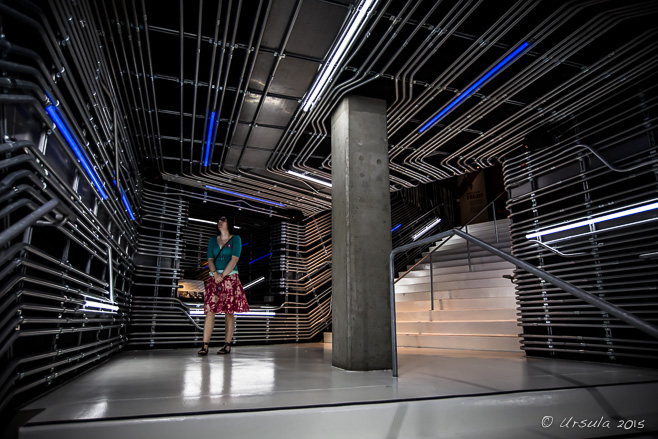
It was too good an opportunity to miss, so I finally made a visit inside … and down memory lane.
Yoda Puppet A puppet, used by Frank Oz and Mark Hamill to rehearse lines for Star Wars: The Empire Strikes Back, sits at the top of the stairs.
Attendant An attendant goes through the rules of admission – which of course include strictly “No Flash!” She also enumerates some of the highlights around the museum.
Darth Sidious Costumes are an integral part of a character’s portrayal. The costumes for Senator Palpatine change in style, colour, texture, and ornamentation, in line with his metamorphosis from seemingly benevolent Senator through to despotic Emperor.
C-3PO Who doesn’t love the stuffy, somewhat pompous, protocol droid C-3PO?
Velvet Dress I am much less familiar with the later movies – the prequels, in effect – but I believe this is one of many richly-made elaborate costumes worn by Padmé Amidala, mother of Luke and Leia.
Intergalactic Queen and Entourage As a Princess, then Queen, and finally Senator, Padmé Amidala is richly costumed and well accompanied.
Mongolian Royal Inspired Senate Headdress Padmé Amidala’sSenate costume pays homage to the elaborate Mongolian court dress of the past.
Sang Jun Lee Costume Sketches “Costume is not separate from character design.” – Sang Jun Lee, Concept Artist, Episode III
Doug Chiang Character-Board “In order to create a future, we looked into the past, and drew inspiration from history and nature in order to give our fictional creations a realistic foundation.” – Doug Chiang, Design Director, Episode I, II
Lightsabers Star Wars introduced the laser sword to the world. In retrospect, this – and the Jedi“force” – is a natural progression from Eastern martial arts, but at the time it seemed quite revolutionary.
Two Sides of Leia Princess Leia, disguised as a bounty hunter on the left, was perfectly capable as a warrior. Actress Carrie Fisher said of the slave costume: “It was like the bikini from hell. It was like steel, not steel, but hard plastic, and if you stood behind me you could see straight to Florida.”
Tusken Raiders The Sand People or Tuskens are a nomadic tribe, indigenous to the fictional desert planet Tatooine.
Darth Vader Listed as the third-greatest movie villain in cinema history by the American Film Institute, Darth Vader, master of “the Dark Side”, is an imposing figure.
“Thriller” We also wandered through the “Can’t Look Away: The Lure of Horror” section. I’m not a horror fan, but the videos of seminal directors talking about the history of the genre was fascinating…
“Shadow Monsters” … and playing with Philip Worthington’s interactive shadow monster installation was great fun.
“Labyrinth” In the “Fantasy: World of Myths and Magic” section, I found costumes from one of my other favourite movies: the 1986 “Labyrinth” with David Bowie and Jennifer Connelly. I thought this fantasy mask, suitable for a Renaissance Fair or a Venetian Ball, would make a fitting final image.
There was much more to see – and of course we explored Seattle’s music scene, including Hendrix and Nirvana. But, we were principally there for the film props and costume exhibits.
I’m glad I got to revisit my memories of the Star Wars movies – and to revel for a while in other fictions and fantasies of my younger, more hopeful, days. As it turns out, the Costume exhibit closes this week, and as I said earlier, that iconic bikini goes under the hammer.
Jaisalmer Predawn Lights bounce off Jaisalmer Fort as we huddle on a cold rooftop waiting for the sun to come up.
It was only the promise of masala chai, or “mixed-spice tea”, that got me out of bed before the sun, and onto a Jaisalmer rooftop with my tripod and cameras on a cold November morning.
I love chai.
Nothing says “India” to me like chai: that hot sweetened tea, made rich from the boiled buffalo milk (or full-cream cow milk) and spicy with the maker’s secret blend of ginger and cardamom, with cinnamon, star anise, fennel seeds, peppercorn, nutmeg and/or cloves.
Visitors to India are warned to avoid all kinds of food, but chai – depending on the cups it is served in – is pretty low risk. If the stand is busy, you can be pretty sure the milk is fresh; in any event, it is heated to boiling before being added to the tea mix. Although it is often served in small glasses, the vendors usually have paper or plastic disposable cups for nervous foreigners. Many years ago in Varanasi, I was introduced to buffalo chai in little terracotta cups: when your drink is finished, you throw the cup into a waiting receptacle, and if the cup breaks, you will have good luck.
Masala chai is also a great equaliser. It has been my time sitting in the rickety plastic chairs in front of curb-side chai stands in many parts of Indian that has allowed me to chat to people (albeit, often without a common language), and to give me the courage to ask consent for portraits.
So, when photographer Karl Grobl and local guide local guide DV Singh told me (and my nine travel companions) that there would an opportunity for a hot cup of chai at street level after our early-morning hour on a cold Jaisalmer rooftop, I grabbed my warmest clothes and set off.
Over the Rooftops The flat roofs of Jaisalmer are used for all manner of storage.
Jaisalmer Dawn Although the sun climbs quickly, the dusty haze keeps the late-autumn sky subdued.
Sunrise through the Latticework
House Crow (Corvus Splendens) As the light comes up, a common Indian crow joins us on the rooftop.
The Chai Wallah Down at street level, steam rises from a pot of freshly made chai as it is strained.
Chai Wallah The chai wallah (the maker of the chai, or spiced tea) is a fixture at this location: he chats to the locals who stop by for hot drinks and breakfast.
Pouring Chai The chai wallah pours hot, steaming chai into plastic bags for take-away orders.
The Chai Wallah Priests and holy men are among the customers waiting for the next batch of chai.
Showboating! Some chai wallah’s are well known for their showmanship, pouring steaming ingredients from great heights.
Adding Sugar Sugar and spice …
Simmering the Pot … and everything nice …
Straining the Chai … makes a pot of masala chai.
Pouring Cups of Chai
Woman and Daughter
Filling a Thermos Some regular customers bring their own containers for filling.
Street Life As the city wakes up, the street sweepers are out and about, chatting with friends.
Woman in Red Even a ghoonghat (veil or headscarf) can’t hide this woman’s smile.
Monks on the Move Early every morning, Theravada Buddhist monks and novices pour into the Nyaung Shwe streets – silently, barefoot, and single file – with their begging bowls.
You have to be early, and you have to be quick, to catch Theravada Buddhist monks on their morning alms rounds.
For over 2,500 years, since the Buddha decided that monks and nuns should not cook or store their own food, Buddhist monks have walked alms rounds. The practice was intended to free religious monastics from the worldly burden of cooking and to make them dependent on the generosity of the lay community, thus encouraging humility. It also enriches the spiritual lives of lay people, as the act of giving freely from a generous heart creates “merit” (puñña): that which accumulates as a result of good deeds, acts, or thoughts and which carries over throughout the life or the subsequent incarnations.
Over the years, in many Buddhist communities, the practice of collecting alms has been adapted to the modern world. It may be that only some monks or novices from a community go out on alms rounds, sharing proceeds with the rest of the religious community. Or, alms rounds may only be conducted on particular days. In many monasteries, lay people bring food in and cook it on site (e.g.: Lining up for Lunch; Monks and Nuns).
But, the alms bowl is still an enduring symbol of the monastic order for all Buddhists, and it is not uncommon to see monks, with their begging bowls, singly or in groups, silently walking the streets of their communities (e.g.: Sangkhlaburi, Thailand;Luang Prabang, Laos).
But, you do have to be up early. Monks and novices take no food after twelve noon, and alms rounds typical start around 6am.
The last time I was able to participate in an alms round was in Nyuang Shwe, Myanmar, where I was on a tour with photographer Karl Grobl and local guide Mr MM. We got up in the low-light of a pre-dawn to be ready in time.
Novices at the Well Nyaung Shwe may well be within the tropics, but it is still cool when the young novices get up to wash themselves before commencing their other morning duties.
Novice with a Bucket The little novices rush around the temple grounds, going about their business – and giving me a chance to practice panning.
The Silent Procession Around 6am the novices file out of their monastery and into the streets. As per custom, their robes are formally arranged over both shoulders, …
Novice Monk … and their faces are solemn with downcast eyes.
Alms Rounds Traditionally, the barefoot monks file through the streets in order of their seniority by ordination date…
Elder Monks … but in Nyaung Shwe the elder monks seem to come out later.
Monks in the Green Countryside It always amazes me how fast the monks move; if we want to take photographs, we have to run to catch up.
Morning Alms But, the local women know where to be. They stand barefoot in the streets, …
Burmese Woman … dispensing still-steaming rice …
Giving Alms … until their bowls are empty or the monk’s alms bowls are full.
Nyaung Shwe This act of giving is a part of everyday life in Nyaung Shwe, as it is in so many other Southeast Asian towns and villages.
“Making Merit” : Puñña The interaction between monk and lay-person can vary, but it is usually a wordless exchange.
Morning Back Light After the monks have gone back to their temple, …
Street Dog … the dusty streets go quiet …
Women Doing Laundry … and people go back to their daily lives.
For the Buddha, the alms round was an important feature of the monastic life.
Being part of the morning rounds is a reminder of simple human generosity.
It always makes me feel better for the rest of the day.
[…] by “Ursula in BKK” who was on Karl’s Myanmar Photo Tour in September 2015. The article – Monks on the Move: Morning Alms Rounds, Nyaungshwe – has some nice photos and narrative so you can actually see what my tour group missed because of […]ReplyCancel
The Rock Bridge – The Spitzkoppe The stars are bright and close in the Namibian winter skies – especially in the Namib Desert. (Light Painting by Ben McRae : Photo and Lightroom editing by myself.)
After being tipped onto the tarmac at Hosea Kutako International Airport in Windhoek, Namibia, one night last month, the first thing I noticed – after the cold, mind you; it was still mid-winter in the Southern Hemisphere – was the sky.
The sky was black, with very little ambient light. And it was full of stars: stars so close you could reach out and touch them.
It is no surprise, then, that the attraction for many tourists to Namibia is its night sky. Away from the young country’s small cities, there is very little light pollution. And, far out in the rural villages and National Parks, there is practically none.
A few days into my Namibian adventure, I was camped out under the stars at the Spitzkoppe Campsite in the Namib Desert, some100+ kilometres inland from the barren, sandy, Atlantic Coast. The Spitzkoppe (German for “pointed dome”) is a group of granite boulders rising dramatically out of the flat desert surrounds. Over 700 million years old, these rocky outcrops rise to as much as 1,784 metres (5,853 ft) above sea level, and are popular with rock climbers and star-gazers. I was there with Photographer Ben McRae, Pedro Ferrão PatríciofromPhotoburst, Namibian guide Morne Griffiths and four other photography enthusiasts. We were preparing to create some star trails and to do some light painting.
This was my first real attempt at star photography and my results (as you will see below) were mixed, but it was a wonderful (if cold) experience.
Bornhardt Rising As we drive across the Namib Desert, a granite bornhardt – a dome-shaped, steep-sided, bald-rock outcropping – comes into view. (iPhone6)
Community? The Spitzkoppe brings a whole new meaning to the idea of “the middle of nowhere”. But, because tourists visit, a small, rough, settlement has grown up. (iPhone 6)
Spitzkoppe Campsite The campsites are a patch of flat ground with parking …
Loo with a View … and a dry toilet enclosure. The cubicle has no door, so I made use of my sarong for privacy. (iPhone 6)
Cape Glossy Starling A Cape Starling (Lamprotornis nitens) hangs around, hoping for lunch scraps.
Afternoon Walk After a late lunch, the group sets out to explore the terrain.
Puppies or Rabbits Kissing? Some of the rock formations take on the shapes of animals. (iPhone 6)
Lone Tree Trees and shrubs cling precariously to life in the dry and austere environment.
The Bridge The Rock Bridge is probably one of the best-known formations.
The Bridge People climb all over it in the afternoon light, giving the structure a sense of scale.
Afternoon Shadows From the top, you get a good view of the surrounding desert.
Last Sun over Spitzkoppe As the sun lowers in the sky, …
Set-Up … we pick spots for our tripods and set up the cameras. (iPhone 6)
Lone Tree We are ready for some long exposures on the night sky and light-painting on the rocks … (Light Painting by Pedro Ferrão Patrício; Photo and Photoshop editing by myself.)
Star Trails on the Bridge … and an attempt at star trails. (143 x 30-sec exposures, compiled with StarStaX)
The stars were, indeed, glorious – and the photos don’t really do them justice. After a few attempts, I retreated to my tent to try to warm up (did I mention, it was cold?) and to prepare myself for a sunrise shoot on the ancient boulders.
[…] Coast, we turned back into the desert, this time to the northerly part, with its clear skies (see: A Sky Full of Stars) and dramatic rocky outcrops (see: Morning over Spitzkoppe), leaving the ocean and the sand dunes […]ReplyCancel
Walking the Barge Being transported up a canal, towed by a slowly plodding shire horse, makes one imagine English country life as it once must have been.
I think they are right. Being transported up a canal, towed by a slowly plodding shire horse, makes one imagine English country life as it must have once been. Scenes from Thomas Hardy novels spring to mind.
It was towards the end of July – the last days of our stay in Britain; after a hectic time with friends and family, a “slow” day out on one of Britain’s few remaining horse-barges, on a charming canal in the sunny Devon countryside, seemed like an ideal tonic.
The Grand Western Canal Country Park and Local Nature Reserve runs just over eleven miles between the towns of Tiverton and Lowdwells, along a preserved canal that was originally intended to be part of a transportation network between the Bristol and English Channels. This section of canal, running along on the border between Devon and Somerset, was first opened in 1814. Other sections of the ambitious plan faced technical difficulties and cost blow-outs, and the whole project was never completed. Competition from the railways in the mid-1800s rendered the canal system impractical, and many sections fell into disuse and subsequent ruin.
The Devon County Council bought what remained of the Grand Western Canal from the British Waterways Board in the early 1970s, and have continued to renovate and maintain the area as public parklands.
The horse-drawn barge has been taking visitors up and down the waterway since the earliest days.
Ross and the Ticket Office Visitors to the Tiverton Canal Company booth are greeted by Ross, a giant, gentle, shire horse.
Ross the Shire Horse The ten-year-old, 17.1-hand- (1.75 metre) tall shire horse is happy to pose for a photo…
Andy … as is Andy, his handler.
Turning Everything on the canal boat is done manually – – –
Tying Up – including the slow process of turning it around on a canal only barely wider than the boat is long.
Mollie One of the resident collies is unhappy about not being in control of the boat, and runs up and down on the opposite shore, making sure the men do their jobs properly.
Turning the Barge Head-horseman David chats to interested passers-by as he prepares to attach the tow rope to Andy the shire horse.
Georgie behind the Bar Inside the boat, Georgie explains the drink, snack and souvenir options.
Walking the Barge Dave and Ross make their way along the towpath, gently pulling the boat.
Watchers on the Shore Walkers on the towpath stop to watch the canal boat glide by.
Bridge over the Canal The canal is on relatively high ground, and the Devon County Council has had to effect numerous repairs to keep the water contained.
Moorhen The canal provides a great nesting-place for various local birds. We saw a number of babies: moorhens, ducks, swans and other waterbirds.
Canberra Bomber Crash Site In 1961, an RAF-operated English Electric Canberra crashed into the Great Western Canal, here at Great Manley. Both men aboard were killed.
Bicyclist A man pauses as Dave and Ross pass under the bridge. In the old days, ponies or donkeys were often used to pull the barges, as some of the bridges are too low and narrow for larger horses.
Ross the Shire Horse On the other side of the bridge, Ross is detached from the barge. He stands patiently while the men turn the barge around in preparation for the return trip.
Pastorale The canal is treed and shady – a beautiful recreation area on a surprisingly hot English summer day.
Ross from the Window Ross uses his freedom from restraint to graze…
To the Aqueduct … as we get off the barge and walk under another bridge to an old aqueduct.
Canal Boats Private houseboats sit on the canal in the sunshine.
Old Aqueduct This aqueduct was built in 1847 as part of a railway expansion.
Water Weeds
Sun on the Aqueduct
Back along the Tow Path The canal-boat passengers return…
Back to the Barge … to reboard for the trip back down the canal.
Ross Loves Polo Mints Some of the passengers stop to pat Ross and feed him the Polo mints he loves.
Millie the Collie From her perch on the roof of the barge, …
Millie the Collie … Millie watches over the proceedings.
Boat on the Canal Recreational boating (canoes, rowboats, and the odd motorboat) is popular on the canal waters.
Swans on the Canal A family of mute swans makes me think of Wind in the Willows and English summer.
On the way back down the canal, David said there was one way to enjoy the real Canal experience. “I ask everyone to be completely quiet for two minutes, so you can get a sense of what it was like in the old times.”
We all sat in silence: the only sounds were from the slapping of the water on the sides of the barge, and the steady clopping of Andy’s hooves.
I guess it is a symptom of our era: about half way into our quiet time, I heard a woman behind me ask her partner impatiently, “That’s two minutes, isn’t it?”
I, on the other hand, was enjoying the meditative calm.
- Performing the Ganga Aarti from Dasaswamedh Ghat, Varanasi
- Buddha Head from Shwedagon Pagoda, Myanmar
- Harry Clarke Window from Dingle, Ireland
- Novice Monk Shwe Yan Pyay Monastery, Myanmar
Packets of 10 for $AU50.
Or - pick any photo from my Flickr or Wanders blog photos.

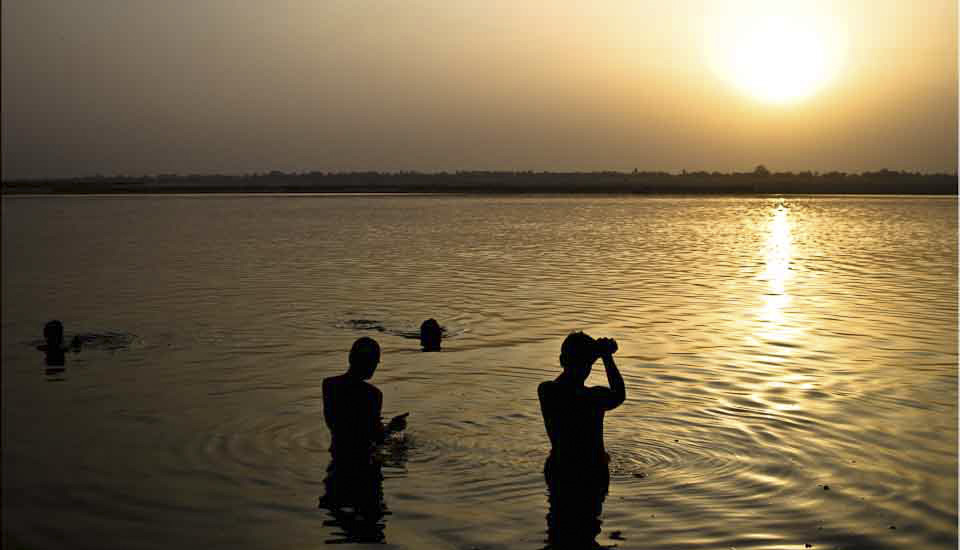

 It is the end of another era…







 I, on the other hand, was enjoying the meditative calm.