Avalokiteśvara Gandantegchinlin, “the great place of complete joy”, is one of Mongolia’s most important monasteries. The central attraction is a 26m statue of Avalokiteśvara, a bodhisattva who embodies the compassion of all Buddhas.
The best way to immerse yourself in a new culture is to spend time where local people congregate and worship.
In the early morning of my first day in Ulaanbaatar, Mongolia, I took a taxi across the busy city centre from my hotel in the east, to the country’s largest monastery, Gandantegchinlen (“the great place of complete joy”) Khiid, west of city centre.
According to the national census of 2010, 53% of Mongolians identify as Buddhist (38.6% profess no religious affiliation, leaving very small proportions practicing traditional Mongolian shamanism, Christianity and Islam).
The country experienced its first wave of Buddhism in the third century B.C, but over the years, the religion’s fortunes have waxed and waned with the political tides. Gandantegchinlen Khiid (Gandan Monastery) was originally built in the centre of Ulaanbaatar in 1810, and was moved to its current location by the 5th Bogd Jebzundamba (the Spiritual Head of Tibetan Buddhism in Mongolia) in 1838. It grew into a complex of colleges of Sutra-Tantra Buddhist teachings, Astrology and Medicine.
Mongolian Buddhism flourished into the early twentieth century, with 843 major Buddhist centers, about 3,000 temples of various sizes, and nearly 6000 associated buildings by 1934. However, the Stalinist religious purges of 1937 took their toll. By 1940, nearly every monk across the country was either dead or had apostatised. Although most of the buildings in the Gandan Monastery were destroyed, it remained open for international display purposes. The Monastery, and its community of 100 monks, didn’t come back to proper life until the 1990s, when Buddhism was once again practiced openly.
Gandantegchinlen Khiid is the largest monastery and temple complex currently in use in the country.
In religious environments there are many photographs which can’t be taken: young monks performing their prayers, ordered by age and rank as they sit on hard wooden benches in expansive rooms with lofty ceilings but little light; or community members in distress seeking comfort and blessings from elders and abbots.
In any event, photographs never quite capture the smell of the incense, or the thrumming drone of Buddhist prayers reverberating against ancient walls.
But, they can give one a small peek into a different world.
Monks Bang the Morning Gong At 9 am, young monks give a single bang to the gong in the drum tower of Gandantegchinlen Monastery, calling all the resident monks to prayers. I was expecting three gongs, so I almost missed them! (iPhone6)
Tashchoimphei Datsan (Monastic College) Their gong-ringing completed, the young monks return the gong to the Datsan …
Old Woman at the Datsan … where resident monks and people from the local community gather for morning prayers.
Golden Roof Mongolia’s famous blue skies are clear – with just an echo of the moon – over a golden Datsan roof.
Deer and the Dharma Wheel Another roof is adorned with the Buddhist symbols of the deer, representing the Buddha’s first sermon at Deer Park, and the Dharma Wheel, which represents the content of the Buddha’s teaching itself.
Incense Burner in the Courtyard As the morning prayers drone on inside the Datsan, people keep arriving, stopping for some incense smoke …
Monk on the Steps … before going inside to take their place for the chanting.
Prayer Wheels Brass prayer wheels invite you to walk the prayer circuit, …
Saying Prayers … spinning the wheels and offering your prayers as you go.
Building inside the Monastery Complex
Vajradhara Temple Built in 1840, the Vajradhara Temple houses a statue of Vajradhara, a Buddha from Tantric practice.
Relics, Buddhas and Icons
Migjid Janraisig Sum Ulaanbaatar is a confusion of old and new.
Gandantegchinlen Stupa
Roof Detail
Migjid Janraisig Sum Built in 1911, Migjid Janraisig Sum features elements of traditional Chinese, Mongol and Tibetan architectural styles.
Door Knocker Heavy doors lead into the dim interior of Migjid Janraisig Sum.
Ayush : “Long Life” The walls of Migjid Janraisig Sum are lined with images of Ayush, the Buddhist god of longevity.
Avalokiteśvara In the centre of the Migjid Janraisig temple, the tallest indoor Buddhist statue in the world – the 26.5-meter-high Avalokiteśvara or “Lord Who Looks Down” – stands over us. Covered in gems and gold leaf, this 1996 statue replaced the original copper one, reputedly dismantled by the Russians in 1938.
Prayer Candles The temple is dimly lit with candles …
A Girl and her Father … which illuminate worshipers.
Prayer Candles
Lighting Candles In a separate nearby building, a man lights countless candles.
Sustained by the memory of flickering candles and the blessings of chanting monks, it was an easy walk back through the streets of Ulaanbaatar, to the hotel.
Chinese Lanterns The entrance to the old town of Hội An is marked by colourful silk lanterns against a winter sky.
Irony: the future of the little city of Hội An has literally been saved by it’s own past demise.
Hội An (會安) means “peaceful meeting place”. Once upon a time, particularly between the seventh and 10th centuries, this strategic port near the mouth of theThu Bon River was part of the Chăm Pa Kingdom (192-1832). The Cham, who were seafarers and traders, controlled the spice trade, and so commanded great wealth and territory before being absorbed and annexed by the Đại Việt (Great Viet) under the Lê dynasty.
Around 1595, under thefeudalNguyễn lord Nguyễn Hoàng, Hội An was established as an international trading port. By the 18th century, the city was considered by many to be the most important trade port on the East Vietnam Sea, or even in all of Asia. Japanese, Chinese, Indian, and Dutch merchants had made their homes there, as had Portuguese Jesuits. Their architectural legacy remains in the “well-preserved complex of 1,107 timber frame buildings, with brick or wooden walls” that are still standing in the old town.
The collapse of Nguyễn rule following the Tây Sơn uprising (1770-1802) marked the end of Hội An’s importance. The Tây Sơn brothers, who saw themselves as champions of the common people, were opposed to foreign trade. When Emperor Gia Long (Nguyễn Phúc Ánh of Nguyễn) defeated the Tây Sơn in 1802, he gave the French exclusive trading rights to nearby Đà Nẵng. That, and the silting up of the Thu Bon river mouth, sealed the fate of Hội An, ensuring its status as a backwater that remained frozen in time.
A single entry ticket to the Ancient Town, costing 120,000 dong, or just over $5 USD, gives you entrance to five of the museums or designated old buildings within the precinct. I don’t think we actually used all five coupons: we spent a lot of our time trying on assorted bamboo-fibre and woven-silk clothing, and visiting some of the countless souvenir and coffee shops that now occupy the old shophouses.
Join me for a relaxing afternoon/evening wandering the ancient streets of old Hội An.
Hội An Old Town Street The streets are tree-lined and shady – it must be lovely (but crowded) in summer! Alas for us, is is still winter, and unseasonably cold. The streets are fairly quiet.
“Ticker” Our first stop is at the Đình Cẩm Phô Đình, the Dinh Cam Pho Communal House, where the Ticket Taker is careful to vet us before we enter.
Dinh Cam Pho The Cam Pho Communal House was restored in 1817 – there is no information inside the temple courtyard to tell us when it was originally built.
Inside the Dinh Cam Pho Communal House Apparently, the communal house was built in the shape of the Chinese character that means “country” – the only information I could find about the building was badly translated, and difficult to understand. Certainly, the roof-ridge and gable ornamentation are Chinese-style.
Mickey Mouse Plant (Ochna Serrulata) Colourful flowers bloom where they are planted in their terracotta pots around the courtyard.
Shrine The Dinh Cam Pho Communal House was built as a shrine for the god of the village, and later included worship of Cam Pho Village ancestors – hence the alternate name: “Cam Pho Huong Hien” (Ancestors of Cam Pho Village).
Street Food Outside the Dinh Cam Pho Communal House, women sit selling freshly cooked corn.
Linh Pham Shop Nguyễn Thị Minh Khai road is lined with shops selling manufactured goods and handicrafts. The clothing stores, with silk, cotton, wool, and bamboo-fibre products, seemed particularly good value, and we came home with several items.
Hoi An Shop Paintings, pottery and handicrafts are on offer – as are intricate cards of paper decoupage.
Hoi An Gallery The shophouses are beautiful maintained.
Old Town Laneway
Descendent Our next stop was at the Nguyen Tuong Ancient Family Chapel – also called the “Ong Lon Palace”(Dinh Ông Lớn) – where a young descendent of Nguyen Tuong, who build the temple in the beginning of the 19th century, shows us around.
Betel Juice Grannie Old Chinese coins and other trinkets are for sale in the street.
Guide in the Phung Hung House The old Phung Hung House is one of several open to the public.
Embroiderer Although the Phung Hung Old House is beautiful with its open stairways and dark timbers, the focus of the tour is the production and sale of hand embroidered tablecloths and handkerchiefs.
View from the Phung Hung Old House The balcony on the second floor is rickety, but gives a good vantage point over the street markets.
Thu Bồn Riverfront
Japanese Covered Bridge The Japanese had a community on one side of a small stream. In 1593, they built a unique covered bridge (Chùa cầu) to connect them to the Chinese community on the other side of the water.
Shrine: Japanese Covered Bridge Inside the bridge is a shrine to Tran Vo Bac De, the Taoist deity of storms and weather.
Bảo tàng Văn hóa Sa Huỳnh The Sa Huynh Culture Museum contains pottery and other artefacts from the Sa Huỳnh culture, dating back over 2000 years.
View of the Street from the Sa Huynh Culture Museum The exhibits in the museum are dark and dusty; I amused myself by taking street photos through the railings in the courtyard.
Fresh Vegetable Markets As night fell, the markets got busier …
Silk Lanterns … and the silk lanterns came into their own.
The Japanese Bridge One of Hoi An’s most popular tourist attractions, the covered Japanese Bridge is beautiful under lights, …
Lovers at the Japanese Bridge … making it a perfect spot for romantic, after-dark photographs.
It is, indeed, like walking into the past –
– but with good food and excellent souvenir shopping.
Flowers in the Rocks The mountains of Southern California are well known for their sunny blue skies and outdoor activities.
California, the third largest state in the USA, covers some remarkable terrain. With almost 900 miles (1450 km) of Pacific coastline and several mountain ranges, the topography ranges from magnificent forests of giant redwoods to the subtropical Mojave desert.
The state is also home to two of the US’s top-five most populous cities, with their notorious fogs and smogs, and home to my least favourite airport. If I have to travel through Los Angeles International Airport (LAX), I always heave a sigh of relief when I break free from it.
So it was last June: we dragged our bags out of one of LAX’s terminals, got into a shuttle bus, and finally pointed our rental car east towards San Bernardino. We drove along the multi-lane Foothill Freeway(Interstate 210), not slowing down until we escaped the basin of smog that hung over the lowlands, and started climbing into the San Bernardino Mountains and some welcome fresh air.
Our final destination was the small resort city of Big Bear Lake. The lake for which the city is named is Southern California’s largest recreation lake, and the surrounding hills are criss-crossed with hiking and biking trails.
One of the most popular walks is the short, steep Castle Rock Trail; I was glad I had a new walking stick!
Join us for an uphill-hike.
California Highway 210 Over an hour out of Los Angeles, and the smog is still with us, hanging over the San Bernardino lowlands and almost obscuring the mountains ahead. (iPhone6)
Bend in the Road Finally we rise up out of the smog, into the fresh air above, twisting and curving our way up into the mountains. (iPhone6)
Pathway up to Castle Rock The Castle Rock Trail is a short (1.3 mile; 2 km), but very steep, walk up to a beautiful rocky crag. The return route is by the same track.
Path to Castle Rock The first half of the hike is the steepest; we ascended through granite boulders and shrubs …
Sun in the Pines … as tall pines touched the sky over our heads.
Rocky Pathway The dry, sandy ground is littered with boulders.
Western Fence Lizard The sun has brought out countless little lizards – almost invisible against their rocky back-drop.
Tree Trunk Most of the trees here are Jeffrey Pine, but there are also Ponderosa Pine, White Fir, Western Cedar and Incense Cedar.
Tree Tops The pines are incredibly tall and straight.
Walkers on the Path Because this trail is so popular, it has a reputation for being over-crowded. We were lucky – even though it was a Saturday, the other walkers were scattered.
Blossoms on the Bushes The summer heat has brought out the blossoms. I thought this was Ocean Spray (Holodiscus discolor), but now I’m not sure.
Steep Climb It feels as if the path will never level out, as we gain over 500 feet (152 m) …
Rocky Terrain … before cresting into more level – but just as rocky – terrain.
Uprooted Trees Fallen trees line the pathway like sculptured art; –
Almost Abstract – their intricate surfaces polished by wind and sand.
Sap on a Log Like jewelled amber, beads of sap sit against slowly decaying wood.
Textured Wood
Rock with Character Finally! Another signpost, indicating that we are on track, comes into view.
Tree on a Rock Castle Rock itself requires a bit of clambering; with two cameras and a tricky knee, I decided against it! It was nice enough sitting on the view points just below the summit.
Pine Needles
Purple Wildflowers As we walk carefully back down the hill, we pause to admire the various wildflowers.
Indian Paintbrush (Castilleja)
Like a Sphinx The lake comes back into view as we descend …
Long Shadows … into long afternoon shadows.
The walk down the hill was much quicker than the walk up! While it was only a short hike, the combination of heat, elevation gain (690 ft / 211 m), and starting altitude (Big Bear Lake sits at 6,752 ft / 2,058 m), had us happily exhausted by the time we returned to our car.
Still, we recovered enough over dinner that we were out on a different track the next day. 😀
[…] It was early summer – hot and dry – when we stayed there; ideal walking weather. Unfortunately, I was not-long off crutches after breaking my knee, and for the first several days had to satisfy myself with moderate strolls around town. Towards the end of the week, though, my husband and I grabbed our walking sticks and challenged ourselves to the short, but very steep, Castle Rock Trail. […]ReplyCancel
Epupa Falls Epupa Falls is a series of cascades stretching about 1.5km through the Kunene Region. This is the northern-most point in Namibia, where the Kunene River forms the border with Angola. (ISO100 16mm f/16 30sec Crop)
It is a primordial landscape, born out of the very heart of the pre-Jurassic Gondwana super-continent.
The Kunene Region in Northern Namibia is dry, mountainous, and underdeveloped. It is home to semi-nomadic tribes whose ways of life have barely changed for hundreds of years (see: Women of the Himba, and Himba Model Shoot).
The Kunene River, which starts in the Angolan highlands and runs 1,050 kilometres to the Atlantic Ocean, is the only perennial river within the ecoregion. The river marks the Angola-Namibia border and tumbles over Epupa Falls at a gorge formed between 2,100 million and 1,750 million years ago.
Although the time-lines are wildly different, I had no trouble imagining dinosaurs walking among the primitive baobab trees that cling to the rocky river banks.
That was, of course, once we got there.
I and four other photography enthusiasts were travelling with photographer Ben McRae and local guide, driver, chief cook and bottle-washer, Morne Griffiths, across the vast expanses that comprise Namibia.
I knew we’d be camping for the next several nights, so I treated myself to a small cabin with a plywood bed the night we stopped in Kamanjab, and enjoyed a decent sleep and a shower with water so splayed that I got my exercise dancing around, trying to get wet without getting scalded; facilities in Namibia can be “rustic”. After a very early hot breakfast, we started our journey of 440 kilometres north through the dry winter landscape dressed in subdued autumnal colours; about six bumpy hours past hornbills perched on electrical wires, ostriches and giraffes loping in the distance, and long-horned cows and humped brahman along the roadside. Gradually, the thorn trees gave way to palm forests, and we came across our first giant baobabs.
Nothing, though, prepared me for the magnificent Epupa Falls.
Join me in Namibia’s timeless Kunene.
Rosy-Faced Lovebird (Agapornis Roseicollis) The sun wasn’t yet up and the winter air was still cold – but the birds were already gathered around the feeder in the rest-camp courtyard in Kamanjab.
View from the Truck We set off early morning, heading out on the long, dusty roads north to Epupa. (iPhone6)
Baobab The mighty baobas (Adansonia digitata) grow along the side of the road.
“Make your Mark” There is an African proverb: “Knowledge and wisdom are like a Baobab tree, one person’s arms cannot encompass it.” The trunks are huge, with an average diameter of 5 m (16 ft).
Scars and Textures Baobab trees frequently live for between 1,000 – 3,000 years. Their succulent trunks have a high resistance to drought and fire.
Look Up! In the right soil, baobabs grow quickly, and can reach between 5–25 m (16–82 ft) in height.
Nests in the Branches
Cairn or Shrine
View from the Truck Leaving the baobab tree behind, we rejoin the the road and climb the rocky hills to Epupa. (iPhone6)
Above Epupa Falls After pitching our tents in the allocated camping spot, we join the other visitors on the dry, rocky terrain above the falls. (ISO200 70mm f/4 1:320sec)
Afternoon above the Falls The afternoon sun still packs heat as the shadows deepen and grow longer. It is not as quiet as it looks, however: the roar of the falls, just hidden from sight, is palpable. (ISO200 24mm f/11 1:100sec)
Epupa Falls Nothing had prepared me for the first sight of the magnificent falls, with the waters of the Kunene tumbling straight down the rocky gorge separating Namibia from Angola. (ISO200 70mm f/3.5 1:400sec)
Below the Falls Before sun-up the next morning, I grabbed a head-lamp and tripod and picked my way carefully over the jagged, primordial landscape below the main falls. Countless waterfalls tumble into the river below from all directions. (ISO 100 70mm f/25 3.2sec)
Morning on the Falls (ISO6400 200mm f/2.8 1/400sec)
Solitude As early as I was, I wasn’t the first. Photographer Ben McRae had already found a spot on the ancient rocks. (ISO800 16mm f/2.8 1/100sec)
Sunrise (ISO200 24mm f/5.6 1/200sec)
Sunrise (ISO100 70mm f/32 3.2sec)
Below the Falls Epupa Falls are thought to be the oldest rock formation in Namibia, between 2,100 million and 1,750 million years old. (ISO400 35mm f/6.3 1/60sec)
Kunene River As the sky finally lightens, the green river contrasts with the ancient rocks of the gorge. (ISO100 16mm f/5.0 1/60sec)
Water on the Rocks (ISO100 200mm f32 2.0sec)
Morning Light on the Baobabs The spray from the falls backlights the baobabs. (ISO100 175mm f/32 0.8sec)
Angola over the River Angola looks wild and empty across the river. (ISO100 30mm f/7.1 1/60sec)
Baobab Trees The giant baobabs have a shallow roots, spreading further than the height of the trees, allowing them to cling to the river banks and survive the dry climate. (ISO400 70mm f/8.0 1/400sec)
Baobab Trees It’s a pre-historic landscape: baobab trees are among the oldest living trees in the world. (ISO100 70mm f/2.8 1/400sec)
Leaves on a Baobab Tree To conserve moisture, baobabs only have leaves about three months a year, during the wet season. (ISO100 35mm f/14 1/60sec)
Top of the Falls (ISO100 200mm f/32 0.6sec)
Top of the Falls “Epupa” is a Herero word for “foam”; the falls are named for the the foam created by the tumbling water. (ISO200 70mm f/5.6 1/400sec)
Girls at the top of the Falls The morning sun lights up this “foam” at the rocky top of Epupa Falls. (ISO100 200mm f/2.8 1/400sec)
Since 2012, Himba chiefs have been protesting against a proposed dam on the Kunene River in the Baynes Mountains. The dam might bring in economic development to the region but would irreparably change the traditional ways of life, and this ancient landscape itself.
[…] after breaking camp the day before at Epupa in northern-most Namibia (see: North to Epupa) – and had entered Etosha National Park just before noon. Our first […]ReplyCancel
[…] Omarunga Camp, within earshot of the magnificent Epupa Falls on the Kunene River (see: Landscapes of the Kunene). Our trip-organiser, photographer Ben McRae had a shoot planned for the late afternoon, and it was […]ReplyCancel
Zähringerbrunnen : the Zähringer Fountain In the UNESCO-listed medieval city-centre of Bern, a fountain topped by a bear in full armour, with a cub at his feet, was built in 1535 as a commemoration to Berchtold von Zähringer, who founded the city in 1191. (iPhone5)
The Swiss city of Bern is indelibly associated with bears. The bear has featured on the city seal and coat of arms since at least the 1220s. Stories relating to the keeping of live bears in a Bärengraben (bear pit) in the centre of the city – in what is still called Bärenplatz(Bear Plaza) –date back to the 1440s (or 1513 – depending on your source!).
Legend has it that Bern was named for the bear that Berchtold V, Duke of Zähringen, came across in the wood that was to be cleared for his new city. He had vowed to name the city for the first animal he saw on his hunt.
This story is widely questioned. For a long time it was thought that the city might have been named after the Italian city of Verona, then known as Bern in Middle High German. Scholars since the 1980s, however, think the name is of Celtic origin.
What is not in question is that Berthold V founded Bern in 1191. He had been charged with establishing a city to help solidify his family’s position over their land holdings. The Zähringer ruling family, decreed dukes by the German king, held much of what is today Switzerland – then considered part of southern Burgundy. In order to reinforce their position in the region, they started or expanded a number of settlements.
For Bern, Berchtold V chose an easily defensible, long and narrow hilly peninsula, surrounded by the Aare river on three sides. Somehow, the old city has managed to retain its medieval charm, while functioning in the modern world. Tram tracks run down the cobbled streets; up-market hotels, fashionable boutiques, and quirky coffee shops are tucked into the covered, arcaded sidewalks. Everywhere you turn, there are colourful statues and fountains and clock towers. Guild flags hang from the buildings that once housed them; canton flags hang from the Renaissance-style Bundeshaus (Parliament Building); geraniums hang from every window. It is the best-preserved historic town centre in Switzerland, and – as the “Old City of Berne” – it was UNESCO-heritage listed in 1983.
The beauty of travelling in Europe is that everything is accessible by train. My husband and I were travelling from England. Friends of ours from Zurich met up with us, and we spent a leisurely day walking around the Old City.
Busker on a Dudelsackspieler Evening in the centre of Old Bern is lively, in spite of a threat of rain. (iPhone5)
Parliament House Evening clouds hang over the buildings used by the National Council and the Council of States. (iPhone5)
Nine Men’s Morris The restaurants fill up as people stroll the streets. (iPhone5)
Bundes Platz – Parliament Square
Flags of the Cantons – Bundeshaus
To the Bundeshaus Terraces An archway leads to the back of the parliament buildings, …
Woman in the Fountain … where there are gardens …
View from the Bundeshaus Terraces … and views over the red-roofed buildings below.
BEKB Bank Building, Bundesplatz
Bern Old City Streets Trams and pedestrians share the old cobbled streets.
Zytglogge Bern’s 800-year-old mechanical clock in its 23-meter tower is one of the the city’s most famous landmarks.
Lion – Marktgasse (iPhone5)
Old Clock Tower – Zytglogge The Old Clock Tower, built by Caspar Brunner between 1527 and 1530, in what was once Bern’s west gate
Medieval Bern The buildings in the Old City include 15th-century arcades of painted limestone.
Doors to the Underground on Kramgasse Intriguing slanted doors lead down to cellar stores and coffee shops.
Monkey Guild Statue
Zähringerbrunnen and Zytglogge on Kramgasse Medieval clock towers and Renaissance fountains are features of the Old City.
Vennerbrunnen – Ensign Fountain The ensign, carrying a flag with the bear of Bern, promises to protect the city.
Das Berner Rathaus – City Hall
Medieval Ships and Dreams There are plenty of shops to fire the imagination.
The Fast-Flowing Aare To reach the Rose Garden and the Bear Park, we crossed the Nydeggbrücke over the Aare River.
The Old Bärengraben – Bear Pit Bern’s first captive bears were held at Bärenplatz (Bear Square) in the Old City from the 1400s or 1500s. The bear enclosures here were first opened in 1857, and were upgraded numerous times. Due to ongoing protests from animal rights groups, the newer Bärenpark was opened in 2009, and this section of pit became an information area, access to the Bärengraben’s shop, and a performance space.
Eurasian brown bear (Ursus arctos arctos) The bears remaining here, near the old enclosures look healthy, but forlorn.
Funding Cobbles Contributors to the improvements are commemorated in the walkways.
View over Old Bern At the Rose Gardens, we enjoyed a late lunch – and views over the old city.
The Bärenpark We walked back down the hill through the Bärenpark – opened in 2009 –
Eurasian Brown Bear (Ursus Arctos Arctos) – where the bears have more room to roam between the old Bärengraben and the bank of the River Aare.
Waiting for the Zytglogge We made our way back through the old city, where people were waiting at the east face –
Zytglogge – for the old clock to perform. At four minutes to the hour, the clock’s mechanical figures (including bears, a crowing cock, a fool, a knight, and a piper) begin their procession.
On Swiss Rail We collected our bags, made our way to the train station, and – sadly – left Bern behind.
It was a delightful city to visit.
Like I said – that’s the beauty of Europe: every delightful city is just a rail-trip away.
[…] It was summer – many years ago now – and we had several weeks in which to explore Switzerland. On the advice of Swiss friends, we had pre-purchased Swiss Rail Passes and had already enjoyed making extensive use of them to get around the country (eg: Wanderweg around the Pfäffikersee; Balade Des Fontaines, Aigle; Château de Chillon; Schaffhausen and Neuhausen am Rheinfall; Gruyères; The Salt Mines of Bex; Leysin; Lucerne; Bern). […]ReplyCancel
- Performing the Ganga Aarti from Dasaswamedh Ghat, Varanasi
- Buddha Head from Shwedagon Pagoda, Myanmar
- Harry Clarke Window from Dingle, Ireland
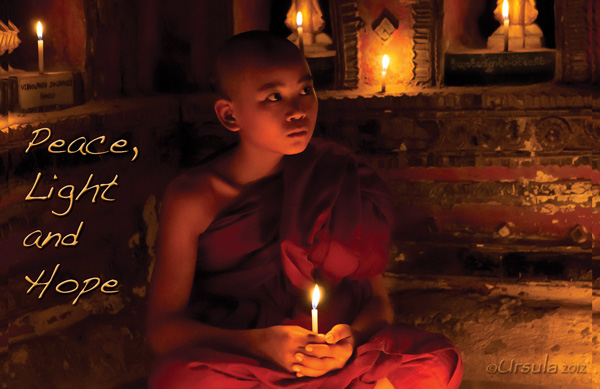
- Novice Monk Shwe Yan Pyay Monastery, Myanmar
Packets of 10 for $AU50.
Or - pick any photo from my Flickr or Wanders blog photos.

.jpg)
.jpg)
.jpg)











Good article & lovely photos
Many thanks to my biggest fan. 😀