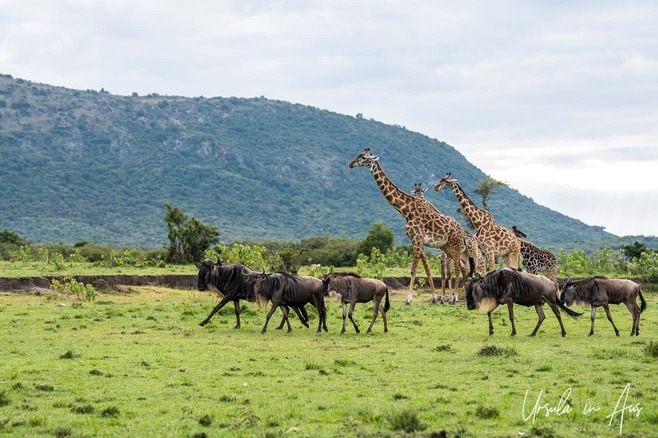
A Morning Migration
Early in the morning, giraffes and wildebeest that have sheltered near the home fires around the Masai villages in the Oloolaimutia Hills in southwestern Kenya return to the waterholes and grasslands in the Masai Mara National Reserve.
The sheer multitude of animal species and individual animals wandering around the Maasai (Masai) Mara beggars belief!
With my driver/guide, I had spent the whole day before in the Masai Mara Game Reserve: hunting down predators, herbivores, and birdlife (see: Just a Day in the Masai Mara). I lost track of how many distinct examples we saw, but I returned to our lodging sated – and with full memory cards and empty batteries.
What is loosely referred to as the Masai (Maasai) Mara is actually a patchwork – made up of the Maasai (Masai) Mara Game Reserve, the Mara Conservancies, and other surrounding Maasai lands and villages. The Game Reserve itself comprises 1,510 sq km (583 sq mi) of land owned and managed by the Kenyan government. The 15 individual Conservancies total another 1,450 sq km (560 sq mi) of lands, communally owned and managed by traditional Maasai landowners. To the west, the Mara runs into the Tanzanian border and the Serengeti National Park.
Entry to the Conservancies is managed by individual tourism partners to the Maasai owners, and is limited to the Maasai landowners and paying customers. Entry to the Reserve is by daily fee, and is only open between 6am and 6pm.
The animals, of course, have no boundaries. They have right of way on the roads and observe their own personal routines: the herbivores follow the rains and the grasses, and the preditors follow their prey.
I was staying high in the Oloolaimutia Hills (see: Sopa Lodge), a hilly area along the southeastern boundary of the Reserve. In theory, it was than five kilometers to the Oloolaimutia Gate; in practice, the steep road was so full of boulders, I was amazed we made it in and out at all!
On this particular day, we left our accommodation early – joining the many animals on their migration back into the park. The large herbivores know that they are safer from predators near the fires burning in the Maasai villages that dot these hills outside the reserve. In groups – or in large herds – they wander back and forth with the dawning and waning of the days.
I was fascinated watching them. Do join me!
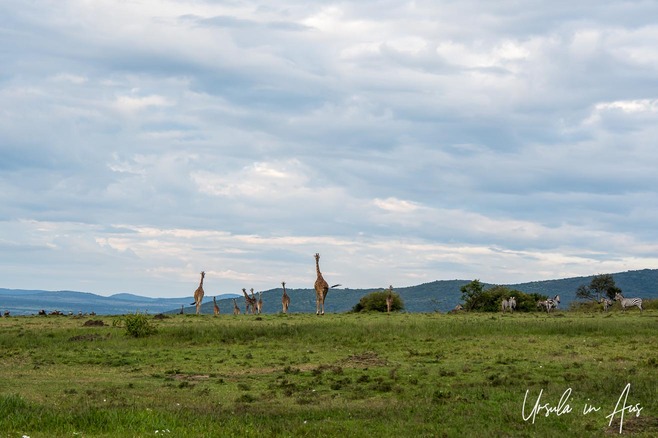
On the Move
The mid-May sun hasn’t been up long; animals are on the move on the horizon.
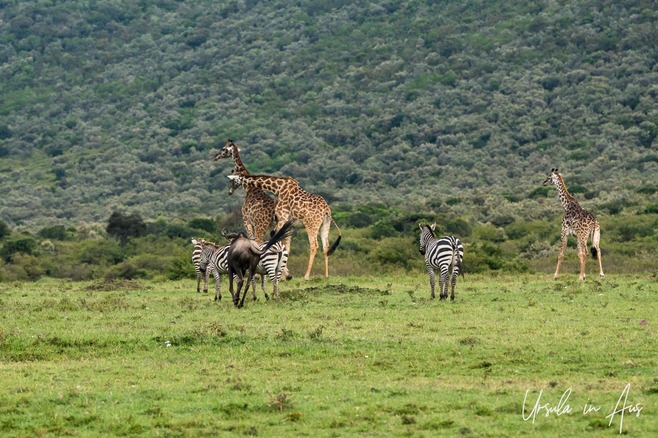
Frisky Wildebeest
The Masai giraffes (Giraffa tippelskirchi) and plains zebras (Equus quagga) stride calmly across the lush grasses. By contrast, the blue wildebeest (Connochaetes taurinus), feels the need to show off in his competition for females: it is coming into breeding season.

En Masse
There is safety in numbers: whether they are browsers or grazers, herbivores often move around in large groups.
On the Move
An Iconic View
The hind view of plains zebras (Equus quagga) shows off their distinctive stripes. These are the Grant’s zebra subspecies (Equus quagga boehmi), the smallest of the plains zebras.
After the Rains
When the rainy season finishes and the male wildebeest are in peak condition, they compete for mates. Or practice competing – I don’t think these guys were serious.
The Rut
This fighting and breeding season is known as the rut, and typically takes place for a few weeks between May and July.
Head Butting
The male wildebeest grunt and clash horns to compete for the females.
Racing around the Giraffes
Some how the giraffes seem oblivious to the blue wildebeest racing around under their feet.
In all Directions
Except for the unruly wildebeest, the procession into the park seems quite orderly.
Black-Chested Snake-Eagle – Circaetus Pectoralis
Overhead, a raptor watches for reptiles or small mammals.
Waterhole
It has been a particularly wet season, and wateholes are scattered all around the open savanna.
Thomson’s Gazelles – Eudorcas Thomsonii
Even though they are the most common type of gazelle in East Africa, I love watching these dainty antelopes.
Sniffing the Grass
Black-backed jackals (Lupulella Mesomelas) are opportunistic omnivores that eat small mammals, birds, insects, fruit, and carrion …
Black-Backed Jackal – Lupulella Mesomelas
… – but they are also pretty little canines.
African Buffaloes – Syncerus Caffer
Also known as Cape buffaloes, these bovines have never been domesticated and are considered one of Africa’s most dangerous animal encounters.
Some People do it in Style!
Not everyone drives into the park; a Cessna Caravan waits for its passengers on the Keekorok Airstrip deep in the Reserve.
Hyena in the Road
A spotted hyena (Crocuta crocuta) watches our approach as we continue along the dirt road.
Spotted Hyena – Crocuta Crocuta
Also known as a laughing hyena, this is one of Africa’s “Ugly Five”.
Topi Crossing
Further down the road, a herd of large antelope topi (Damaliscus lunatus) crosses in front of us.
Topi – Damaliscus Lunatus
Personally, I think these large antelope with their long faces have a stake in the “ugly” race!
So many animals already – and it wasn’t even nine o’clock yet!
I was ready for a coffee before continuing our safari drive.
 Until then,
Safe travels!
Pictures: 14May2026