Hands at Work
Kashmiri weaving is a unique, centuries-old textile tradition. Instead of a single shuttle carrying the weft threads, weavers use dozens to hundreds of tiny bobbins or needles called kanis (or tujis), each wrapped in a different colored pashmina thread.
Kashmir is synonymous with sumptuous shawls, rich embroidery, and stunning carpets.
My cupboards are bursting – but I still can’t resist new textile pieces when I see them. Kashmiri handwoven and hand-embroidered gems are available in stores all over India (and much of Southeast Asia), but it was special to see these art pieces come to life in the place they originate: the Kashmir Valley in northern India.
Kashmiri carpets and textiles have a long tradition, dating back the 15th-century, when Persian influences were introduced under Sultan Zain-ul-Abidin (1395 or 1401 – 1470). Zain-ul-Abidin was affectionately known as Budshah (meaning “The Great King”). He used his long reign (from 1420 to 1470) to reverse the harsh policies of his father, and to usher in a golden age of peace, cultural renaissance, and economic growth in the region. He invited skilled artisans and craftsmen from Central Asia and Persia to Kashmir to augment and support traditional crafts including wood carving, pashmina shawl weaving, carpet making, papier-mâché, silk production, and paper-making (eg: Water, Dreams, and Woodwork and Street Markets, Mosque Markets and Crafts).
I was travelling with a small group of photography enthusiasts. We were staying in beautifully carved wooden houseboats on Dal Lake in Srinagar, the summer capital of the Union Territory of Jammu and Kashmir. The lake is is framed by the Zabarwan Mountains, a branch of the Great Himalayan Range.
Those same high-altitude mountains are home to Himalayan Changthangi (Changra, Chyangra) goats – goats whose fine, downy undercoat is the only source of true pashmina wool. Once a year during the spring molting season, their ultra-fine winter undercoat is carefully combed out and spun into fine pashmina wool by hand.
Cashmere fibers are slightly thicker, and comes from various breeds of goats found across Mongolia, China, Iran, and Central Asia. Cashmere is often machine-processed and mass-produced into everyday knitwear like sweaters and coats – and is often misleadingly labeled as pashmina.
The ateliers we visited around Baramulla and Batpora were using age-old methods to craft kani pashmina shawls. Kani shawls begins as a hand-drawn sketch, which is then translated into a meticulously calculated graph called a taleem (talim). Using a traditional wooden loom and kanis – small wooden or cane spools, each wound with a different coloured yarn – one or two weavers interlock the weft threads individually in a process that can take several months to a year or more.
Similarly, the carpet-makers we watched were using traditional taleem patterns, natural threads, and pains-taking hand-knotting techniques. We also watched artisans creating sozni embroidery: complex borders of florals and paisley patterns which are virtually reversible..
Come watch masters as they create beautiful artworks following timeless traditions:
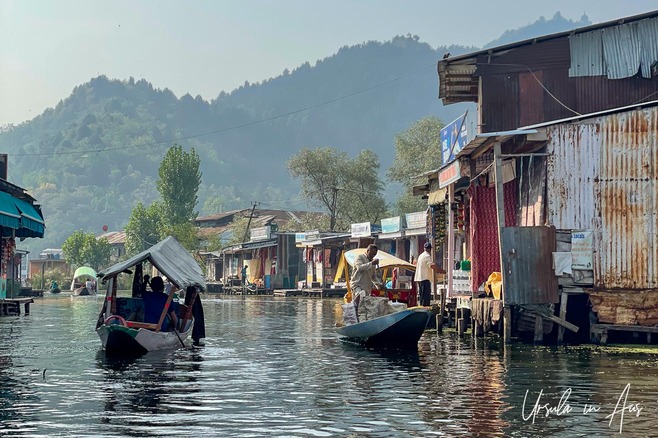
Shikaras on Dal Lake
We are staying in beautiful wooden houseboats on Dal Lake in Srinagar. So, every time we are ferried in and out, we get a glimpse of everyday life on the waterways.
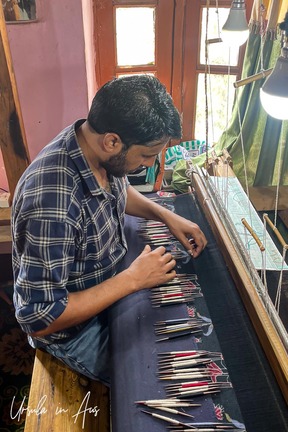
Skilled Weaver
Handmade kani pashminas are painstakingly
intricate to weave …

Colourful Spindles
… and can take from several months to a year or more to complete.
Yarn on Spindles
The complex patterns are traditionally woven using ultra-fine pashmina yarn wound onto kanis.
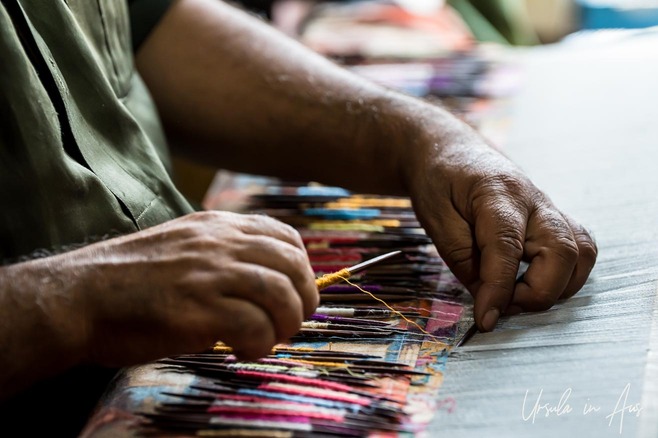
Hands on the Spindles
To protect the work that has already been done, and to allow weavers to maintain focus, a black cloth is often placed over the already-woven portion.
A Pair of Weavers
For very wide cloths, two expert weavers work side-by-side.
Working the Loom
We try not to interrupt the craftsmen’s concentration. The rooms are hot, crowded, and illuminated in harshly contrasting light – all of which makes photography difficult.
Intricate Detail
The patterns are built directly into the structure of the cloth using a double-interlock twill tapestry technique, making the pattern a seamless and integrated part of the shawl rather than an added embroidery.
Portrait of a Weaver
Choosing Colours
Farmer In the Rice
As we were driving from one workshop to another, we came across a farmer harvesting his rice by hand.
Ragwort and Rice
In Kashmir, ragwort (Jacobaea vulgaris) grows wild along the margins of agricultural fields like this harvested paddy field.
Grain Ready for Harvest
Mushk budji (Mushqbudji) is a prized variety of fragrant, short-grained rice mainly grown in these higher regions.
Sheaves
Bundles of harvested rice stalks and paddy (rice straw) are laid out to dry in the sun before threshing.
Mansion in the Golden Grain
This modern take on traditional Kashmiri residential design is typical of upscale housing in this area.
Old Farmer
Traditional farming is had work: farmers manually cut, bundle, and thresh rice stalks by hand or against racks to separate the grains before storing or transporting them to local grain markets.
Making a Kashmiri Carpet
Kashmiri carpets are crafted from natural fibres: pure silk, pure merino wool, or fine silk-wool blends on a background of cotton or silk.
Knotting Hands
Renowned for their intricate patterns and exceptional craftsmanship, Kashmiri carpets are entirely hand-knotted. A specialized curved knife or hook tool cuts and positions the yarn, a wooden or metal comb is used to push the knots and weft tightly together, and a pair of short scissors cuts the pile to an even length once the carpet is finished (see: Village Square). The quality of the carpet is determined by its materials, and by the number of knots per square inch.
Sozni Embroidery
This style of ultra-fine needlework is added to plain pashmina or woolen shawls using thin silk threads. The dense floral, paisley (buteh), and jamawar patterns follow centuries-old traditions.
Concentration
The focus and concentration of the craftsman – who is sitting cross-legged on a patch of carpet in the corner of a room – is admirable.
Deft Needlework
In spite of the speed with which the craftsman works, a simple border design might take one skilled artisan a month to finish.
Weaving the Warp
The traditional looms used in Kashmiri weaving are operated by foot pedal.
 I have always looked forward to enjoying India’s beautiful textiles and carpets. I now feel I have a better understanding of their true worth.
Pictures: 13September2023