.jpg) The Bridge Overhead
The iconic Capilano Suspension Bridge in North Vancouver is one of the most popular tourist attractions in Vancouver. I can’t count how many times I have crossed it with visitors to the region. “It is not so much for its beauty that the forest makes a claim upon men’s hearts, as for that subtle something, that quality of air, that emanation from old trees, that so wonderfully changes and renews a weary spirit.”
– Robert Louis Stevenson
That Robert Louis Stevenson quote is on a signboard along one of the winding paths through the old-growth temperate rainforest in the Capilano Suspension Bridge Park. There is something majestic and awe-inspiring about the tall trees of Canada’s West Coast: Douglas firs, western red cedars, maples, and birch are the most visible among the 40 different species of native varieties growing here.
This canyon is one of those iconic places that – while it attracts throngs of international visitors – says ‘home’ to me.
The Capilano Canyon in North Vancouver has been crossed by a 140 metre (460 ft) suspension bridge since 1889. The original bridge was constructed of hemp ropes with a deck of cedar planks. This was replaced in 1903 – and many times since – with wire cable bridges. The current steel cable bridge, built in 1956, was truly tested in 2006, when, during a winter storm after an unusually cold, wet season, a massive Douglas fir tree was uprooted. The top of the tree snapped off and landed in the canyon 70 metres (230 feet) below, but about 17 tons of tree hit the bridge with the estimated force of a fully laden gravel truck travelling at 100 km/h (60 miles/h).
The bridge survived.
I don’t remember paying entry the last time I visited, so I was rather shocked at the prices now; then again, it’s been six years since my last trip ‘home’ (see: Woods and Waterfalls) and I think my last stop at the canyon was many years before that! The bridge is on private land and the surrounds have been expanded over the years. The current owner has held the property since 1983, and opened Treetops Adventures in 2004. This added a network of seven suspended footbridges up to 30 metres (98 ft) above the forest floor. According to information signposts on site, this series of walkways, suspended between old-growth Douglas firs, was entirely crafted by hand to avoid damaging them. Without using any nails or large machinery, the trees were encircled with specially designed steel collars that spread the pressure and weight out equally.
Come explore!
.jpg) Lions Gate Bridge
This says ‘home’ to me: driving through Stanley Park towards Vancouver’s iconic bridge over the Burrard Inlet. When it was opened in 1938, it was the longest suspension bridge in the British Empire. (iPhone12Pro) .jpg) Kia’palano Totems
Since 1935, the local First Nations people, the Kia’palano – meaning “beautiful river” – have been invited to place their artwork to the park.  Welcome Totem (iPhone12Pro) Artworks (iPhone12Pro) The Capilano Suspension Bridge
The 140 metre (460 ft) suspension bridge stretches off into the distance; people cling to the sides as it bounces and sways. Capilano River
The river tumbles over rocks about 70 metres (230 ft) below us, … Up River
… which gives you an idea how tall those magnificent trees are! Common Periwinkle – Vinca Minor
Although the tree-tops are the draw-card in the park, and although this is an invasive species, I still had to admire the flowers at ground level. Periwinkle were introduced to BC as an ornamental ground cover, but they escaped into the wild where they thrive in the kind of shaded, moist conditions that forest-sheltered waterways like this provide. Little Creek
The Nature’s Edge Boardwalk takes one past a number of watercourses that tumble over low falls … Almost Abstract : Pond Reflections
… or collect in small pools that reflect the green around them. (iPhone12Pro) Little Waterfall
I’m loving the long exposure app on my iPhone. It sure beats dragging a tripod around! (iPhone12Pro) Western Skunk Cabbage – Lysichiton Americanus
Fortunately, this native perennial has a very mild scent compared to the real thing! Ferns, Moss, and Fallen Logs
Cut pieces from fallen trees provide nutrients to the rich life in the understory. Flora
I never succeeding in identifying this. Any answers? Ivy on a Stump Roots of Fallen Tree
I love the rich greens of the moss and ferns everywhere. In the Treetops
A stairway takes you up to the Treetops Adventure, where seven suspension bridges lead you around the mid-story among the 250 year-old Douglas-firs. Treetops Adventure
The viewing platforms are attached using an adjustable and moveable tree collar system that uses no bolts or nails and can accommodate the ongoing growth of the trees. Bigleaf Maples – Acer Macrophyllum
With the colder-than-usual weather, the spring bloom on the trees is later than normal. Maple Flowers
Maple trees bear thousands of flowers which hang straight down like an old lace. Walkways Every-Which-Way
From the viewing platforms, we can look down through the tall trunks to the boardwalk below. Ferns and Rivulets
After traversing the seven suspension bridges overhead, I descend back to new pathways through the mossy forest floor. (iPhone12Pro) Father and Daughter Pretend-/Fishing
A cabin at the edge of one pond epitomizes the ‘summer cabins’ that were part of the mythology of my youth. Activity sheets are given out to youngsters in the park and are wonderfully engaging – including measuring your own height against the growth rate of different trees. The reward is a wildflower seed-encrusted paper bracelet that can be planted. As an educator, I was suitably impressed! Peaceful
The green of the tall trees and their reflections in the still ponds make the environment peaceful – even though there are a lot of people around. Western Skunk Cabbage
The beautiful, but odorous, skunk cabbage is everywhere in the creeks. Back on the Bridge
The suspension bridge takes me back to the other side where the new ‘Clifftop’ walk beckons, but my car also waits to take me to the ferry north. Given the focus the park places on respect, education, and conservation, I felt so much better about the entry price!
It truly is money well spent to save this beautiful old forest, and to share its importance with the decision-makers of the future.
“A grove of giant redwoods or sequoias should be kept just as we keep a great or beautiful cathedral.”
– Theodore Roosevelt
Pictures: 06May2022
Tomb Façade – Little Petra
Some time between the 1st century BC and the 1st century AD, the Nabataeans – an ancient tribe of Arabian nomads – carved buildings into the sandstone walls of the Siq al-Barid, or Cold Canyon, in Jordan. Even without the elaborate tomb and temple architecture carved into the walls of the sandstone canyons, this mountainous desert terrain – high above sea level – is magnificent.
Adding in the majestic artifacts created over two thousand years ago renders the landscape truly awe-inspiring!
A few hours north of Wadi Rum (see: A Morning in Wadi Rum) and south of the Dead Sea, this high plateau honeycombed with sandstone formations is punctuated with natural and man-made caves and structures.
This is Little Petra: known in Arabic as Siq al-Barid, or Cold Canyon. Six kilometres (four miles) north of the centre of Petra, this smaller – but still amazing – site is included in the UNESCO World Heritage Site-listing for its cultural, archaeological, historical, and aesthetic value.
The buildings were carved out by the Nabataeans (Nabateans) some time between the 1st century BC and the 1st century AD. The Nabataeans were a fiercely independent nomadic Bedouin tribe who emerged as a distinct civilization between the 4th and 2nd centuries BCE. The Nabataean Kingdom controlled many of the trade routes between the Arabian and Sinai Peninsulas, bringing its people considerable wealth and influence across the ancient world.
Although no one is sure, archaeologists believe Little Petra was a suburb of Petra, the Nabataean capital, and was meant to house visiting Silk Road traders. The cool of the canyon would have been a perfect place for long-distance travellers to stop: to the east, the Arabian Desert opens up. To the west, the rugged terrain drops down into the Jordan Rift Valley, with lands as low as 400 metres (1,300 ft) below sea level. The immediately surrounding plains were fertile, allowing visiting animal trains to graze extensively, and allowing agriculture – including wine-grape growing – to flourish.
As the name implies, this site is much smaller than Petra itself (Watch this space!). I was pleased that I got to see it before setting foot in the larger and busier archaeological grounds: it allowed me to appreciate its beautiful Hellenistic-influenced architecture without being completely overwhelmed!
Join me on a tour:
Petra Hills
The sign outside the Sita Bazaar – next to the Petra Viewpoint where we alighted our bus for a comfort stop – calls this the “Third Best View in the World.” Wadi Musa – The Valley of Moses
This is a biblical landscape: you can walk down through the valley, past the rock from which Moses reputedly struck water, and on to the Nabataean complex of Petra. Entry to Little Petra
We drove past the bustling town of Wadi Musa and the larger archaeological site of Petra, and parked on the gravel and sand outside Little Petra. Entrance to the Triclinium
We are immediately greeted with the large, rock-cut tomb with a classical façade that sits at the outside of the site. Sometimes called the triclinium (a room containing couches along three sides), the chamber inside was never finished, so the building would never actually have been used as a burial place. Entrance to the Tomb
The rock-cut doorway features two flat relief pillars with quarter columns and Nabataean capitals. The frieze over the doorway incorporates the classical Greco-Roman decorative style adopted by the Nabataeans. Bedouin Souvenirs
There is no entry charge to this site: even the souvenir stands are low-key. Entry to Siq al-Barid
The entry to the canyon is so narrow that we wait for others to exit before trying to get through. Souvenirs or Artifacts Through the Canyon
We work our way through the steep-sided canyon … Through the Siq
… before coming out into more-open areas. Guide in a Cave Room
Our local guide gave us an explanation of what archaeologists think these areas were for. Cave Rooms
There are carved cave entrances everywhere. Woman Spinning
In yet another cave, an Arab woman in Nabataean costume demonstrates how to spin wool. Coffee, Tea, and Trinkets View from the Biclinium
The second, wider, area of Siq al-Barid contains a two-storey rock structure which we access via carved external stone stairs, and which gave us good views over the cliffs on the opposite side. Painting in the Biclinium
The room here contains Nabataean paintings on the stucco walls and ceiling, in what is called a Hellenistic Alexandrian style. Textured Canyon Walls
The walls of the canyon are so textured and pock-marked that the man-made features blend in with those created by nature, … Stairs
… but the natural cliffs are extensively carved with cisterns, cave rooms, and weathered stairways leading in all directions. Rock-cut Staircase
A narrow, steep, and well-worn stairway leads to the top of the canyon … Carved Key
… where I am greeted with ancient artifacts, … View Across the Hills
… and views across the jagged sandstone crags … The Next Wadi
… and into the next rugged wadi, or dry river valley. Kettle on the Fire
There is also the opportunity for a cup of coffee or tea. Back in the Siq al-Barid
I made my way – very carefully – back down the treacherous stairway to the canyon floor … Caves and Cloths
… and back past the two-story biclinium to find my way out of the little complex. I was so glad to have visited this amazing site!
Looking back at my pictures of these two-thousand year-old structures, I continue to be astounded by the engineering abilities and architectural creativity of these ancient people.

Until next time,
Happy Travels!
Pictures: 15October2019
‘Semicircular Space’
This gorgeous installation by Berlin-based, Danish contemporary artist Jeppe Hein is just one of the many artworks on the 16-acre outdoor sculpture park within the Pt. Leo Estate vineyard. Who could resist? A hatted restaurant set in a vineyard with its own sculpture park!
Mornington Peninsula, just an hour south of Central Melbourne in Australia, is a sensory feast. Although the whole government area is technically part of Metropolitan Melbourne, with its charming coastal villages and spectacularly wild coastline, and with its boutique farms and vineyards serving up seasonal produce and pairing menus in their own restaurants, you could be in another world.
The region’s tourism authority has produced a user-friendly map chock full of activities, sights, food, drink, arts, and retail, and I certainly had no difficulty filling the six days I had staying there (eg: Weekly Wanders Mornington). My biggest problem was making sure I didn’t eat and drink too much and have to roll home!
A visit to the Pt Leo Estate and Sculpture Park – and lunch at the restaurant there – was high on my list. Apparently, ‘Vine Art’ is a thing – a global movement – and this sculpture park, in its glorious ocean-front setting, has a well-deserved place.
Of course, this is the kind of project that requires broad vision and deep pockets! In late 2017, the local Shopping-Centre billionaire Gandel family opened up part of their 135 hectare (334 acre) estate on the south coast of Mornington Peninsula to the public: this included a fine dining restaurant and winery cellar door, and 50 or so world-class, large-scale contemporary art works that they had collected over the five years prior (see: Sculpture among the Vines).
Thanks to Covid restrictions at the restaurant, I only managed to book in there on my final full day in the region. Talk about saving the best for last! It was a win-win, really.
Naked Vines
The trimmed-back vines on the Pt Leo Estate stretch out into the distance under a wintery sky. View from my Table
I don’t remember what I ate: I do remember it was excellent – as was the local wine I enjoyed. From my table, I could see the giant pop installation by New York-based KAWS, aka Brian Donnelly, and the red Vega abstract by Australian Lenton Parr. In the distance, across the water, is Phillip Island. Pt Leo Estate
There is a small admission fee to enter the sculpture park: worth it, I thought, to better enjoy them, and to work off the extra wine at lunch! Australian Deborah Halpern’s colourful Portal to Another Time and Place stands to the right. Lynn Chadwick: Jubilee IV
British sculptor Lynn Chadwick’s Jubilee Walking Figures in bronze are quite well known. Although the one on the left is male, they made me think of Margaret Atwood’s Handmaidens. Michael Le Grand : Tsunami (1988)
I love how the naked trees slope down to meet the rising waves of blue metal. Winter Vineyard
Meanwhile, the winter vines curve off around the landscape. Big Boy (2016)
Part of the ‘People I saw but never met’ series, this sculpture by Yemen-born, London-based artist Zadok Ben David looks three-dimensional because of the way it is cut from a single sheet of corten steel. To the Centre (2000)
Australian sculptor Greg Johns’ twisting metal sculpture changes shape as you move around it. Here, it frames one of the Angus cows in the next paddock. Peter Blizzard : Reflected Moon (2009)
Australian sculptor Peter Blizzard draws his inspiration from his local environment, and his artistic influence from Japanese art and its reverence for nature. Anthony Pryor : Horizons (2011)
While art critics see stairway, cloud, and rainbow motifs in this painted steel and bronze work by Australian sculptor Pyor, I see a praying mantis! Jeppe Hein : Semicircular Mirror Labyrinth (2015)
This beautiful arc of stainless steel and aluminium colonnades has been called reminiscent of a classical temple. I loved it – and enjoyed working with my own reflection to create a selfie. Private poetry (2010) by Richard Tipping
Australian visual poet and word sculptor Tipping is known for his ironic adaptations of official signs; it took me two readings to catch this one! Peter Blizzard – Ancient Range Floating (2003)
The title of this work is meant to refer to the upper section of rock: said to be sourced from an ancient mountain range. Again, I am too literal! I see a sheep. Andrew Rogers : Rise 1 (2010)
This is another of my favourites; I loved how this work changed from every angle. Les Kossatz : Laban’s Seal III (1983)
Australian printmaker and sculptor Les Kossatz once nursed an injured sheep; … Detail: Les Kossatz : Laban’s Seal III
… the sheep motif in his work references this, as well as signifying the spirit of Australia. The title alludes to an Old Testament bible story about Laban ‘the Aramean‘. Robert Hague : West Orbis (2009)
New Zealand-born artist Hague is known for work ranging from highly realistic representations to the kind of ‘lyrical abstraction’ we see here. Skeleton Trees against a Winter Sky Barry Flanagan : Drummer (1986)
Welsh-born Barry Flanagan is known for his monumental bronze hares; this drummer marches along on its hind legs. Thanks to popular culture, I can’t help but see Jar Jar Binks. Geoffrey Bartlett : Nautilus Study with Three Legs (2011)
The nautilus shell is a ‘living fossil’; Bartlett says he attempts only to interpret nature – not to mimic it or improve on it. Certainly this tall sculpture commands attention: I took several pictures of it from different places around the park. It was a wonderful wander, and a great way to work off some of my sumptuous lunch.
The park has a program of future acquisitions and a number of site-specific commissions in progress, so there are often new pieces to enjoy.

What a good excuse to go back one day!
Until then,
Happy Wandering!
Pictures: 23June2021
Posted in art,Australia,sculpture,TravelTags: Australia,Mornington Peninsula,Pt. Leo,sculpture,Sculpture Park,travel,Travel Blog,Ursula Wall
Dreams and Reflections
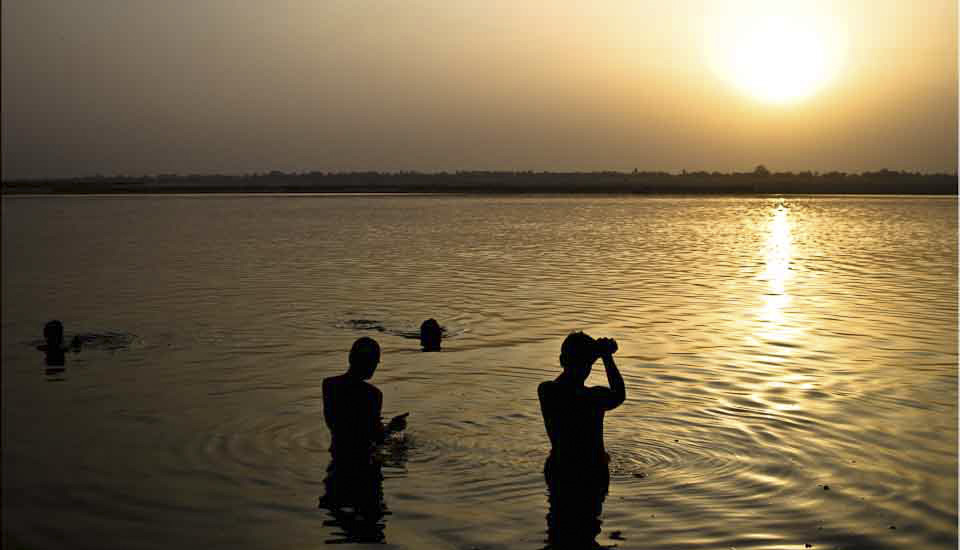
Being on a boat on the Ganges is soporific: the air hums like a high-tension electrical wire in the heat; the smells of incense and pollution envelope you; the oars dip quietly; and the pressing crowd of buildings along the ghats float off into the haze. From time immemorial, the Ganges has been the holy river of Hinduism.
And, of all the spots on this long river – which rises in the western Himalaya and flows 2,510 km (1560 mi) through India and Bangladesh and into the the Bay of Bengal – the ghats, the steps leading down to the water’s edge, at Varanasi are the most sacred. If you bathe in the goddess Ganga Ma or “Mother Ganges” here at Varanasi, you wash away all your sins. Even better: if you die here, you escape the cycle of reincarnation and achieve instant salvation (see: Life and Death on the Ghats). From pre-dawn until after dark, ritual fires burn in Varanasi to offer prayers and pay tribute to this sacred river.
Even as a non-Hindu, I was captivated by the spirit of the place.
I was travelling with photographers Gavin Gough and Matt Brandon, and because it was a photographic trip, I had plenty of time to wander, soak up the atmosphere, and contemplate life and photographic projects. I had spent the very early hours watching the Hindu priests prepare and conduct their morning aarti – a devotional ritual that uses fire as an offering – for the Goddess Ganga (see: Light the Darkness).
It was still early, but the ghats were already humming with activity. I met my group at Assi Ghat, and we divided up into wooden rowboats for a sedate look at the riverbanks from the water.
It is an experience not to be missed!
Boats off Assi Ghat
We get into our boats near Assi Ghat … Along the Ghats
… at the very southern end of the Varanasi ghats. Jain Ghat
Jain Ghat or Bachraj Ghat has three Jain Temples. In Hinduism, the right-facing swastika (卐) symbolises surya, the sun, and brings prosperity and good luck. Men Bathing
Every day, thousands of people bathe in the Ganges: a ritual dip in the holy waters at Varanasi is said to purify the soul. Rowboats
The wooden boats are kept busy … Boats on the Ganges
… with pilgrims and tourists alike. Washing in the Ganges
You can see some of the rubbish in the background here; it is said that pollution levels in the waters of the Ganges … Water Colours
… are 3000 times higher than the limits prescribed as safe by the World Health Organization. Untouchable Kids
Further up the river, near Harishchandra Ghat, the children of the men who manage the cremation pyres hunt for objects in the remains of the fires. In theory, the caste system is no longer legal in India – but the evidence of ongoing practice is everywhere. The Desolate East Bank
The story goes that if you die on the eastern bank of the Ganges, you will be reborn as a donkey. Certainly, most of the life of the city concentrates on the western side of the river. Mansarovar Ghat
A bright red guest house makes a colourful landmark atop the steps built by Raja Man Singh of Amber (Jaipur) in 1585. Boatman
Our boatman was taciturn, and mostly rowed in silence – unlike that of my companions. He kept pointing out bundles bobbing in the water: ‘Sadhu body’. Sadhus are revered as next to the supreme being, and are therefore in the small group of Hindus who do not need fire for purification at death. Instead, they are wrapped in banana leaves and weighted down in the river. They do not always stay down – and can be seen floating away. Meditation
Time marches differently here; people meditating along the river sit in absolute stillness for long periods. Candy-Coloured Boats
I love the colours and textures of the boats – especially against the dreamy heat haze of the ghats in the background. The Eyes of the Boats Prayag Ghat
This is one of the busiest sections of the ghats – being just left of Dashaswamedh Ghat, … Boats off Dashashwamedh Ghat
… which the most important section of river in Varanasi. One of the oldest and holiest of the ghats, the famous Ganga aarti takes place here every evening (see: Life and Death). Yellow Row Boat Women in the Ghat
While a ritual dip is a spiritual experience, it is also communal – and fun: people are happy to smile at us as we pass in our boat. More Boats on the Ganges
The rich red sandstone of Maharaja Chet Singh Fort, built by the Raja of Benares in the 1770s, stands out in the background. Laundry on the Ghat
Long cloths are stretched out along the ghats to dry – hopefully after washing, not dyeing: chemical dyes are only one of the many things polluting this mighty river. The irony, of course, is that these sacred waters which can save you from eternal rebirth are so polluted that they might also be what kills you. Experts link the pollution in India’s rivers to the country’s high rate of waterborne illnesses, which kill an estimated 1.5 million children every year (e.g.: PBS Ganga River; SMH Holy River from Hell).
While there is a push to clean the river, dropping water levels, the demands of industry and farming, and just the sheer press of humanity, make this an uphill battle.
And, there is a deep belief that as well as being able to cleanse us of our sins, Mother Ganga can look after herself.
Personally, I wouldn’t be surprised if she is feeling rather overwhelmed!
ॐ
Photos: 10April2010
Posted in India,Landscapes,TravelTags: boats,Ganges,hindu,hinduism,India,Photo Blog,temple,travel,Travel Blog,Ursula Wall,Varanasi
Market Women at Tambomachay
High in the Peruvian Andes, at the heart of the ancient Inca Empire, Quechua people knit while waiting for tourists. I was breathless with excitement!
Or maybe it was just the altitude? Or the psychoactive effects of the coca tea we’d been drinking?
Flying into Cusco (previously Cuzco) felt like flying into another world. And it was: it was a world away, and a long time ago.
My husband and I were planning to walk the Inca Trail, and Cusco is the jumping off point for most trekkers. This is the UNESCO-listed capital of the ancient Inca Empire and the more modern home of Coca Cola: even though real coca (from which cocaine is extracted) was removed from the soft drink back in 1930s, the giant Coca Cola sign welcoming us to the city was the first thing I noticed from the airplane.
We were greeted at our lodgings with cups of coca tea, which is supposed to help with any altitude sickness. Sitting high in the Central Peruvian Andes, at 3350 metres (2 miles) above sea level, Cusco is a good place to acclimatise in preparation for the even higher passes on the trail. The tea must work, because aside from fatigue and headaches, none of our group of seven intrepid travelers suffered too badly. A couple, however, did have panic attacks when they thought about what might happen if they were drug-tested when they went back to work – even though the leaves are relatively low in psychoactive alkaloid.
Cusco is an intriguing mix of time and culture. Located in a fertile alluvial valley fed by several rivers, it was occupied for well over 3,000 years by non-Inca ethnic Quechua people. After the rise of the Inca civilisation sometime in the early 13th century, the city was conquered by Manco Cápac and became the centre of a small city-state: the Kingdom of Cusco. It is said that in the mid 1400’s, the city was redesigned and remodelled to look like a puma, the Inca representative of the earthly plane.
The invading Spaniards reached Inca territory by 1526 and overtook Cusco by 1533. They did their best to stamp out the native customs and beliefs, building awe-inspiring churches and monasteries on top of the original Inca buildings. Fortunately, the original structures were stronger than the Spaniards imagined, and the granite walls of the Coricancha / Qorikancha (and other original architectural sites) resurfaced after surviving an earthquake in 1950.
The customs have also survived and integrated themselves into the local version of Catholicism. For example, modern versions of ancient coca-leaf healing rituals involve a ‘priest or healer’ saying three Hail Marys and reciting a prayer to the traditional Quechua Gods of the underworld, the land, and the heavens.
I really enjoyed exploring Cusco – even though most of the time the historical explanations our guide was giving us went straight over my head. The different Spanish and Quechua (the most widely spoken indigenous language in Peru) names, and the accent – Peruvians speak their Spanish very quickly, and they speak English the same way: “j” sounds like an aspirated /h/, while “h” and “g” disappear somewhere down the back of the throat – made understanding difficult. I hit information overload very quickly, and contented myself with taking pictures and talking in sign-language to the villagers.
Of course, those pictures that I took were on my very first little digital camera and with a fairly underdeveloped-eye! Sometimes I can’t even crop these old offerings into a more modern 2×3 format without completely losing any semblance of composition.
But, they represent some good memories of a very special time and place. I hope you, too, enjoy them.
Over the Andes
It is a short flight from Lima (see: Postcards from Lima) to Cusco; as we get closer to the old capital of the Inca empire, I marvel at the mountains we will later be walking through. Welcome Band
You could be nowhere else! The Peruvian band playing their pan flutes next to the baggage carousel made me feel as if we had truly arrived in another time and place. Qorikancha : Santo Domingo del Cusco
Any exploration of Cusco takes in the Coricancha (Koricancha, Qoricancha or Qorikancha), the Golden Temple. Originally called Intikancha or Intiwasi, the Inca stone building included astrological elements, and was dedicated to Inti, the Sun God. Looking Back over Cusco
The Spaniards destroyed most of the temple and built the Convent of Santo Domingo on the original foundations. Inside Qorickancha
Much of the first convent building – finished in 1610 – collapsed in the 1650 earthquake … Inside the Convent of Santo Domingo
… and the building standing here now was built between 1680 and the early 1700s. INRI
Today a museum operates inside the convent – but there is still plenty of Catholic symbolism. Hammered Gold
This whole building was once coated in gold. This gold plate is thought to depict the original altar, Mother Earth and the cosmos. The Valley below Q’enqo
A short drive up out of Cusco, we come to the archaeological site of Q’enqo. Guide in Q’enqo
Q’enqo (Qenko, Kenko, or Quenco) is from the Quechua for labyrinth or zig-zag. Like other huacas (holy places) this site was carved into naturally occurring rock formations. Stones at Q’enqo
Although no one is sure, it is thought that this is a place where death rituals, including sacrifices and/or mummification, took place. Sun God Picnic
A modern ‘Sun God’ lounges with his friends while we explore – and is on hand for tourist pictures before we leave! Rocks and Ruins around Q’enqo Puca Pucara
Our next stop is at what is called the Red Fort, thought to have been an Inca fortress. Rocks at Tambomachay
At nearby Tambomachay, you get an appreciation of the intricacies of the construction: the blocks nest into their surrounds perfectly. Tambomachay Fountain
This site consists of a series of aqueducts and canals that channel waters from nearby springs through the terraced rocks. Trinkets and Souvenirs A Girl and her Llama Peruvian Child with a Chuckie Doll
OK – so it isn’t Chucky, but you can see a resemblance! Saksaywaman / Sacsayhuamán
Our next stop is at an incredible site on the northern outskirts of the city: spelled many ways, sections of this citadel were first built about 1100 CE by the Killke people who lived here from 900 CE, and added to by the Inca. No one has been able to explain how the ancient builders achieved this: the massive asymmetrical limestone blocks are so precisely cut and fitted that a single piece of paper won’t fit between them. The White Christ behind Saksaywaman
On the top of Pukamoqo Hill, an eight metre (26 foot) granite, marble, and plaster statue of Jesus Christ overlooks Cusco. It was donated in 1945 by Cusco’s Palestinian Arab colony. Under the Rainbow
It’s hard to refuse a ‘tourist shot’ when Nature puts on a show like this! Cusco from Saksaywaman Iglesia de la Compañía de Jesús – Church of the Society of Jesus
Back in Cusco, we walk around the colonial buildings in the Plaza de Armas – Weapons Square. Built on the remains of one the Inca’s most important gathering spots, it is surrounded by arcades and colonial architecture – including the basilica, built between 1560 and 1654, and this Baroque church started in 1576 and finished in 1668. Iglesia del Triunfo
Built in 1538 and attached to the Cathedral Basilica of the Assumption of the Virgin, … Doors to the Church
… the Church of Triumph was the first Christian church built in Cusco. Guinea Pig
Our day finished with dinner – which included the Peruvian delicacy: roasted guinea pig. This was a challenge for vegetarians like me and my husband, but sampling strange foods is part of the experience. Sometimes you have to not think about what you are eating!

It was certainly a full and interesting day – and whether it was the excitement, the altitude, or all the stimulant tea, I thought about it long into the night.
Until next time,
Happy Travels!
Pictures: 05April2006
Posted in Architecture,History,Peru,TravelTags: archaeology,architecture,environmental portrait,history,Peru,Photo Blog,ruins,travel,Travel Blog,UNESCO
« Older posts
Newer posts »
|







.jpg)


