A Couple on Bow Lake Bow Peak, Bowcrow Peak, and other mountains in the Waputik range stand tall and majestic around the beautiful glacial Bow Lake. Just a short detour from Highway 93 in Canada’s Rocky Mountains, it feels miles from anywhere.
Highway 93, which runs the 233 kilometers (143 miles) between the little hamlet of Lake Louise in Banff National Park and the alpine town of Jasper in the Jasper National Park, runs parallel with North America’sContinental Divide through some of the most stunning scenery you could ever hope for.
It is breathtaking! Even in the rain.
I was disappointed to wake up to grey skies and scattered rain on the day I was set to drive north from Lake Louise. While May weather is predictably unpredictable, the month was almost over, and I’d been lucky on my walk the day before (see: The Bow River Loop).
Driving time – without stops – between the two little settlements is well under two hours. But, it is all through National Parks and the scenery is so stunning, it hard not to stop every few minutes! I had done my homework, and knew I would have no cell phone or wifi for most of the route, so I kept the paper map I had picked up at the Park’s Office. I also knew that the very few available facilities along the road were predominantly closed for off-season: I packed plenty of water and bought myself a picnic lunch before leaving Lake Louise.
Braving the ceaseless rain, I pulled out my umbrella at Mosquito Creek, a mere 20-odd minutes (27 km – 16 mi) after setting off. It was eerily quiet without the crush of visitors who camp or cabin there in summertime.
My second and third stops were soon after: a mere 10.4 km (6.5 mi) and 2 km (1.2 mi) further north, at Bow Lake Viewpoint and The Lodge at Bow Lake, respectively.
Join me for a short section of the Icefields Parkway!
Start of the Highway 93N The driving itself was easy: the road was in excellent condition, and a lot less twisty than many mountain roads I’ve travelled. The hardest part is not becoming too distracted by the scenery all around. (iPhone12Pro)
A Very Wet Walk The clouds dropped down and the skies opened up: it was very wet when I got to Mosquito Creek.
Mosquito Creek It was too wet for any serious walking, but I explored the nearby creek.
Cairns in Mosquito Creek
Islands in the Creek The cold and crystal clear waters here have raced down from one of the over 100 glaciers in the surrounding mountains.
“Moosequito” It was very quiet: although the hostel – and the campground on the other side of the creek – are open year round, there didn’t seem to be any guests.
Rain on the Highway Back on the road, the mountains loom and the rain continues. (iPhone12Pro)
Mountains around Bow Lake Less than ten minutes later, like magic the clouds lifted and patches of blue sky appeared. (iPhone12Pro)
Crowfoot Glacier Viewpoint There is a small pull-off at the side of the road …
The Weight of Snow … that allows great views of the Crowfoot Glacier. The still-impressive-but-shrinking glacier, which once had an extra claw making it look like the foot of a bird, is one of the many water sources for the Bow River below.
Bow Lake Viewpoint My next stop was literally one minute further up the road. There you have clear views over the magnificent Bow Lake. Like other glacial lakes, it is impossibly aqua-blue-green. Fine particles of rock are picked up, ground small, and deposited into the water by slow-moving and melting glaciers. The suspended particles filter the reflected light, giving these lakes their spectacular colours. Crowfoot Mountain stands tall (3055 m – 10023 ft) on the opposite shore.
The Lodge across Bow Lake The historic Num-Ti-Jah Lodge is dwarfed by Mt Jimmy Simpson ( 2966 m – 9731 ft) behind it.
Bow Lake To get a closer look, I turned in towards the lodge, where I managed to park along the roadside. Bow Lake is just beautiful from every angle! (iPhone12Pro)
Douglas Fir – Pseudotsuga Menziesii
Wild Strawberry – Fragaria Virginiana I follow a narrow, wet dirt path parallel to the lakeshore; it is slippery and full of tangled tree roots and small plants …
South over Bow Lake … but the views are glorious …
Waters around Bow Lake … in every direction.
Shallow Waters
Bridge on Bow Lake Closer to the lodge, the path improves, and leads over a small bridge.
Location, Location! What a spot! This 24-guest-room lodge was the dream child of Jimmy Simpson, mountaineer, trapper, and guide, who came to these mountains from Scotland in 1898. Little has changed since Jimmy first opened it to customers in 1922: with no cell-phone or wifi, the Num-Ti-Jah Lodge is truly an escape into nature.
People on the Lake Time stands still here.
Unfortunately, my time was marching on!
It was already 1 pm, and I had covered less than 40 kilometres (25 miles). If I continued at that pace, I wasn’t going to be reaching Jasper before dark.
Reluctantly, I pressed on – vowing to come back some day.
The Greek Flag on the Venetian Fort This is Crete: blue skies, a killer September sun, and layers of history everywhere you look!
Perfect weather, fabulous food, and historical and natural sites galore: Crete was an absolute joy to visit.
I was staying in the hills outside the island’s capital of Heraklion/Iraklio, and had no difficulty filling my days with fascinating day trips (see: Weekly Wanders Crete). Towards the end of my week, I decided to explore closer to home, and took the shuttle into the old port. I had pre-booked myself one of those Hop-on, Hop-off buses, to facilitate my access to the main sights downtown – although I probably didn’t need it..
I started the day in the old port, making my way across the waterfront around the ancient Venetian harbour to my first pick-up point – hopping off the bus again to explore sections of the old city walls and to enjoy a traditional lunch and Greek coffee at a sidewalk cafe.
The bus circuit took me past the Palace of Knossos, which I had already visited (see: The Minotaur, Mythology, and an Ancient Palace). I alighted again back in town, and headed for the Heraklion Archaeological Museum. I took longer than I had expected to admire the wonderful collection there and have written separately about the truly breathtaking 4000 year-old arts and artefacts from the Minoans on display (see: Modern Art from an Ancient Culture).
It was definitely time for a break, and I made my way through the heart of the old town to the historic Morozini Fountain and found a seat at another cafe for more coffee and some people-watching.
My last stop before finding the return shuttle to my accommodation was back on the waterfront, where I explored the Venetian fort, alternately known as Koules Fortress, Rocca a Mare Fortress, or Castello a Mare (“Castle on the Sea” in Italian).
Join me for a walk around the vibrant seaport of Heraklion.
Wooden Boat on the Waterfront The old Venetian port is an eclectic mix of ancient and modern: considered a historical landmark, an old wooden boat sits in the green space near the marina.
Souvenir Shop Nestled in the breakwater near my first bus stop, vendors take advantage of the countless tourists that walk the waterfront.
Koules Fortress Built in the 16th-century, Koules Fortress stands as monument to Heraklion’s Venetian past.
Venetian Walls I hopped off the bus a short distance away from the waterfront – along the western edge of the fortified walls built around the old centre by the Venetians in the 16th century.
Inscription over the Jesus Gate – Kenourgia Porta – New Gate The year here is 1580, and I think the inscription honours John Mocenigo, the Proconsul (Governor) of the city-state at that time.
Old Bricks and New Growth Heraklion’s walls, armaments, and other fortifications, were designed by military architect and urban planner, Michele Sanmicheli (1484-1559) of Verona. Although requiring repairs after earthquakes, age, and modern warfare, the walls withstood against the second longest siege in history – finally falling to the Ottomans after 21 years in 1669. The sections that remain today are still impressive.
View from the Wall From the top of the wall, you can see where the old city meets the new.
Tunnel in the Wall
Madonna Sculpture Renaissance Park is nestled into a triangle of space at the base of the old wall.
Mother and Infant I could find no information about this intriguing modern sculpture.
Fountain of the Tekke of the “Three-Men Order” (Üçleria) On the other hand, the 18th century ablution fountain in Renaissance Park has numerous names: for example, it has been called the Fountain of the Joint (The Hookah Lounge) and the Ottoman Fountain of the Tekke (a monastery of Dervishes).
Holy Church of Agios Andreas Across the road, we jump ahead a century or two, …
Church Bell … to a little Greek Orthodox chapel.
Bust of a Local Dignitary Some of the public art is identified only in Greek, so I have no clue!
Doors in the Wall near the Kainouria Porta While they are called the Venetian Walls, original sections (mostly lost now) were built by the Byzantines who occupied the area for hundreds of years before the Venetians arrived. Subsequently, sections were replaced by the Turks.
Hercules – Heracles There are different stones and details everywhere you look. Heraklion is named for Hercules, who reputedly came to Crete to perform the seventh of his labours. He is honoured in the walls near the Kainouria Porta – the New Gate.
Gate Pantocrator – Chania Porta Although there are only four arched city gates (portals) through the old walls, they all took on different names over the years, making it feel like there are many more!
Morozini Fountain Much later, back in the centre of the city, I go in search of the city’s famous fountain. In the middle of Eleftheriou Venizelou Square – more commonly known as Lions Square – is the marble fountain built in 1629. Its purpose was to bring water from the mountains into city; its four lions are an enduring symbol of Venetian power.
The Municipal Gallery The civic buildings combine …
Reflections in an Arched Window … classic elegance …
Municipal Art … with modern interpretations.
Church of Agios (Saint) Titos The Cathedral of Saint Titus(Hagios Titos)was originally built as a mosque in 1869, and was converted to an Orthodox Church in 1925. It is dedicated to dedicated to the apostle Titus, the first bishop of Crete.
Candles in the Church The interior is dark, and smells of smoke and incense.
Inside the Church of Agios Titos Ornately carved wood surrounds the Christian icons at the altar.
Koules Fortress Back at the waterfront, I make a visit to the Castello a Mare – known today by its Turkish name of Koules. Built on the site of previous fortifications, this Venetian fortress was finished in 1540.
Inside Koules Fortress The complex seems incredibly solid – although it has recently undergone extensive renovation, so who knows what is original and what isn’t!
From the Battlements The interior is quite plain, but the battlements afford unencumbered views …
Boats on the Harbour … in all directions – especially over the marina and city.
Flag on the Walls
Old Stones The fort was armed with cannons in 1630.
Looking out Old Windows Today, windows look out over the two kilometre (1.2 mile) promenade that serves as a recreational sea walk and a functional break-water.
Tourist Train Back on the waterfront, I spotted the charming little train that circuits the old city.
Pirate Ship in the Harbour Crete’s location in the middle of the Aegean Sea, within striking distance of both Europe and Anatolia, has made it attractive to pirates over the years. In the ninth century, it became home to Arab Moors from Spain, who made Heraklion (Chandax) the principal base of what has been called a Pirate Emirate. The celebrated Barbarycorsairs, brothers Aruj and Chayrad’din, collectively known as the Pirate Barbarossa, were regular visitors to the city, and reputedly had hideouts nearby. Today, modernised ‘pirate ships’ serve as tourist boats.
Heraklion Lighthouse My last impression, as I leave the city, is of the lighthouse at the end of the seawall that shelters the old Heraklion harbour.
The city is truly a wonderful mix of old Venetian and Ottoman elements …
… with just enough modern Cretan influences – and good Greek food and coffee!
Har Ki Pauri Every night on Har Ki Pauri – one of the most sacred ghats in Haridwar – the magnificent Ganga Aarti is performed.
The Ganges River, known more commonly as the Ganga Mata(Mother Ganges), is revered in Hindu worship and culture. More than just a river, she is the embodiment of a goddess whose purity cleanses one’s sins: bathing in her waters releases the faithful from samsara, the endless cycle of death and rebirth.
All along the banks of this long river, from the source at Gaumukh in the Himalaya, to the mouth on the Bay of Bengal, Hindu faithful seek to bathe in the waters to rid themselves of sins. They also pay their respects to the Mother, making offerings or pujas (ceremonial worship), and often carry water home again in copper pots for use in rituals. When loved ones are dying, it is customary to place a few drops of Ganga water in the mouth of the departing.
Some places along the river’s long banks have additional spiritual significance – and one of these is the ancient holy city of Haridwar. There, whole temples are devoted to the worship of the river/Goddess, and an aarti to her is performed twice a day – at sunrise and sunset.
An aarti (arti or arati) is a Hindu ritual employed in worship, often part of a puja, in which light is ritually waved in veneration of deities. This light – usually in the form of a flame – symbolically removes rātrī, or darkness. The evening Ganga Aarti at Har Ki Pauri, one of the most sacred ghats in Haridwar, involves a number of priests addressing the Mother and leading prayers and chanted mantras in reverence. They blow conch shells, ring bells, bang brass cymbals, and wave lighted multi-tiered brass lamps, all in a traditional ceremony which lasts about 45 minutes.
I was travelling with photographer Karl Grobl and local guide DV Singh; they got us into a great vantage point across the water from the aarti. I was as much impressed by the welcoming friendliness of the people around me as I was by the ritual on the opposite shore.
Join me for some environmental portraits from the ghats in Haridwar.
Haridwar Street It is a short walk from our hotel to the ghats on the Ganges.
Jewellery Salesman Our walk takes us through narrow lanes with brightly lit stores selling jewellery in gold and semi-precious stones.
Young Woman in the Gold
Women in the Street Many of the pilgrims I meet have travelled a long way; they gather outside the shops to admire the jewellery – and possibly add to their collection of bangles.
Man in a Cap
Bridge over the Ganges We walk across the Shiv Setu bridge to get to our vantage point on the opposite bank.
Flowers on the Water Flowers are swept away underneath us. Any time of day or night, people say prayers and offer gifts to the Ganga Ma.
Hindu Priests on Har Ki Pauri It is still early – the aarti takes place at sunrise and sundown – but the ghat is already a hive of activity.
Priests on the Steps With spectators either side on the stairs of the ghat, the priests launch into their litany of chanted prayers.
Woman in Red Our side of the river is quite crowded, but everyone is in a good humour …
Woman and her Husband … and there are plenty of smiles to welcome the strangers in their midst.
Women in the Crowd
Worshipers on the Ghat As the light falls, our ghat becomes quite crowded.
“Om Jai Gange Mata” When the traditional song venerating the Mother Ganges starts, everyone joins in, …
“Jai Ganga, Qui Jai” … throwing their hands in the air with gusto on the chorus.
Prayers to Ganga Ma The belief that the Ganges is the living embodiment of a Goddess or spiritual Mother runs strong, …
Reverence … and people offer up their heartfelt prayers to this celestial river.
Woman and her Husband: Reprise Twilight falls over the crowd on the ghat.
Woman in Brown All around me, the audience/participants take the time …
Woman in a Colourful Scarf … to smile and have their pictures made.
Smiling Girl
Man in a Woolen Cap Once the sun is gone, the temperature cools dramatically.
A Couple on the Ghat
Priests with Lamps Fire is central to any aarti: the flames are ritually waved in veneration of the deity – in this case, Ganga Ma.
Priest with a Lamp After the aarti, lighted wicks are are passed around …
Young Woman with a Lamp … and worshippers pass their hands through the scented smoke …
Woman with a Lamp … and then wave this over their face to receive the purifying blessings, before passing the flame on.
End of the Aarti on Har Ki Pauri Soon it is dark, and the aarti is finishing up. Scented smoke lingers on the air.
The aarti in Haridwar was completely different from those that I had watched some years prior in Varanasi (see: Light the Darkness and Life and Death on the Ghats) – a further illustration that worship can be done in any manner, as long as it is mindful.
Minaret and Mountains This is so prototypically Oman: the minaret of Al Qala’a Mosque and the walls of the seventeenth century Nizwa Fort and Souq stands out against the arid and rugged Hajar Mountains.
I spent less than a week in the Sultanate of Oman, an Islamic Arab country on the southeastern coast of the Arabian Peninsula.
In that time, however, I saw countless forts, castles, and towers (see: Oman’s Fortress Castles and Jabreen Castle). Perhaps this is unsurprising, as the country is called “the land of [a] thousand forts.” These structures – whether in ruins or extensively restored and opened as museums – punctuate the landscape. They rise, solitary, out of rocky hilltops, or blend into sprawling urban complexes.
Nizwa Fort is described as among Oman’s top forts – and is often rated as the number one. It is certainly the most visited – probably in part because it is only two hours away from Muscat, Oman’s capital and most populous city.
Nizwa is the most important city in Oman’s interior and one of the oldest continuously occupied settlements in the country. It was the centre of the al Julanda dynasty in the 6th and 7th century CE and became known as a spiritual capital. It’s location in an area with water and abundant natural wealth, and at the crossroads of a number of vital trading routes, made it attractive to outsiders.
Hence, the fort.
The very impressive Nizwa Fort was built over a span of 12 years in the 17th century by Sultan bin Saif al Yaruba, the first imam of the Ya’aruba dynasty. The sprawling structure, with its impressive 40 m (31 ft) tower, sits on foundations dating back to the 12th century.
The extensively renovated structure is a popular tourist destination, with historical displays throughout, and magnificent views from the rooftop battlements. I was just as impressed by the traditional souqs (or souks, meaning markets) that surround it at ground-level. There, I got to taste-test freshly-made halwa (literally: Arabic for sweet), and admire the colourful glass lamps and silver jewellery.
Come for a wander:
Dates in the Souk Oman is home to more than 250 indigenous varieties of dates: they are the first thing to greet me in the souq.
Painter in the Rafters High overhead, a tradesman pauses to smile for the camera.
Ingredients Halwa all starts with the same basic ingredients, …
Sweet Treats … but ends up in countless forms and flavours.
Salesman in a Kuma The smiling salesman in his embroidered Omani cap tried to persuade me to take some halwa home; unfortunately, it doesn’t have a very long shelf-life!
Omani Lamps in the Market
Spices
Guide at the Entry My local guide Said waits at the fort entry to provide an informative walk-through.
Entering Nizwa Fort It is cool and dark inside the thick walls – a welcome relief from the desert heat.
Sun over Nizwa Fort It is only mid-morning, but the sun is high and fierce over the curving walls around the courtyard.
Nizwa and the Hajar Mountains From the top of the fort, the views extend over the plateau in all directions …
View into the Courtyard … including into the lower levels of the fort itself.
Gazebo with a Golden Dome We also get a good view of the Arabic script decorating the public gazebo in the city below.
Al Qala’a Mosque
Cannon The fort was designed to conduct – and withstand – cannon-based warfare. The original cannons in the tower allowed complete 360-degree coverage across the countryside.
Women’s Wealth The heavy and ornate silver jewellery worn by important women signalled their wealth and societal status.
Silver Finery
Fort Layout Strategically-place signboards explain the fort’s layout and aspects of it structure. Without my guide, I would have become hopelessly lost!
Arches and Information
The Omani Khanjar These curved daggers are traditional weapons that are symbols of pride to the Omani people and part of the men’s national dress.
Antique Dallah Coffee Pot
Rooftop From another vantage point, we can see over the walls and into the surrounding date palm plantations.
Into the Walls From one of the information signs: “Although the terms ‘fort’ and ‘castle’ are often used interchangeably, they have very different meanings: A ‘fort’ (ga’lah) is a garrisoned military post. A ‘castle’ (hisn) is a fortified building or group of buildings allocated to administrative or residential use.” The entrance to the armoury is next to the arched passageway.
Ancient Well A reliable source of water is crucial to any fortified building.
Tented Shop Back in the souq, everything has a Bedouin flavour.
Pottery Lamps These pottery lamps were everywhere in Oman.
In the Shops The many shops in the souq are a treasure-trove of craft and artistry – and a respite from the heat and glare outside.
In the Souk Fortunately for me, everything was too heavy or too fragile for my suitcase, and I escaped without purchases.
Well, without purchases except for dates and halwa; …
Village in the Mist Ghandruk is a charming Gurung village in Nepal’s Modi Khola Valley. The usually stunning Annapurnas are hiding in the background, behind the rain and mists.
I was distressed to hear about the earthquake in Nepal earlier this month (3 November 2023): multi-storied brick houses in the remote, mountainous districts of Jajarkot and West Rukum collapsed after the 6.4 magnitude (USGS) quake, burying whole families in the rubble.
This beautiful country has had a special place in my heart since my first trekking trip there many years ago. My last visit was in March of 2017. Although that was almost two full years after the previous major earthquake – the Gorkha earthquake of April 2015 – the wreckage of that disaster could still be seen everywhere, and rebuilding was taking place slowly. The Gorkha quake was much more destructive than this November one – at least in part because it was in more built-up and populated areas, destroying homes and precious heritage temples all around the Kathmandu Valley. Even so, the thought of the lives lost and the extra hardships visited on the people affected by this most recent natural disaster as we come into a northern winter gives me pause.
On my 2017 trip to the country, I spent some time walking in the Kathmandu Valley (see: Ursula’s Weekly Wanders: Kathmandu Valley Rim) before participating in a photography workshop with the delightful Gavin Gough. After the workshop, my husband joined me, and a group of us undertook a slow circuit trek in the Annapurnas under the guidance of Angfula Sherpa.
On the penultimate day of our trek, we set off early from Tadapani, and travelled east towards the traditional Gurung village of Ghandruk. Although this portion of the Ghorepani/Poon Hill trek is rated as relatively easy, and is mostly downhill, I wasn’t the only one feeling my joints and my age. It was our fifth day of walking, and much of it had been through rain. I was happy to pace slowly, and thrilled to stop for an early lunch in the tiny hamlet of Bhaisi Kharka (see: One Enchanted Morning).
Sometimes it is easier to enjoy walks when revisiting the old photos! The foot-sore fatigue and insidious rain are all but forgotten when I look once again at the beauty of those hardy people and distant landscapes.
Join me in and around Ghandruk.
In the Courtyard We had stopped for early lunch in the hamlet of Bhaisi Kharka, where Gavin chatted with the locals …
Child with a Phone … and watched as a young child played with his phone.
Flower in the Stream We are surrounded by the famous Himalayan forests of rhododendron trees. The spring blooming season is coming to an end, and flowers drop from the tall trees around us and into the waters rushing past.
Waterfall The mountain waters – in what is probably the Ghatte Khola – rush down the rocks in a steep fall …
Steep Stairs … and narrow stone steps follow beside them. We are gradually dropping down in altitude; watch your footing!
Prayer Flags Tibetan prayer flags bless the surrounding countryside and colour our path.
Mossy Steps I can’t help but wonder how long these mountain paths have been in use …
Stone Steps … as they wind off around the mountainside.
Twisted Trees It is like being in the enchanted forests that populate old fairy tales! The mossy tree trunks bend and twist around us in the damp.
Wild Rhododendron This is the land of the lali gurans(lali guras), Nepal’s national flower, the red rhododendron. Some are still blooming in the dense forest around us.
Buffalo (Bubalus Bubalis) Grazing Nepal relies on buffalo, which contribute more than half the milk and over one-third of the country’s meat production.
Wood Pile Winters are long and hard: in the absence of reliable electricity, these remote areas still depend on wood for heating and cooking.
Broken Window I love the colours and textures – and have to wonder how long it has been since this actually operated as a store!
Ghandruk in the Rain The heavy mists have developed into full-on rain. As we round the corner to Ghandruk, most of the village disappears into cloud.
Ponies and Donkeys on the Path Closer to the village, we share the wet cobbles …
Pack Animals at Work … with trains of ponies and donkeys.
Old Gurung Woman The local people seem unconcerned by the rain; on the other hand, we are coated in plastic!
Mountain Dog in the Rain From time to time we meet variations on the beautiful Tibetan mastiff.
Shiny Kitchen Later, once I’m in dry clothes, I admire the shiny utensils in the kitchen of our guesthouse.
Saleswoman The next morning, we get up from our cosy room to find a saleswoman ready and waiting outside in the courtyard with her beautiful mountain gems. (iPhone6)
Our Team This will be our last day walking, so I make a picture of our wonderful guides and porters. (iPhone6)
Ponies on the Track The pack horses are already at work when we set off out of the village. Even though people are becoming more aware of animal welfare, the dainty animals look a bit sad to me.
Boy on a Rock The misty rains continue, keeping the mountain range hidden.
A Cheeky Smile An impromptu environmental portrait session almost makes up for the weather!
Leaving Ghandruk We pause to mark the start of our final leg , …
Fields Below … as the valley we’ll be descending into beckons in the mists below …
Ponies on the Path … and the narrow track winds out in front of us.
Over the course of this portion of our walk, we dropped from about 2548 m (8361 ft) at Bhaisi Kharka to 2012 m (6601 ft) at Ghandruk. It was noticeable in the vegetation around us: almost gone were the rhododendron forests, replaced by expanses of terraced farms.
My legs and lungs also noticed the difference in altitude, and were thankful.
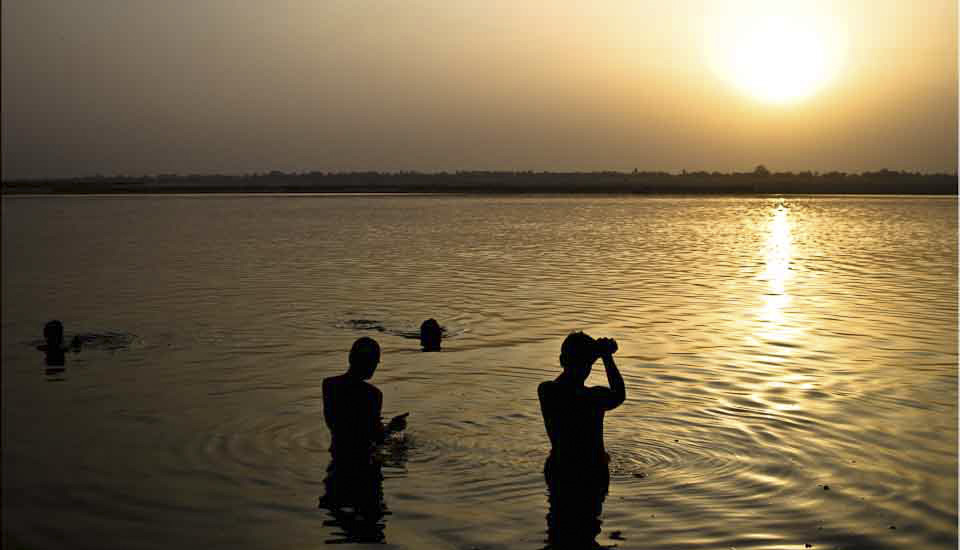
- Performing the Ganga Aarti from Dasaswamedh Ghat, Varanasi
- Buddha Head from Shwedagon Pagoda, Myanmar
- Harry Clarke Window from Dingle, Ireland
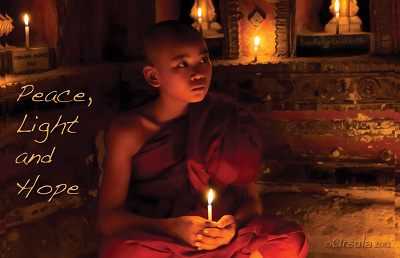
- Novice Monk Shwe Yan Pyay Monastery, Myanmar
Packets of 10 for $AU50.
Or - pick any photo from my Flickr or Wanders blog photos.

.jpg)
.jpg)
.jpg)

 Until then –






 … and I didn’t have to carry those home!