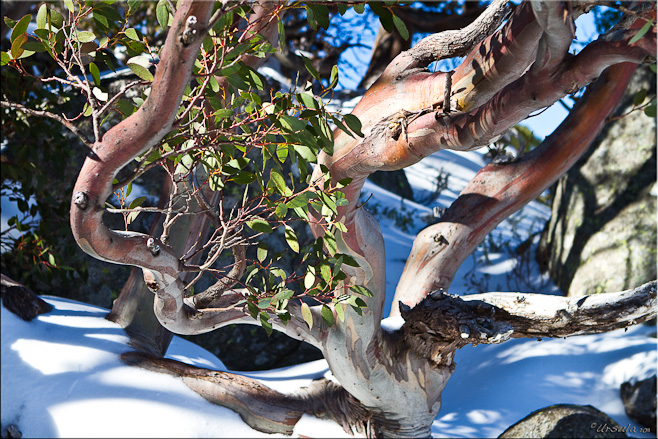
 Twisted Snow Gum (Eucalyptus pauciflora) in a Bed of Snow ~ Charlotte's Pass The snows came early this year.
It was only mid-May, and already the tops of the Australian Alps were covered with white. Even down in Jindabyne (934 metres) where we were staying, wet flakes settled briefly on our noses before puddling into cold water. Late one afternoon we tried to drive up to Charlotte Pass, at the top of Kosciuszko Road, only to be turned back by a nice National Parks employee who laughed at our Queensland-plated rental car and asked us where our snow chains were. We had to be satisfied with a view-stop at the Waste Point Lookout and a drive up to Threadbo, where, in spite of grey skies and light flurries, the road was still open.
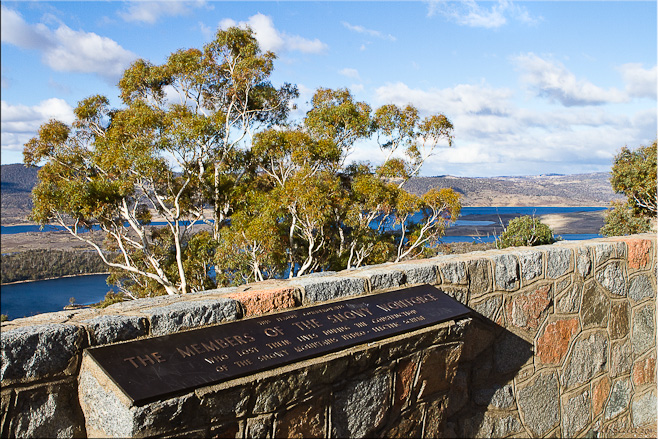 Against the Backdrop of Lake Jindabyne, at the Waste Point Lookout, is a Plaque Commemorating the Workers who Lost Lives Building the Snowy Hydro-Electric Scheme 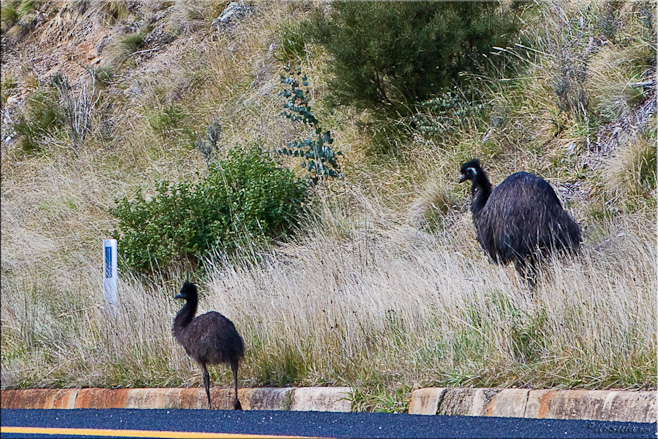 Junior and Senior Emu (Dromaius novaehollandiae), Alpine Way, NSW We had tried to get snow chains, but winter rentals are a seasonal business, and with the ski season not due to open for another three or four weeks, none of the rental shops were operating. Snows fell in the Australian Alps in April this year, which is unseasonably early – although snow can fall any time from May to October, significant falls before June (when the ski season usually opens) are unusual. Australia is a relatively flat, dry continent with the alpine area comprising a minute (about 0.15%) proportion of the total landmass. The country’s highest point, Mount Kosciuszko, at 2228 meters, has a bare peak in summer, and the alpine area only hangs onto the smallest patches of snow, tucked into shady hollows, between winters.
 Through the Windscreen and into the Snowy Mountains The next morning we tried again and this time succeeded, albeit slowly and carefully, in making it up through the slush, snow and ice to Charlotte Pass and the fabulously gnarled snow gums that line the aptly named Snow Gums Boardwalk.
Snow Gums (Eucalyptus pauciflora) are amazing trees. Living between 1500m and the tree line, they have adapted themselves to the extreme conditions of the alpine slopes. Curled against the wind, the snow gums have a bark that changes colour in response to climactic conditions and external branches that slope down to allow the snow to fall off. As one writer puts it: “it is their twisted shapes that makes you stand in awe and feel humbled, moved, and inspired by their resilience and determination”.
A Colourful Snow Gum The Smooth Pale Bark of the Snow Gum Peels in Patches ~ The Colours Change with the Barometric Pressure The Red Bark of a Snow Gum Stands in Contrast Against Snowy Mt Townsend Snow Gums and Mountains ~ The Road at Charlotte Pass The Last Grasses Like Other Kosciuszko Shrubs, Fragrant Mountain Mint Withstands Being Buried Every Year Spencers Creek and the Mountains Still Life ~ Stone and Snow The plants and animals that live here, many of which live nowhere else, are well adapted to the snowy conditions. They are, however, vulnerable to the already-measurable effects of climate change, and it is likely that the next decades will see significantly changes in this unique landscape.
Ice and Snow, Spencers Creek Afternoon Light, Spencers Creek 
Many species will probably be lost entirely within our lifetime.
It’s a shame, isn’t it?
Until next time…
Posted in Australia,NatureTags: Australian Alps,blog,Kosciuszko,National Park,nature,Photo Blog,seasons,snow,travel,Travel Blog,Ursula Wall,winter
Madonna and Child, L'Église St Michel, Duilhac Religious expression, or more precisely, the expression of the Roman Catholic faith, is in evidence everywhere in France. Every town has at least one church, with a bell and a cross. On our recent walk along the Cathar Trail, we came across crucifixes, large and small, at every turn.
The Ancient Fortified Centre is the Heart of the Village ~ The Iron Mission Cross (1855) ~ Duilhac Of course, religious expression is not always peaceful – there is often an uncomfortable tension between war and worship. The images above are from the small town of Duilhac-sous-Peyrepertuse, which as the name suggests, sits under (sous) the ruined fortress of Peyrepertuse. Called a Châteaux cathares (Cathar castle), Peyrepertuse was a temporary haven for the persecuted Cathars during the Albigensian Crusade in the early 1200s, and so stands as a symbol of their eradiacation in the name of religion. Another of the «cinq fils de Carcassonne», the ’Five Sons of Carcassonne’, the Château de Peyrepertuse was originally built by the kings of Aragon in the 11th Century as part of their border defence system.
The climb to the magnificent 800 meter-high ruins was to be the high point (pardon the pun!) of Day Three of our ‘randonnée pyrénéenne’.
Trip Notes: Day 3: Duilhac to Cubières sur Cinoble
We walk up to the Château of Peyrepertuse, through the unforgettable Galamus Gorges and continue to Cubières sur Cinoble to overnight at the Accueil au Village.
Points of interest: Peyrepertuse Fortress, Galamus Gorges, St Antoine de Galamus Hermitage, and Cubières Village.
15 kms. 5 hrs. Altitude gain/descent: +250m -340m
The trip notes make the day sound like a walk in the park. We thought we’d have a relatively easy time of it for two reasons: 1) unlike the day of our last visit in 2008, there was no sign of rain; and 2) our walk to Cubière would be 4km shorter than the walk to Bouchard, which we had done two years earlier. However, the time, distance and altitude estimates in the notes don’t include the steep walk up to the castle and back or the time spent exploring the extensive ruins.
Peyrepertuse ~ "Citadelle du Vertige" ~ Citadel of Vertigo From a Single Acorn... Snails on the Hill Spring Holly Road into Peyrepertuse The young English couple walking the same direction as us asked if the ruins were worth the extra work, to which my answer was an emphatic “yes!” I’m not alone in thinking Peyrepertuse is one of the most beautiful of the Corbière castles. The ruins, blending into the landscape like an organic outgrowth, are spectacularly situated on the rocky bluffs of the Upper Corbières. It is no wonder these fortresses were considered impregnable; although this one has been bought and sold by rulers and kings, it has never been successfully assailed. Walking over the grounds, I couldn’t help but marvel in awe at what people were able to build and wonder at how difficult life must have been here in the Middle Ages.
"Peyrepertuse": From the Ancient Occitan for "Pierre Percée" or Pierced Rock Arched Stone Entry to the Castle of Peyrepertuse Inside Peyrepertuse Le Bas-Château / The Lower Castle Resembling the Prow of a Ship, Dates to the 11th Century As amazing as Peyrepertuse is, I find it discouraging to descend from it, tired, sore and wind-blown, only to realise that it is already well past noon and we still have most of our 15km walk in front of us!
We battled winds for an hour before finding sufficient shelter to allow us a lunch stop, and then continued through farmlands, grasslands and forests before reaching the highway that would take us to Galamus Gorges.
Flowers on the Trail More Spring Holly "Here's looking at you, kid!" A calf eyes me on Col de la Corbasse. It was late afternoon when we reached the start of Galamus Gorges and the parking lot for visitors, and it was tempting to by-pass it rather than walk the extra descent and ascent in and out of the gorge to visit the Hermitage.
The Hermitage of Galamus was built in the 15th Century by the Franciscans in Honour of Saint Antoine, the Founder of Christian Monastic Traditions But, the descent is worth it. The Hermitage was open and the hermit, though reclusive, was in. We visited the chapel, with its tributes to Saint Antoine, the first Christian hermit (born 251 in Egypt), and bought “hermit cookies”, made by hand with tasty lemon zest by the current resident-caretaker of the site, before tunnelling through the mountain and climbing up to re-join the long, narrow, windy road along the gorge itself.
"Merci" ~ "Thank You" ~ Thanks Given to Saint Antoine the Hermit Every Hermitage a Bell! Galamus Hermitage. "Le Christ et L'Humanité" ~ Christ and the People ~ Galamus Hold onto your Hat! Walking up the Gorge is as Risky as it is Windy. Cars Hope not to Meet any Oncoming Traffic as they can Barely Pass. Like a Fairy Tale ~ Horses in a Field Outside Cubières sur Cinoble.
Once we crossed a bridge out of the gorge and saw horses in a field of apple and cherry blossom, we knew we were almost ‘home’ for the night. Our evening glass of muscat could not be far away! Like horses sensing the barn, we picked up our pace, found our accommodation, and looked forward to drinks and stories over the dinner table.
‘Till next time, à votre santé ~ to your health!
Posted in Culture,France,History,Nature,Religious Practice,Rural,TravelTags: architecture,arts and crafts,blog,Catholicism,France,nature,Photo Blog,religion,rural,sculpture,Sentier Cathare,The Cathar Trail,The Cathar Way,travel,Travel Blog,Ursula Wall,worship
Vines, Garrigue and Castles: This is the Corbières I can’t help but love a country that is passionate about food, wine and walking. While ‘walking’ may not be the first thing that comes to mind when you think of France, the French take their walking trails seriously. The country is criss-crossed by roughly 177,030 kilometres of marked, mapped and well-maintained paths.
The Institut Géographique National (IGN), an official government agency, produces detailed maps in varying scales, and the Féderation Française de la Randonnée Pédestre (FFRP), or ‘French Long Distance Walking Association’, comprised of over 2000 local clubs, maintains the tracks and publishes guide books. With a map, a compass and some notes, it is possible to plan a walking tour (une randonnée) from village to village, staying in local hotels and bed-and-breakfasts, almost anywhere in the country.
Last month, my husband and I spent two weeks eating, drinking and walking our way across a tiny portion (only 0.1%!) of this vast network of trails: we traversed about 200 kilometres of south-eastern France, following the Sentier Cathare (the Cathar Way) through the Pyrenees from Tuchan in Langudoc-Roussillon to Foix in the Midi-Pyrénées. We did it the easy way: we used an agent. We had walking notes in English; our accommodation was pre-booked; and the majority of our baggage was transported for us. Even so, the walk lived up to its ‘moderately strenuous’ rating, with a lot of daily ups and downs. It is an area of natural beauty with a poignant history. Over the next few weeks, I hope to share some of this magnificent region with you.
Trip Notes: Day 1: Arrive in the pretty town of Tuchan for overnight at Hostellerie du Mont Tauch.
I wouldn’t have called Tuchan a ‘pretty town’, but it is in a picturesque location: in the Corbières – a wild, mountainous region where ‘garrigue’, that wonderfully fragrant Mediterranean scrubland, alternates with vineyards and rocky outcrops. Because of our previous experience of arriving on a Monday when the hotel is closed, I made sure we would arrive on a Sunday instead. Train from Clermont-Ferrand to Nîmes; overnight in Nîmes; train from Nîmes to Narbonne; taxi from Narbonne to Tuchan. Easy, right? We packed ourselves a lunch just in case! We arrived early afternoon, with enough time before dinner to consult our ‘Green Guide’ and our host, and set off for a walk/run to the nearest castle: the Château d’Aguilar. Originally built in 1021, the more recent ruins of this pentagonal fortification date back to the 13th century. One one of the « cinq fils de Carcassonne », the ‘Five Sons of Carcassonne’, the castle and its occupants fell to the notorious Simon de Montfort in 1210.
The Ruins of Château d'Aguilar ~ Tuchan, Les Corbières Château d'Aguilar is on a relatively low (321 AMSL) 'pog' or outcrop, but affords a nice view. The garrigue has taken over the castle ruins ~ Château d'Aquilar Wild winds don't deter visitors to the ruins ~ Château d'Aquilar, Tuchan Vines d'Appellation Fitou ~ Tuchan, Les Corbières Wild Roses on the Trail Trip Notes:Day 2: Short transfer to Padern.
Today we walk from the Château of Padern through contrasting landscapes to the fortress of Queribus and from there we continue to Duilhac-sous-Peyrepertuse for overnight at The Hostellerie du Vieux Moulin.
Points of interest: Padern Castle, ruins of Mollet church, Château de Quéribus, and Cucugnan village.
16 kms. 5 hrs. Altitude gain/descent: +436m -260m
Sounds easy enough, right? But, you have to add in the actual climb to the castle and the time you might want to spend exploring it; in our case, an additional two hours. Nor do the notes factor in the wind: cold, biting 20 kilometre/hour gusts straight off the snow fields higher up in the Pyrenees; winds that threatened to blow us off hills and made a mockery of the clear spring sunshine.
We shared the transfer with a young couple from England who, like us, were setting off to do the whole walk. For them, the day was a piece of cake. Me, well, I hadn’t realised quite how much age and living the good life had caught up with me! I was a little slow on the up-hills, and, with hip and knee problems, a lot slow on the downhills.
Blue Spring Skies at the top of our First Little Hill ~ Chapelle St Roch ~ Padern Château de Padern: Dating back to 1026, Padern belonged to l’abbaye Lagrasse from 1283- 1579. Reconstructed in the 17th century, it now sits in ruins atop a crumbling rocky slope. "Turn left at the beehives." Cottages and Countryside. The Graceful Ruins of the Prieuré de Molhet View Back Over the Hills: Prieuré de Molhet on the First Hill, Château de Peyrepertuse in the Background Succulents Snow in the Pyrénées ~ Château de Quéribus Looming on the Hill The story of the Cathar people is tragic one. They lived across much of Europe from the 11th to 13th century – particularly in the Languedoc, France and in northern Italy. They are believed to have had a dualistic concept of life and to have adhered to an ascetic form of early Christian practice, but historical reports regarding their origins and their actual beliefs are patchy and contradictory. They had the support of many local lords and landholders, and it is likely that they were seen as a political (rather than religious) threat to the hegemony of the King and his church.
What is not in dispute is that they were labelled heretics by the Catholic Church, and wiped out of France by the Inquisition and the Albigensian Crusade.
Stairs up into the Château de Quéribus ~ Hang onto the sides, lest the wind blow you away! First mentioned in 1020, the castle of Quéribus sits on the highest peak for miles around, blending in with its surrounds. A Patch of Blue, Quéribus Can you Imagine the Floor Plan? Stone Walls, Quéribus How did they build these things?? Stone Spiral Staircase, Quéribus The so-called Cathar Castles were built, not by the Cathars themselves, but by the French kings to protect their territories from invasion from the south. The Cathars, under the pressure of persecution, retreated to these fortified cities before being annihilated.
The Château de Quéribus, another of the “Five Sons of Carcassonne”, is often called their last stronghold, as many Cathars retreated there after the fall of Montségur. It is thought that most slipped away to other Cathar regions in 1255, in advance of the French army that was dispatched to deal with them.
The Cathars have been romanticised in literature from the 19th century onwards, and it is now hard to see them in their Mediaeval context. Climbing up and down the steps of these castles, however, you can try to imagine the rigours of life in these aeries.
Charming Cucugnan ~ Nestled Amid the Spring Vines and Green Hills From the Château de Quéribus, it’s a steep, rocky descent into the nearby village of Cucugnan, where we were finally able to stop for a very late lunch. Then off again on the long, picturesque, winding walk to Duilhac for our accommodation, evening meal, and some famous Corbières red wine – a suitable reward for a long day’s walk!
Immortalised by Alphonse Daudet: the Windmill of Cucugnan Wild Figs Grow Everywhere Along the Sides of the Trails High up (800m) on the Distant Mountain, Le Château de Peyrepertuse Summons us Home... Giant Meringues in the Bakery in Duilhac-sous-Peyrepertuse ~ We've Arrived! Until next time ~ ‘santé!’ ~ to your health!
Posted in Architecture,France,History,Nature,Religious Practice,Rural,TravelTags: ancient,architecture,blog,Catholicism,France,Photo Blog,religion,rural,Sentier Cathare,The Cathar Trail,The Cathar Way,travel,Travel Blog,Ursula Wall
Buddha ~ Wat Thang Sai When we want to escape Bangkok, one of our favourite destinations is Prachuap Khiri Khan. Once you have broken free of the Bangkok traffic (and that can take a while!), it is an easy 3 hour drive south to a relatively quiet area with magic mountains and beautiful beaches.
The province’s name means the ‘land of many mountains’, which it is, if you consider the border regions with Myanmar, but none of the mountains is very high: Khao Luang, at 1494 metres, is the highest. Still, with altitudes varying from 0 – 1200 meters above sea level, the terrain is sufficiently interesting. The coast is dotted with pretty fishing villages and the inland has its share of National Parks. And, as is the case with most of Thailand, almost every hill, on the coastal side at least, has a temple and/or a buddha image on top of it.
With its golden spires and red tiled roofs, Wat Thang Sai sits like a little girl’s fairy-tale dream castle above the little fishing village of Ban Krut.
The Spires of Wat Thang Sai rise out of the Frangipani Blossoms like a Fairy-Tale Dream Castle To Reach the Wat (Temple), You Have to Climb the Steep Naga (King Cobra-like Deity) Stairs Golden Buddha, Wat Thang Sai (วัดทางสาย) Cotton Candy Colours ~ Guardian Giant (Yaak : ยักษ์) Reclining Buddha, Wat Thang Sai Always Ready to be Photographed! Two young Girls with Precious Gold Leaf on their Foreheads Buddha Watching Over the Gulf of Thailand, Wat Thang Sai I’ve mentioned before that Prachuap is the narrowest province in Thailand, running between the mountainous border with Myanmar and the beaches along the Bay of Thailand. Dan Singkhon is a border crossing at the narrowest point of Thailand, and so is easily accessible form the highway. Although only Thais and Burmese can cross here, it is interesting to have a look at what the orchid vendors have on sale. And, the coffee is good: for some reason, Thai border crossings sell some of the best coffee in Thailand, and this one is no exception.
Waiting for Customers, Dan Singkhon Border Crossing Markets Burmese Youngsters at the Border ~ With Tanakha or "Bangnakha" (แป้งนาคา) on their Faces Lucky Birds, Dan Singkhon Border Crossing Markets Orchids for Sale, Dan Singkhon, Prachuap Khiri Khan Tributes to the Tree Spirits, Dan Singkhon, Prachuap Khiri Khan You never have to drive far in Thailand before there is another hill to climb. Khao Chong Krajok in the town centre of Prachuap Khiri Khan promises (and delivers) great views over the Gulf of Thailand. Before tackling the 396 steps up, we bought bags of corn on the cob – not for us, but to placate the resident monkey hords who live on the hill. The monkeys seemed to belong to at least two distinct groups, and were indulging in some sort of turf warfare while we were there, racing back and forth at each other with lots of snarling and baring of teeth… Not at all the “sociable monkeys” that were written up in the guide book.
More Steps! 396 Steps up to the Shrine atop Khao Chong Krajok, Prachuap Khiri Khan Shrine Atop Khao Chong Krajok, Wat Thammikaram Worawihan Below Pigeon's Eye View of the Bay of Thailand, Prachuap Khiri Khan
One of the Many Monkeys at Khao Chong Krachok, Prachuap Khiri Khan View Over Phrachuap Khiri Khan from Khao Chong Krajok (เขาช่องกระจก) Steps Down from Khao Chong Krajok ~ Wat Thammikaram Worawihan Thailand is a nation of “grazers” and you are never far from food – depending, of course, what you like to eat. Seafood is cheap and fresh all along the long Prachuap coastline. We also found tiny fried frogs, and a full range of insects, from larvae to full-grown. Not exactly my cup of tea, but extremely popular with the locals. We satisfied ourselves with more mundane, but equally fresh, stir-fried vegetables with noodles before continuing on the road north to return home.
Popular Thai Delicacies in the Prachuap Khiri Khan Market: Fried Chrysalis Popular Thai Delicacies in the Prachuap Khiri Khan Market: Fried Cicadas The Evening Drive Home... 
Enjoy your next escape!
Posted in Culture,Every Day Life,Nature,Religious Practice,Thailand,Travel,WorkTags: architecture,Bay of Thailand,blog,buddhism,children,nature,Photo Blog,PrachuapKhiriKhan,sculpture,thai,Thailand,Ursula Wall,work,worship
Tulips at the Winery, Beaune, Bourgogne. 03/04/2011 “Les hirondelles sont là!” ~ “The swallows are here!” The phonecall from my friend’s brother heralded the official beginning of spring in France: the arrival of the swallows was proof of the season – as though any further proof were needed. Buds were sprouting on the trees, cherry-, apple- and plum-trees were covered in blossoms, and hardy bulbs were blooming in every city park and private garden.
There is something magical about the transition between seasons in a temperate climate. The air is alive with possibilities as new colours transform the landscape. It is one of the things I have missed most, living in the tropics where we joke about having three seasons: “Hot, hot, and hotter!” Growing up, I always loved feeling the change in air quality and watching the transition of colours as the seasons turned. And, after a seemingly endless Canadian winter buried in snow, spring, and it’s association with crocus, skipping ropes and Easter eggs, was particularly special. Spring is both a real time and a metaphoric symbol of growth, renewal, new life, and hope.
Green Lawns Waiting for Summer Garden Parties, Hostellerie Saint-Martin, Pérignat-lès-Sarliève, Auvergne, 30/03/2011 Wet Country Lane, Pérignat-lès-Sarliève, Auvergne, 30/03/2011 Forsythia Means Spring! Pérignat-lès-Sarliève, Auvergne, 30/03/2011 This stay in France during March and April was the first spring I’ve experienced for many years. Although the weather was changeable (often wet with chillingly cold winds; typical spring weather, really), I relished the rich scent of the warming soil, the sharp perfume of tulips, jonquils and other bulb flowers, and the subtle colours of new grass and emerging buds. Everywhere we went, the smells, colours and sounds of spring were all around.
Buds, Pérignat-lès-Sarliève, Auvergne, 30/03/2011 Man Walking his Dog, Pérignat-lès-Sarliève, 30/03/2011 New Apple Blossom ~ Gnarly Old Tree, Pérignat-lès-Sarliève, 30/03/2011 Violets on the Forest Floor, Pérignat-lès-Sarliève, 30/03/2011 Fluffy White and Grey Clouds Over the French Countryside, Pérignat-lès-Sarliève, 30/03/2011 Wet and Muddy in their Winter Coats ~ Shaggy Black Horses, Pérignat-lès-Sarliève, 30/03/2011 Jonquils in the Street, Beaune, Bourgogne (Burgundy), 02/04/2011 Short Sleeves and Blossoms, Beaune, Bourgogne (Burgundy), 02/04/2011 Tulips and Daffodils in the Street, Beaune, Bourgogne (Burgundy), 03/04/2011 Tulips the Colours of Sunshine, Clermont-Ferrand, Auvergne, 05/04/2011 Large Crucifix ~ Christian Symbol of Rebirth ~ Clermont-Ferrand, Auvergne, 05/04/2011 The Other Springs: Orange Flowers Outside the Vichy Spring Water Rooms, Vichy, Auvergne, 06/04/2011 Fresh Greens, Montségure, Ariège, 21/04/2011 Fountain Flowers, Toulouse, 24/04/2011 Colours and Textures ~ Saint Sernin Cathedral, Toulouse, 24/04/2011 Golden Poppies, Toulouse, 24/04/2011 France in the springtime: a true sensory delight!
The year’s at the spring
And day’s at the morn;
Morning’s at seven;
The hillside’s dew-pearled;
The lark’s on the wing;
The snail’s on the thorn;
God’s in His heaven
-
All’s right with the world!
~ Robert Browning
Enjoy the season.

Posted in France,Nature,Religious Practice,Rural,TravelTags: blog,christianity,flowers,France,nature,Photo Blog,religion,rural,sculpture,travel,Travel Blog,Ursula Wall
« Older posts
Newer posts »
|







.jpg)


.jpg)


Great stuff Ursula. That Snow Gum bark is amazing, such wonderful texture and colours.
Thanks for stopping in, ฝรั่ง. Yes – Snow Gums are amazing trees. 😀
this is a trip I can make, and should… the tragedy that some of these amazing species could be lost in such a short period of time when we still have pollies discussing whether or not climate change is valid is awful, or unbelieveable depending on where you stand on the matter… they say that the koala is on borrowed time, between disease, climate changes and habitat loss we really do need to STOP…THINK… ACT…before it’s too late.
thanks for the share, those gums are magic!
Hi Signe!
I never quite understand how there can be a debate, except regarding the extent of the impact. Published government documents are quite clear:
http://www.australianalps.environment.gov.au/nature/conservation.html and http://www.australianalps.environment.gov.au/publications/general/pubs/climate.pdf
Thanks for stopping by! U.
[…] That is one of the reasons why I like to get away to the Australian Alps. […]