The English word ‘souvenir’ comes from the same word in French; in French le souvenir can be the memory itself, or, as it is in English, the keepsake in which the memory is signified. Photographs are my mementos, my souvenirs, but some of my clearest memories of our long walk in the Pyrenees never made it onto the camera.
Mealtimes, for example.
In Granès, on the eve of our sixth day, we dined at long tables with a dozen or so French-speaking horse-riding tour-guides! A circuit of les “Châteaux Cathares” (the “Cathar Castles”) is often done by horseback and our lodging in Granès is a common transfer point. We happened to be in town on the same day as the end of one equestrian circuit and the start of another, so there was lively conversation around our table: amongst the two sets of guides, who came from all over France, and ourselves, when my French could keep up. I’m not sure if it was all the wine, or trying to process the crossfire of conversation in a language that I struggle with, but the next morning as we set off again, my head was still buzzing with a pastiche of sound snippets and image fragments from the night before.
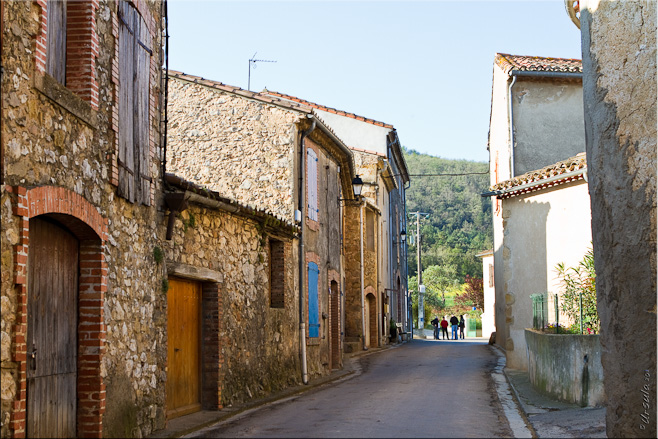 Granes (with or without its accent grave è) wakes up slowly as the cavaliers (horse riders) get together to plan their day. 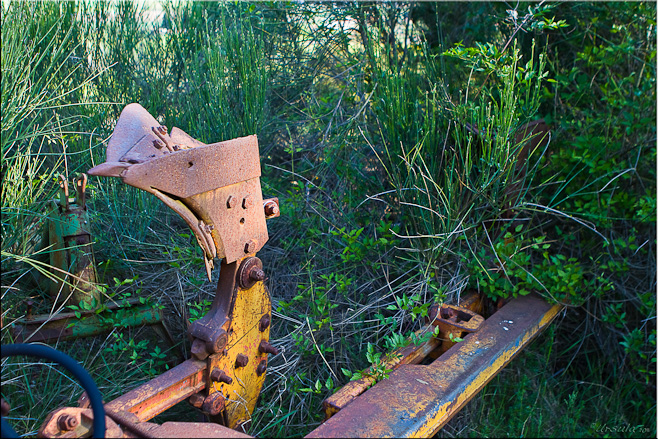 Rural Abstract: Discarded, Rusting Machinery ~ Granes, Limoux, Aude 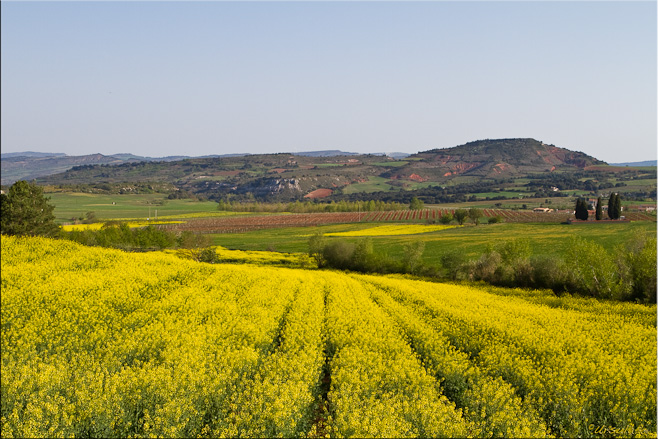 Fields of Mustard in Bloom ~ Granes Trip Notes: Day 6: Granes to Quillan
The route from Granes to Quillan follows the GR (“GR®” Grandes Randonnées / Long Distance Footpaths) along a well known path that used to be an important link and means of communication between the small Pyreneen hamlets. We traverse the high saddle of the Col des Trois Quilles before arriving in Quillan.
Points of Interest: Typical traditional Pyrenean villages and the Col des Trois Quilles viewpoint
18 kms/11.25 miles. 5hrs. Altitude gain/descent: +350m -440m
The first half of our walk was through woods and countryside, interspersed with tiny villages. Granès had a population of only 124 people in 2007, and the nearby towns are of similar sizes. In the morning, although part of our walk was on bitumen, the only vehicle we passed was the regional mail van, and the only others we noticed were tractors in the fields and a Citroën, parked in its old garage.
 Small Flowers on the Forest Floor Roses in the Garden ~ Saint Ferriol Old Citroën; Old Garage ~ Sant Ferriol (Population 142) Cypress (Cupressus) Trees ~ Domaine Sainte Eugénie Checking the Maps and Notes ~ Saint-Julia-de-Bec (Population 119) Daisies on the Verge ~ These always remind me of childhood trips to Stanley Park (Vancouver): I'd look for the pinkest daisy I could find, but when I picked it, it would look plain white.... Just another of the many plants that look best where they grow naturally! Les Chevaux - Horses ~ Saint-Julia-de-Bec Gorse on the Verge ~ Saint-Julia-de-Bec Spring Apple Blossoms ~ Saint-Julia-de-Bec Next Year's Wine? New Vines Tiny Wildflowers in the Wind Last season's last oak leaf clings to the branch amid new growth: This made me think of the O. Henry short story: "The Last Leaf" Everlasting? Forest Floor, Aude, Languedoc-Roussillon Wild Violet, Forest Floor, Aude, Languedoc-Roussillon Looking Down from the Col de Quilles (Ninepins, Skittles) to Belvianes-et-Cavirac (Pop. 285) Quillan ~ Old Ruins, Newer Town Castle Walls ~ Quillan Castle Ruins I thought these were lilacs, but on closer inspection, they are more like a pea, broom or gorse. Quillan and the River Aude from the Castle Le Pont Vieux; The Old Bridge (11-12th Century) over the River Aude ~ Quillan For us, one of the nicest things about this day was that the Trip Notes were relatively believable! After the five hours suggested walking time, we were actually sitting in the sun in the centre of Quillan, drinking coffee and beer, and people watching.
Because Quillan is a town of reasonable size (population 3,406 in 2007) we were booked into a hotel and needed to find our own dinner. We were reading the ‘Specials’ outside an Italian restaurant when the owner leaned out of an upstairs window and directed us to the English menu on the opposite side of the sign-board. He knew no self-respecting French person would be reading a dinner menu at only six in the evening! They wouldn’t even be open for another hour, so we sat outside the tabac downstairs for some kir, and some more people watching. A sketch artist would have had a field day – though many many of the resulting drawings could easily be mistaken for caricatures.
It was the Saturday eve of Palm Sunday, and a parade of residents filed past us on their way home after church, clutching small boughs of greenery representing palms. Old men in battered felt hats and shiny grey suits shuffled along side matronly women in black dresses, black sweaters, and kerchiefs. An impossibly thin, tall woman with her grey hair pinned in a perfect french roll, wearing oversized pearls and a cream and navy wool suit, circa 1960’s, crossed the plaza with her friends, similarly decked out in Sunday best that looked as if it had been washed, polished and mended every week for forty-plus years. In ancient times, Quillan was a major stop-over between Carcassonne with Perpignan. Today, the population is not only reducing with each census since the mid-seventies, it is ageing significantly and a staggering 17% of residents are 75 or older.
The evening ‘bar’ crowd sharing the tabac with us were of two different groups, distinct from the church-attenders. A small group of round-faced middle-aged male British expats with large bellies and large beers alternated between their outside smoking table and watching the soccer match on TV indoors, while a larger loose group of Hispanic-speaking itinerant workers came and went, kissing cheeks with each other, sitting, sharing news, smoking gitanes and drinking pastisse (the ubiquitous anisette liquor) before kissing cheeks again and moving on. Resembling gypsies of old, these people all had black hair, dark colouring, and handsome angular features. One bent-over tiny old man with a wizened face, tattoos, earings and dread-locked hair limped in with his large pack and medium-sized dog, like a character out of a French version of Charles Dickens.
 How I would have loved to have taken pictures! How I would have loved to have taken pictures!
But, sometimes it does not feel appropriate to ask. More mental images that never made it onto the camera ~ mes souvenirs ~ my memories.
Posted in Culture,Every Day Life,France,Nature,Religious Practice,RuralTags: architecture,blog,France,nature,people,Photo Blog,religion,rural,Sentier Cathare,The Cathar Trail,The Cathar Way,travel,Travel Blog,Ursula Wall,walk,worship
For the Future of Thai Children, (amongst other things) One PC Each and Free WiFi… Thailand goes to the polls this Sunday. For weeks, the streets of Bangkok have been lined with colourful political posters: posters with pictures of bland-faced politicians and their pork-barrel promises of fiscal payouts to just about every demographic; posters of “everywoman” in her tennis whites and “everyman” in his golf gear; posters depicting the candidates as animals (a grievous insult) and exhorting people not to vote at all; pictures of a massage-parlour operator campaigning “against corruption”; and my personal favourite: a poster in official Thai flag colours promising WiFi and a free PC to every schoolchild.
Now, call me cynical, but having just recently returned from another trip to visit schools in “The Hills” of Thailand, I can think of many things that these children need more than their own individual PCs! Like: dorms with enough space for all the pupils who want to study but live too far from school; some proper bunks and some new bedding; somewhere to do their laundry; a spare uniform; a pair of new shoes; a canteen with a clean floor and enough tables and chairs; more teachers and auxiliary staff to help in over-crowded classrooms; the list goes on.
Historically, successive Thai governments have provided the barest of essentials for public schooling. True, Thailand is a “developing country”, but even so, it is well down the international ranks in terms of percentage GDP allocated to education (just 4.1% in 2009). The current government increased educational access to 15 years: three years of pre-school and grades 1 through 12, and it is true that 18% of government expenditure is on education, but this is in the context of low tax revenues and weak spending overall. In remote and marginalised Hilltribe communities, many of the auxiliary buildings in and around the local schools are funded, not by the government, but by charitable organisations.
At the end of May, just as the new school year was about to start, I was able to visit some schools in Mae Hong Son province in northern Thailand, with Susan Race, founder and manager of THEP – Thailand Hilltribe Education Projects, one of these charitable organisations. I’ve been on these trips before (see: Budding Potentials, Building Futures, and Schools), and what always impresses me – other than the beauty of the countryside – is the cheerful resilience of the local people.
The highlight of this particular trip was our stay at the school at Mae Lit and visiting the local community where the predominantly Karen people eke out a living growing cabbages and rice. We arrived on a Sunday, the last day of school holidays and stayed for the ‘official’ school opening.
Stopping for a Chat ~ Proud Father of a University Scholarship Recipient Side by Side ~ Karen Couple in Front of Rice Terraces, Ready for Planting Seven-Year-Old Ornwara is Starting Grade One Tomorrow! She is one of Sixty Students Accommodated in Three Dorm Rooms at the School The First-Graders: Ornwara’s parents won’t be there to watch her start school tomorrow – they live too far away – but she has her friends to keep her company. Airing the Laundry ~ Typical Karen House, Mae Lit Always a Smile for the Visitors ~ Karen Boy, Mae Lit View from the Balcony ~ Karen Girl, Mae Lit Frail Granny with Hand Tattoos Watches From Next Door Bringing Home the Buffalo ~ Mae Lit Extended Family at Home ~ Mae Lit Making Ties for Rice Planting Afternoon Light Over the Hills ~ They’ve had electricity here for a year or so, but it is still hard to know where they would put all those PCs! On Monday morning the dormitory children got up early to dress, cook themselves breakfast, eat, wash the dishes and do housekeeping chores before the school bell rang.
Monday Morning Before First Day of Term: The Children Go About their Morning Tasks Spicy Vegetables for Breakfast Kitchen Chores ~ Mae Lit School Readying the School for Opening Kids, Bikes and Dogs ~ A generous benefactor donated a number of bicycles to the school, so the children had a nice surprise for their first day back. Lines of Official Thai School-Girl Hair-Cuts Monk Presiding Susan Chats to a Young Scholarship Recipient Torch Ginger (Zingiberaceae) in the Schoolyard Fragrant and Impossibly Green ~ Early Rice on the Road Back Down Out of The Hills These are some of the poorest villages in the country, where life changes slowly. The days in the fields are long and hard, so it is tempting to keep older children home to help. Many families have virtually no income, making it impossible to pay for uniforms, books, travel, and all the other things the government doesn’t provide for school-aged children. But, traditions are strong, communities are bonded and food is plentiful. The children at these schools are helpful, polite and wonderfully self-reliant. I have nothing against them having ready access to PCs – there is just so much else that they need more!
Regardless of who wins the next election, I have little faith that it will result in any major improvements in these communities. For these children to participate fully in the education that is theoretically available, but practically just out of reach, they will continue to need the help of “outsiders”. Susan will be visiting the students and the projects she manages again in November. If you are prepared to eat local (fresh and delicious!), travel rough on roads that sometimes disappear, and sleep on the odd floor (with mats and bedding), I know she’d love to have you along to see what is needed for yourself. and sleep on the odd floor (with mats and bedding), I know she’d love to have you along to see what is needed for yourself.
In the meantime, happy travels.
Posted in Culture,Education,Every Day Life,Rural,Thailand,Travel,WorkTags: blog,children,education,farm,farming,flowers,Mae Hong Son,nature,people,Photo Blog,rural,thai,Thailand,travel,Travel Blog,Ursula Wall,work
Blue and White ~ Siam Ceramics ~ Bangkok Sky Pottery is one of the markers of ‘civilisation’. With archeological examples dating back to B.C. 3,600, Thailand’s pottery traditions are amongst the oldest in the world. Over the years clear regional styles developed, with the quality of the products largely dependent on the types of clay found in the area.
Ceramics traditions also crossed borders: with the migrations of people and as a commodity across the region. For example, King Ramkamhaeng (1279-1298) brought potters from China to set up the now-famous Sukhothai kiln, and 600 to 800 more kilns were built around the region using the imported technology during the Sukothai period.
Today many of the small cottage industries in the Thai ceramics business make Chinese-style pottery, with one of the most popular being the ‘blue and white’ under-glazed porcelain, sometimes called ‘Ming’ porcelain (although the style originated in the earlier (1127 – 1279) Yuan dynasty).
Siam Ceramic “House of Blue and White Pottery” Shop Front Blue and White ~ In the Ming (1368 – 1644) Tradition Over the last fifteen years, Thai ceramics producers have repositioned themselves to become significant international exporters. They have used the quality of their products to compete favourably against regional rivals (China, the Philippines, Indonesia and Malaysia) in the the United States, Japan, Hong Kong, Australia and United Kingdom markets.
In addition to the popular blue and white pottery, Thailand is famous for its celadon: high-fired stonewares with the distinctively crackled feldspathic and wood-ash glazes. The traces of iron in the clay, or in the glaze formulation itself, give celadon its characteristic colours: greens that are almost-white, subtly grayed, honey yellow, brown, rich Jade or olive.
Benjarong, another traditional Thai porcelain, has its roots in the Ming dynasty style of painting enamels onto a white porcelain base. The Thai name ‘Benjarong’ is from the Pali and Sanskrit words Benja and Rong, meaning ‘Five Colours’, and is descriptive: five enamel colours (red, white, yellow, black and green) are most commonly used, although some Benjarong patterns use only three colours, while others have as many as eight. Gold is liberally featured and the intricately repeated patterns are applied much more thickly than in the earlier Chinese examples, giving a highly textured finish.
The ‘Five Colours’ of Benjaron ~ With the Liberal Applications of Gold The “Chakri Blue” Benjarong Pattern Individually Applied ‘Wool’ Buttons on a Ceramic Sheep The Ubiquitous Thai Elephant ~ in Blue and White Last month I was able to visit two porcelain factory outlets close to Bangkok for a small glimpse of the quality and range of Thai ceramic products. I was travelling with a group of women from ANZWG (the Australian New Zealand Women’s Group), and so we were invited ‘backstage’. “If they had shown us the workroom first, I would have appreciated the pieces even more!” exclaimed one of the women as we watched the men at work. For while the kilns and potters’ wheels might be greatly improved over what they were a thousand years ago, much of the process of creating beautiful ceramics has remained unchanged. Every piece is painstakingly painted by hand – a fact that is NOT, by Western standards, reflected in the local selling prices.
Chinese Shar-Pei Guarding the Workshop Entrance Ceramic Greenware Babies Women Shopping while the Greenware Dries Delicate Work ~ Underglazing the Blue and White Porcelain Siamese Aristocats? Greenware in the Workroom Artisan at Work: Three days for a piece this size, he told me. Storeroom: Blue and White Pots and Celadon Buddhas Blue ~ White ~ and a Generous Brush of Gold Lids: Blue ~ White ~ and Gold Ceramic Tiles and Pots at the Chieng Sang Factory Outlet Sitting on our balcony later that evening, watching the storm clouds rolling in over a city of shiny ceramic-glazed high rise buildings, I couldn’t help but think about how ceramics define modern ‘civilisation’ – being used for everything from teeth to tiles, from car parts to communications, from everyday kitchen products to aerospace. At the same time, Thai pottery traditions continue to evolve as they have for six thousand years.
Blue ~ White ~ and Gold  Blue and white ceramics are like a symbolic bridge between the past and the future. Blue and white ceramics are like a symbolic bridge between the past and the future.
And, an example of the time and effort that goes into things of beauty.
Happy travels!
Posted in Culture,Fine Arts,Thailand,Travel,WorkTags: arts and crafts,Bay of Thailand,blog,ceramics,people,Photo Blog,pottery,travel,Travel Blog,Ursula Wall,work
Almost Abstract: Rusty Machinery Parts, Sougraigne We were in the car, in Australia, driving to an appointment last month, when my husband remarked: “You know, it took us two weeks to walk this same distance!”
It’s true – we routinely cover great distances driving without giving it much thought. When I’m walking, on the other hand, I’m acutely aware of the landscape that I am part of. On our walk along the Cathar Trails in the Pyrenees, one of the things we both commented on was how different our walks were each day: the nature of the forests, streams, and even farms and villages, were quite distinctive. Even the smells of the woods and fields and the sounds of the birds changed from one locale to the next.
Trip Notes Day 5: Sougraigne to Granes
We pass the village of Rennes les Bains and on to Rennes le Château with its small castle dominating the surrounding hills. We spend the night at in a chambre d’hôtes in Granes.
Points of interest: Rennes–le–Château
19kms. 5hrs30. Altitude gain/descent: +445m -450m
No Two Towns Exactly the Same: Sougraigne Village Church Roughly Worn Iron Crucifix Marks an Old Grave, Sougraigne (Sepia) While it is true that every French village has a church, and every church has a bell, even these were distinctive in their own ways. Every village also has its own crucifix, or several, but no two were exactly alike.
Fresh Leaves and Fresh Flowers on the Massive Chestnut Trees, Sougraigne One of the biggest differences, as we set off from Sougraine to Granes on our fourth day walking, was that we were finally out of the wind and the sun was warming the earth. We heard cuckoos for the first time: further proof, if any was needed, that we were in Europe – and that spring had arrived.
Our day started along the Sals River in « Le domaine de l’Eau Salée » (“The Salty Domain”). The waterways here work their way through the limestone mountains, picking up salt and minerals before bubbling up at the source of the Sals River, near Sougraigne. At times, the Sals has 60 grams per litre of salt – twice that of the Mediterranean. Historically, this high salt content lead to the establishment of baths (including at Rennes les Bains, where Mary Magdalene purportedly baptised people) and ‘salins’; lagoons for the evaporation of valuable salt.
It is also an area where people live off the track and off the grid: in railway cars, self-built dwellings, and old caravans.
Peeling Paint on a Temporary Dwelling: The Circus has Left Town Modern Rendition or Ancient Remnant of Continental Celtic Traditions? Almost Abstract: The Texture of Sky Almost Abstract: The Textures and Colours of Tree Bark We left the Sals River and forded the River Blanque to visit the Madeleine Spring. According to our notes, there are two springs “surging out of the rock”: one rich in iron, the other sulphurous. I have to wonder how old the notes are; there is no longer much sign of either spring. Our noses found the sulphurous trickle, while the iron was a mere sludge patch across the rock. I’m told it is good luck to bath your feet here – there was enough moisture to make the whole area dangerously slippery, but certainly not enough for a foot bath!
Ancient Graffiti on the Rock Face at the Madeleine Spring La Blanque River: This is our Crossing Point ~ I was more than a little worried, as neither my shoes nor my cameras are waterproof! From the river valley, we climbed up through vegetation that changed again: new forests on the sunny-side of the hill, old farming terraces in the shade and “La Roche Temblant” (The Trembling Rock) towards the top. We came out on a logging road which was bordered by shrubbery, plane trees, chestnuts and pines, and which culminated in modern farming operations.
Textures: Newly Sawn Tree on the Crunchy Leaves of the Forest Floor Layers ~ View through the Pine Cones Colours and Textures: Fungus, Pine Cones and the Forest Floor Light and Shade: La Roche Tremblante The Colour and Texture of New Pine Growth Even the Cows Differed from Place to Place. Wild Poppy: Remembrance of Days (and Wars) Past As a reward for our hard work, we stopped for a real coffee when we reached Rennes Le Château, perched atop its hill. Rennes Le Château hides its own mysteries: one of the most prominent stories is of buried treasures – originally belonging to the Visigoths, the Cathars, and/or the Templars. Other stories concern the Arc of the Covenant, and near by tombs of Jesus, Joseph of Arimathea and Mary Magdalene. And so on… I settled for the treasures that the local glass-maker creates.
Charming Housed ~ Glass and Shutters ~ Rennes-le-ChâteauLadder for Rapunzel? The Castle of Rennes-le-Château Sweet Smells ~ Pink and Purple Lilac, Rennes-le-Château Light a Candle for your Prayers, Church of Saint Mary Magdalene, Rennes-le-Château Colours and Textures: Stained Glass and Wrought Iron, Presbytery of Rennes-le-Chateau Heat! Glass Maker at Work, Rennes-le-Château View back to Rennes-le-Château from above Les Labadous
As always seems to be the case, the last few miles were the longest and slowest, but we stumbled into our lodgings at a reasonable hour, with tired legs and whetted appetites – ready for a hot shower, our evening glass of muscat, and a good meal.
Cheers ~ à votre santé ~ ‘till next time.
Posted in Culture,France,Nature,Religious Practice,Rural,TravelTags: arts and crafts,blog,flowers,France,nature,people,Photo Blog,religion,rural,Sentier Cathare,The Cathar Trail,The Cathar Way,travel,Travel Blog,Ursula Wall,walk,work,worship
Pic de Bugarach, Apple Blossoms and Blue Sky If you want to bear witness to what happens as the world comes to an end, then (the story goes) Pech de Thauze, more commonly called Pic de Bugarach, is the place to be.
There are a lot of doomsday predictions around at the moment. The one that concerns this story is not the May 21, 2011 day of earthquakes and judgement and subsequent rapture for faithful Christians, as prophesized by evangelist Harold Camping, which passed without a tremor or a murmer. Nor is it his revised October 21, 2011 ‘end of the world’ prediction.
The date that we were talking about over dinner and copious drinks at Accueil au Village, Cubières sur Cinoble, was the December 21, 2012 ‘Armageddon’ which coincides with the end of a 5,125-year-long cycle in the Mesoamerican Long Count calendar – the Maya or Mayan calendar.
To be fair to the Mayans, there is no indication they thought that the end of this cycle was a bad thing. The doomsday predictions seem to be a more recent combinatation of new-age theories, pseudo-science, and hoax mixed in with interpretations of religious eschatology. Whatever the reasons behind the predictions, international hysteria is causing a lot of local consternation.
Apparently Bugarach, which can be seen from from Cubières, is no ordinary mountain. For one thing, it is a geological anomoly: the top of the mountain is millions of years older than the bottom. In other words, Bugarach is upside down! Although I assume this to be a fact, after hours on the internet, I could find no actual verification. What is verifiable is that Bugarach, which stands at 1230m, is the highest of the Corbières Mountains, and its limestone is riddled with caves.
Secondly, the mountain is said to have “an enormous energy”, both magnetic and spiritual. I couldn’t verify the belief that Nostradamus thought the mountain’s “vibrations” useful in his work, or that Jules Verne found the entrance to an inner world, which he fictionalized in “A Journey to the Centre of the Earth”. Then there are the stories that the mountain hides the holy grail, and possibly even the body of Jesus, or that it houses aliens. “The internet abounds with tales of the late President François Mitterrand being curiously heliported onto the peak, of mysterious digs conducted by the Nazis and later Mossad, the Israeli secret services…. A visit to Bugarach is said to have inspired Steven Spielberg in his film, Close Encounters of the Third Kind – although the actual mountain he used is Devil’s Tower in Wyoming.”
The current story, which is causing headaches for long-time locals, is the belief that at world’s end, December 21 next year, the aliens residing in the mountain will leave, airlifting a few lucky humans with them. According to one source, dozens of UFOers camped out atop the mountain on December 31, 1999, to see in the previous end-of-the-world at the dawn of the new millennium. While (clearly) that ‘end’ did not happen, this has not dampened doomsday enthusiasm, and the tiny villages of Bugarach, with less than 200 residents, and neighbouring Cubières, which is of similar size, are attracting a new kind of visitor. Property prices have been driven up, and the current infastructure can’t cope with what may become a massive influx of people. The Telegraph (UK) interviewed the mayor of Bugarach and numerous other locals before posting two items (1 and 2) one year in advance of the predicted 2012 Armageddon. A month later, the story was picked up by the NY Times. As our host Françoise, former mayor of Cubières, told us, this has only agravated the problem of alternate-lifestylers moving into the area but not wanting to be part of the local ‘community.’
The mountain may well be magic, but the only ‘energy’ we experienced as we sat around the Cubières dinner table on the eve of our walk around Bugarach was the buzz of local wine, home-cooked food, and lively conversation with an international group of visitors and residents. But, we did pay special attention to the mountain, which was in our sights most of the next day.
Trip Notes: Day 4: Cubières sur Cinoble to Sougraigne
Our walk today is in the very heart of the Cathar country as we walk between the Fenouillèdes and the Corbières. We traverse the Bugarach massif and the Salso Col before arriving in the beautiful small village of Sougraigne.
Points of Interest: Chestnut Forest and Bugarach Village
15kms. 5hrs. +250m -605m
If you are going to circumnavigate half a magic mountain, what better place to start than the local church. L’Abbaye de Cubières sur Cinoble, which was redesigned and rebuilt over the ruins of a ninth century abby, is atypical in that, unlike most European churches, it is oriented on a north-south, rather than an east-west axis.
The Local Church, L'Abbaye de Cubières sur Cinoble, has its own Colourful Stories ~ Including Statues of Jesus, Joan d'Arc, and the The Madonna Looking Through the Tiny Town of Cubières sur Cinoble to the Magic Mountain Into the Woods ~ Lichen and Ivy Approaching the Village of Camps-sur-l'Agly Ivy-Clad Ruins and Modern Village Housing, Camps-sur-l'Agly Rusty Pump at the Doors, Camps-sur-l'Agly ~ Presumably the Nailed Goats' Feet Ward off Evil Spring Flowers Everywhere: Front Doors ~ Back Gardens, Camps-sur-l'Agly Every Small Town a Bell ~ Camps-sur-l'Agly Although the spring sun still held little warmth, the skies were blue and the winds had reduced somewhat, making for a pleasant walk winding through the countryside on stony tracks and small paved roads. We passed large farm holdings and small barnyards, eating our copious packed lunch in the lee of Bugarach and under the watchful eye of the local chickens and sheep.
The Chickens in the Barnyard Come Running to Look at Us Apple Blossom The Hamlet of Pastressis, in the Lee of Bugarach Sheep Watch us Before Running Off, The Hamlet of Pastressis Bugarach from The Col de Linas ~ Traces of Cigar Clouds in the Sky (Many Scientist Attribute UFO Sightings to these Types of Cloud Formations) If Bugarach has a magnetic force, it clearly didn’t work for us. Somewhere after Col de Linas, we lost the trail and ended up working our way down toward the town following goat tracks. A couple of French hikers passed us by, heading the same general direction. When I asked if we were on the path to Bugarach, they refused to confirm it until I pronounced it correctly. You have to love the French, their pursed [y] sound – and their sense of humour! Leaving the town, we lost the track again – not really our fault this time, as all the trees with our way-markers had been cut down by loggers.
Wild Flowers in the Grass Still Life Found: Rusty Bits of Abandoned Machinery Last Views of Pech de Bugarach, before we Cross Over the Col de la Pourteille Wild Violets on the Forest Floor Sougraigne ~ Our Home for the Next Two Nights New Growth: Beech Leaves Overhead Trunk of a Beech Tree Pine, Beech and Oak on The Forest Floor The way down into Sougraigne was much longer than I remembered from our last visit… But once we got there, the hotel was as delightful as we recalled and the food was superb:
Entrée: Croustillants au chèvre en confit d’oignon
Plat: Côte de porc fermier, Bouchée aux champignons et légumes du jour
Frommage
Dessert: Carré aux pommes
Vin compris
Now that is magic! There could be no better place for an extra night and a much needed rest. ‘Till next time!
Posted in France,History,Nature,Para-Normal,Religious Practice,Rural,TravelTags: armageddon,blog,doomsday,end of the world,France,magic,nature,para-normal,Photo Blog,religion,rural,Sentier Cathare,The Cathar Trail,The Cathar Way,Travel Blog,Ursula Wall,walk
« Older posts
Newer posts »
|





.jpg)


the book titled “as I walked the world’ should have quite a bit of material now….what magical stories and events. SO very much appreciate the share… be well
Ha Ha Ha!!! Know any good publishers? 😀
I think Signe is on to something for publication
[…] was the first morning of the second half of our walk through the Cathar Castles of the Pyrenees. I have written before about the colourful characters that inhabit the region, and once again we were to find the people on the road every bit as fascinating as the area’s […]