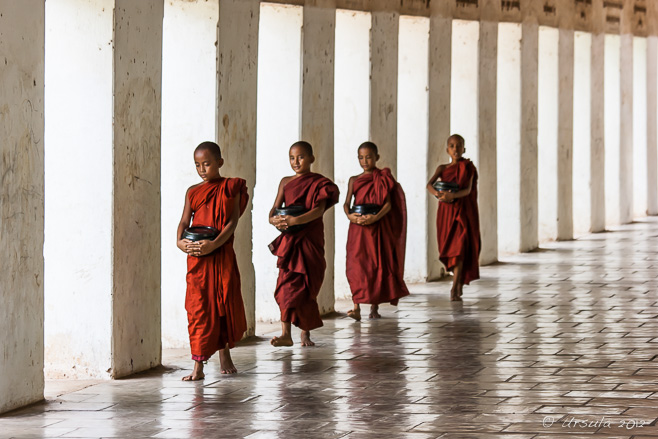
 Four Novices
In the beautifully lit, covered south-entrance causeway leading to Shwezigon Pagoda, four young novices walk with their begging bowls. Bagan, in Central Myanmar, is known for its temples.
Not all its temples, however, are ruined relics of the Pagan Empire (9th to 13th Century). Others – like the beautiful Shwezigon Pagoda – are still living, breathing places.
Shwezigon was Pagan’s first Buddhist temple. It was started by King Anawrahta after he took the throne by force in 1044, unified the country, and introduced Theravada Buddhism to the people. Most accounts agree he died in 1077 or 1078: before the elaborate pagoda was completed. One story says he was killed by a wild buffalo; others mention only the phase of the moon at the time of his death. The Shwezigon complex, somewhat modified from Anawrahta’s original plans, was completed in 1102, under his son, King Kyanzittha.
The symmetrical pagoda is 160 feet high and 160 feet square at the base. It sits in a square compound, where it is surrounded by smaller temples and shrines – and flanked by typical burmese markets, crowded full of people.
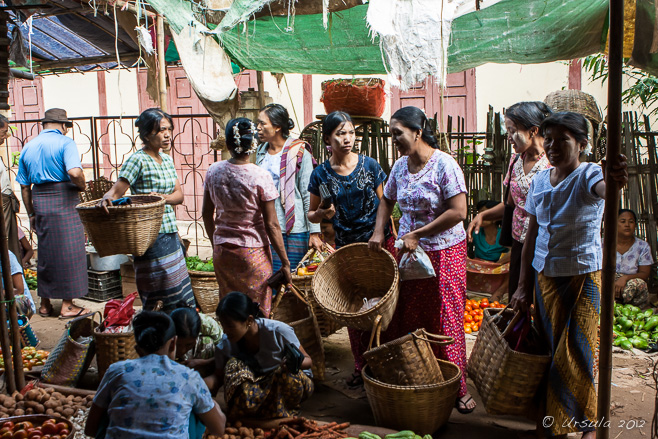 Women in the Market 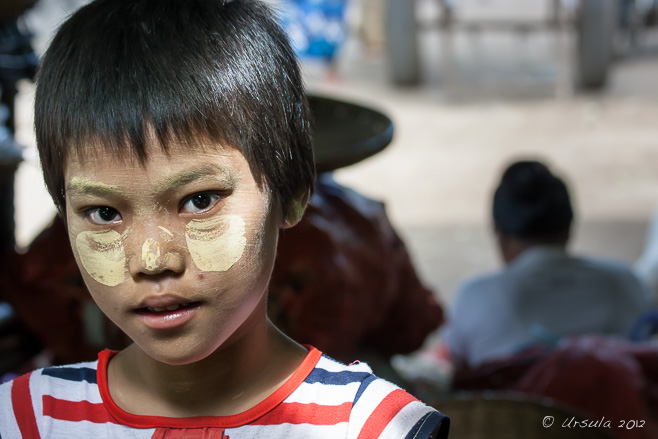 Burmese Child  Smoking Woman Mother and Child
Everyone in the market is wearing their protective thanaka powder. Burmese Child
Children learn the “V” sign early. Saleswoman in Pink Mother and Baby Baby in the Market Shwezigon Pagoda
The prototypical circular Burmese stupa: the gold-leaf gilded Shwezigon Pagoda sits in at the centre of a square compound. Golden Lion
Stylised lions guard the pagoda. Plaque in Marble and Gold
Richly decorated Burmese prayers punctuate the courtyard. Brass Flower Trees, Stone Almes Bowls, and Incense Burners Nun Praying
In pavilions around the pagoda, there are plenty of peaceful places to sit. Nun with a Book of Prayer Book of Burmese Prayer Barefoot
Pilgrims and visitors carry their shoes through the covered causeway leading to the pagoda. Three Novices Novice Running Novices
Our photo-group leader Karl Grobl and local guide Mr MM have persuaded the Abbot to let us “borrow” a few novices – Jumping Novice
– and we encourage them to engage in some un-novice-like behaviour. Running Novice
The novices clearly enjoy the task that has been set for them – Running Novice
– flying down the sedate, grand, covered causeway at Shwezigon’s South Entrance – Running Novice
– with great enthusiasm. 
With roots in Bagan’s rich history, Shwezigon is a beautiful temple to visit.
My visit was only made better by the novices, the nuns, and the other people who comprise the life within the compound perimeters.
Keep Smiling!
Pictures: 18September2012
Posted in Architecture,Myanmar,Religious Practice,TravelTags: architecture,blog,buddhism,buddhist,children,environmental portrait,environmental portraits,Myanmar,Photo Blog,temple,travel,Travel Blog,Ursula Wall
Taj Mahal Morning
The classic view of an Indian icon. “Not a piece of architecture, as other buildings are,
but the proud passion of an emperor’s love wrought in living stones.”
– Sir Edwin Arnold
We all know the story: the Taj Mahal, considered the epitome of Mughal art and architecture, was built by emperor Shah Jahan in memory of his beloved third wife, Mumtaz Mahal.
Prince Khurram, the son of Jehangir, the fourth Mughal emperor of India and the favourite grandson of Akbar the Great, was born in 1592. According to popular story, in 1607 he was wandering through Meena Bazaar when he spotted a girl selling silk and glass beads. She was the daughter of a noble Persian family and it was love at first sight. They became engaged, but were not married for five years – during which time, the prince married two other women and had two children.
He and Arjumand Banu Begum were finally married in 1612, when the prince was 20 and she was 21. In 1627, after the death of his father and a bitter power struggle with his brothers, he became the Emperor of Agra, and his favourite wife became known as Mumtaz Mahal, Persian for “the chosen one of the Palace”. She died in 1631, aged 40, giving birth to their 14th child.
Shah Jahan was heartbroken by his wife’s death, ordering the court into mourning for two years, and commencing construction of the Taj Mahal, the magnificent mausoleum to house her body, in 1632.
I was thrilled to be visiting the Taj Mahal for sunrise.
I had been in Agra once before: in 2008 with my husband. We had tried to book an early start to visit this designated UNESCO World Heritage site; our guide had told us the gates didn’t open until 9am – and then arrived an hour later than the time we had arranged with him. This time, however, I was on a photo-tour organised for me and my companions by photographer Karl Grobl and local guide DV Singh. So, we were at the gates early – very early – and still we weren’t the first! A group of American women had beat us to the front of the queue.
Morning Guard
A young guard keeps an eye on the visitors as we queue up in the cold of pre-dawn. Spruiker
As we drink hot chai from the street vendors to keep warm, an agent offers visitors local guides. Morning Guard
It is a long wait for 6am when the gates will open, and the light rises slowly. Taj Entry (2013)
Once the south gates open … Taj Entry (2008)
… people make their way into the gardens… Taj Mahal and the Reflecting Pool
… and there it is! That most perfect of buildings! Sunrise
We arrived on the grounds early enough to watch the sun rise over the mausoleum. Taj Morning
Moment by moment, the white marble changes colour, along with the sky behind it. Pilgrims on the Stairs
Wooden steps lead up to mausoleum platform. Dome and Finial
Unlike his father and grandfather who were rather liberal, Shah Jahan was a pious Muslim. The mausoleum is built in a style that combines Islamic, Persian, Ottoman Turkish and Indian architectural elements. Marble Carving and Inlay (2008)
The mausoleum is beautifully constructed of carved white marble, inlaid with semi-precious stones including jade, crystal, lapis lazuli, amethyst and turquoise. Taj Mahal Mosque
As the sun rises, it angles over the mosque. Sunrise over the Mosque
… silhouetting the minarets against the morning sky. Yamuna River
It seems very quiet at the back of the mausoleum, where the morning mists roll over the river. Mausoleum Marble
As the day lightens, the inlaid marble starts to gleam against the blue sky. Visitors to the Mausoleum
No photography inside! Visitor to the Taj
Rugged-up against the cold of Autumn, many Indians are determined to visit their heritage sites. Visitors
Around 3 million people a year visit the Taj Mahal. Scalloped View
Back at the main gate, the archways frame the Taj Mahal beautifully. The story has a bitter-sweet ending. Shah Jahan became ill in 1658, and his descendants fought for rule of the empire. Aurangzeb, his third son, was the eventual winner. When Shah Jahan recovered, Aurangzeb declared him incompetent to rule and placed him under house arrest in Agra Fort. He lived out his days in a room there – able to see the Taj Mahal, the tomb of his love, but not able to leave – until his death in 1666. Then, he was reunited with his wife: interred next to her in the mausoleum he had built.
From Agra Fort (2008)
A view over the river flood-plains to the Taj Mahal from Agra Fort to the east. The Back of the Taj
The evening before our visit to the Taj Mahal, we took advantage of the view from across the Yamuna River. Recognised by UNESCO as “the jewel of Muslim art in India and one of the universally admired masterpieces of the world’s heritage”, the beauty of Taj Mahal has been threatened by air pollution. The structural integrity is threatened by dropping water levels and by water pollution from the Yamuna River, which reaches Agra heavily contaminated with chemical and human waste from upstream.
Sadhu
A Sadhu from a nearby camp tells us off if we venture too close to the fencing… Razor Wire at the Back of the Taj
… but the razor-wire fencing is convincing enough on it’s own! It is a shame that such an iconic site is so at risk. It also seems ironic, somehow, to see a tribute to love wrapped up in razor wire.
But that is India – Incredible India.
And I am thrilled to have seen it at all –
 Twice! Twice!
That is pretty special.
Pictures: 21April2008 and 16-17November2013
Posted in Architecture,India,Portraits,TravelTags: architecture,blog,environmental portrait,India,Photo Blog,travel,Travel Blog,UNESCO,Ursula Wall
Srey Channthy
Powerful vocals; heartbreaking stories…
(Double click for: Whiskey Cambodia, from the album of the same name by The Cambodian Space Project)
A female chanteuse in long hair and short skirt is dwarfed by the stage until she opens her mouth. Her vocals wail across Asian half-notes – off the scale and back again – to a back-beat of pounding music ranging from Khmer pop, to psychedelic rock, and beyond. It was easy to imagine oneself in a dark, smoky bar in Phnom Penh, circa late 1960s. The room would be filled with mostly white, male patrons: world-weary foreign correspondents, hard-drinking army personnel on R&R from the war in neighbouring Vietnam, and expat French businessmen left over from the colonial days.
But, no, I wasn’t in Phnom Penh. I was at the Crossroads Stage at Bluesfest 2014 on a hot Sunday afternoon in Australia’s Byron Bay, and The Cambodian Space Project was filling the room with sound. Billed by the festival organisers as an “Asian Rock ‘n’ Roll space odyssey”, they were on my “not-to-be-missed” list.
Srey Thy (Channthy) and The Cambodian Space Project Under the Pol Pot rule of Cambodia between 1975 and 1979, anyone deemed an “intellectual” was targeted. Over 17,000 Cambodian people were executed in the Killing Fields, and these included most of the country’s writers, artists and musicians. As a consequence, the country’s musical, artistic and literary traditions were as good as wiped out.
Srey Thy was born as part of the baby-boom that followed the Vietnamese liberation of Cambodia from Pol Pot’s horrendous rule. She grew up in a poor, rural region, working hard from a young age, and inheriting her mother’s love of singing.
According to the band’s bio, Julien Poulson, a musician from Tasmania with a grant to work on a project aimed at reviving Cambodia’s lost musical traditions, first heard Srey sing in a karaoke bar in Phnom Penh in 2009. He persuaded her to join him, and together they are the nucleus of The Cambodian Space Project.
Srey Thy is firmly grounded in her rural roots, and the band regularly plays in remote villages across Cambodia. Srey recalls their first visit to her home village in her song: Whiskey Cambodia. With a cheeky smile, broken English and sparkling eyes, she told the Byron Bay audience that the villagers were worried because they had “no red wine” for the foreigners, and the guests would have to make do with “whiskey Cambodia” – which, I can attest, is an extremely potent brew.
Srey Channthy Julien Poulson Srey Channthy Singing the Songs of the Past
The band’s repertoire includes Khmer-pop songs made famous by singer-songwriter Pan Ron, who was at the height of popularity in the 1960s and early 1970s, before being killed in 1975 by the Khmer Rouge in one of their final mass-executions. Romantic Ballads
The set also included songs popularised between 1967 and 1975 by Ros Serey Sothea. Known as “the golden voice of the royal capital,” she is also thought to have been killed by the Khmer Rouge.
The songs were all in Khmer (although one was at least partially sung in French – a remnant from the days of colonial rule), and the explanations of the titles were almost as much fun as the music: my favourite is “Cut your Beard (I love you)”.
The Cambodian Space Project (CSP)
Monday evening, against a backdrop of stars, the group took to the Delta Stage to once again woo and wow the audience. The Chanteuse
I was as captivated by Srey’s songs and story-telling as I had been the day before. Stars in our Eyes
Srey was born and raised in one of the poorest regions of Cambodia. She learned to sing from her mother, who survive the Khmer Rouge purges by disguising herself as a peasant boy. Twist and Dance
One minute I was reminded of the go-go dancers who graced the clubs and television sets of the late sixties; the next minute Srey incorporated elegant traditional Khmer dance moves.
Power and Pain
Srey is at her most powerful on CSP original works, like the lament: “The Boat”, a hauntingly beautiful song about asylum seekers trying to make their way to Australia. She had me in tears. More than once.
I’m sure part of that is my deep attachment to her homeland, and a small sense of the pain that is there. What an achievement it is to rise above it, and turn that pain into music! Music that commemorates those murdered Cambodian singers of the past and music that also tells stories of today: “positive and powerful stories”.

For Srey Thy is not just a stage presence with an enormous voice; she is a human rights advocate and a songwriter working for a better future.
For herself, and for her country.
Impressive.
Pictures: 20-21April2014
(On a tragic note: Srey Channthy was killed on 20 March 2018 when the tuk-tuk in which she was a passenger was hit by a car. She is greatly missed.)
Posted in Music,PortraitsTags: biography,blog,Byron Bay Bluesfest,environmental portrait,people,performance,performers,Photo Blog,portrait,portraits,Travel Blog,Ursula Wall
Stage Lights
Sound and people fill the large marquees; sometimes the performers seem to be a long way away. Bluesfest 2014, Byron Bay. This year, the Easter long weekend marked the 25th anniversary of the annual Byron Bay Bluesfest.
We were ready!
Thanks to glorious, sunny, Autumn weather, we were able to leave our rain-coats and gumboots in the car – along with the folding chairs the organisers had rendered superfluous – as we made our way through the ticketing and security checkpoints onto Tyagarah Tee Tree Farm, not far from the famous beachside town of Byron Bay.
We had so enjoyed our three-day pass last year (Singing the Blues) that we had signed on for the full five days, thinking that if it all got too much, we could take time out. Which, of course, we didn’t. For the most part, we arrived as bands were tuning up, and left long after the cold nights had fallen. While I didn’t catch all of the 107 artists who performed across the seven stages, I made a pretty good try of seeing a lot of them – several more than once.
After five days of bouncing around, shoulder-to-shoulder with a mass of other excited music fans, I had sore legs and feet, a happy heart, and flash-cards full of more than 2000 images. Of course, attempts at shooting moving-objects-at-a-distance-in-low-light-while-dancing resulted in a lot of blurry and/or noisy and/or out-of-focus pictures destined for the scrap-heap, and it is taking me forever to go through them.
For now, at the risk of sounding like a name-dropper, I’ll share a selection of shots from the first two days.
Enjoy!
Tijuana Cartel
Although the sun was shining brightly when we arrived Thursday afternoon, it was already dark at the stage ends of the massive Crossroads marquee where drums, … Tijuana Cartel
… keyboard and guitar beat out Mexican rhythms. Hats and Heads
There was a buzz of excitement in the air, and already a lot of people around. The trick was finding a spot with a view! Arakwal Opening Ceremony
As is befitting any function held on Traditional Lands, one of the first events payed homage to the Indigenous people of the area. Festival Director Peter Noble introduces the Arakwal performers and elders. Black Sorrows
Joe Camilleri on saxophone with Garland Jeffreys performing guest vocals. Food Court
There was plenty of choice at the various food stalls at the food court and scattered around the festival site. I ate my way through a variety of tasty cuisines. Lantern Parade
Oversized characters from children’s books weave through the night crowds. Charlie Musselwhite
Legendary. Just legendary! Charlie Musselwhite Band Dr John and the Nite Trippers
Billed as playing “voodoo-funk, creole blues”, the 73 year old Dr John is also the model for my favourite muppet. Dr John on Guitar
No wonder they call it “psychedelic rock”: that inimitable voice and his crazy, rambling lyrics… trippy indeed. John Mayer on the Livescreen
We stopped at the Mojo Tent on our way out Thursday evening to catch a bit of John Mayer‘s awesome guitar (and uncomfortable patter) before heading home to recharge our batteries – literal and figurative. Daniel Champagne
People were already pushed into the tiny Juke Joint when we arrived shortly after noon Friday. Daniel Champagne‘s prodigious guitar-playing got our day off to a wonderful start. Cavanbah
Suzanne Vega clearly had more draw-power than the tiny venue allocated to her allowed for. I had been looking forward to her performance, but sadly, missed out. Beth Hart
It was a day of power-house women… Beth Hart
…and this woman is truly a force to be reckoned with. What a voice! I had goosebumps. Beth Hart and PJ Barth
It is always a joy to watch good performers having fun. Camera Operator
Bluesfest performances are recorded; many of the clips (authorised and otherwise) are already available on-line. Joss Stone
Another young powerhouse: soaring vocals, heartfelt lyrics and charming chatter – Joss Stone delivers. Buddy Guy
“Heaven is lying at Buddy Guy’s feet while listening to him play the guitar.”
– Jimi Hendrix
So, what do you call it when the 77 year-old Buddy Guy shows off his Jimi Hendrix licks? Beyond heaven. Boz Scaggs
Boz took me back to Silk Degrees, one of the few albums I owned as a teenager, … Boz Scaggs’ Guitar (Livescreen)
… as well as putting his distinctive stamp on classic songs and some new compositions. The Doobie Brothers
Even those in the packed audience who were presumably too young to remember the string of Doobie Brothers‘ hits from the 70s were up and dancing in the aisles. The Doobie Brothers
Although they are all over 60, they haven’t lost a beat. Duelling Guitars
Patrick Simmons and John McFee playing complementary guitars. The Doobie Brothers Livescreen
The Livescreens outside the marquee allow the participants camped out on blankets on the grass to watch the performance against the cold night sky… Night Lights
… or to watch the crowds and the livescreens inside. I was smiling to overflowing.
From being introduced to performers I didn’t know, both local and international, through meeting timeless legends from before my time, and ultimately revisiting the sounds of my youth, it was a brilliant couple of days.
That wasn’t the end of our festival – or even the end of our night (more on that some other time) – but what a high!
There is just nothing like music.
Keep smiling!
Pictures: 17-18April2014
Posted in Australia,Culture,Music,PortraitsTags: Australia,environmental portrait,environmental portraits,music,musicians,people,performance,performers,Photo Blog,portrait,portraits,Ursula Wall
Flowers for Peace
Hellfire Pass Memorial Museum, Kanchanaburi (Photo: 29/12/2010) It is ANZAC Day today.
ANZAC Day is the official “Remembrance Day” for Australians and New Zealanders. First observed in 1916, it started as a tribute to the Australia New Zealand Army Corps (the ANZACs) on the anniversary of their landing on the beaches of Gallipoli in Turkey on April 25th, 1915 during World War I. It is said that as many as 650 ANZACs died that day, with about 2000 casualties – and a legend was born.
Today the meaning of ANZAC, while not entirely uncontroversial, has come to include all Australian and New Zealand service personnel. According to official Australian Army documents, ANZAC Day is celebrated “all over the two nations and wherever Australians are overseas. It is our day – a day to remember with affection the courage of people and the value of friendship – to honour the dead and to acknowledge those who suffer still from the effects of war. We do not celebrate victory or glorify war – we celebrate the human spirit – the spirit of ANZAC.”
“His duty fearlessly and nobly done – ever remembered.” I am no fan of war. But, I take no issue with paying respect to those who serve their countries and who either come back changed, or don’t come back at all. I have no doubt that many who serve do NOT live up to the stereotypes that are bandied about as part of the the ANZAC myth: courage, endurance, irreverent good humour and egalitarian mateship. But then, until we are under the same pressure, none of us knows how we might behave.
“I have a conviction that it’s only when you are put at full stretch that you can realise your full potential”
– Sir Edward (Weary) Dunlop
Thailand was caught in the middle of World War II. In a bid to retain some independence, the Thai government allowed Japan ‘safe passage’ in the country. In practice, this meant that the Japanese stationed 150,000 troops on Thai soil and were able to force the building of their proposed supply line to Burma: the infamous “Death Railway”. About twenty-two thousand Australians were captured defending British territories in Asia and 13000 of these were among the 180,000 conscripted Asian labourers and 60,000 Allied Prisoners of War (POWs) transported to Burma and Thailand to work on the 420 kilometre Burma–Thailand Railway.
Kanchanaburi Allied War Cemetery (Photo: 09/02/2008) “In honoured remembrance of the fortitude and sacrifice…”
Kanchanaburi Allied War Cemetery (Photos: 26/12/2010) The brutal conditions under which the railway was built cost 90,000 Asian labourers and 16,000 Allied POWs (including 2,815 Australians) their lives. Almost 9000 of these are interred in beautifully maintained cemeteries in Kanchanaburi where people can visit and pay tribute.
Life Among the Headstones
Kanchanaburi Allied War Cemetery (photo: 26/12/2010) It is somewhat ironic that the most notorious stretch of railway was started on ANZAC Day in 1943. The Japanese were running out of time, and this, coupled with the difficulties of the sheer expanse of rock to cut through, the remoteness of the area and the lack of proper tools, led to unimaginable conditions and a horrendous loss of life.
For twelve weeks in tropical summer heat, POWs worked 12-18 hour shifts to build a 17 metre deep and 110-m long cutting through solid limestone and quartz using eight-pound hammers, steel tap drills, explosives, pinch bars, picks, shovels, hoes and bare hands. Work continued through the night, and the combination of the noise, the heat, the light from fires, bamboo torches and carbide lamps, gave rise to the name: Hellfire Pass (Thai: ช่องเขาขาด, Chong Khao Khart; Japanese: “Konyu Cutting”).
Jungle Vines
Looking To The Tennasarim Mountains (Photo: 12/09/2009) “… to all the men and women who suffered and died…”
HellFire Pass Memorial Museum (Photo: 29/12/2010) The Descent into Hell …
… is much easier these days, thanks to the modern Australian Walkway. (Photos: 12/09/2009) The beautifully laid out and maintained Hellfire Pass Memorial Museum, co-sponsored by the Australian and Thai governments, and managed by the Office of Australian War Graves, sits at the top of Hellfire Pass. Complete with air-conditioning, quiet, and clean toilets, it is a far cry from what the POWs endured. A wooden staircase takes you down into the Hellfire Cutting area. An area of the cutting has been cleared and one section of track from the original rails and sleepers has been relaid by Australian forces.
Konyu Cutting
Short section of track, recovered in 1989 and relaid in 2006. (Photo: 26/09/2010) Tribute to those who built the Thai-Burma Railway (Photo: 12/09/2009) Against the odds, in spite of starvation, malnutrition, beriberi, pellagra, dysentery, malaria, overwork and beatings, many men survived. One of the best known Australian survivors was a Captain in the Royal Australian Army Medical Corps (R.A.A.M.C.), surgeon Ernest Edward Dunlop. In true Australian fashion, he was nicknamed ‘Weary’ – a pun on ‘Dunlop’, the makers of tyres/tires, and ‘tired’.
Rusty Railway Spikes and Ties
(Photo: 12/09/2009) Iron Spike, Railway Tie, Balsa Crosses and Poppies for Remembrance Australian Flag and Remembrance Poppies, Hellfire Pass
(Photo: 27/12/2010) When Weary’s hospital in Bandoeng, Java, was captured by the Japanese, he was amongst the first men to be sent to Thailand to look after his ‘work crew’ of over one thousand men (‘Dunlop Force’ or ‘Dunlop’s Thousand’). He was a true representative of ‘the ANZAC spirit’, and his ingenuity, bravery, and leadership skills were lauded by all he met, even his Japanese captors. Dunlop was tortured and beaten on numerous occasions, but never stopped behaving with dignity. After the war, said: ‘We must forgive but never forget’.
Memorial for Sir Edward “Weary” Dunlop
(12 July 1907- 12th July 1993) (Photo: 12/09/2009) Weary Dunlop survived the war and returned to Australia where he married his sweetheart, raised two sons, continued a distinguished medical career, was knighted, became Australian of the Year and an honorary member of the Returned and Services League, and was an exemplar of Buddhist forgiveness. He died July 1993. His ashes were spread at Hellfire Pass on ANZAC Day the next year.
Red Poppies for Remembrance; Koala for Australia (Photo: 27/12/2010) Koala and Flowers for the POWs End of the Track: Hellfire Pass Another survivor of the Death Railway was Peter Rushforth, who returned to Australia to become an internationally recognised potter, and whose “Peace Vessel” has pride of place at the HellFire Pass Memorial Museum.
“Peace Vessel” by Peter Rushforth
The endless jungle and the Tennasarim Mountains bordering Myanmar in the background, Kanchanaburi Province. (Photo:12/09/2009) “My three and a half years as a POW influenced me in developing work related to art and the humanities,” says Peter. “The Peace Vessel emphasises the positive values of life where war once raged.”

It looks like there is no end in sight to war. Let us hope we can at least behave with dignity in the face of conflict.
(The original post was written and scheduled for ANZAC Day 2011. Reposted, with slight modifications, 25April2014.)
Posted in Australia,History,Memorial,Museum,Thailand,TravelTags: ANZAC,armed forces,Australia,australian,biography,blog,Kanchanaburi,museum,nature,people,Photo Blog,thai,Thailand,travel,Travel Blog,Ursula Wall,war,WWII
« Older posts
Newer posts »
|












Beautiful pictures & good story
Thanks to my best fan. 😀
Nice set of photos. Really brought back memories.
Thanks, Katy. It was nice going back to the pictures – I still have so many more! Not to mention all my flowers from California. 😉
Amazing pics as always 🙂
Thanks for the “visit”, Sue – and for the lovely comments. 😀
nice report and photos Ursula. I love the smoking woman, I smoked cigars too many year ago.
https://www.flickr.com/photos/reisgekki/2912031546/in/set-72157607848475477
greetings, Dietmut
😀 I bought some little cigars in Myanmar and was sorely tempted, Dietmut – – but I knew I would love them too much and my doctor would notice. 😉
It is of course better, if we are strong and not smoking Ursula.
Warm greetings, Dietmut
Indeed, Dietmut! 😀