Solitary Tree The dead trees of Deadvlei(“Dead Marsh”) in Namibia’s Namib-Naukluft Park, have their own personality.
In Deadvlei,deep inside Namib-Naukluft Park in Namibia, the dead trees have a character all their own. They stand like sentinels in a surreal landscape of red sand and parched white clay that could have been imagined by Salvador Dalí.
I’m in Namibia, in Southern Africa at the moment. The stars are low and bright, the air is cold and clean, and there is no internet in the campsites where I am bedding down – or anywhere else, it would seem! So, this will be short: a brief introduction to Deadvlei, an eerie, much photographed, landscape. (More will follow one day.)
Hundreds of years ago, the Tsauchab River flowed through this area. Shallow pools formed during floods, allowing camel thorn trees to grow. The encroaching sand dunes, growing up to 400 metres tall around the area (more about them one day, too), blocked the river. Over time, the clay pan dried up and water table receded. The camel thorn trees died some 600-700 years ago, but they still stand: sun-burnt, but neither rotted nor decayed. The “Dead Marsh” was formed.
(For those of you interested in such things, I had my polariser on my wide angle lens and a UV filter on my 24-200. Lightroom processing is minimal – I had no time and this place “pops” on its own!)
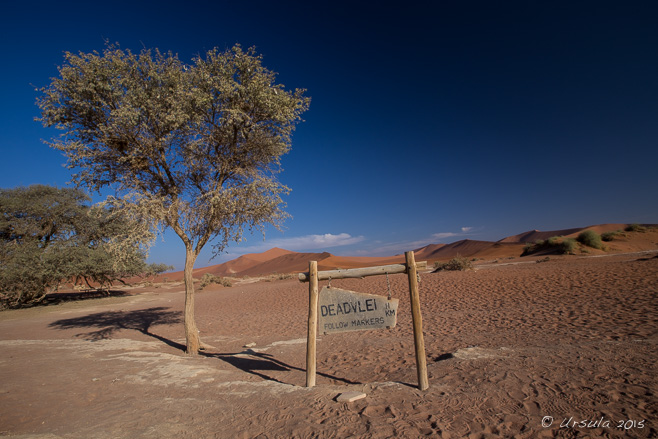
Entrance to Deadvlei Starting out early morning, we drove about 300km across Namibia from Windhoek to Sossusvlei, many of those kilometres over bumpy gravel roads. Early afternoon we arrived at the National Park to be picked up by special four-wheel drives and be driven 5 km over loose, shifting sand. This small sign greeted us, and we walked up and down across the dunes, cameras and tripods in tow.
Sands and Brush Sparse vegetation clings to dunes that ripple around us.
Deadvlei The former marsh looks small at first – but once you are into it, it extends around the base of the dunes and there are new features at every turn.
Dead Camel Thorn Tree Each tree-skeleton has its own personality.
Parched Clay
Sentinels across the Landscape
Sunburst in the Camel Thorns
Afternoon The air is still and the heat pulsates across the baked clay.
Set Up and Ready
Late Afternoon Moment by moment …
Late Afternoon … the colours deepen and the shadows lengthen.
Vegetation Up on the dunes, the bushes cling to life.
Leaving Deadvlei We walk out of Deadvlei at twilight …
… but we were back early the next morning. One day, I’ll get a chance to look at those photos!
Karen Boy All over Northern Thailand, bright-faced “Hilltribe” children approach their school day with enthusiasm.
“I am not the same, having seen the moon on the other side of the world.”
– Mary Anne Radmacher
Travel is such an eyeopener. There are parts of the world that fill me with joy and humble gratitude.
I love Thailand, and I especially love trips into Mae Hong Son in Thailand’s north. It is gorgeous country: green jungle-draped mountains that rise steeply into the clouds, cold waters tumbling down the hills into the river valleys below, and picturesque thatched-roofed wooden houses punctuating terraces of cabbages and rice for market.
What makes The Hills special, though, is the welcoming warmth of the people. People who work hard and have little, but who are still willing to share.
Many of the people here belong to one of several “Hilltribes” – the ethnic minority groups that live in remote villages across Northern Thailand, Cambodia, Laos, Vietnam and Myanmar. These communities are often well beyond the reach of basic infrastructure, like electricity and/or running water, and people support their families through subsistence farming.
Across Thailand, schooling is free to all its young citizens and the Department of Education provides classrooms and teachers. It does not, however, provide funding for auxiliary infrastructure, like libraries, canteens and dormitories, and does not help with other school expenses, like books, uniforms and (required) extra-curricular activities.
Schools in “The Hills” – especially beyond the earliest grades – might be a long, difficult walk away. Without dormitory accommodation during the school week and help with school expenses, historically, many Hilltribe children dropped out of school early, and the poverty cycle continued.
THEP operates completely transparently, and Susan is always happy to have companions on her trips. You just have to be able to keep up! The attached pictures are only a sampling of the projects we visited and the students we interviewed on just one day.
Plants in the Watering Garden One of the most effective ways of helping traditional communities is to help them do what they are already doing just a little bit better. One of the first projects Susan was involved with was a hillside irrigation system. Our first stop on this particular day was at a school where the headmaster (Khru Apichart) had built a small shade house.
Girls Reading On special days, Karen Hilltribe children wear their traditional hand-woven clothing.
Teacher All the teachers I’ve met at Hilltribe schools work extra hard, looking after children’s needs, well beyond the educational.
Tree Planting Khru Apichart (in the background) has worked tirelessly to improve every school he has been part of. He’d not been Principal at this school long, but had already organised a tree-planting day to help provide much needed shade.
Karen Girl with Amulets Unlike other Hilltribe groups, most Karen are Christian. This little girl, however, was wearing Buddhist/Animist amulets.
Weaving the Royal Purple Behind the school, there is a weaving area – one of the Queen’s projects – where Karen women weave cloth for export to the city.
Karen Weaver
Khru Sunthorn One of the first teacher/principals to work with Susan on THEP projects, Sunthorn Ananchai still takes an active interest.
Susan and a Student Our next stop was at Department of Educations offices, where Susan and her colleagues conducted student interviews. In spite of handling a large number of sponsored Student Scholarships, she remembers students’ names and details about their families.
Khru Usa Another tireless worker, Usa Intra knows the value of education and leads by example: she was working hard on her Masters degree when this was taken. She always has a smile for us and her students.
Sponsor Interview Susan is always happy for people – especially student or project sponsors – to come along on trips. With a local teacher acting as an interpreter, a sponsor chats with two scholarship students.
Boys on the Pond Back outside in the sunshine, a group of boys in their delightful school uniforms play in the pond.
Opening the Dormitory Because of the remoteness of many Hilltribe communities, students – especially at Mathayom (High) School level – travel great distances to get to class. So, to keep them from dropping out, school dormitories allow them to stay overnight. Many then go home on weekends. The building of this dorm was sponsored by ANZWG.
Inside the Dormitory Conditions are simple: a tiled room with metal-framed beds, and a string for hanging clothing…
Portrait of a Karen ‘Tween The girls in their dormitory are happy to show off their space.
Karen Girl Beds are bought through sponsorship; there is little other furnishing.
Susan and Visitors Susan explains processes and projects to some of the ANZWG visitors.
Boys in the Yard
School Canteen Our next visit was to a school canteen – also built with donated project funding.
Meal in the Canteen There are no extra employees to look after the kids who stay at school: teachers and older students all pitch in to keep things running smoothly.
“Gin Khao” With no furniture, everyone sits neatly on the floor…
“Eat Rice” … to gin khao, or “eat rice”.
Eventually, we head off to find our own meals, and tuck into our beds to recharge batteries for the next day’s round of school visits and student interviews.
The indefatigable Susan will be sitting at a table somewhere, going over the accounts and making sure projects are on time and within budget…
With her down-to-earth efforts through THEP, a lot of Hilltribe children can continue their educations and improve the future of their communities. These pictures were taken some years ago, and these children are all older now. THEP recently had its first University graduate!
With our help, the work can continue.
To the Future!
“Travel makes one modest. You see what a tiny place you occupy in the world.”
I was doing more research today to reduce the 13 villages I had on my list to visit. I was able to narrow it down to those in the Mae Hong Son province. As I reviewed internet information, I came across an article that blew my mind and changed my attitude of how to help the children there. It was on a UNICEF 2022 news article: https://www.unicef.org/thailand/media/9546/file/Closing%20the%20learning%20gap%20in%20Mae%20Hong%20Son%20EN.pdf
I downloaded some of the information I can send if you do not want to read the whole 56 pages. Now I have to rethink my trip length, locations, and how best to help the children. Wilai’s suggestion about helping with a place to stay for those students a long ways from home to school got me rethinking also. The more I know what to expect will help me more before the trip.
Do you have more information to share about this area?
CalReplyCancel
Speke Hall, Liverpool Set upon a commodious property, this old Tudor manor retains much of its stately grace under the management of the National Trust.
Call it fate; call it co-incidence; call it what you will: my family has strong ties to Liverpool.
My father moved his new bride from Europe to his Liverpool, UK, home after their marriage, and I was subsequently born there. I spent a few years there (which I mostly don’t remember!) until my parents and I emigrated to Canada when I was a toddler – before I acquired the distinctive “Scouser” accent. I made my first trip back to “the old country” as a young adult, and it was in England that I met the Australian who became my partner. He, funnily enough, was from Liverpool – Australia – and both my children grew up in that Liverpool area.
My daughter moved to the UK several years ago, and was nursing in a war zone when she met the man she would marry. He was from (you guessed it) Liverpool, UK. In fact, it turns out that his mother and I were born in the same hospital!
So, we are back in England at the moment: for the marriage of my Australian daughter to her British man. And, I couldn’t resist visiting Liverpool again: with my husband and adult son, to show them some of my roots (see: The Mersey).
My first trip back to England was a revelation to me: after growing up in a land with a relatively young Western history, the ancient stories represented in the stones and walls of the cities and buildings was awesome. More amazingly, as I was taken around the city of my birth by an elderly relative, I learned that my own great-grandparents had met while working as servants in Speke Hall, an old house which is now maintained by the National Trust, and open to the public.
Speke Hall is an almost 500-year-old Tudor timber-framed manor house with Victorian improvements, and is well worth a visit – even if your family didn’t live and work there!
Built between 1530 and 1598 by the family of William Norris II – Catholics during a time of religious tumult in England – the original house included a priest’s hole hidden in the walls and attic. Spy holes and an eavesdropper ensured that visitors could be vetted and any priest in residence could hide in time. Towards the end of the 18th century, the Norris’ moved to the more fashionable London, and the building fell into disrepair. There was a time when it was even used as a cow shed!
The dilapidated estate was sold in 1795 to Richard Watt, who made his money in Jamaican sugar. Over subsequent generations, the fortunes of the house rose and fell, before being inherited by Miss Adelaide Watt when she turned 21 in 1878. She lived in the hall until her death in 1921, and under trust arrangements, much of the farm property was sold – later becoming the site of the Liverpool Aerodrome – and the house was looked after by her butler and staff until it became property of the National Trust in 1943.
What remains of the grounds, on the banks of the River Mersey, is still extensive. The property features playgrounds and picnic grounds; a new Victorian-themed hedge maze; traditional formal gardens established in the 1860s; a large kitchen garden that dates back further and still supplies the coffee shop; expansive lawns; and ancient woodlands. Wandering around the house and gardens, it is easy to forget where (and when) you are – until a jet from Liverpool’s John Lennon Airport next door roars low overhead.
Speke Hall The approach to the old house is over the old moat.
Front Doors Our entry to the house was through the small inset in the heavy front door. What we can’t see is the “eavesdrop” overhead: the listening tube that allows servants to listen in to what we might be saying.
Tudor Courtyard Construction on the house began in 1530, and around that time two yew trees ( ‘Adam’ and ‘Eve’) were planted in the courtyard of the main building.
Tudor Details Although few of the lines in the wattle and daub house are straight or level after all these years, the details are still beautiful.
Volunteer David We missed the formal guided tours of the house – available on a first-come, first-serve basis – but we were able to wander through it on our own. In each open room, a National Trust Volunteer was stationed to tell us about the history and features.
Ancient Yews: Dreamcatchers Guide David told us that the two yew trees, ‘Adam’ and ‘Eve,’ acted as “dreamcatchers”: preventing evil forces from entering the house. These trees are now some 500 years old.
Delft and Fireplace The morning room is where Miss Adelaide would have her breakfast and meet tradesmen. It is a small world: the last time I saw Delft ceramic tiles was in a Mogul palace in Rajasthan.
Library Original William Morris wallpaper was added by Frederick Leyland during his ten-year tenancy from 1867.
“Metal Mickey”
Tudor Fireplace in the Great Hall (The English are so polite: rather than nasty signs, sprigs of holly are place on the fragile chairs to make people think twice before sitting down!)
Woodwork Details All around the house, ornately carved oak panels, many depicting stories of the Norris family, decorate walls and furniture.
The Blue Parlour Victorian elegance with stained glass windows and strong>Louis XV furniture.
Plant in the Hallway I love the leaded windows: a sign of riches in Tudor times.
Leaded Windows From the upstairs hallway, one looks out over the courtyard.
Servant’s Bells “Below stairs” are the very bells that my great-grandparents would have listened out for.
Servant’s Bells Charles Wall worked as a coachman from the early 1890s. Louise (Louisa) Ashley was a housemaid. They married and left the house for independent lives early 1895 or so.
Downstairs Diningroom The size of the servants’ dining room gives an indication of how many staff were employed. Many stayed on for life.
Tudor Guide Back outside, a volunteer guide in Tudor period costume, prepares for the afternoon tour groups.
Before leaving the heritage property, we stopped in the repurposed farm buildings which now operate as coffee shop and souvenir sales. Traditional favourites like “scouse” (“lobscous”, a lamb or beef stew); a local version of a vegetable pasty; were on offer.
My great grandmother is Norris. She married Edwards. This is our family heritage manor. I was born in Maryborough QLD. Australia. My mother, Elaine, has original documents. My sister has visited this wonderful heritage home of our family. My mobile, as I do not do emails, is 0423602836. Australian mobile phone.ReplyCancel
A Kayan Lahwi Woman Sitting on a teak staircase in a weaving factory on Inle Lake, a woman wearing a colourful headdress and brass neck rings poses.
Inle Lake in the Shan Hills of Myanmar may not be particularly large, but it is rich with culture.
Its shores are laced with canals and waterways that give access to cities and villages housing about 70,000 people. Inle Lake is as ethnically diverse as the Shan State as a whole; pockets of Intha(“People of the Lake”), Shan, Taungyo, Pa’O (Taungthu), Danu, Kayah (Karen), Danaw, and Bamar live on the waters and around the shores. Regardless of ethnicity, most of the people here are devout Buddhists who live largely traditional lives in simple wood and bamboo houses – often on stilts over the water.
The people on the lake are largely self-sufficient, living on their fishing and farming. Extra household income comes from the making and selling of handcrafts – the area is well known for its woven textiles and hand-rolled cheroots in particular – and from the relatively newly burgeoning tourist trade.
I’ve posted photo-stories from this area before (see: Inle Lake). Join me for another boat trip on these beautiful Burmese waters.
Boatman on Inle Lake As I have said before, the only practical way of getting around on Inle Lake is by boat.
Phaung Daw Oo Pagoda Regardless of ethnicity, most communities around the lake are Buddhist. Some of the temples are just stunning – and represent real feats of engineering and architecture, built as they are, over water.
Boatload of Produce Much of the boat-transport on the lake is by low-riding wooden paddle boats.
Wooden Thread Frame The stilted teak buildings in Inn Paw Khon Village are home to a thriving cottage industry in silk and lotus weaving.
Woman Spooling the Thread The weaving “industry” is labour intensive: this woman had to walk up and down the length of the frame with her silk threads many, many times…
Ikat … before the threads are tied off for dyeing. Ikat(known as mut mee in Laos and Northern Thailand) is a complex dyeing technique used to pattern textiles: warp or weft threads are tied off in a pattern before the threads are dyed and then woven.
Worker Next Door The buildings are so close that you can see across the water and in through the window to the dark workspace next door.
A Weaver Inside the factory is dark, with light angling through the open windows.
The Loom The wooden looms for weaving the lengths of silk fabric are large and complex.
Elderly Woman Spinning People use their skills as long as they are able…
Weaver’s Hands … performing delicate and intricate work …
Elderly Weaver … for long hours and little pay.
Weaver in the Light The work is repetitive and requires concentration.
Lotus Fibres Inle Lake is the only place in Myanmar where the unique fibres from the lotus plant are produced. These are then woven into special kya thingahn (lotus robes) for Buddha images.
Dyeing Cloth Lengths of cloth are hand dyed in buckets.
Rolling Cheroots In Nam Pan Village, on the opposite side of the lake, young women roll cheroots. The cigars come in a variety of sizes and flavours: the crushed tobacco and bits of dried wood can be flavoured with dried banana, pineapple, tamarind, honey, rice wine, or spices, before being rolled in thanal-phet tree leaves.
Young Women Their fingers are quick – but they still have time to check out the visitors.
Young Woman in Thanaka Ubiquitous in Myanmar, thanaka powder – made from ground bark – is used for cosmetic beauty and to prevent sunburn. It also has anti-fungal properties.
A Kayan Lahwi Woman Nearby, a bamboo and teak building houses a Kayan (Red Karen) gift shop.
Woman on the Stairs
Often referred to as Padaung – Burmese for “Long Neck” – women in the Kayan Lahwi group or “tribe” wear brass rings around their necks, arms, and legs from an early age. The weight of the brass rings on the neck pushes the collar bone down and compresses the sternum and rib cage, giving the neck its lengthened appearance.
No one seems to know why the Kayan Lahwi started wearing the rings. Some stories say it was to protect them from being attacked by tigers, others say it made them look like dragons, and others say it protected the women against the slave trade. Today, most the women will simply cite tradition and beauty.
Historically from the Karenni (Kayah) State, many Kayan Lahwi moved into the Shan State and neighbouring Thailand in the 1980s and early 1990s because of conflict with the military regime. In Thailand, because of their unusual appearance, they became political pawns, and were set up in camps as tourist attractions which have been described as “Human Zoos”.
Kayan Lahwi Women Women these days tend to wear fewer neck coils – and some don’t wear them at all.
Back Weaving Like other Karen groups, Kayan Lahwi women practice back weaving, using a back strap loom. Light and portable, back looms allow you to weave anywhere, but the pieces can be no wider than your hips.
Back Weaving The Kayan Lahwi women work mostly in cotton and synthetic fibres, weaving brilliant pattern, making the traditional scarves and tunics.
I’ve met a number of Kayan Lahwi women over the years, and they have always struck me as intelligent, self-possessed people who are neither pawns nor fools.
Tourism is a double-edge sword: traditional communities and their handicrafts can benefit from the direct financial input of the tourist dollar, but they are also at risk of exploitation by unscrupulous operators, and risk the distortion of values that a sudden influx of money can bring.
I hope that these traditionally self-reliant communities can find away to improve their own lives without losing those things they consider important.
Fishing on Yundang Waihu Just another day in Xiamen, China: men quietly fishing in timeless tradition on Yudang Lake, as the modern city rises up behind them.
It is reasonably accessible to foreign tourists, as well. Some time ago, while my husband was busy with meetings in a nearby free-trade zone, I spent a few days following a dual-language map around the city.
First established during the Ming Dynasty (A.D. 1368-1644) as a major Chinese seaport, Xiamen – with its industrial-development, investment, and free-trade zones – continues to be an important land, sea, and air hub for Southeast Asia. Only 180 kilometres (110 mi) across the Taiwan Strait(Formosa Strait) from Taiwan, it considers itself an international city.
Rather ethnocentrically, I took “international” to mean Westernised, but although Gulangyu Island, a short ferry ride from downtown Xiamen, features Victorian-era European architecture, Xiamen itself is very Asian. Many of the Hokkien natives of this area emigrated to other countries in Southeast Asia during the 19th and early 20th century; many have returned with “foreign” (Asian) ideas, and some with money for universities and cultural institutions.
It is probably this free-flow of money and ideas that contributes to the “liveability” of the city: it has preserved the past in its temples (see: Nan Putuo Temple), forts, and other historical buildings (see: Gulangyu Island); it is surrounded by water and filled with parks, lakes, cultural buildings, and public art; and its university, the first university in China founded by overseas Chinese, helps the city look to its future.
Xiamen High-Rises Yundang Waihu– Yundang Lake is a tranquil oasis in the city –
Around Yundang Waihu – where locals walk, or fish or just sit.
Bailouzhou Park Entrance In the middle of Yundang Lake is a large island park with four access points. Elaborate stone sculptured gates decorate one entrance.
Stone Sculpture Other sculptures can be found within the large park – which also houses various recreation facilities.
“Keep the Environment Clean and Preserve Social Morality” This isChina: there are signs everywhere, telling us what to do!
Cotton Tree (Bombax Ceiba) The park is a natural buffer against the city – for the local people, …
Cotton Tree (Bombax Ceiba) … for lovers of beauty and nature, …
Lake Waterfront … and for resident and migratory birdlife.
Steps down to the Harbour Waters The Port of Xiamen is an important and busy deep-water port –
Swimmers in the Port – but even so, swimmers, with their own life buoys, do their morning exercise in the chilly harbour waters.
Working Boats The harbour is full of ferries –
Loaded Ferry – laden with goods and/or passengers.
Woman on the Harbour On a harbour walkway there is a sculpture of a woman waiting for the boats to come in.
Gulangyu Island Across the sea mists, Gulangyu (Kulangsu) Island, a popular domestic tourist destination, is also accessible by ferry service.
Fruit Sellers On the street, fresh-fruit sellers set up their rose-apple stands.
Street Scenes A few blocks away, other fresh fruits are available on the sidewalk.
Two Men and a Fungus? There is a plaque, in Chinese, explaining this art piece. I can’t even guess what they are doing, and could find no information on line – but it is another example of the sculptures dotted around the city.
“Poison to Raise Colour” I think something has been lost in translation; sweet basil seeds are often used in Asian cooking, and are considered a super-food and slimming aide. But “poison?” Perhaps “potion”.
Lucky Turtles Another sculpture has been erected under a tree in a major thoroughfare.
China Town? A Chinese restaurant sits among some other old-style looking shop-fronts.
Stringing Beads There are a variety of things available in the open-air markets on the wide city streets.
Mannequin The shop-fronts make for fascinating window-shopping.
Walmart This I did NOT expect! International, indeed.
University Entrance Xiamen University makes the TripAdvisor list of places to visit. There was a special function on the day I tried, and only those with invitations were allowed in. I spent the afternoon at Nan Putuo Templeinstead.
“A Brief Introduction to Hulishan” Hulishan Fortress was built in the 1890s, during Emperor Guangxu’s reign, on a strong base made of camphor tree sap mixed with liquid brown sugar, glutinous rice, clay and sand.
Cannon Fire When I arrived at the fort, “solders” in period dress were reenacting a cannon battle.
Standard Bearer After the reenactment, …
Chinese Warrior … the “soldiers” pose for photographs.
Early Cannons For history buffs or munitions aficionados, Hulishan Fortress has a number of Chinese-made cannons, as well the “King of Cannons”, a 19th-century Krupp cannon from Germany – recognised by the 2000 Guinness Book of World Records as the oldest and largest coastal cannon on its original site in the world.
Coastal Cannons However, I was more interested in the surrounds and the people tending the gardens.
Worker Sculpture I also enjoyed the sculptures, dioramas, and murals, which brought the story of the fortress to life in a way all the signage around the 13,000 square metre site could not.
Ammunition Caisson The views from the fort were nice, and would be pretty spectacular on a clear day. It was evident that the local visitors were enjoying their day out at a site of national historic importance to them.
When Britain took control of Hong Kong after the first Opium War, China opened five Treaty Ports, of which Xiamen (literally: “lower gate”; Amoy in local Min Nan dialect) was one.
- Performing the Ganga Aarti from Dasaswamedh Ghat, Varanasi
- Buddha Head from Shwedagon Pagoda, Myanmar
- Harry Clarke Window from Dingle, Ireland
- Novice Monk Shwe Yan Pyay Monastery, Myanmar
Packets of 10 for $AU50.
Or - pick any photo from my Flickr or Wanders blog photos.




 ‘Till then,




 With our help, the work can continue.


.jpg)


[…] Dead Trees… and then walk into the clay pans and the ancient sunburnt dead trees of Deadvlei (see: Portrait of a Tree). […]