North x Northwest
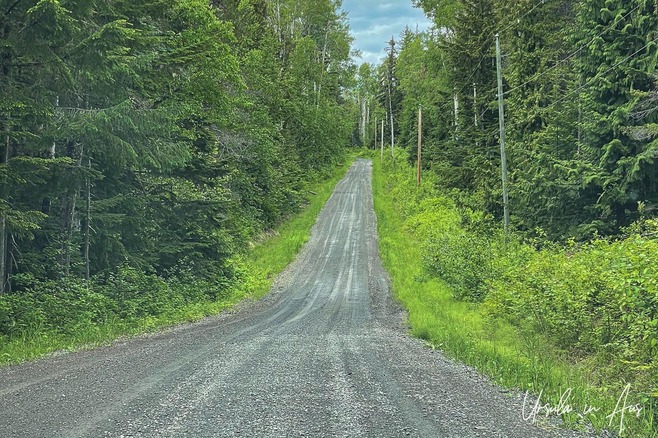
Gingolx (Kincolith), on the west coast of Canada’s British Columbia, is remote. So remote that until recently the only way to get and out was by boat or plane. In 2003, the road connecting Gingolx to the other three Nisg̱a’a communities and Canada’s Yellowhead Highway was finally completed.
Where I am standing feels like a long way from anywhere.
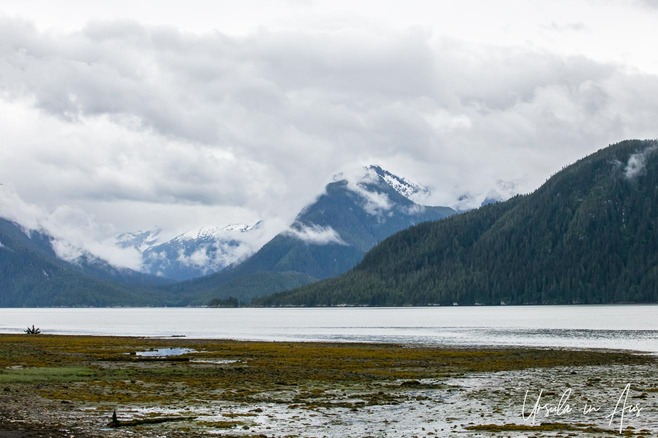
In fact, the border of Alaska is just over the mountains you see in the picture above – just 16 kilometres (10 miles) to the west. But, the only way to cover that gap is by boat or plane.
Gingolx (Kincolith) is a small Nisga’a First Nation community of about 400 people in the northwest of Canada’s westernmost province of British Columbia (BC). Before the incursion of the Christian missionaries who came down the Nass River by raft in 1867, the area was inhabited by two Nisga’a clans.
Today, Gingolx is one of four communities that make up the self-governing Nisg̱a’a Nation, covering roughly 1,992 square kilometers (769 square miles) of the Nass River Valley. Sitting on Portland Inlet at the confluence of the Ksi Gingolx (Kincolith River) and the Nass River – and otherwise surrounded by densely-forested and snow-capped mountains, the villagers who live there rely on fishing, forestry, and tourism for their main sources of revenue.
The town is known as the seafood capital of the Nass Valley. My host at the guesthouse where I was staying near Gitlax̱tʼaamiks – at the other end of the Nisga’a Nation – recommended that I lunch there for some of North America’s finest seafood.
So, I duly planned my day of sight-seeing in the Nass Valley (see: Nisga’a Lands and Memories) to get me into Gingolx near lunch time.
In spite of rainy weather, the village (and its lunch offerings!) did not disappoint. I wandered around the streets with their scattered wooden buildings, and along the lush Ksi Gingolx; I walked along the rainy waterfront and watched as a juvenile eagle searched for its lunch. And, in a charming little restaurant, I dined on freshly caught and cooked halibut surrounded by beautiful Nisga’a art.
It might be at the end of the road – but it is well worth the drive! Join me:
Gingolx – Kincolith
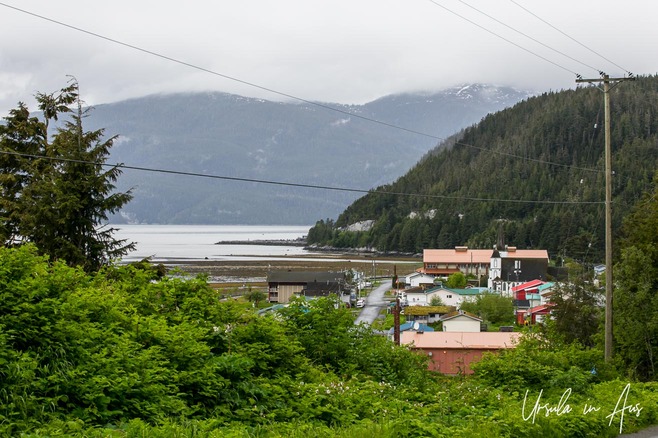
Near the end the Nisg̱a’a Highway, I get my first glimpse over the cheerfully painted buildings in the little village of Gingolx.
Thimbleberry – Rubus Parviflorus
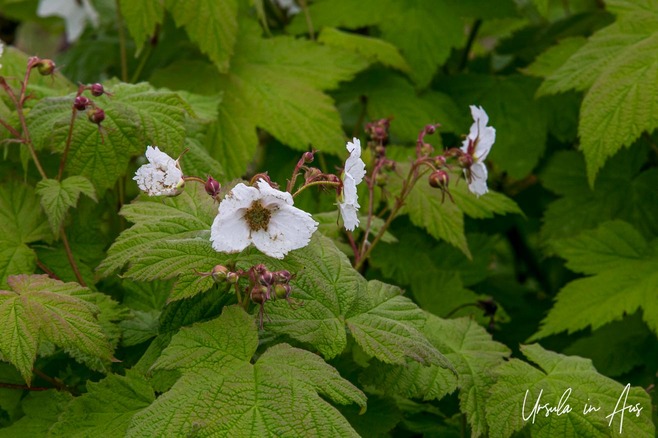
All around, the large fuzzy leaves of the thimbleberry are full of the white blossoms that predict a crop of lush, red, raspberry-like fruit.

Amazing Incidental Art
Like that of other Pacific Northwest Indigenous communities, Nisga’a art features formline designs in red and black depicting animals, spiritual beings, and clan crests. It is an integral part of everyday life, and seen everywhere – like on this traditional canoe casually parked near the Gingolx waterfront.
Lush Green Grasses
The lush growth along the Ksi Gingolx looks like it has been planted! But, it is actually the product of the wet, temperate climate.
Nootka Lupine – Lupinus Nootkatensis
Island in the Ksi Gingolx
The river here is punctuated by a number of little islands.
Portland Inlet
The waters of Ksi Gingolx empty into the Nass River and Portland Inlet. The river is known for steelhead, and is a spawning ground for four types of salmon, as well as fore the all-important ksi-hoon or eulachon, a small fish harvested for its oil.
Still Life Found
Rusty iron machinery and weathered wood stand like a sculpture against the green.
Sculptured Rock
The landscape all around me is dramatic. This rock-formation makes me think of a wild animal, and I love how the tall fir trees bend gracefully at the top.
Trees and Mountains
Even on an overcast and rainy day, it is a stunning landscape.
Great Blue Heron – Ardea Herodias
Back on the foreshore of the Nass River, waterbirds hunt for food.
Totem Pole – Carved by Alver Tait
Many of the wooden houses have clan poles that tell you about their families – if you know how to read them!
Nature’s Sculpture
The foreshore displays its own artworks.
Juvenile Bald Eagle – Haliaeetus Leucocephalus
I don’t know where all the grown-ups were, but this juvenile was watching the water closely for fish.
Old Boat
Everywhere I look, old boats sit casually above the high-tide mark, …
Old Boats
… waiting for their next seasonal fishing trip.
Follow The Food: Halibut And Chips
When lunch time arrives, I do as my host had suggested, and stop in at U See Food Ù Eat it Services. It was as good as promised!
Bonny Moore
The restaurant (and catering service) co-owner was a delight to chat with – and posed for a photo at my request.
Kincolith Christ Church
The arrival of Christian missionaries in 1867, the banning (by BC law) of some cultural practices, and the imposition of residential schooling, has contributed to a complicated blending of traditions. Younger members of the community have reclaimed and revitalized language and culture since the 20th century, but elders tend to hang onto their Christian teachings (eg: Where Christianity Meets, and Diverges, in Nisga’a Culture).
Stump in the Water
Nature’s changes command ones attention here.
Water and Mountains
I take a last look at the vastness of space to the west of me – and reflect on the continued relative isolation of this place.
Surprisingly, there is a whole lot of land north of me before BC finishes … and even more before you run off the map and into the North Pole.
Even so, I feel like I’m at the end of the known world.
This is a land of rich cultural history and wild natural beauty.
Its very isolation has probably helped it to stay that way.
Until next time …