.jpg) Bathing at Pura Tirta Empul
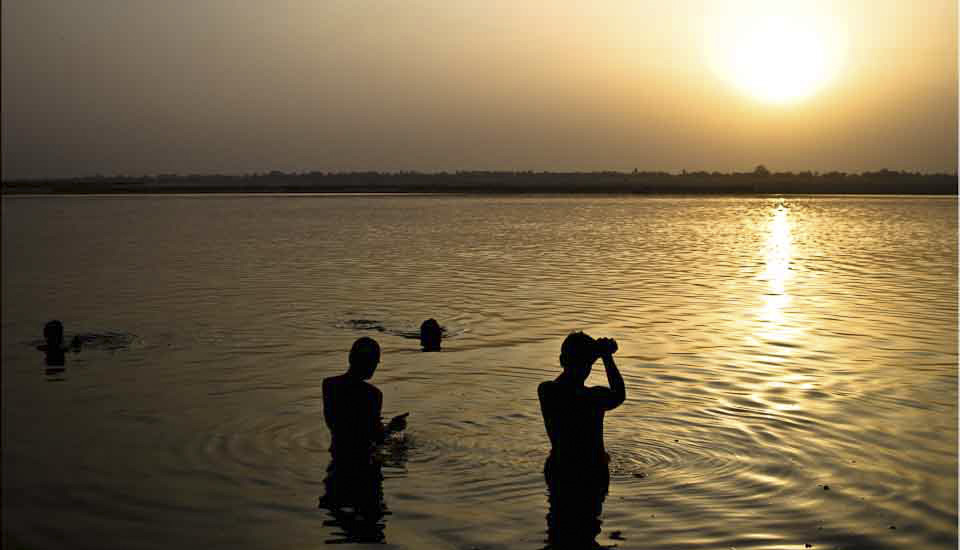
The temples of Bali are both ancient and living; at the Hindu water temple of Tirta Empul, Balinese bathe in the spring waters that have been funnelled through waterspouts since 962 A.D. Many years ago, my husband and I went to Bali for our honeymoon. On our first day there, we were separated from our money.
To say that we were “robbed” puts it much too harshly: we were attracted by friendly, smiling faces into a little blue van that purported to be going our way. I’d read about the blue taxis in my Lonely Planet, and the garrulous chatter of the men in the van distracted me from the fact that this blue vehicle didn’t have the requisite “Bali Taxi” written on it. When I was startled by the noise of our disposable camera falling to the floor, the men were also startled, and all of a sudden, they weren’t going our way after all. They hurriedly dropped us off at a motorcycle-taxi shelter and disappeared.
It was only when we went to pay the motorcycle drivers at the top of a long hill that we discovered that my husband’s wallet was empty. He was not well pleased – it was one of the few times I ever saw him lose his temper, but it was day-one of our marriage, so I did wonder what I had let myself in for!
Fortunately, we had divvied up the money that morning before setting out for the day. Half our cash was in my wallet back in our room, and he had a few dollars in his pocket with which to mollify the motorcycle drivers. The temple we had arrived at had no prescribed fee, so we set off to wander around.
Another young Balinese man seemed to have attached himself to us: he offered to show us the short-cut to the water-temple that I wanted to visit next. As he had witnessed our reaction to having no money, he couldn’t be looking for a tip, so I persuaded my husband that it was ok.
What felt like an eternity later (probably about fifteen minutes), we were bathed in wet, hot, air and surrounded by dense jungle on a path I could not make out. When our ‘guide’ shouted out to people I couldn’t see through the dense vegetation, I panicked and thought our number was up. We were going to be kidnaped, or murdered, and it was all my fault!! Never have I felt so frightened and so helpless.
Of course, a moment – or a lifetime – later, the jungle opened up, and we were looking down over the most wonderful fresh-spring stone-baths. Our guide probably wondered why we looked so very relieved as he showed us where to put our things. Warm water never felt so good!
The theft and the fright could not prevent us from appreciating what a rich and beautiful cultural experience Bali is. Last year, we returned to celebrate our anniversary.
I wanted to visit the same temples we had seen those years ago, and negotiated a trip with a guide we had met on the side of the road (Balinese are most persuasive!). We spent the day with him, a car, and a driver.
Join us at two uniquely Balinese sites.
.jpg) Family at the Entry to Pura Tirta Empul
The springs at Tirta Empul Temple are said to have magical powers, and are therefore important to the Balinese. .jpg) In the Baths
Bathers dress for modesty, and wear clothing or sarongs in the spring waters.  Bathing Fun
As is the case in many Southeast Asian temples, ritual blends seamlessly with fun and frolic. Taking Turns
In the inner yard, people line up to bathe under each of the spouts, working from left to right across the pond. Many faithful have containers to take the healing waters home with them. Ritual Baths
Visitors pay a camera fee; many watch and photograph from outside the pools. Offerings
There are offerings of flowers and incense to the Gods – particularly Vishnu – everywhere. Bathing Tirta Empul Baths
These might have been the same baths we visited many years before, but it all looked so different! Guardian at the Entry
There is beautiful stone work everywhere. The whole complex was restored in the 1960s, but with the patina of moss on everything, it is hard to tell what is old and what isn’t. Priest in a Pavillion
Balinese Hindu priests light incense and ring bells as they recite prayers. Cutting Fruit
Fresh fruit is cut for offerings. Fish Pond
Up on the hill overlooking the temple complex is Istana Negara, an unspectacular single-story palace built by Soekarno, the first President of Indonesia. Fish Patterns Markets
Naturally, where people gather, there will be markets! People on the Steps
Just a kilometre down-river from Pura Tirta Empul is the entry to Gunung Kawi. Woman Crocheting
The people lining the pathway are either selling things or making things for sale. Rice Terraces
The walk down to the river is steep, and runs through typical verdant Balinese rice terraces. Gunung Kawi Royal Tombs
Across the river, we come to the amazing Gunung Kawi: … Gunung Kawi
… ten 7-metre-high (23 ft) candi (shrines) carved into the stone cliff along the riverbank. Bale Pelik at Gunung Kawi
Carved in the 11th century, the tombs are believed to be memorials in honour of King Anak Wungsu of the Udayana dynasty and his favourite queens. Water Fountain Terraces
What goes down must come up again… There are more than 100 steps down to the river – and the same number coming back up. Checking out the beautiful terraces gave us a good excuse to take a breather as we climbed back up to the parking lot. I had hoped to find the same temples we had visited on our honeymoon, but everything looked different. Surely monuments that had existed for centuries could not have changed so much!
Maybe I dreamed the whole thing? 
Until next time,
Happy Wandering!
Photos: 30January2017
Posted in Architecture,Bali,Indonesia,LandscapesTags: architecture,Bali,environmental portrait,hindu,hinduism,Indonesia,Photo Blog,temple,travel,Travel Blog,Ursula Wall,worship
Girl on the Steps
A young woman was well ahead of us on the walking path between Dhulikhel and Nagarkot in the Kathmandu Valley, Nepal, but I think her curiosity got the better of her, so she stopped walking until we reached her. It was still low season, so trekkers like us were still rare, and worth checking out! The dramatic landscapes of Nepal are stunning.
Even so, it is the people that make Nepalese trekking such a joy! Everywhere I have been in the country, people have have been friendly and welcoming, and most amenable to having their pictures taken.
A friend and I were hiking around the Eastern Rim of the Kathmandu Valley under the watchful eye of local guide, Angfula Sherpa. We were in Nepal ahead of a photo-workshop with photographers Gavin Gough and Jack Kurtz, so this was our chance to acclimatise to the country.
Even though the four day trek is rated as “easy”, thanks to ageing joints and atrophying muscles, I was finding it – especially the up-hills (of which there are many!) – hard work. On our third morning, I was still tired from the hills and steps from the day before (see: A Thousand Steps). Plus, I had a glorious view from my Dhulikhel Lodge Resort balcony and was enjoying watching the sunrise over the surrounding mountains.
So, it was with some real reluctance that I packed my bags and set off again – uphill.
For every path in Nepal seems to be uphill!
Morning over the Mountains at Dhulikhel
The sun rose gently over the mists and mountains that surround Dhulikhel. Thanks to the weather, we didn’t have the clearest view of the soaring surrounding Himalayan peaks, but it was still a lovely spot. Woman and a Goat
As the road – and then dusty walking track – led us up and out of Dhulikhel towards Opi, the people along the route were a welcome distraction, and a good excuse to stop for rest. Hindu Shrine
At the top of one rise, we came across a small Hindu shrine, … Hindu Schoolboys
… with its own small group of student/novice priests. Paths into the Hills
We leave the temple behind us and follow the dirt path … Terraced Hills
… as it leads off and around the foothills. Woman in a Blanket
All along the trails, we can see the effects of the 2015 earthquake. A woman in a blanket sits in the shade of a pile of new bricks, while behind her we can see the reinforcing steel rebar that is now placed much more closely to protect new buildings from further earthquakes. Woman in Pink
I love the gentle wisdom in people’s faces – and their willingness to engage with us and to be photographed. Family Upstairs
A mother and her children come out of their house to greet us and watch our passing. Double-Story House
These double-story brick homes, where the upstairs is mostly grain and food storage, accessible by an internal ladder or staircase, are pretty typical in the Kathmandu Valley and foothills. Terraced Hills
The terraced hills seem to go on forever. Women on the Hill Girl in a Cardboard Hat
I’m pretty she this young girl wasn’t meant to look like a chivalrous Knight of the Round Table; just a coincidence of the colours of her dress, and the shape of her cardboard hat …
She did remind me, however, how creative and imaginative children can be even when they have very few toys and/or resources. Smiling Girl in Pink Two Young Friends Grannie in her Garden Tin Shed on a Hill
Too many people are still managing with make-shift houses, in spite of the weather extremes in Nepal’s mountains and hills. Young Woman
Scarlet lips and lined eyes – makeup is an every-day thing among young Nepali women. Terraced Hills
After three hours walking, the terraced hills still stretch out in all directions. On the Ridge
We seem to have left all the small settlements behind as we finally start making our way downhill … Angfula on the Ridge
… with our guide striding out in front. Path into the Distance
The dirt track seems to go on forever … Through the Trees
… as we wind through pine forests and past more terraced hills. Nepali Set Meal
It was late when we finally sat down to eat – but dinner was well worth waiting for! Our dal bhat (spicy lentil soup and rice), roti, curried vegetables and a seasoned mushroom dish, was topped off with an elaborate bird carved from apple. It was a long day, but an enjoyable one. I felt like I was finally getting into my stride!
As the sun fell, the temperature turned cold. We got the guesthouse to rustle up some hot-water bottles, and I slept soundly, dreaming of terraced hills.
 Until next time, Until next time,
Namaste!
Pictures: 8March2017
Posted in environmental portrait,Landscapes,Nepal,TravelTags: environmental portrait,environmental portraits,Kathmandu Valley,landscape,Nepal,Photo Blog,Religious Practice,travel,Travel Blog,Ursula Wall,walk
Wooden Dolls In Hungarian Folk Costumes
Folk art and trinkets are among the many things on sale at the Central Market in Budapest. I love markets!
Any regular reader of these “pages” knows that when I travel, I visit local markets whenever I can. Markets give visitors a wonderful insight into the daily life of the people in a country, and – depending on their light and layout – present an idiosyncratic a photographic challenge.
On a visit to Budapest in Hungary with my husband, I was thrilled to have the chance to spend time in the Great Market Hall on Fővám Square. We were staying on boat docked on the Danube River, and had some time free to wander between visiting the hilltop fortress in old Buda (see: From the Danube to Buda Castle), and reconnecting with long lost relatives.
The market – the largest and oldest indoor market in Budapest, Hungary – was the dream of the first mayor of Budapest, Károly Kamermayer. Originally designed and built by Hungarian architect and academic, Samu Pecz (1854 – 1922), the market opened in 1897, and soon became an important import-export centre. “In the early days an aisle for wagons ran through the center, with retailers on the east side and wholesalers on the west.”
The market was badly damaged during World War II, and had to be closed for several years. Extensive restoration in the 1990s, however, brought it back to its former glory. The vast three-level hall is light and airy, with a high roof held aloft by elegant steel beams and light pouring in through a huge patchwork of latticed windows. The three floors of stalls, shops and services are popular with tourists and locals alike.
Wandering around there was a treat!
Nagyvásárcsarnok – Great Market Hall
The entrance gate to Budapest’s largest and oldest indoor has an ornate, neo-gothic facade. Inside the Nagyvásárcsarnok (Central Market)
The market was badly damaged during World War II, but was extensively restored in the 1990s. Traditional Hungarian Food and Drink “Can I Help You?”
Locals chat with the counter-staff as they do their daily shopping. Counter Service Service with a Smile
There is a wide range of goods on offer; my husband couldn’t see past the poppy-seed rolls in the counter window. Flower Chocolate
I was fascinated by the exotic chocolates with fruit and edible flowers embedded in them. Fresh Vegetables Green Grocer and his Fruit Fresh Grocery
Garlic and chilis hang neatly around grocer’s stalls. Vegetable Bins Tomatoes Pigs’ Trotters and Tripe Tourists inside the Market Cold Cuts Meat Counter Kolbász
Sausage, in all its variety, is central to Hungarian diet. Goat’s Head at the Butchers’
Clearly the butchers at the Central Market have a bizarre sense of humour. Dried Fruit Dried Nuts Looking over the Hall
From the upstairs, where the bars, coffee-shops and eateries are, you can look down over the stalls in the spacious hall. Shopping for Wooden Trinkets
There are plenty of souvenirs for tourists upstairs, as well, … Traditional Embroidery
… although, rumour has it that most of these “traditional” goods are actually made in China. Cotton, Linen and Lace
If you look hard, you can find some nice pieces. Markets are also a wonderful source of inspiration: we picked up colourful packets of paprika – perfect for Hungarian goulash – to take home with us as little gifts for friends and neighbours.
 They provide a colourful and fragrant reminder of an afternoon well spent! They provide a colourful and fragrant reminder of an afternoon well spent!
Until next time,
Happy Shopping!
Pictures: 22August2014
Posted in Europe,Every Day Life,Hungary,TravelTags: architecture,arts and crafts,environmental portraits,everyday life,food,market,Photo Blog,travel,Travel Blog,Ursula Wall
Prideaux Haven
This is paradise! Prideaux Haven is a bay in Desolation Sound Provincial Marine Park, surrounded by spectacular deep water fjords and mountains. Time loops and folds in the waters and fjords of British Columbia’s Strait of Georgia.
As you turn into the deep channel of Desolation Sound – given it’s morose name by the dyspeptic Captain George Vancouver when he first explored the area in bad weather in 1792 – it is almost as if time ceases to exist. The surrounding mountains have stood forever and the towering trees are nearly as old. There are virtually no roads up here: access to trading stations and small First Nation communities is by boat only. Distance, rugged terrain, and swathes of Provincial Parks limit development to tumble-down traditional hamlets and very wealthy summer retreats.
On our motor/sail to Desolation Sound, my husband and I stopped into the charming town of Lund (see: Strait Sailing Part 2) where, among other things, I bought The Curve of Time, an account of visiting these same waters in the late 1920s and early 1930s in a twenty-five-foot diesel motor-boat, written by local woman Capi (M. Wylie Blanchet). A widow, she spent her summers exploring BC waters up and down the whole coast, accompanied by assorted children and sometimes a dog. The real “character” in the book, however, is the landscape: the moody, atmospheric West Coast British Columbia woods and waters.
I devoured the book in three days of calm waters as we sailed our boat Graystone into Squirrel Cove on Cortes Island for an overnight stop (Strait Sailing Part 2), and then crossed to West Redonda Island to top-up our supplies at the Refuge Cove Store, before cruising into the secluded Melanie Bay in the Desolation Sound Marine Provincial Park. Matching the places Capi visited over 80 years ago with the ones we were seeing in 2015 gave her poetic imagery extra poignancy.
Little had changed. Desolation Sound is a magic, enthralling, timeless place.
“Time did not exist; or if it did it did not matter… Our world then was both wide and narrow — wide in the immensity of the sea and mountain; narrow in that the boat was very small, and we lived and camped, explored and swam in a little realm of our own making…”
– M. Wylie Blanchet
Desolation Sound
The rock at the entrance to Desolation Sound Provincial Marine Park features a small sign. Kayaks on the Sound
Kayakers are small against the rocks and trees, and quiet in the expanse of water. Boats on Melanie Cove
The boats anchored on Melanie Cove come in all shapes and sizes. Later in the summer, when it gets really busy, companions often have to raft up together. Jellyfish in the Waters
The waters all around our dinghy … Jellyfish
… are alive with jellyfish. Double-Masted Schooner
A lot of boats on Prideaux Haven have travelled north from American waters; we are about 100 nautical miles north of Vancouver, and Desolation Sound is a popular cruising destination. Lunch in Prideaux Haven
Dinghies allow us to enjoy a picnic lunch with friends, overlooking the waters. Dinghy on Prideaux Haven Prideaux Haven Boats in and out of Melanie Cove Melanie Cove
At the head of Melanie Cove, we take our dinghy ashore … “Loo with a View”
… and go for a walk into the woods. Light in the Ferns
Few patches of light reach the forest floor … Light Above
… through the tall Douglas firs and western red cedars, … Spanish Moss
… and the Spanish moss that hangs from their branches. Spanish Moss Path in the Woods
Although this is a very popular place for boats, especially later in the season, I don’t think these paths are walked too often! There is a trail that leads across to Laura Cove; we never saw it. Maple Leaves Above Into the Woods
The trunks of the trees rise straight and tall. Mosses
Mosses and fallen leaves adorn the forest floor. Melanie Cove Below
From the top of Melanie Point, we can peer through the twisting arbutus (Arbutus menziesii – Pacific madrona) boughs and trunks to our boat, safely anchored for another night, below. Moonrise – Stones Marina
Three nights later, with Graystone safely tucked into her home berth in Nanaimo, we sat in the evening quiet – surrounded by masts instead of trees – dreaming of a return to Desolation Sound. It is a spectacularly beautiful place, and we’ll get back there one day…
 Until then, Until then,
Safe Sailing!
Pictures: 25-29June2015
Posted in Canada,Nature,Sailing,TravelTags: BC,boats,British Columbia,Canada,Desolation Sound,landscape,Melanie Cove,nature,Photo Blog,sailing,travel,Travel Blog,Ursula Wall,waterscape
Castillo de Santa Bárbara on Mount Benacantil
Commanding the skyline over the Spanish port city of Alicante, the ancient Santa Bárbara Castle is well worth exploring. It is no wonder that northern Europeans flock to the south coast of Spain in droves!
Cheap, delicious food; blue skies and a wonderful temperate Mediterranean climate; and history and culture around every corner: my husband and I became as infatuated with Spain’s Costa Blanca (White Coast) as any other tourists.
Our visit in mid-May last year was before the height of the European tourist season, so the region was much less crowded than it would be later in the summer. We were staying at the Valencian seaside resort town of Albir (see: Walking to El Faro). We had booked ourselves onto a boat trip down the picturesque coast from the waterfront city of Benidorm to the tiny islet of Tabarca (see: Mediterranean Blues and History). On the return trip north, the boat pulled into the port city Alicante, and we had a couple of hours to explore. After a quick look through the “Things to Do”, we decided on the half-hour walk to the elevator that would take us up to the 9th-century Muslim castle that sits high on a hill, dominating the city.
One of the things I love most about Europe is the layers of history embedded in every nook and cranny. The original Moorish castle in what we now call Alicante, was built high on a mountain covered in artefacts dating to the Bronze, Iberian, and Roman ages. The fortress was captured by Alfonso XI of Castile on December 4 – the feast day of Santa Barbara, for whom it was renamed – in 1248. James II of Aragon – who was also King of Valencia – took the castle in 1296, and ordered it to be rebuilt. Reconstruction continued over the next four centuries, before it was taken by the French in 1691, and later, the English …
The many-layered castle ruins have been open to the public since 1963. Come and explore!
Benidorm
As we pull out of dock, we get a different view of the popular Mediterranean holiday city of Benidorm. Known for its bars and nightlife, what struck me, though – aside from the high-rise buildings and the mountainous backdrop – was the number of tandem mobility scooters on the water-front promenades! We are definitely part of an ageing population. Costa Blanca
The whole coastline is dotted with resort accommodation. Passengers on the Deck
Northern tourists take advantage of the sunny weather. Alicante from the Water
The Port of Alicante is bustling with pleasure boats in the mid-afternoon sun when we draw close. That castle – nestled into the massive rocky outcrop in the middle of the city – is where we are headed. Paseo de Gomiz – Alicante Promenade
The rippled tiles on the promenade along the waterfront made my eyes swim; fortunately, there were plenty of market stalls and coffee shops to take my mind off it. Castillo de Santa Bárbara
My summer sandals were doing my feet no favours, so I was more than happy to pay the small fee for the elevator ride up inside the mountain to the fortress itself. Macho del Castillo
Originally built in the 9th century during the era of Muslim control of the Iberian Peninsula (711-1296), the castle was reconstructed during the reign of James II of Aragon in the late 13th century. It is one of Spain’s largest medieval fortresses. Turret over Alicante
The castle sits at a height of 166 metres (545 feet) above sea level, … Alicante from the Fortress
… allowing for expansive views over the city … Waters off Alicante
… and the blue Mediterranean. Arches Upward
The castle climbs up and around the rocky bluff. More Arches Baluarte de Santa Ana
Alicante and the coastal mountains are in the gun sights of the Bastion of Santa Ana. Ayuntamiento de Santa Bárbara de Casa
The site was used as a prison in the 18th century and then fell into disuse until it was opened to the public in 1963. It is managed by the local council, and entry is free. Flag Flying View over the Castle and the Mediterranean Down through the Arches
I love the rough-textured walls, and the delicate plants that cling to them. Metal Soldier
Medieval soldiers are scattered around the fortress. The castle houses exhibits and museums – and even hosts concerts under the stars. King of the Castle Ruinas de la Ermita de Santa Bárbara
The ruins of the Hermitage of Santa Bárbara are quite lovely – and house several ancient statues. Corridor Out of Mount Benacantil
After our visit around the castle, we took the elevator back down the mountain and walked through the corridor and back into the bright lights of the city. There we treated ourselves to huge ice creams before heading back to our boat. Costa Blanca Coastline
At six o’clock in the evening, the skies are still light as we cruise north along the Costa Blanca. Benidorm Coastline
The day is long when we approach our dock – but that is ok, as the Spanish typically dine late. We stopped in Benidorm for dinner before returning to our accommodation – replete after a fascinating day of water views, history and fabulous food.

Until next time,
Happy Travels!
Photos: 18May2017
Posted in History,Spain,TravelTags: Alicante,architecture,Castillo de Santa Bárbara,flowers,history,landscape,Photo Blog,Santa Barbara Castle,Spain,travel,Travel Blog,Ursula Wall
« Older posts
Newer posts »
|