Searching for Beauty The tropical sunsets over the palms and waters are unbeatable in Florida, even when you are in the built-up areas full of ugly, concrete buildings. (iPhone4S)
My predominant memory of Florida is of miles of asphalt and concrete, overlooked by garish neon signs for noisy bars, and gaudy billboards promoting guns and gambling, escort clubs, the bible and ‘pro life’; a landscape punctuated with plastic theme parks and lined with strip malls, drive-throughs, and featureless clumps of condominiums gathered around kitsch swimming pools.
But, there is another Florida: if you look past the tacky souvenir shops and fast-food outlets, you can find National Parks, Indian Reservations, StateReserves, and privately bequeathed lands that are protected green spaces and a breath of fresh air.
We had made use of one of those indistinguishable timeshares, rubbing shoulders with families from all over the mainland USA looking for a vacation with their children. We even took advantage of our free Universal Studios Florida tickets. But for me, the ‘real’ places – like the Kennedy Space Center at Cape Canaveral (see: To Infinity and Beyond!), the out-of-the-way places (see: Key West) – and the preserved natural places (e.g.: Flamingo Gardens; Kissimmee Lake; and Crane Point) – were far more enjoyable.
Come dip your toes in Universal Studios Florida and the Everglades, and decide for yourself!
The Universal Globe When in Florida, you really have to take in at least one theme park!
Universal Entry School holidays haven’t started yet, and rain is in the forecast, so the entry is not too crowded when we arrive.
Emmys for Lucy All five of comedienne Lucille Ball’s Emmy Awards were on display in a case in the Lucy: A Tribute exhibit. This walk-through museum has closed since our visit.
Marlene and the Old Cameras
Cars in the Lot Who doesn’t remember American Graffiti? Those wonderful cars from 1958 and earlier still sit outside Mel’s Drive-In. We admired the classic vehicles, but didn’t stop to eat.
Jack the Clown I’m not a fan of horror movies, but Universal’s Horror Make-Up Show was on our path, so we checked it out. I could be forgiven for not knowing Jack the Clown, as he was invented for the Universal Halloween Horror Nights.
Hellboy I did know Hellboy, having seen Ron Perlman in the 2004 movie with my son, …
Lon Chaney … and horror fan or not, everybody knows Lon Chaney!
Curious George Car The sprinklers were going full-force, but there were no young children around to explore the Curious George Town. That was probably just as well, as we found a large sea snake in the paddling pool!
Raincoats in the Street As predicted, the rains came. Most of the shopfronts are restaurants and souvenir shops; they did a good trade in plastic raincoats! (iPhone4S)
Hollywood Rip Ride Rockit In spite of the weather, there were plenty of takers for the various roller coaster rides.
Jimmy Buffet Plane We opted instead for a quiet lunch at Jimmy Buffet’s Margaritaville, and then watched a new-release move before leaving the park.
Riding the Everglades Airboat A week later, we were enjoying our second Florida airboat ride: this time on the Miccosukee Indian Reservation in the Everglades.
Miccosukee Indian Reservation There is a wealth of birdlife in the ‘River of Grass’, as the Everglades is called, but it is hard to take photos with the noisy vibrations of the airboat.
Spatterdock (Nuphar Luteum) Spatterdock, or cow lily, is a large aquatic plant native to Florida.
Spatterdock With its wonderfully showy seed pods, it is one of my favourite Everglade plants.
Miccosukee Village I chose this particular airboat ride (out of the many on offer) because I was interested in learning a bit about the Native American Miccosukee people who live here.
Water Hyacinth under the Bridge Getting off the airboat allowed us a closer look at some of the plant life.
Water Hyacinth (Eichhornia Crassipes) Beautiful though it might be, this imported plant, native to the Amazon basin in South America, is considered a major weed species in Florida. Considerable money and effort has been put into its control and management.
Everglades Airboat Although we get to look through old village buildings, I don’t feel as if I learned much from the static displays. Our Miccosukee driver is rather uncommunicative, and stays with the boat while we explore.
Everglade Grass The water is dead calm in the high overcast; there is not a whisper of wind in the grass.
Small Fish The fresh water around us is so crystal-clear that it looks as if the fish are floating in air.
Spatterdock (Nuphar luteum) It is going to rain. But for now, everything is hushed, calm, and luminous.
Crested Floating Heart – Nymphoides Cristata Introduced to the United States as a water garden plant, this pretty lily-like freshwater floating perennial from tropical Asia is another invasive pest in the Everglades.
Great Blue Heron (Ardea Herodias) Southwest Florida is home to the great blue heron, the Louisiana heron, the little blue heron, the great white heron, the little green heron, the Wurdemann’s heron, and to the yellow-crowned and the black-crowned night herons. I’m pretty sure this one is a great blue heron.
Rainy Roads As expected, the rains came. We ducked into the Miccosukee Restaurant for a late lunch and a last taste of the Everglades before battling the weather and driving west out of the grasslands. (iPhone4S)
It is certainly true that Florida has something for everyone.
I for one prefer the wild natural spaces over the concrete jungle and plastic theme parks.
“Desert Dreams” The lines and waves of the Sharqiya Sands Desert blur as the rising wind whips the sand up into the setting sun.
“The desert never leaves you.”
My driver, who had declared his love of the desert as we were driving into it, said this with awe in his voice.
I agree with him. I too, love the desert: there is something mystical about the way seas of sand drape and fold into the distance. The shimmering light is mesmerising; the dry heat wraps you in a blanket of support and warmth; and the soft sands and sensuously billowing dunes invite you to lie down in them. There is a poetry in this landscape which is both timeless and ever-changing. It gets into your bones – into your soul.
It also gets into your hair and your teeth and your eyes!
The winds had picked up, and even with my tightly-wrapped Bedouin headscarf, the sand was biting into my hands and eyes. “You’ll be finding bits of it, years from now!” my driver continued with a soft laugh.
We were in the Sharqiya Sands – also called the Wahiba Sands after the Bani Wahiba tribe who are the predominant Bedouin residents there. This desert stretches across 200 kilometres (125 miles) of loosely-populated space between Oman’sEastern Hajar Mountains and the Arabian Sea. The area is less than three hours from Muscat – the country’s capital – and is often referred to as “Oman’s adventure playground”.
On our way in, we stopped at the nearest town to have the tyre pressure reduced in our modern four-wheel drive before driving off the bitumen and into the uncharted sands.
I say ‘uncharted’ because it is: GoogleMaps is no help here. Our guide/driver from NTT Tours knew where he was going, but there were no roads, signposts, or markers. Just sand. Even the tread-marks of previous vehicles were not good indicators, as they could have been from campers who were heading into the wilds. We, however, were over-nighting at the evocatively-named 1000 Nights Sharqiya Sands Camp, which the driver somehow found. While it may sound as if I am being overly dramatic, a family who were self-driving chose wait until we were ready to leave the next day, and to follow us out of the desert and back to the closest town: they were concerned about getting lost or stranded!
The resort is in a magic location, nestled at the foot of a large dune. In the afternoon, we drove high into the hills to watch the sunset. The next morning, I set off well before sunrise to climb the soft sand behind the resort to wait for daybreak.
Join me for some desert landscapes:
Toyota Four-Wheel Drive With four-wheel drive and reduced tyre air pressure, a modern, air-conditioned and comfortable vehicle can take you almost anywhere! We drove high into the undulating dunes to wait for the sunset.
Afternoon Sands The waves and ripples of sand – amber-tinted by the afternoon sun – stretch out into the distance.
Waves and Dunes The dunes rise up to 100 meters (330 feet) high, …
Patterns in the Sand … with ripples and waves of sand running between them.
Curves and Waves The seductive curves stretch out before me …
Late Sun on the Sands … as the sun goes down.
Wind and Waves Afternoon light emphasises the shadows carved out of the sands …
Almost Abstract: Patterns in the Sand … by the rising winds.
Sunset Sands The sun drops further in the sky …
Almost Abstract: Parallel Waves … and all around me the patterns shift and flow.
Predawn Footprints on the Dunes I set my alarm very early the next morning, and set off with a head lamp and my cameras to climb the dune behind the resort. It wasn’t as dark as I’d expected, but I’d forgotten how hard it can be to climb through sand. On the steeper sections, I was on all fours like a bear, trying not to sink too deeply, and using my hands to keep from tumbling backwards. Finally, I reached the top and an undulating vista stretched out before (and behind!) me.
Rippled Dune Rising
Almost Abstract: Ripples and Waves
Constant Motion Wind whips at the edges of the dunes where they fall in corrugated stripes into the valleys between them.
Sunrise over the Sharqiyah Desert Finally, the sun creeps over the horizon.
Morning on the Desert It turns out I am not alone; …
Morning on the Dunes … a small group watches the morning break from a distant dune …
Footprints … and tracks all around me show where small creatures have been.
Sunrise over the Camp As the sun rises, I can see my resort below. It was time to head back and have breakfast – after I brush the sand out of my teeth!
Fortunately, sliding down the dunes in daylight is easier than climbing up them in the dark.
Unfortunately, the rising sun also shone light on a disappointing amount of litter, thoughtlessly dropped by travellers and tossed by the wind. I filled a chip bag I found half-submerged with refuse I collected on my walk back to camp.
[…] sensually seductive place, with the sands ebbing and flowing over the dunes into the distance (see: Sand Songs and Desert Dreams). But, don’t be fooled! Once that sun rises over the horizon, the temperatures will skyrocket […]ReplyCancel
[…] towards the green date palms after two days in the magical Sharqiya Sands Desert (see: Sand Songs and Desert Dreams and Life in the Desert), it was easy for me to conjure up romantic notions of starry nights, […]ReplyCancel
The Prayer-Flag Hanger For centuries, Boudhanath Stupa has been an important pilgrimage site for Tibetan Buddhists. So, prayer flags hung there are particularly auspicious; but they don’t hang themselves!
Dancing on the wind, dispersing prayers, mantras, and general good will across the landscape, strings of prayer flags hang to the four corners of Boudhanath Stupa.
Somewhere, amongst them, were mine!
Prayer flags are said to date back to the battle flags used by the Gautama Buddha in the fight against the asuras – malevolent divine beings considered by Indian mythology to be enemies of the gods. Ubiquitous in the Tibetan Buddhist world (e.g.: Prayers on the Wind: Bhutan), prayer flags come in different styles and shapes, but the most commonly seen are the Lungta (wind horse) flags. These colourful squares of cloth are woodblock-printed with sacred images, sutras and mantras, and hung horizontally in sets of five. The five fabric colours represent the five elements and the Five Pure Lights: blue is for the sky and space, white stands for the air and wind, red is fire, green depicts water, and yellow symbolises earth. Keeping these five elements balanced is thought to produce health and harmony.
Prayer flags are believed to release peace, compassion, strength, and wisdom into the very air, bringing benefit to everyone. They can also include prayers for a long life of good fortune on behalf of the person who supplies them.
What could be more auspicious, then, than adding one’s prayers to all of those fluttering under the careful watch of the Buddha’s eyes at the Boudhanath Stupa in the heart of Kathmandu!
We then watched in fascination as the designated prayer-flag-hanger tied lengths of flags together, climbed to the top of the 36 metre (118 ft) dome, secured one end of the bundled flags to the gilded spire, let the bundles unravel to the lower landings, and then secured the other ends to the outer corners of the complex.
That accomplished, our prayers were free to mingle with all the other positive vibes dancing across the Kathmandu Valley and beyond, to all the pervading space in the six worldly realms.
Prayers Flags and the Eyes of the Buddha My accommodation was a short walk from the magnificent stupa, so I took every opportunity to visit it at different times of day. (iPhone6)
The Stupa One of the largest Buddhist stupas in the world, this iconic structure stands tall over the surrounding skyline. It was badly damaged by the horrific April 2015 Nepal Earthquake, but the site is of such importance that repairs (costing 230 million Nepalese Rupees – about $USD 2,000,000) were begun almost immediately.
Flags on Boudhanath The all-seeing eyes face in four directions, and – like the eyes in a painting – follow your progression around the temple.
Bundled Prayer Flags Flags come in numerous different sizes, but the order of the colours (blue, white, red, green and yellow) is invariable. Wooden block printing is the preferred means of printing the patterns, but some are now screen printed.
Plane over Boudhanath The thirteen tiers that form the pyramid at the top of the stupa symbolise the thirteen steps of initiation leading to enlightenment. The lacy gilded canopy atop the steps stands for the air, and the spire is the fifth element in Buddhist philosophy: space or “ether”. We are near a flight path, and regular jets use that space to fly over us and out of the valley.
Flags on the Landing Before anyone begins the long climb up the restricted area to the top of the stupa, the ends of each flag section have to be tied together.
Angfula and the Prayer Flags Our guide keeps an eye on the whole process.
Ang on the Landing Lime powder is mixed with water to make a lime wash, which is carried up to the top, and poured down over the dome periodically.
Flags Dropping Down Saffron water is then thrown over the whitewash by a worker skilled in making the arches, creating a decorative lotus petal pattern.
Unfurling Flags
Guiding the Flags The whole process of affixing the flags is quite labour-intensive; …
Flags on the Stupa … each string has to be guided across each landing ….
At the Edge of the Stupa … and out to the perimeters of the stupa …
Affixing the Flags … where they are carefully tied on.
Flags at the Corner
On the Landing With a diameter exceeding 100 metes (328 feet), the stupa is huge. Outside the base, the shops and restaurants are almost as fascinating as the stupa itself. The nine levels of the stupa represent the mythical Mt. Meru, centre of the Tibetan Buddhist cosmos.
Guiding the Prayer Flags The whole process of attaching the long strands is repeated, over and over, as fresh flags are continually added.
Flags on the Wind The wind horse, in picture or in words, is the central element of a Lungta flag.
Flags on the Wire The outside corners of the flag are guarded by symbols or drawings of the four great animals: Garuda, dragon, tiger, and snow lion, and the texts are usually a collection of mantras or a short sutra.
Flags to the Gilded Spire More than 30kg of gold were used to repair the badly-damaged golden spire.
Flags to the Spire of Boudhanath The Spring skies darken overhead, as the eyes of the stupa keep watch.
Boudhanath under Storm Clouds The crowds at the base thin, as people start to head home, …
Overloaded! … grabbing any public-transport they can find before the rains get serious.
The air was full of prayers and rain as I dodged rubble and puddles walking back to my hotel.
The beauty of staying so close was that I was able to visit repeatedly, checking out the different moods and activities happening at different times of day (e.g.: Light a Candle).
Each visit, I looked up – up to the flags fluttering overhead, sending good will into the atmosphere.
Auṃ Maṇi Bêmê Hūṃ – ཨོཾ་མ་ཎི་པ་དྨེ་ཧཱུྃ – “The jewel is in the lotus.”
Hamar Man The Hamar people of Ethiopia’s Omo Valley carry themselves with a regal bearing, and meet strangers with a clear and direct gaze.
It is hot, and arid, and a long way from anywhere.
The harsh environment is at least part of the reason why the 16+ ethnic groups who live in the far reaches of Ethiopia’s Omo Valley, near the border with South Sudan, have been left alone to maintain their traditional lifestyles and cultural practices.
One writer has called the Omo Valley a “cultural melting pot”, but this is misleading. They have not blended or melted: their cultures have stayed as sharply differentiated from ours – and from those of each other – as shards of coloured glass. While they are predominantly pastoralists, or agro-pastoralists, who value their livestock (mostly cattle, goats and sheep) above all else, each tribe has their individual traditions, clothing styles, and customs. More importantly, each ethnic group has its own defined territory in the Southern Nations, Nationalities, and Peoples Region (SNNPR) of Ethiopia and speaks its own language – with linguistic roots in one of three distinct language families.
The Hamar are among the most recognisable of these tribal groups: as I’ve said previously (A Visit to a Hamar Village), they are a tall and good-looking people. The women decorate their hair with ochre-butter, and wear shell-beaded goat-skin bibs for special occasions; the men wear distinctive feathered clay caps, and carry their small wooden stools/pillows with them as they go about their business – often with an AK47 slung over one shoulder; and all: men, women and children, wear multiple strands of colourful beads.
I visited the Hamar people on a number of occasions with photographer Ben McRae, as part of a small-group Piper Mackay Photo-Tour. These environmental portraits are from a village near the market town of Turmi where we participated in the “pay-per-click” photo-tourism common in the Omo Valley: the tribes here trade on their distinctive appearances to supplement their incomes.
In theory, this is a win-win system: we visitors pay for the privilege of making photographs. In practice, I found it extremely transactional: it was hard to have natural interactions with the local people when they were making sure we didn’t ‘sneak’ any unpaid shots of cows or fences. I felt like I was collecting ‘head shots’ rather than making connections or gaining any real insight into people’s lives.
But, I tried.
Come meet some Hamar people.
Mother and Child The family compound of round, woven houses is surrounded by a simple wooden fence. The mothers – in their blankets and beads – are proud to show off their babies. Naturally, we pay extra for the children in the photos!
Hamar Woman The metal necklaces on this woman tell us she is married; men can have as many wives as they can afford – payed for in goats, cattle and guns.
A First Wife This woman wears a burkule or binyere: a leather and metal necklace with a large cylindrical detail on the front. This indicates she is her husband’s “first wife”: a position of status in the community.
First Wife and Child Infants and toddlers are everywhere. Up until recent times, children with perceived physical abnormalities were judged to be Mingi, or ritually impure, and were killed or abandoned to die.
Young Woman with Attitude These women seem to have such confidence, …
Young Hamar Woman … and face the camera win an insouciance that is enviable!
Young Hamar Man Traditional hairstyles take a variety of forms, …
Man with a Watch and a Stick … but it is the outfits …
Tommy Hilfiger and Beads … that truly give pause.
Layered Beads and a Close Shave Patterned head-shaving is popular, and if I were to go back to the region, I’d take spare razor blades, as they are highly valued.
Blanket and Attitude
Traditional Goatskin Smock
Woman Carving a Gourd Everyone has something to do: this married woman in a traditional goatskin smock is preparing a gourd which will probably be used to contain coffee.
Child with a Child As is the case in many traditional communities, children often care for their younger siblings.
Young Girl in Profile This adorable young girl was raking in the cash; …
Young Hamar Girl … she has an infectious smile, and we all wanted her picture!
Hamar Man in Profile I’m in awe of those chiselled cheekbones! It’s hard to know where the sculpted hair stops and the feathered clay cap begins; …
Man’s Cap … traditionally, men wear painted clay caps which are decorated with precious feathers and other ornaments.
First Wife A ‘first’ and chosen wife, in her heavy – and heavily symbolic neck adornments – …
Hamar Woman … shows us her goatskin clothes: richly decorated with colourful beads …
In Full Dress … and cowry shells – which symbolise womanhood, fertility, birth, and wealth.
Uncompromising Young Woman These women have strength! They look into the camera with no compromise.
Those Eyes! This young girl (whose picture I have shared before), on the other hand, had such large, emotive eyes, she made me think of those dreadful velvet paintings of large-eyed-children with teardrops that were so popular in my youth.
I’ve left a lot of ‘background’ in my shots because I want to convey some of the dusty, hot environment in which these people live.
But, I don’t for a moment pretend I understand how they do it! I can only hope I left more than I took.
[…] where our base was in Turmi. Over the next days, we visited Hamar (e.g.: Visit to a Hamar Village, Face in a Hamar Village; Hamar Village Portraits; and Morning Portraits), Daasanach (see: A Visit to the Daasanach) and […]ReplyCancel
Man in a Red Turban India is a feast of colours and impressions. Everywhere you go, people in brightly dyed fabrics sit in contrast against roughly painted or wash-tinted walls – as if they are just waiting for random street-photographers to appreciate them.
I just love the photogenic faces of India!
So much of Indian life happens in the streets and public spaces. As a foreigner, wandering around – either alone, or in the company of a guide or group – I have always found that my cameras and I are welcomed into that street life. I meet the eyes of strangers, and they acknowledge me and my desire to make their picture; sometimes they want to see the result on the digital display on the back of the camera, but most of the time, we just exchange a laugh and a thumbs-up, or a namaste of thanks. Some people indicate they are reluctant or unwilling to be photographed – a sentiment I completely understand, and naturally, respect – but in India, that doesn’t happen that often.
It has been ages since I’ve spent time in India. My last small-group visit, with photographer Karl Grobl from Jim Cline Photo Tours, and local guide DV Singh Jagat, included the annual autumn Camel Fair in the Northern Indian town of Pushkar (see: Faces at the Camel Fair, and Among the Camels and Horses). Pushkar Lake has attracted pilgrims at least as far back as the 2nd Century BC. Today, the lake is registered as sacred, and is ringed by Hindu temples, Sikh gurdwaras, and 52 bathing ghats.
The start of the Camel Fair and the Hindu observance of Prabodhini Ekadashi are determined by the Hindu calendar, taking place on the 11th lunar day of Kartik – which usually coincided with November on the Gregorian calendar. The town and the adjacent fair grounds are filled with crowds of religious pilgrims, animal-traders, entertainers, touts, merchants, and international tourists (see: Street Scenes in Pushkar).
Most of the international tourists are like me: travelling alone or in small groups with big cameras, and are there for the life and the colour.
Seated Sadu The life of a Hindu aesthetic is relatively simple: what you see here is probably everything this man owns: blankets to sit on and wrap in, a kumbh – or pot – for collecting sacred waters, a copy of the Rama Gita or some other holy text, and a small bag for other assorted toiletries, etc.
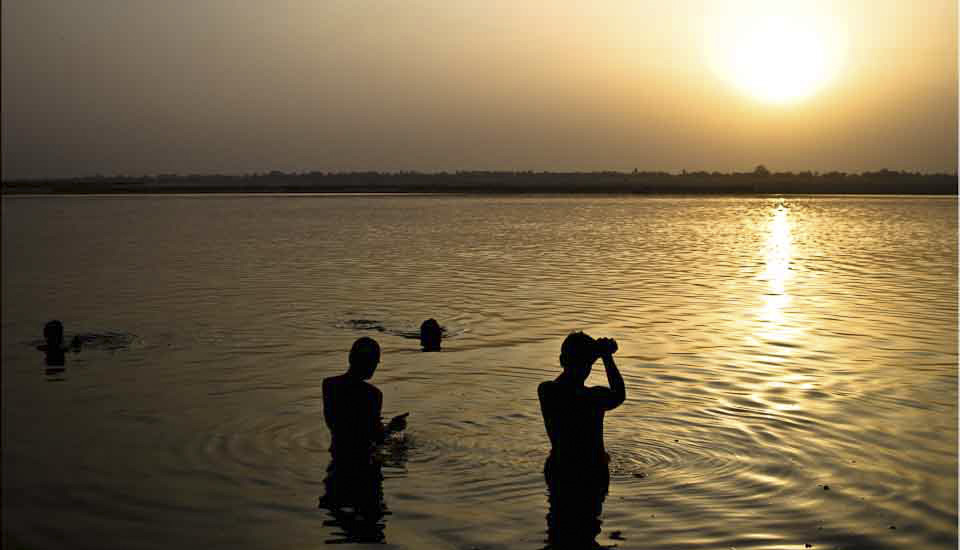
People on the Ghats Today is Prabodhini Ekadashi – “awakening eleventh” – the day that Vishnu woke up from his four-month sleep over Chaturmas. Ritual observances include chanting, fasting, and bathing in Lake Pushkar.
Woman in the Crowd The streets are busy with pilgrims heading to the ghats and temples.
Salesman in a Kumbh Shop During the Pushkar Fair period, a ritual bath in the lake is said to lead to salvation. Hindu faithful also carry water home with them: often buying special containers, or kumbh, for the purpose.
Prayer Beads and a Blazer I can’t help but wonder how far some of the pilgrims have walked carrying their kumbhs.
Sadhus on the Road The different styles of sadhu are fascinating to watch as they make their way into town.
Sadhu Portrait
Cooking Street Food The streets are lined with fresh food …
Sequinned Textiles … and colourful goods.
Colourful Dupatta Women in red headscarves check out the jewellery on offer in stalls alongside the road.
Pilgrim Women Friends find places to sit and rest on their walk into town.
Older Woman in Blue
Woman with a Young Boy
Woman in Pink and Red
Selling Vegetables Roadside vendors clump into groups, where the conversation is as important the sale.
Mannequins The shop-front mannequins seem strangely out of place.
Street Colours The streets are full of colour as pilgrims make their way …
Child in the Crowd … through the crowded streets …
Outside Gau Ghat … and into Pushkar’s most important bathing ghat.
Woman with a Head Load Even though the pilgrims keep coming, …
A Moment’s Respite … there are moments of quiet reflection, …
Heat and Smiles … and there is always time for a smile.
Face amid the Saris Between the ghats and the fairgrounds, the crowds continue.
Old Sadhu
Women at Tea Shop I love masala chai! An open-air teashop just outside the fairgrounds provides me with a good opportunity to stop, …
Woman in a Pink Sari … chat with the women, …
Woman in a Marigold Sari … and raise a cup of chai.
Hot, sweet, rich, masala chai –
As hot as the streets, as rich as the colours, and as sweet as the welcoming smiles.
Yet again Ursula, it is wonderful to see your smiling face in my Inbox, reliving our great time together once more. Do hope you are well and thank you for the little walk here down memory lane. You are so amazing too. . . . the stories and the depth of your knowledge. Absolutely Amazing. Miss you Girlfriend. . . .ReplyCancel
- Performing the Ganga Aarti from Dasaswamedh Ghat, Varanasi
- Buddha Head from Shwedagon Pagoda, Myanmar
- Harry Clarke Window from Dingle, Ireland
- Novice Monk Shwe Yan Pyay Monastery, Myanmar
Packets of 10 for $AU50.
Or - pick any photo from my Flickr or Wanders blog photos.

.jpg)
.jpg)
.jpg)








 But, I don’t for a moment pretend I understand how they do it! I can only hope I left more than I took.


 As hot as the streets, as rich as the colours, and as sweet as the welcoming smiles.


