.jpg) Afternoon Light in the Wadi
The rains have stopped, but there are still clouds overhead and puddles in the sand as we bounce across the desert in Wadi Rum, Jordan, in the back of our Bedouin trucks. Lawrence of Arabia screened on free-to air television here in Australia on Easter Saturday. It seemed an odd choice for the Easter weekend, but nothing is ‘normal’ this year.
I’d forgotten what a long movie it is (four and a half hours with ad breaks!) but with the Covid-19 lock-down, it’s not as if I was going anywhere else! So I settled in. The portrayal of the archaeologist, army officer, diplomat, and writer Colonel Thomas Edward Lawrence and his role in the Arab Revolt of 1916–18 as depicted in the movie is problematic, but those visuals! And that wonderful score!! Watching the opening scenes where the sun slowly comes up over the empty horizon, the long sequences of two camel riders dwarfed by the majestic sand dunes, and the later images of mirages dancing in the heat, I was reminded how much I love the film – and how much I love the desert.
I first saw the movie at a drive-in as a youngster, when I was learning about ‘Arabia’ in Social Studies at school. I certainly didn’t understand the plot details or the subtleties of characterisation, but I was captured by the flowing sands and the expanses of space and sky. I later read a biography of T.E. Lawrence’s life, and watched the movie many more times.
Watching the film again this last week made me ache to get back to my pictures from some of that very same landscape.
I thought about Lawrence – and that movie – a lot last year while I was in the Wadi Rum Protected Area in the south of Jordan. Souvenirs of Lawrence’s time in this region are everywhere. And the landscape itself is – quite literally – awesome. The name is apt: Wadi means valley, and Rum means high or elevated; the dramatic red rock cliffs rising high over the floor of the desert valley at Wadi Rum are nothing short of spectacular.
As if this wasn’t special enough, it actually rained while we were exploring the rock formations! Wadi Rum is one of the driest places on earth, with precipitation generally limited to short, light showers on 15 days or less a year. So, the spattering of rain and hail as were clambering over the sands added extra mystique.
The resulting colours and light were just amazing – and constantly changing under the late afternoon sun.
Do join me in the magic of the Wadi Rum desert.
.jpg) The Seven Pillars of Wisdom
After about four hours of driving south from Amman, Jordan’s capital city, the dramatic sandstone formation named for Lawrence’s autobiographical book, come into sight from our bus windows. Before the First World War, Lawrence was writing a book about the seven great cities of the Middle East. The planned title – Seven Pillars of Wisdom – comes from the Book of Proverbs (9:1) in the King James Bible. However, when the war broke out, Lawrence was based here in Wadi Rum as part of the British Forces of North Africa. Instead of finishing the first book, he used the title for his autobiographical account of his experiences during the Arab Revolt of 1916–18. The title was then borrowed to name this stunning rock formation. .jpg) Wadi Rum Visitor Center
The Visitor Centre is an essential stop, as we all need entry permits for the UNESCO-listed Wadi Rum Protected Area. It also affords us another view of the Seven Pillars of Wisdom.  Vendors at Rest
As well as information about the area, the Visitor Centre houses gift and souvenir shops. We weren’t giving them much business! Grocery Store: Wadi Rum Village
The village of Wadi Rum is tiny – but we are able to buy drinks and tasty local take-away lunches of rice and spicy topping. Trucks into the Desert
We leave the highway – and our air-conditioned bus – behind, and head off into the desert in rustic pick-up trucks. Into the Wadi
There are no roads here; we make our own tracks across the valley floor. Camel at the Ready
Naturally, where you have Arabian desert, you will find camels. Camels
These, however, are not for us – we will get our chance to ride the next day. Tourists and the Red Rocks
It is like a scene from another planet; no wonder that The Martian, starring Matt Damon (amongst other movies), was filmed here. In the Wadi
The wadi seems to go on for ever, each rock formation more magnificent than the last. Tourist Trucks
The protected area is 74,180 hectares (183,300 acres) of unique desert landforms. Camels Made Small
The sandstone cliffs dwarf us. There are six Bedouin tribes that still live in villages in the Wadi Rum area. Many operate tourism ventures, like these camels for hire … Campsite in the Shelter
… and the overnight campsites we see along our way. Dunes in the Wadi
It starts to rain as we climb our first dune, rendering the colour of the sand an even darker red. Hail on the Sands
The light dances on the rocks below as hail joins the rain. The afternoon has been hot, so the cooling hail is welcome. Camels in the Hail Rain and Hail
The light changes from one moment to the next as the clouds block the sun overhead. (iPhone6) Truck in the Red Sands
The rain storm passes, and we head to our next stop. Light in the Desert Flash Flooding in the Wadi
A wadi is a valley that is usually dry; … Fresh Water in the Wadi
… the waters from the recent rains have people excited to bathe. Trucks in the Desert Light
It is the iron oxide in the sand and stone here that gives us all the different shades of red. Car Parking in the Brightness
The light glistens off the puddles collected in the rocks as we climb another formation. Climbing the Formations
This is Instagram Selfie heaven! People climb onto the outcrops to get pictures of themselves. Lawrence’s House
It is hard to imagine someone living here! This shelter was built over the ruins of a Nabataean water cistern. Lawrence’s House
According to legend, Lawrence stayed here during the Arab Revolt. Little remains … Rock Formations
… except for the magnificent views. More Formations Petroglyphs
Wadi Rum has been inhabited for more than 12,000 years. The petroglyphs at Khaz’ali Canyon are thought to date to the Thamud people who lived here from at least the 8th century BC to about 600 CE. Horses on the Trail Wadi Rum Night Luxury Camp
The down-side of the surprising rain was that the skies were not as clear as normal – so the starry skies over the domes inspired by The Martian would have been less impressive. Tourist Tents
I didn’t mind: I was tucked into a woven Bedouin-style tent, complete with ensuite. The autumn night was cool, and I was glad to snuggle into my bed, dreaming of red rocks and desert heroes – and looking forward to the wadi sunrise in the morning.
 What a majestic place! What a majestic place!
Like Lawrence, I too fell in love with it.
Until next time …
Pictures: 14October2019
Posted in Jordan,landscape,TravelTags: desert,Jordan,landscape,Landscapes,nature,nature reserve,Photo Blog,travel,Travel Blog,Ursula Wall,Wadi Rum
Enga Woman
High in the rugged mountains of Papua New Guinea, Engan people practice age-old cultural traditions. Papua New Guinea (PNG) is a rugged land of steep, jungle-clad mountains and fast-flowing rivers. The impenetrable terrain has not only cut the interior of the country off from outsiders, but has segmented the local population as well. PNG is one of the world’s most ethnically diverse countries, with over a thousand tribal clans across its 22 provinces, and more than 850 indigenous languages being spoken.
The highest and one of the most rugged of PNG’s provinces is Enga, which sits in the north-most region of the Central Range or Central Cordillera. Unknown to outsiders until 1934 when gold prospectors made forays into their territory, even other Highlanders call Engans ‘mountain people’! But the province is also unique in that it has only one major linguistic and ethnic group, making Enga speakers (approximately 300,000 people) the largest single native-language group in the country.
Like many of the Highland tribes, the Engans have a long history of inter-clan tribal fighting. In the 1850s, Engan leaders developed a system of ritual gift (often pigs) exchange called tee to reduce the violence. “Tee” means “to ask for” in the Enga language, and the Tee ceremonies create exchange networks and allow bigmen (chiefs) to show off their influence and wealth.
The easiest way to meet and mix with representatives of PNGs many tribal people and to get a small taste of their traditions of dress and customs is to attend a sing sing – a gathering of tribal groups to share culture, dance, and music. I was at the Paiya Village Mini Cultural Show in the Western Highlands Province with photographer Karl Grobl from Jim Cline Photo Tours and a small group of photography enthusiasts.
A group of young women (the men weren’t attending) had come to the festival from Enga, the province next door, to share their suli muli dance. This ‘dance’, which involves jumping up and down, beating their kundu drums, and singing “suli muli”, has become synonymous with ‘Engan‘ as a tribal identifier.
I particularly enjoyed spending time with these engaging young women, and ‘chatting’ with them even though we had no shared language.
Join me!
Through the Crops
These Highland mountains are fertile; we walk past tidy crop rows on our way to the fair grounds. Engan Women
At the top of a hill, I meet a group of young Engan women who are in the process of getting ready for the sing sing. Engan Tattoos
Facial tattooing is common among Engan women. The black around the eyes is paint, reserved for special occasions. Engan Woman in a Woollen Cap
I am staggered by how many people in the tropics wear woollen hats! Not all the women are dancing; … Getting Ready
… a number of helpers are along to help to complete the preparations. Those wonderful giant hats are made of moss and plant fibres. With her Drum
All the women have their kundu – drums. With their Kundu
… which they use to accompany their rhythmic jumping-dance. Enga Woman
These young women were bright and engaging; … Enga Women
… we managed lengthy conversations – without the benefit of a common language! In a Dark Cottage …
The buildings around the property don’t have electricity; inside one, more Engan women are getting ready for their performance. Animal Pen Child in Pink
The children local to the village hang about to watch the proceedings. Engan Dancers
The women get together for an impromptu demonstration of the suli muli. Short Suli Muli Video
Suli Muli
When they perform on the festival grounds, they are in their full costuming, … Engan Dancers
… complete with tall bird of paradise feathers in their hats … Engan Woman in Body Paint
… and a lumpy body-coating made from clay, mud, plant oil, and pig fat. Engan Dance Troupe
They circle the festival grounds several times before breaking off into social groups. Proud Profile Two Young Engan Women Last Word …
It turns out that my principle contact was also the last photo I took of the Engan women at the festival. 
They were a joy to meet and photograph.
Until next time,
Keep Smiling!
Photographs: 18August2017
Posted in Papua New Guinea,Portraits,TravelTags: Enga,Enga Province,environmental portrait,environmental portraits,Papua New Guinea,people,Photo Blog,PNG,travel,Travel Blog,tribal life,Ursula Wall
Water’s Edge at Short Point
Blue skies, red rocks, and sapphire waters: just another beautiful day on the Far South Coast of New South Wales, Australia. I am very fortunate: I live in a beautiful little corner of the planet.
I am also a bit lazy, and aside from regular morning walks on my boardwalk (See: A Little Slice of Paradise), I tend to not explore my neighbourhood as much as I should. So, I’m always glad when someone else organises something, nudging me out of my inertia.
My local branch of the National Parks Association of NSW had to cancel their January bush walk because all our parks were closed due to fire danger. Luckily for us, the date of the March meeting fell in that very small window of opportunity between the catastrophic bush fires and damaging storms that followed, and the recent coronavirus lock-down. It was a brief interval during which we could still get together (although already without any hugs, cheek kisses, or any other physical contact) as a group of nature-enthusiasts, and go for a hike.
Our walk co-ordinator chose a short and easy stroll to give participants – most of whom are older, and some of whom are unwell – an opportunity to relax and socialise after what has been an exceptionally difficult summer. Clearly, it was a good choice: we participants spent as much time chatting, debriefing about individual fire experiences, and commiserating over derailed future travel plans, as we did admiring the flora, fauna, and vistas. It was a perfect Autumn day: warm, sunny, and clear.
Join our little group on the short but lovely Mundooi Walk along the Short Point Beach section of the Sapphire Coast:
Entry to Mundooi Walk
Initiated by the local Lions Club, this lovely two-kilometre track is enriched by the interpretive signage funded by the Bega Valley Shire Council through project funding to the Tura-Mirador Landcare and Far South Coast Landcare Association. View over the Sapphire Coast
From the viewing platform, we can look east over Short Point Beach and the Pacific Ocean, north to Tura Head, … View over Short Beach
… and south to the coastal communities of Mirador and Merimbula. Gull on Short Point Beach
You could believe yourself to be all alone! However, the path follows the narrow strip of land between the beach and private housing. Walkers in the Coastal Bushland
We follow the track into the thickly packed stands of bracelet honey myrtle (Melaleuca armillaris). The flowers are finished, but the bush still smells beautifully fresh. Yellow-Tailed Black Cockatoo
We hear the yellow-tailed black cockatoos (Calyptorhynchus funereus) before we see them cracking seeds high in the myrtle branches overhead. Yellow-Tailed Black Cockatoo
Blue skies allow a clearer view of another “cockie” nearby. Ancient Dune
The dune on the foreshore here is said to have been formed over 8000 years ago when the sea level was lower. Still standing between 6-8 metres, it is held together by sea-grasses and long-established vegetation. Back Lake
Back Lake is classed as an ICOLL – an “Intermittently Closed and Open Lake or Lagoon”. The mouth of the lagoon closes over when there is insufficient rainfall to flush the sand out. Fishing in Back Lake
Back Lake is one of the many ICOLLs in this region, providing recreational opportunities for the community, but also raising environmental water-management issues for our local council. Family on Short Point Beach Short Point
The grassy lands of Short Point Recreation Reserve overlook the beach … Rocks on Short Point
… and the tumbled rocks on the foreshore. Walkers on the Cliffs
After lunch on the grass at the Short Point Recreation Reserve, some of us head down the rocky ledge below. Short Point to Middle Beach
The rocks here are in ancient layers; the waters wash over them. … Waters on Short Point
… or collect in pools. Waters on Short Point Rough and Rocky Textures
Salt is encrusted in the dried-out pockets in the rocks. Sooty Oystercatcher
A sooty oystercatcher (Haematopus fuliginosus) prowls the rocky foreshore. Sooty Oystercatchers
There are others on the foamy tide-line, looking for food. Rock Fishing on Short Point
Across the sapphire waters, you can see Middle Beach, and the marks of aeons layered into the colourful rock-face beyond it. Red Rocks on Short Point
Rocks along this coastline date back to the Devonian period. They are rust-coloured from iron oxide sediment caused by the rise in oxygen levels created by the world’s first forests. Walkers on Short Point
We work our way back along the shelf, … Nature’s Building Blocks
… past giant tumbled boulders, … Lone Fisherman
… and leave the solo fisherman in the sea spray on his rocky promontory. Whether it was the walk itself, the wonderful weather and beautiful scenery, or the chance to debrief with like-minded people, I returned to my car lighter in spirit.
 Truly, it was a much-needed breath of fresh air! Truly, it was a much-needed breath of fresh air!
Wishing you well as we all batten down.
Pictures: 15March2020
Posted in Australia,landscape,NatureTags: Australia,landscape,Merimbula,Mundooi Walk,nature,NSW,park,Photo Blog,Short Point,travel,Travel Blog,Tura Beach,Ursula Wall,walk
Brekkefossen
Just outside the hamlet of Flåm in the fjords of southwestern Norway, the Ljosdøla-Brekkeelvi River drops about 100 metres over the Brekkefossen, or Brekke Falls. Is there anything more uplifting than a walk in the woods with the sounds of falling water?
The short walk from my accommodation outside the little village of Flåm in southwestern Norway, along the Flåmselvi (Moldåni) River, past bucolic fields and wooden farm houses, into a birch forest and up a mountainside to views over the Brekkefossen Waterfall, was a delightful antidote for what had been a rather stressful arrival into this breathtakingly beautiful area.
For the Flåmsdalen (Flåm Valley) in Norway’s Vestland is stunning. Called a “typical West Norwegian fjord valley”, the actions of sequential glaciers over millions of years have cut their way through the surrounding mountains, creating steep slopes covered in trees that rise to snow-capped peaks and drop to fast-moving waters. The hamlet of Flåm, whose name comes from an Old Norse word meaning “a little place between steep mountains”, sits at the innermost arm of the Aurlandsfjord, a 29-kilometre long fjord that is part of the branching UNESCO-listed Sognefjord system.
Travelling solo and carrying roller-bags that had traversed three continents, I had arrived the the day before into a town better suited to back-packers. The nature of the exclusions on my travel-insurance meant that I was riding the rails across Norway without my husband, who had been called back to Australia prematurely… That’s a long story for some other time, but suffice it to say, in spite of my going to great pains to call ahead from Bergen the day before, the keys to my accommodation were not at the reception office, and the reception office was as far from the train station – and from my pre-paid rooms – as it was possible to be in this tiny town.
But, I was determined to make the best of my day in this incredible environment: I booked an afternoon boat trip into the Nærøyfjord (see: In Aurlandsfjord) and took myself for a morning walk into the woods, following the well-marked maps from the local information centre.
I know that the reference to “Norwegian Wood” in the Beatles song of the same name was a comment on the cheap pine wall-panelling popular in London in the 1960s, and nothing to do with Norway, but I found myself humming all the lines I could remember as I walked up the mountainside and into the beautiful birch forest …
Do join me for a walk in the Norwegian woods!
View from the Train
My first sighting of Brekkefossen was from the Flåmsbana, the steep railway down the mountainside from Myrdal to Flam. Flåm Housing
Flåm is a small village of about 450 people, but gets very busy in summer with tourists. Luckily, at the end of April, the weather was still cool, and the guest- and farm-houses were quiet. Birch Tree
The fields are green with spring growth, and the trees – fell birch (Betula pubescens ssp. tortuosa), I believe – are beautiful. Along the Flåmselvi
It is a pleasant walk on asphalt up along the Flåm River, which starts as runoff from the Omnsbreen Glacier, and travels 40 kilometres (25 miles) before emptying into the Aurlandsfjord on the other side of town. Sheep in the Fields
Tidy fields line the other side of the road. Brekke Gard Hostel
The route takes me back past where I’d had to retrieve my keys the evening before, … Flåm Farmhouse
… and past more farms with mossy roof tiles and fresh paint. Flåm Farm Buildings
I get my first glimpse of the waterfall over the local farms … Brekkefossen Track
… before I leave the road and head up a stony track. Norwegian Woods
The path rises steeply up through the birch trees, and I start to hum:
“I once had a girl – Or should I say she once had me –
She showed me her room – Isn’t it good Norwegian wood?” Signpost
Fences ensure that walkers don’t stray into protected lands. Flåm Village
Looking back at the village through the trees, I get a real sense of how surrounded by steep mountains it actually is. Water Falling
The river runs down over mossy rocks at our feet … Mountains Rising
… and the mountains rise up through the still winter-bare trees around us. Taking Photos over the Valley
After about 30 minutes uphill hiking, the trail opens up on a grassy ledge. The views over Flåm and the fjord makes the short, but steep climb, well worth it! Brekkefossen
As the falls come closer, the sound is deafening … The Bottom of Brekkefossen
… and a very faint rainbow is visible in the pool at the bottom. Flåm Village
It is a stunning spot, and of course, the 2.5 kilometres back to the centre of town are much quicker than the hike up the hill! Brekkefossen from the Train
I got to appreciate the Brekkefossen’s power again from the Flåmsbana the next day as I headed back up the mountain to the main rail line at Myrdal. What a magical place! And, how restorative is a walk in woods near water…
As we “Socially-Distance” ourselves, I revel in my woods and water. I hope you, too, have a patch of nature within your sphere.
“And when I awoke I was alone
This bird had flown
So I lit a fire
Isn’t it good Norwegian wood?”
Pictures: 29-30April2018 and 1May2018
Posted in Nature,Norway,TravelTags: Brekkefossen Waterfall,Flåm,landscape,nature,Norway,Photo Blog,travel,Travel Blog,Ursula Wall,walk,woods
On the Ghats
The steps down to the Ganges River are crowded with Hindu faithful who want to access the sacred waters during the auspicious Kumbh Mela in Haridwar, India (13April2010). Much of the world is currently in lock-down, thanks to the COVID-19 pandemic and the inadvisability of being in small spaces with large numbers of people. I currently have two lots of travel insurance – and travel plans – that are functionally worthless as countries spiral into panic and wonder how their already-stretched health systems will cope.
So, as Australia locks its borders and limits gatherings to less than ten people, I can’t help but think back to a time when I was part of one of the largest masses of human movement on the planet: a Kumbh Mela in India.
The Kumbh Mela (or Kumbha Mela) is a Hindu religious festival that is celebrated four times every 12 years. The tradition is attributed to the 8th-century Indian philosopher Shankara who wanted religious ascetics and holy men to meet for periodic discussion and debate. The location rotates around four pilgrimage places on four sacred rivers: Haridwar on the Ganges River, Ujjain on the Shipra, Nashik on the Godavari, and Prayag (Allahabad) at the confluence of the Ganges, the Yamuna (Jamuna), and the mythical Sarasvati.
The sacredness of these four locations is rooted in ancient Hindu texts, particularly the samudra manthana (Sanskrit: समुद्रमन्थन, churning of the ocean). Long before our time, gods and demons fought continuously over the pot (kumbha) of amrita, the elixir of immortality that is produced by their joint churning up of the milky ocean of creation. In the course of their struggle, drops of the elixir fell on those four earthly sites. When the Sun, the Moon, and Jupiter line up over the respective sites, the associated rivers turn back into that primordial nectar, giving pilgrims the chance to bathe in the essence of purity, auspiciousness, and immortality.
So, the pilgrims come – they come from all over, carrying kumbhs (water pots) or other containers to carry water from the sacred rivers home with them. They come on foot. They come by tuk tuk or bicycle or car. They come by train – as we did when I attended the 2010 Kumbh Mela in Haridwar with photographers Gavin Gough and Matt Brandon. (Being piled into an over-night second-class rail carriage across India gave me plenty of stories to tell, but is not an experience I would repeat or recommend.) For days, they keep coming.
The dates of the mela are determined by the Holy men, who measure the astrological positions for the site whose mela it will be: the holiest time is the exact moment when the Sun, the Moon, and Jupiter, are fully aligned. On April 14th 2010 – the day after these particular pictures were taken – approximately 10 million people bathed in the Ganga Mata (Mother Ganges) in Haridwar.
This is not the first time I’ve returned to this old set of photo-files (see: Faces in the Crowd), but digging through the archives and dusting off some of the pictures I made of the exuberantly smiling faces during this mass-gathering seemed like a good way of making lemonade out the lemons the world is currently throwing at us.
Enjoy!
Bicycle on the Move
Being on a main artery into the Haridwar city centre gave me and my old camera a chance to practice panning. (Canon 7D, ISO100, 34mm, f/3.2, 1/40 sec.) Motorcycle on the Move
This is such a common sight – people without helmets squashed onto small motorcycles, with female passengers riding pillion on the back. (Canon 7D, ISO100, 25mm, f/4.0, 1/40 sec.) Tuk-Tuk on the Road
Most vehicles are filled to over-capacity. (Canon 7D, ISO100, 24mm, f/4.5, 1/40 sec.) Cycle Rickshaw
I can’t help but feel sorry for the poor rickshaw operators … (Canon 7D, ISO100, 32mm, f/3.5, 1/40 sec.) Rickshaw on the Road
… with their heavy loads of passengers. (Canon 7D, ISO100, 24mm, f/8.0, 1/40 sec.) Colours of India
The roadside shops are busy, as pilgrims – in their white shirts and colourful saris – stop for a break and a masala chai. Couple
Most people on the road were happy to stop and chat … Woman in a Ghoonghat
… and many insisted on having their pictures taken. Fruit Sellers
Colour and texture is all around, in the walls … Woman in a Ghoonghat
… and in the faces and clothing. Girl in Pink
Smiles are everywhere. Pilgrim in Lace Walking into Haridwar
And the crowd keeps moving, … Men on the Move
… walking towards the sacred river. Sadu Pilgrim in Orange
You can stop for blessings along the road. Notice the copper kumbh sitting on the mat – this sadhu has already collected some sacred water. Men on the Road Young Girl
Pilgrims come in all ages. Buildings on the Ganges Preparing Offerings
At the ghats on the river … Man with Offerings
… people are preparing ritual offerings … Ganga Mata
… with which to worship the Mother Ganges. Bridge over the Ganges
Whole stretches of river are packed with worshipers … In the Ganges
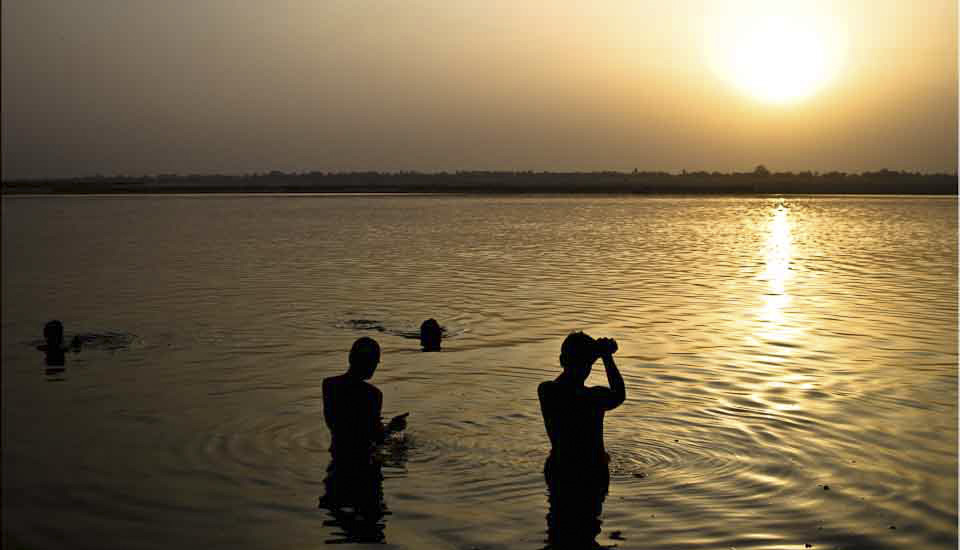
… who come to bathe in the fast running waters of the river. The chain-link fence keeps people from being swept away. Shiva Watching
A 30.5 m (100 ft) statue of Lord Shiva watches over the worshipers on Har ki Pauri ghats. Crossing a Bridge over the Ganges
The flood of humanity continues across the river … Shiva on the Ganges
… under Shiva’s watch. Haridwar is a holy town, as its name illustrates: Hari (meaning God) and Dwar (Gate). Such a crush of humanity!
And, for the most part, a happy and positive crowd. There was an episode the following day where five people were killed in a stampede; while that is – of course – tragic, given the millions of people present, the odds were still good.
 Better than the odds that we seem to be confronting at the moment as we face down an invisible viral foe in social isolation. Better than the odds that we seem to be confronting at the moment as we face down an invisible viral foe in social isolation.
I wish you well however you are riding out the next months.
Namaste!
Photos: 13April2010
Posted in environmental portraits,India,Religious Practice,Travel BlogTags: environmental portrait,environmental portraits,Haridwar,hindu,hinduism,India,Kumbh Mela,Photo Blog,portrait,portraits,Religious Practice,travel,Travel Blog,UNESCO,Ursula Wall
« Older posts
Newer posts »
|








[…] that was the exhortation of every second person I met, once they heard I was from Australia (see: Desert Rains and the Seven Pillars). Who knew we actually sell camels to the Middle East? I knew there were feral camels – at […]