Sunrise on Kata Tjuta It is just after six in the morning: the sun creeps over the horizon behind me and lights up the desert oaks on the flat plains and the boulders that make up Kata Tjuta.
It’s an incredible landscape.
Red, flat, and empty as far as the eye can see, except for two remarkable – and remarkably different – ancient rock formations: Uluru, the 348 m (1,142 ft) high sandstone monolith, and Kata Tjuta, the 36 domes of conglomerated sand, pebbles, and cobbles. This is a living, culturally-rich topography, home to countless ancient stories belonging to the IndigenousAnangu people. The “spectacular geological formations”, and their place in the belief system of the traditional owners, was formally recognised by UNESCO in 1987.
A visit to Australia’s Red Centre was always on my grey nomad bucket list; then Covid-19 happened and international travel was off the table. Even interstate travel within Australia was severely curtailed, but I managed to find a small window of opportunity and a package deal to the Ayers Rock Resort.
I was determined to fit as much exploration as I could into the short time I had in the area, so I booked myself into a range of activities (see: A Camel Ride into the Red Centre and The Field of Light). On my second morning, I got up pre-dawn to join the SEIT Kata Tjuta tour, which includes a sunrise-stop at a special viewing area inside the Uluru-Kata Tjuta National Park, and a short walk into Walpa Gorge at Kata Tjuta.
Kata Tjuta means ‘many heads’ in Pitjantjatjara, one of the two major Indigenous languages in the region. The formation is also known as the Olgas: the highest dome was named Mount Olga, by Anglo-Australian explorer Ernest Giles, in honour of Queen Olga of Württemberg (born Grand Duchess Olga of Russia, daughter of Tsar Nicholas I) in 1872. In 1993, a dual-naming policy was adopted, leading to the current official name: “Kata Tjuṯa / Mount Olga”
Join me for a walk into an ancient world:
Sun below the Horizon At the viewing platform just inside the Uluru-Kata Tjuta National Park, it is cold and dark. The sky is just starting to lighten behind Uluru to the east of us.
Dawn at Kata Tjuta This is the desert: the chilly pre-dawn light stretches to the boulders on the horizon to the west of us.
Day-Break on Uluru There is something about that rock that resonates in my soul, …
Sunrise on Kata Tjuta … even though I find Kata Tjuta more visually interesting.
Sunrise at Uluru Finally! The sun slips over the horizon, and very quickly the whole landscape is light.
Rest Area – Western Side of Kata Tjuta From the sunrise viewing platform, we drive a short distance to our breakfast spot.
Sun Flares on Kata Tjuta There is enough time to play with the morning light while the kettle boils.
Sun through the Trees
Entry to the Walpa Gorge After breakfast, we drive a short distance to the entry for the walk. That same sun angles straight into our eyes as we make our way over the gleaming 600 million year-old conglomerate rock.
Boulders and Scrub Desert-loving plants cling to patches of poor soil along the path.
Waterhole There had been a rare rainfall a few days before I arrived: a few standing pools of water were home to small tadpoles and fast-growing frogs.
Walpa Gorge The gorge is named for the wind (Walpa) that whistles between the massive domes, which are polished smooth by the eons. This is a sacred site, and we were given instructions about where we can and cannot photograph.
Stone Stairs The sheen and colour of the rock is amazing – and is due to the feldspar and iron oxide in the conglomerate of granite and basalt.
Inland Thornbill and Grey-Headed Honeyeater The park is home to 178 species of birds; I saw only these two.
Pink Mulla Mulla All the plants here are well-adapted to the arid conditions.
Nature’s Artworks: Standing Water
Dead Gum Outside the gorge, it is hot and still. A leafless gum provides no shade.
Nature’s Abstracts: Gum Tree
Last Look Even from the bus as we are returning to the resort, the shapes and colours are incredible!
Walking through 600 million-year-old rocks, at least 30,000 years of living history, and the left-over waters from the last week’s rains, was truly magical!
Pilgrims in the Street Three months into the last Haridwar Kumbh Mela, crowds of pilgrims were still pouring into the city – pausing briefly to gaze directly into my camera.
The crush of humanity heading to and from the Ganges through the streets of Haridwar seems unimaginable now.
Haridwar, in Uttarakhand in North India, flanks the holy River Ganges as it flows south and east out of the Western Himalaya. The city has a population of just over 310,000 (2011), but when I was there (with photographers Gavin Gough and Matt Brandon) in 2010, an additional 10 million people were streaming through the streets to take a ritual bath in the river: for Haridwar is a sacred city and is one of the four sites of the Kumbh Mela.
The Kumbh Mela, literally the Festival of the Sacred Pitcher, happens roughly every four years on rotation across Haridwar, Prayag (Allahabad), Trimbak (Nashik), and Ujjain. It is a major pilgrimage festival in Hinduism (e.g.: Sadhus, Smoke and Street Food) that includes rituals, religious discussions, devotional singing, and traditional ceremonies. One of the most important rituals is bathing in the holy river waters.
I’ve said it before: returning to old photos is always risky. As I look at the settings on some of these – taken on a camera I no longer own – I can’t help but wonder: “What was I thinking?” But, for all their flaws, they represent a time and place, and remind me how much I miss the wonderfully photogenic people of India.
Of course, unlike in some parts of the world, wandering around with a camera in India can make you a bit of a Pied Piper: at one stage I had people literally lining up to have their pictures taken. For many of these pilgrims, this would have been their only trip to a Mela, and they all wanted this event recorded – even if that record was by me, a stranger whom they would never see again! Thank heavens for digital images.
Join me for some more portraits from the crowded streets of Haridwar:
Sadhus and their Chai Although the pilgrims in the Haridwar streets were from all walks of life, the sadhus – the Hindu holy men – were the most common and the most colourful.
Sadhu in White I was drawn to their kind faces …
Sadhu Necklace … and fascinated by the variety of iconography they wore or carried.
Women India is street-portrait heaven! People are so generous with their smiles.
Sadhu in Red and Orange The colour and style of a sadhu’s robes and the design of his tilaka (forehead markings) tell the initiated something about the sect he belongs to. I never cracked the code!
Sadhu in Yellow and Orange Most of the pilgrims had their kumbhs – Sanskrit for a pitcher or pot – with them. This was to carry water from the Ganges back home again.
Woman into Haridwar How I wished I could converse more easily with these pilgrims; …
Old Woman and her Company … their faces were full of stories!
Women Carrying Loads Many had travelled great distances, with their luggage on their heads, …
Water Carrier … and containers for the holy waters.
Pilgrim in White
Masala Chai
Blind Singers Having seen Slumdog Millionaire, wherein street children are blinded to make them more effective beggars, I couldn’t help but worry about how these performers had come by their sightlessness.
Woman in Yellow There is a contrast between the elegantly monochrome …
Colourful Sadhu … and the flamboyantly colourful …
Couple in Yellow … as the pilgrims keep coming.
Cows And, of course, it wouldn’t be India without cows wandering through the rubbish in the streets.
A Woman and her Man
Man in Yellow and Grey A stern-looking husband was happy enough to share a chai and a chat.
Woman in Orange His smiling wife opted for a soft drink.
Friends Many people tried to tell me how far they had travelled, but my knowledge of Indian towns and cities was not up to understanding the distances; I could only say “wow!” and try to look impressed.
Hennaed Hands Henna is associated with positive spirits and good luck, and many of the women walking into town were beautifully decorated.
White Dreadlocks The pilgrims kept coming …
Man in a Doorway … and the locals kept watch.
Textured Walls
Today, after almost a year of Social Distancing here in Australia – and across much of the world – the idea of having roughly 10 million people walking through one’s city is almost inconceivable.
This year’s Kumbh Mela is in Haridwar again, and again began on 14th January. I can’t help but wonder how different it must be,
Ursula – Love the site and your posts. Having been fortunate to have visited many of the places you have visited, seeing the images and reading your take on the places brings back fabulous memories for me. Thank you.ReplyCancel
Hi Kent – I’m so pleased to have your visit, and very glad I can remind you of those days when we could actually travel to wonderful places! 😀ReplyCancel
I have visited the zoo twice; the first time was back in the days of film, and when I was not yet used to the tropics. Aside from the fact that I was introduced to a python instead of an orangutan at the Jungle Breakfast with Wildlife, I don’t remember much about it. For my second visit, years later, I made sure the orangutans would be in attendance before I booked our breakfast tickets (see: Hands, Teeth, and Almost Abstract).
The complex attracts about 1.9 million visitors annually, and is one of the few zoos in the world to be able to boast it is ‘cage-free’. Many of the naturalistic exhibits are surrounded by moats that are disguised with vegetation or are dropped below the line of sight. Areas that house dangerous animals, or that enclose water or require temperature control, feature glass walls. I loved these for the unique way they refracted the light and created reflections, adding an artistic dimension to viewing the animals.
There are currently about 300 species of animals across 28 hectares of lush rainforest. This is possible without a feeling of crowding because of the layering, with lemurs wandering freely, and orangutans and gibbons swinging high above the ground while the visitors watch from below. This concept is epitomised in the Fragile Forest, a 20,000 cubic metre bio-dome that mimics a tropical rainforest teeming with life at every level. Following the walkways, you can get close to denizens of the tropical forest floor, the rainforest under-storey, and up into the canopy.
As I walked around the zoo with the dual goals of enjoying the animals in their pseudo-natural environments and of making pictures that I thought interesting or artistic, I couldn’t help but marvel at how uniquely different each species – and indeed, each individual – is.
Join me for a walk in the (almost) wild.
White Tiger All white tigers in captivity are the descendants of Mohan, a wild-caught Bengal tiger from Rewa, India. The white stripes and blue eyes are product of a recessive gene which only occurs in the wild about once in 10,000 births. None have been seen in the wild for some years, and it is thought that the white colour makes them more visible – and therefore less effective hunters.
Splash! Watching the power of this animal as he leaps for the incoming food is just breath-taking.
Omar You can see the deadly canines in the powerful jaw. At 16, Omar was already old for a tiger, and he died 16 months after this was taken.
Keeper Kishen As much as possible, we followed the keepers and animal talks.
Bird in the Garden An open zoo attracts all kinds of visitors. This little bird is small – but that beak is serious!
Great White Pelican By contrast, the great white pelican is a huge bird – second largest in the pelican family – …
Pelican Bill … and that unique bill is a real fish-trap.
African Penguins The penguins are a delight to watch. As they waddle out single file on opposite feet, I’m reminded of my daughter’s tap dance classes.
Front and Back No wonder they came up with the idea for the movie Happy Feet!
Penguin Split The reflections in the water and glass add texture to the rock and feathers.
The Claws of an Asian Sun Bear (Helarctos Malayanus) Being primarily nocturnal creatures, sun bears look sweet and somnolent – but locals say they are the most dangerous animals in their forests, and that even tigers keep their distance. Looking at their sharp, sickle-shaped claws – which are more than ten centimetres (four inches) long – it is easy to see why.
Tree Tops Whenever we move from one area of the zoo to another, we need only look up to see more magnificent apes. That baby must have quite the grip to be able to hang on to mum’s chest as they swing through the trees!
White Rhino Hide The second largest land mammal in the world (after the elephant), the rhino has a reputation for having a tough skin. While the skin can be up to 5 centimetres (2 inches) thick, it is surprisingly sensitive, being susceptible to sunburn and insect bites.
Southern White Rhinoceros – Ceratotherium Simum Simum This is one reason they love mud baths: in addition to cooling them in their native southern-African savannah habitat, dried mud acts as a sunscreen and insect repellent.
Ears and Whiskers African red river hogs (Potamochoerus porcus), or bush pigs, have striking orange-brown fur and prominent facial whiskers.
Siblings
Spots Animal patterns are functional – often as part of their camouflage. Cheetahs’ spots cover almost their entire body, and like the ring pattern on their tails, are as unique as fingerprints. The distinctive black tear stripes under their eyes act like the sights on a rifle and reflect the sun: both helpful when running at full speed during daytime hunting.
Giraffes in Dappled Shade “… and what with the slippery-slidy shadows of the trees falling on them, the Giraffe grew blotchy, and the Zebra grew stripy …” – Rudyard Kipling, Just-So Stories
Stripes After years of research, scientists have established that zebra stripes protect the animals from biting flies. They probably also help in thermoregulation and camouflage.
Red Leaves and Light
Naked Mole Rats – Heterocephalus Glaber It always amazes me how the incredibly diverse the animal kingdom really is! I’m pretty sure I’ve never seen these small, hairless, long-lived, cancer-resistant, burrowing rodents before.
Malayan Flying Fox At the other end of the environmental-habitat spectrum, high in the tops of the Fragile Forest, we find greater flying foxes feeding on watermelon and carrot.
Malayan Flying Fox These large frugivorous bats have a fox-like faces and long sharp claws.
Butterflies on Watermelon Sometimes the butterflies beat the bats to the fruit.
Ring-Tailed Lemurs Many of the lemurs have free-range of the zoo, but being very social creatures, they are mostly seen in clumps.
Big Eyes Endemic to the island of Madagascar, ring-tailed lemurs are said to have a cat-like appearance, but with those eye-rings, they remind me more of racoons.
Furry Fingers Lemur fingers are slender and padded on the underside, with a leathery texture to help with climbing.
Almost Abstract: Crocodile Scales and Bamboo Reflections Saltwater crocodiles are the largest known living reptile. Looking at this one – almost invisible under the water – it is easy to see how they can ambush their prey.
As much as I’d prefer to see these animals in the wild, it is wonderful to have the opportunity to wander around this much-awarded zoo where such a wide range of creatures is available to us.
Basílica y Convento de San Francisco The Historic Centre of Lima has a view and a story around every corner and through every window. The iconic and much-photographed cloister windows at the San Francisco Monastery are an example.
The only travel I can do at the moment is vicariously: with our government giving us no clue as to when borders might open again, it is impossible to plan and it is hard to even dream …
I am trying to use this down-time productively: cleaning out boxes and drawers and cupboards. But, I’m not very successful; I keep finding things that send me down rabbit warrens of memories.
The other day, I came across trip notes and maps from a long-ago trip to South America. Well, to be more accurate, from Argentina (see: Perito Moreno and El Chaltén) and Peru. South America is a big place! Naturally, the trip notes beckoned me into a hunt for some almost-forgotten photos: taken in rough JPEG formats on non-SLR cameras, and stored on an old computer that takes thirty minutes to fire up and shut down again.
My husband and I had three short stays in Lima: before and after walking the Inca Trail, and again after a trip to the head of the Amazon (more on those travels some other day), and were based each time at a charming hotel in the beautiful coastal suburb of Miraflorés.
Being 12 degrees off the equator, Lima is in a tropical, but dry, climate zone, getting almost no rain. It is also surprisingly cool, benefiting from something called the Humboldt Current – cold, low salinity waters that flow north from Antarctica towards the equator. This gives Lima in general, and Miraflores in particular, almost constant misty fog from the Pacific Ocean, resulting in enough humidity to keep the skies grey and the gardens green.
On our first visit we enjoyed a city tour. The influence of the previous Spanish colonial masters is still much evident in the Moorish architecture, particularly in the city centre, or Plaza de Armas, which is a UNESCO-listed heritage site. Originally known to the Spaniards as the “Ciudad de los Reyes” (City of Kings), it has a strongly Catholic heritage, and many of the important buildings in the old centre are churches or monasteries. I was particularly startled by the Catacombs under the San Francisco Monastery where the bones of some 25,000 humans have been kept in brick wells since the 1700’s. In the nearby Santo Domingo Church, the heads of three Saints are preserved and on display in cases!
Our second visit was spent comfortably settled in the delightful courtyard of our hotel, sorting out photos and catching up with work.
We spent a day on the water on our third stay – visiting the islands off Puerto del Callao. The birdlife in the area was amazing: Peruvian boobies dive-bombing the water, massive pelicans cruising just above it, and turkey vultures perched atop islands waiting for dinner. At the Islas Palominas, I actually braved the freezing waters of the Peruvian Sea to swim with the sea lions. Even in a wetsuit, those waters from Antarctica are bracing! But what I remember most is the smell: there is nothing like an island that is home to guano-producing birds and fish-eating sea lions for producing stench! Even our English word “guano” comes to us via Spanish (huano) from the local indigenous Quechua language word huanu, meaning ‘dung’.
Still – it’s worth it! Do join me.
Ancient Olive Press On the short drive from the airport, we get glimpses of the rich history and heritage in the City of Kings.
Local Guide Our vivacious guide took real joy in explaining all the sights as we passed them.
Plaza De Armas De Lima The Spanish conquistador Francisco Pizarro established the city of Lima – and the 140-square-meter (1,500-square-foot) Plaza Mayor or Plaza de Armas – in 1535. Although the buildings surrounding the plaza don’t date back quite that far, they are a beautiful collaboration between “Old World” architectural styles and local craftsmanship.
History Lessons This area was an agricultural region known as Limaq to the native Peruvians. Limaq, meaning “talker” or “speaker” in the coastal Quechua language, was a famous oracle in the Rímac Valley. The Spaniards called it theCity of Kings, but this name fell into disuse. “Lima” is probably from a mispronunciation of the original name .
Fountain The fountain at the centre of the plaza dates to 1651, built under the government of Viceroy García Sarmiento de Sotomayor.
Police in the Plaza De Armas Lima has an unfortunate reputation for high rates of muggings and theft. The police presence was high.
Palacio Municipal de Lima Although this building only dates to 1939, it is modelled on the earlier civil colonial buildings with their exquisite Moorish-style window treatments.
The Nave Built between 1535 and 1649, and most recently restored in 1940, the Basilica Cathedral of Lima is ornately carved and richly gilded.
Capilla de Nuestra Señora de la Evangelizacion More simply called Lima Cathedral, the Roman Catholic cathedral features a Chapel of Our Lady.
Basilica of San Francisco The Spanish-baroque styled Saint Francis Monastery was built between 1673 and 1674.
Service from the Choir Loft Although some of the original buildings have been given over to secular uses, the temple is still a place of worship.
Cloister Windows The second-story windows around the main cloister in the San Francisco Monastery are beautiful …
Courtyard … and overlook a formal courtyard with a central fountain.
Ossuary Underground at the monastery, crypts built of bricks and mortar contain decoratively arranged human remains. Used as a burial-place until 1808, the mass graves – estimated to contain 25,000 bodies – were only rediscovered in in 1943. It is an eerie sight – somewhat spoiled by the bits of litter that have found their way onto the bone piles. I have read that photos are not allowed in the catacombs; when we visited, we were told no flash.
Different City – Different Taxi Colour It is a relief to climb out of the dusty catacombs, and back into the colourful city. I love the small differences that make cities distinctive: local taxis are one of those things that always stand out for me.
Fruit Cart – Lima
El Parque del Amor
Our hotel in Miraflores was a short walk from Love Park. This park, which is said to be inspired by the work of Spanish architect, Antoní Gaudí, opened on Valentine’s Day in 1993. The ceramic mosaics weaving along the boundaries are embedded with quotes about love from Peruvian writers.
Faro de la Marina The nearby waterfront parklands feature the still active, much-visited, La Marina Lighthouse.
Intihuatana – The Hitching Post A 2002 sculpture by Fernando de Szyszlo pays homage to indigenous Quechua sun worship. An Intihuatana is a ritual stone associated with Incan astronomic clocks or calendars. As the sculptor explained, a hitching post to catch the sun is needed to counteract Lima’s overcast skies.
Cactus and Colours Miraflores streets are colourful with adobe-style buildings and greenery.
Lighthouse Clock Tower A rare glimpse of blue sky boded well for our trip onto the cold waters off the coast of Callao.
Capitanía Guardacosta Maritima Del Callao Callao was founded by the Spanish in 1537, and is still one of Latin America’s largest commercial ports. The Coast Guard (housed in what was once the Harbour Master headquarters) oversees maritime traffic.
Islas Palomino Our trip to the Palomino Islands is a short ride into the Humbolt Current, past small fishing boats, past the large Isla San Lorenzo and several smaller islands, and past flights of fishing birds. It is hard to pinpoint which hits you first: the smell or the noise! Countless screeching birds compete against the sound of the waves crashing, and the bellowing barks of as many as eight-thousand sea lions.
Swimming with the Sea Lions Our guide and I were the only ones to brave the freezing waters. Truthfully, I was a bit nervous: even a female South American sea lion can grow to 2 m (7 ft) and around 150 kg (330 lb). Their fishy breath alone is enough to knock you over! The males (who didn’t come out to meet us) are twice that size.
Peruvian Folk Dance Vibrance and bold tones colour local folk dance. This one goes back to Black traditions: the Conquistadores brought many African slaves with them.
Peruvian Folk Dance In spite of colonialism, the Inca heritage runs deep through Peruvian culture, and comes to life in the distinctive woven and embroidered fabrics.
Night Lights on Cathedral of Lima
One of the many high-points of our visit was the food: every meal we had was a winner. The locally-grown olives were wonderful, and even though I’m not a fish lover, the ceviche – raw fish marinated in piquant spices and lime – was a taste treat. My favourite, though, were the ‘world famous’ pisco sours, made from pisco (locally produced grape brandy), lime juice, egg white and bitters.
Mindima Firemaking Group The tribes of the Papuan New Guinea Highlands are a diverse lot – with numerous different languages and cultural expressions.
Papua New Guinea is a remote and rugged country that was untouched by foreign influences for a very long time. Its jungle-clad mountains and wild river valleys are home to one of the most culturally and linguistically diverse populations in the world. For a long time, outsiders thought the Highlands region was unpopulated, and international missionaries, mining interests, and anthropologists made almost no inroads into the interior until well into the 20th century.
Almost 40% of Papua New Guinea’s 7 million people (July 2020 est.) live below the poverty line. Although agriculture still provides a subsistence livelihood for 75% of the population, it is considered to be one of the poorest countries in the Asia Pacific region. Nearly two-thirds of the county’s export earnings come from mineral deposits developed since the 1970s, but the resultant economic boom has not trickled down into local communities.
So, the growing tourism and hospitality sector provides some hope for distinctive tribal communities who want to preserve their cultural heritage into the future while gaining access to economic boons.
Sing sings, gatherings of neighbouring Papua New Guinean tribes or villages to share their distinct culture, dance, and music, have long been a feature in the country, and have resulted in a welcome mitigation of traditional inter-tribal warfare. In recent years, these festivals have been more actively marketed to tourists, contributing to local income and an ongoing pride in culture and heritage.
But, this is not without its own difficulties: some of the more distinctive and popular groups are, in effect, fighting a “trademark” battle over their own traditional costumes. The image of the Asaro mudmen from the Eastern Highlands Province, for example, has often been used in advertising and popular culture without the consent of the originating community. And, much to the dismay of Asaro families, in the neighbouring Simbu (Chimbu) Province, mudmen designed there have been incorporated into local tourist demonstrations (see: The Asaro Mudmen: Local Property, Public Culture?). The Chimbu, or Simbu, are credited with originating the zombie-like skeleton men (see: Skeleton Men) – but these unique creations have also migrated outside the region of their origins, and taken on new forms.
For the outsider, it is a minefield! Some tourism operators do warn that, with the lure of money, some groups might perform ceremonies “not traditional to their tribal group or … [not] at the traditional time of year.” But, even with responsible operators, visitors can get caught up in local disputes. I have personally been contacted by someone who said the mudmen whose photos I shared previously (see: Asaro Mudmen), were not entitled to the representation; I referred him back to my local contact, as I’m in no position to judge!
In spite of the Highlands being a field-study goldmine for burgeoning anthropologists all through the 20th century (including for one of my favourite tutors back at university), I have found getting any in-depth information on-line about individual tribes difficult. (I found one lengthy and not particularly helpful monograph written by a Lutheran minister who lived and worked in Simbu Province for 40-odd years – but little else.) Even when I have looked up the sing sing group names as written on the cardboard signboards, I have found little or no information. Plenty of poorly-captioned pictures exist, and tourist-operator blurbs saying: “Little is known about …”, referring to this tribe or that. Different variations of custom-origin stories get cut-and-pasted from one site to the next, but with the dearth of substantial information, it is no surprise that cultural appropriation takes place in a land where open tribal warfare still exists.
So, although I was at the Mount Hagen Cultural Show, one of Papua New Guinea’s most popular cultural events, with photographerKarl Grobl from Jim Cline Photo Tours, and with the guidance of a well-credentialed local operator, I can’t speak to the bonafides of the tribal people I met and photographed. Nor can I tell you much about the “why” of most of their particular customs and festival attire.
I can, however, share a wonderful glimpse into a unique tribal world of fiercely guarded, proud traditions.
Join me!
Skeleton in the Smoke Outside the Kagamuga Showgrounds, Chimbu people from Simbu Province get ready for their parts as skeletons and fire-makers.
Simbu/Chimbu Woman It is not uncommon for women to have small facial tattoos, and to wear their net bilum bags on their heads; …
Simbu Woman … it is also not uncommon to see warm smiles, stained by the ubiquitous betel nut.
Painting the Skeleton I have shared a story of the origins of skeleton-men and pictures of their preparation before (see: Bugamo Skeleton Men).
Man Painting a Young Skeleton Body-painting for the sing sing takes a lot of time and patience.
Skeleton Skull I loved watching the quiet stoicism displayed by the youngsters …
Eyes of the Skeleton … as they submitted to the long task of sing sing preparation.
Painting Skeleton Hands
Skeleton Boy Everyone is at a different stage of readiness.
Skeleton Preparations I saw no female skeletons – and I don’t believe they exist – but I did see women assisting with the painting.
Mindima Firemakers This man, from the same group, tried to explain to me the relationship between the skeletons and the fire-makers, but my tok pisin was not up to understanding his story. I did get the part where he explained how careful one had to be with the fire-pot-headdress, so as not to burn oneself!
Mindima Firemaker The evidence of a lifetime of betel-nut chewing is everywhere; …
Betel-Nut Sellers … betel nuts, seeds of the areca palm, are also everywhere. This man was hoping I’d have a cigarette for him! Tobacco is as popular as betel chew.
Police Special Services Division As the competing tribes get ready for the festival, the police presence is conspicuous and well armed – but friendly.
Crafting a Mud Mask In another quadrant of the paddock, a man fashions a ferocious mud mask.
Mud Mask Although there are various explanations for the origins of these frightening – but hot and cumbersome – headdresses, the most convincing one relates to the pre-colonial custom of disguising oneself when conducting raids against neighbouring tribes to prevent being recognised and thus making retaliation impossible.
Little Mudmen Today, small versions are made to be sold as souvenirs.
Model Masks Like the real masks – which are often embedded with boars’ teeth – the grotesque models show a lot of variety.
Final Preparations Once their bodies are coated in mud and their masks are on, the men are ready to head to the parade ground – …
Asaro Mud Men … – pausing briefly to have their pictures taken.
Omo Masalai from Simbu Looking like something from The Walking Dead, and followed by some sort of fur-covered demon, members of one group march toward the fair grounds.
Omo Masala Skeletons Skeletons follow closely behind.
Mindima Firemaking In contrast with the skeletons, the firemakers feature stripes instead of bones, making me think of men in old-fashioned prison garb.
Nursing the Flames The next day I went back to the same area to see if I could get a better explanation of the Mindima firemaking.
Concentration I found no one to speak with: these people are among the 120,000 native-Kuman speakers, and may or may not have Tok Pisin as a second language. English is well down the list!
Mindima Child Making Fire So, I cannot tell you why these people transport fire on their heads.
Skeletons in the Grass Meanwhile, another group of skeleton men are ready to take their place on the parade grounds, …
Skeletons on the Warpath … where, rather than being zombie-like, …
Skeletons on the Attack … they leap around in a menacing manner.
It is easy to see how these warring tribes were able to intimidate each other in the past.
At least today it is mostly in good humour and for show.
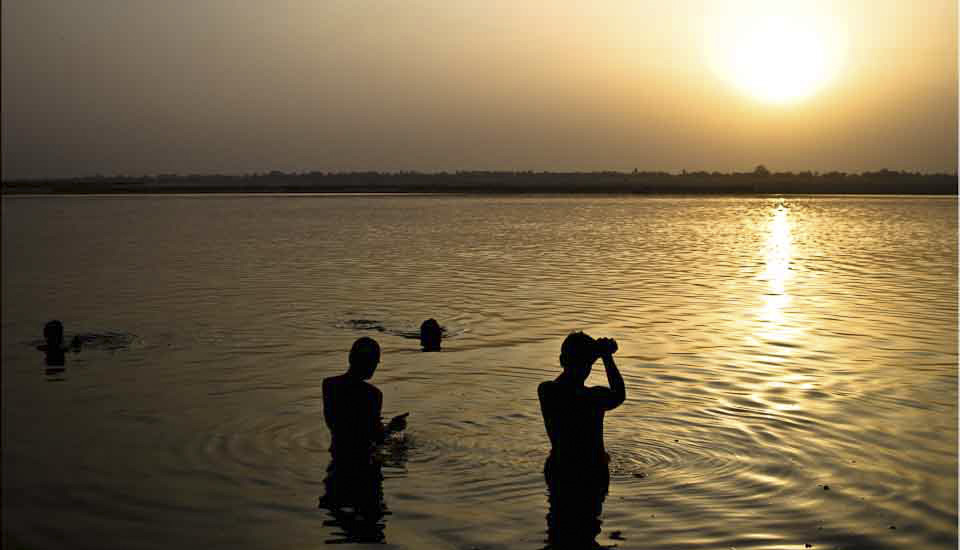
- Performing the Ganga Aarti from Dasaswamedh Ghat, Varanasi
- Buddha Head from Shwedagon Pagoda, Myanmar
- Harry Clarke Window from Dingle, Ireland
- Novice Monk Shwe Yan Pyay Monastery, Myanmar
Packets of 10 for $AU50.
Or - pick any photo from my Flickr or Wanders blog photos.

.jpg)
.jpg)
.jpg)




 This year’s Kumbh Mela is in Haridwar again, and again began on 14th January. I can’t help but wonder how different it must be,









It’s been so long since I’ve visited this region, I really should make plans to go back.
Hi Kevin,
Always good to see you on line. 😀 Great place, isn’t it?
Thanks for the information, will definitely be using it for our upcoming trip.
Hi Fran,
Thanks so much for your visit to my website! You’ll love Uluru – just magic.