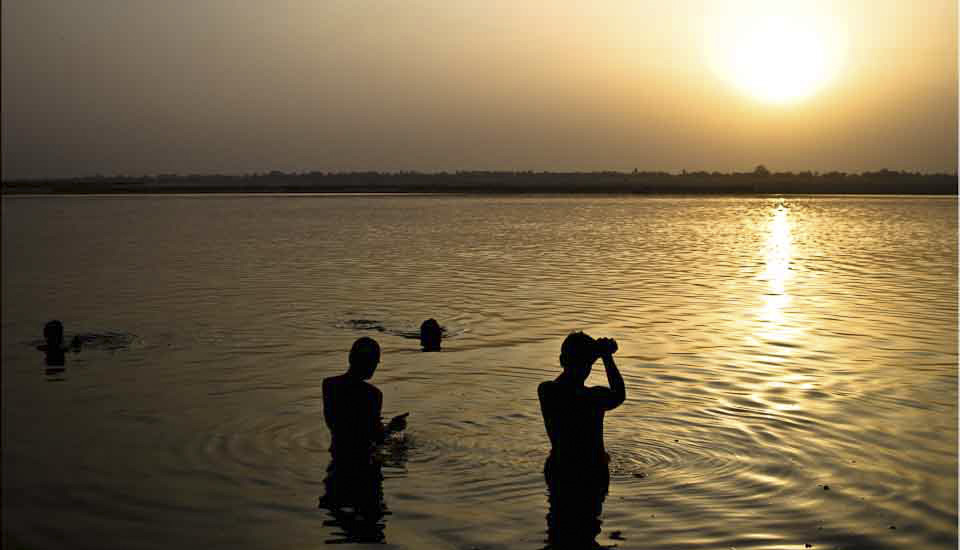
Ritual Flames Varanasi is an ancient and sacred city imbued with religious symbolism. At the holy Dasaswamedh Ghat, young priests perform the Gangaaarti every evening at sunset.
(Click for: Ganga Aarti : Sacred Hindu Chants)
It is said that Lord Shiva, one of the Trimurti, the Hindu trinity, created the city of Kashi (Varanasi) with his hands. That is why Varanasi, one of India’s seven holy cities, is said to be the country’s spiritual capital.
The holiest parts of this sacred city are along the ghats – the stairs – leading down to Ganges, the river known in India as the goddess GangaMa or “Mother Ganges.”
I was captivated: the dry heat was uplifting, the air was electric, and the people were both fascinating and welcoming (see: Life on the Ghats).
For devout Hindus,Varanasi is a centre devoted to the cycle of life and death.
Reincarnation is a key belief within Hinduism. All life goes through birth, life, death, and rebirth, in the cycle of samsara; when a living being dies, its atman (inner self or soul) will be reborn or reincarnated into a different entity, depending on its karma from its previous life. However, if one is lucky enough to die in Varanasi and to be cremated on one of the two designated ghats: Manikarnika Ghat or Maharaja Harishchandra Ghat, one achieves moksha—liberation from reincarnation and direct entry to nirvana.
Even if you don’t die in Varanasi, if you have bathed in the Ganges there – especially on auspicious days – you will be washed of your sins, giving you a better starting point for the next life.
As the sun sets in Varanasi, the Ganga Aarti is performed at Dasaswamedh Ghat. An aarti is a devotional ritual that uses fire as an offering; a form of Ganga Aarti takes place every evening at three holy cities on the Ganges: Haridwar, Rishikesh, and Varanasi. The one in Varanasi takes about 45 minutes, and is a colourful, highly choreographed, and beautiful ritual of worship dedicated to River Ganga, Surya – the setting sun, Agni – the fire and Lord Shiva.
It was the high point of my first day along the Varanasighats, and an experience that has stayed with me since.
Wood and Scales The funeral pyres on Harishchandra Ghat are a smoky reminder of life’s limits. A traditional Hindu funeral pyre needs six hours and 500–600 kilograms (1,102–1,323 pounds) of wood to burn a body completely – and clearly the keepers of the sacred fires measure this out carefully.
Woodpile and a Nanny A goat with her full udder is like a symbol of new life as she walks past the funeral wood. I watched a few families as they sent one of their relatives off. We were asked not to photograph the actual pyres – and respected that request – but a Dom community member (the sect of hereditary undertakers) was happy to explain the rituals surrounding the cremations as they happened.
Holy Person in a Yellow Turban On a balcony in the building next door, …
Religious Contemplation … a holy person sits in in quiet contemplation.
Kedar Ghat A little further north, Kedareshwar Temple rises in all its colourful glory.
Ganges Waterfront The river curves off into the hazy distance …
Boats on the Ganges … with beautiful wooden boats lining the edge.
Colourful Homes – Narad Ghat Between the palaces and temples, domestic buildings rise in a colourful tumble.
Man in a Checked Dhoti People from all walks of life are seated on the steps below.
Water Buffaloes and a Common Crow
Sadhus in Orange The sadhus are endlessly fascinating. I quickly discovered that sharing a cup of masala chai (spiced tea) with them was a great icebreaker.
Bicycle in a Laneway
Women in a Doorway In the streets behind the ghats, …
Chai Wallah … everyday life goes on.
Blue Boats I loved the wooden boats on the foreshore of the Ganges.
Blue and Red Boat Their colours and textures were wonderful.
Elderly Man in a White Hat
White Hair and White Beard
Dashashwamedh Ghat As the sun drops lower in the sky, the last of the bathers in the waters finish up …
Mother and Daughter … and spectators of all ages find seats on the ghat where the Ganga aarti will soon be performed.
Twilight Preparations The priests of Gangotri Seva Samiti set the stage for the Ganga aarti on Dashashwamedh Ghat.
Candelabra
Religious Trinkets
Watching from the Water Many spectators opt for a seat in one of the boats in the river. I was lucky: an Indian woman who had scored an excellent position level with the priests invited me to sit with her and her family.
Big Eyes
Flower Seller
Flower Offerings The sellers have prepared offerings that can be lit and set afloat for the Mother Ganges.
Bells and Flames The Ganga Aartistarts soon after sunset and lasts for about 45 minutes. Once the young pandits have prepared all the necessary paraphernalia, they sit in meditation. Then, they start a chant of mantras while circling small flames and ringing brass bells.
Bells and Incense The fragrance of incense permeates the still-warm evening air, and the chime of bells continues.
Bells and Smoke The bells are said to create an ‘auspicious sound’ which aligns the chakras, and the incense represents a purified state of mind.
Ceremonial Brass Lamps An aarti is essentially a Vedic fire ritual, using fire as an offering to the Goddess Ganga. Once lit, the multi-tiered brass lamps are impressive.
Like Feathers Towards the end of arati yak-tail fans (chanvar) are waved to send the element of air back to its source.
Kids on the Steps The children in the audience are as transfixed as I am.
Bowing Down
Woman on the Ghats When the last notes die down, I say a heartfelt thank you to the lovely woman who, after arriving an hour early on the ghat to secure her spot, so generously shared it with me.
With the drone of the music still ringing in my ears, and the soft smell of incense clinging to my skin, I walked back to my room in a happy daze.
Varanasi gets into your soul.
It certainly captivated me, and shifted my perspective on life. And death.
[…] Ganga Aarti on Dashashwamedh Ghat attracts both pilgrims and tourists in great numbers (see: Life and Death on the Varanasi Ghats), the devotional rituals along the river start before […]ReplyCancel
Uluru under the Strut Glowing red in the afternoon light, that magic sandstone monolith at the heart of Australia rises up 348 m (1142 ft) out of the surrounding plains – and extends even further underground.
In these days of rolling lockdowns and seriously curtailed travel, flying feels like a thing of the past.
But, last year in October, I managed to get on not one, but two different airplanes in the space of a few days.
Like most travellers with international itineraries, I was flattened in 2020 when Covid-19 pulled the rug out from under all my plans, and left me – and everyone else in Australia – self-distancing at home. Now, eighteen months later, international borders are still effectively closed and interstate travel within the country is severely restricted.
But, there have been small windows of opportunity, and I managed to squeeze a package deal to the Ayers Rock Resort in the red heart of Australia into one of these openings (see: Weekly Wanders Yulara).
It’s a three-hour and twenty-minute flight from Sydney to Ayers Rock/Connellan Airport in Yulara, Northern Territory: it is easy to forget how big Australia actually is! It felt strange walking around the unusually quiet Kingsford Smith Airport, mindfully keeping my mask on and skirting around others at a respectful ‘social’ distance. Of course, once on the airplane, we were packed in like sardines, as per normal on a low-cost airline! Deplaning took forever, as everyone had to ‘prove’, via bank statements, etc, that they hadn’t been in any declared areas of concern.
This part of the Red Centre – the vast, red, sandy plain in central Australia – is formally recognised by UNESCO World Heritage for both its natural and cultural values. It has been home to the Indigenous Anangu people since Dreamtime, and features in countless ancient stories they have handed down explaining the origins and nature of the “spectacular geological formations” that are found here. For, rising out of a red landscape that is flat and empty out to the horizons in all directions, are two incredible ancient rock formations: Uluru, the 348 m (1,142 ft) high sandstone monolith, and Kata Tjuta, the 36 domes of conglomerated sand, pebbles, and cobbles.
Both these timeless and magnificent formations are contained within the Uluru-Kata Tjuta (formerly the Uluru (Ayers Rock – Mount Olga)) National Park, which is jointly managed by the Anangu people – the traditional owners – and Parks Australia.
It was just after lengthy lockdowns and the resort was quiet without the usual international visitors. The Anangu Cultural Centre was off-limits to us ‘outsiders’ to protect the small Indigenous community from possible infection. So, I booked everything else I could get my hands on. I didn’t have to think twice about taking advantage of the scenic flights available over the area! After all, it had taken me a long time to get there – it might be a long time before I was back.
On the day of my arrival, I wandered through the Field of Lights. The next day, I explored the resort, taking in a talk on bush tucker and other activities (Watch this space!), and went for a sunset camel ride. I watched the sunrise and walked into the Walpa Gorge in Kata Tjuta, and I planned to walked around the base of Uluru the day after my sunset flight. (Watch this space!)
It is amazing how different these magnificent rock formations are in every light and from every angle! Join me in the air:
Pilot Chris Chris welcomes us to the brightly decorated, Australian-manufactured, Gippsland Aeronautics G8.
Safety Briefing Before we board, Chris shows us how to operate the doors in an emergency.
Ayers Rock Scenic Flights I was originally booked on the little Cessna sitting on the Ayers Rock (Uluru) Airport tarmac.
Helicopters at the Airport It’s that time of day: all the scenic flights are out. After we clear the runway, two helicopters take off below us.
Uluru The 500+ million year-old sandstone monolith, known variously as Uluru and Ayers Rock, rises dramatically out of the vast red desert plain.
Kata Tjuta Chris wants to make the most of the last available light, so we make our way to Kata Tjuta – 25 km (16 mi) east of Uluru – first. (iPhone6)
Kata Tjuṯa Domes In Pitjantjatjara, one of the two principle Aboriginal languages in this region, Kata Tjuṯa means ‘many heads’.
Kata Tjuta and Uluru The 36 conglomerate domes that make up what is also called the Olgas were formed roughly 600 million years ago and stretch across almost 22 square kilometres (8.37 sq mi). Uluru looks small in the distance.
Kata Tjuṯa / Mount Olga I had enjoyed sunrise over these domed rock formations and walked in amongst them that very morning (see: Walpa Gorge); they look very different from the air.
Kata Tjuta under the Wing The local Aboriginal Anangu people have lived in this area for more than 22,000 years, and since 1995 Kata Tjuta is being used again for cultural ceremonies. There are many Dreamtime legends (creation stories) told here, but because this is a place of sacred ‘men’s business’, most of them are not disclosed to outsiders – particularly women.
Shadows on Kata Tjuta The light drops quickly, and the shapes of the boulders soften as we move away.
Golden Light When we turn back towards Uluru, the lowering sun sets fire to the wings of our plane, …
Uluru in Colour … and turns the red plain purple.
The Red Centre Between 500 and 400 million years ago, this whole area was covered by a sea. It is easy to imagine, as we look at the waves of arid sand and rock below.
Uluru in the Afternoon Sun All of Uluru is sacred to the local Pitjantjatjara, but some parts are more secret than others: out of respect, pilots do not overfly certain parts of the rock.
Uluru in the Last Light As we fly closer to the darkening rock, we can see the closed Aboriginal community of Mutitjulu behind it.
Like a Dream In the other direction, Kata Tjuta fades into the clouds …
Kata Tjuta from the Air … and silhouettes against the darkening sky.
Sunset OK – it’s not the best sunset shot I’ve ever made, but it’s the best ‘sunset over Kata Tjuṯa from the air’ shot I could manage!
Twilight over Yulara and Uluru
Touchdown! All too soon, it is getting dark, and we are back on the ground.
I was still floating on air when I got back to the resort in time for dinner.
I do love small planes – and these rocks are magnificent.
Goatherds at Sundown Every day, Kara boys and men bring the goats back into the Dus Village compound for the night. The older males carry their AK-47s to protect the precious herds against wild animals and marauding rival tribes.
Life in for the semi-nomadic Kara(Karo) people in Ethiopia’s Omo Valley is simple – simple, but not easy.
There is no electricity and no running water. The people live in dark, circular huts made from sticks and grass. Tradition dictates one’s place and ritual determines one’s behaviour. Every day, the women grind sorghum on large stones to make meal for the staple diet of porridge. And, every day, the boys and men look after the precious goats.
Tsetse flies, which spread African Trypanosomiasis – or ‘sleeping sickness’, are prevalent in the region. So, the Kara focus on goats and sheep, which are less vulnerable to the illness than larger livestock. They do keep a few cattle, but that meat is reserved for special occasions.
The Kara are a small group who maintain friendly, symbiotic relations with the neighbouring and loosely-related Hamar, Banna, Dassanetch, and Arbore tribes. However, they cultivate ongoing animosities with the Mursi and Nyangatom: the Nyangatom live across the Omo River, occupying territory the Kara believe is theirs, and bloody skirmishes are not uncommon.
For this reason, and for the protection of the herds, every young man must own an AK-47 before he is allowed to marry. He is expected to demonstrate his ability to protect his village, his family, and the herd that represents his wealth.
Like the other Omo Valley ethnic tribes, the Kara are happy to earn money from tourists who come to photograph their creative body- and face-paint, and to learn about their daily practices and customs. But, the three little Kara villages are hard to get to, even by Ethiopian standards. Grand Holidays Ethiopia organised and set up a mobile campsite, complete with generators and portable showers, so that our group – travelling with photographer Ben McRae on a Piper Mackay tour – could stay several days in the heart of Kara territory in comfort.
This proximity had allowed us to visit the largest Kara settlement, Dus Village, a number of times. Sadly, it was our last full day there. After a morning of portraiture (see: Tribal Portraits), I was off to make a second attempt at capturing the daily activity of bringing the goats home at sundown (see: Men and Goats and Dust).
Join me in the dust of the plateau above the beautiful Omo River:
A Gun and a Baby Goat The gentle way in which this man is carrying a baby kid belies his status as a proven warrior: his feathered clay cap tells us he has been responsible for a kill of an enemy or dangerous animal in recent times.
Kara Warrior with a Kid I don’t know why this kid is being so tenderly carried, when the rest of the herd walks.
Kara Goatherd A young lad in body paint uses a switch …
Herding Goats … to keep the precious herd moving.
Kara Goatherd in Stripes Barefoot and bare chested, the young goatherds in their body paint and wrap skirts …
Young Kara Goatherd … keep the goat herd together and compact.
Warrior with Goats and an AK-47 In spite of the prevalence of Kalashnikovs – and warriors who have demonstrated their deadliness – I never felt remotely at risk with these people.
Goatherd with a Kalashnikov
Silhouetted Goatherd As the afternoon sun drops in the sky, …
Goatherd at Sundown … the goats and the goatherd are silhouetted in the last light.
Goatherd and Goats The late afternoon sun creates interesting lighting effects.
Goats in the Dust The animals are quite large, and many have beautiful markings.
Goatherd with his Stool The men in the Omo Valley all carry their small stools carved from acacia wood; these are also used as headrests when the men are out with the flocks.
Goats on the Plateau Looking back away from the sun, the herd is bathed in afternoon light.
Goats at Sunset
Goats like Scherenschnitten As a child, I was fascinated by scherenschnitten: German scissor-cut outlines in black paper. As I lay in the dust, watching the herd silhouetted against the evening sky, I was reminded of that traditional art.
Guns and Goats The evening sun sends its last rays over the horizon.
Twilight in the Dust A stool and gun – what more could a warrior want?
Goat Herders on the Plateau The last light angles over the herd on the plateau above the village, …
Water Tower … setting a red glow behind the village water tower.
I was sad to farewell these beautiful people and to pack up my wonderful tent in the dappled jungle clearing …
But, while we were off on another adventure tomorrow, the Kara men and boys would – once again – be looking after their goats and sheep.
[…] Thought to number about 30,000 people across South Sudan and Ethiopia, the Nyangatom have a reputation for being aggressive, and conflicts between themselves and neighbouring tribes are not uncommon. The village I visited on the west bank of the Omo River was on contested lands that was reputedly taken from the Kara people in bloody battle (see: Goats and Guns at Sunset). […]ReplyCancel
Bryggen Hanseatic Wharf The colourful wooden boathouses that make up the historic harbour district of Bergen, Norway, are immediately recognisable.
It’s hard to imagine a more dramatic location for a most picturesque city!
Surrounded by steep, snowcapped mountains with glaciers tucked within them, and sliced by deep fjords and fast-running rivers, historic Bergen has long Viking roots and rich Hanseatic heritage. The iconic medieval harbour district Bryggen is immediately recognisable with its colourful collection of UNESCO-listed wooden buildings.
Norway’s second-largest city and one of North Europe’s oldest ports, the city was said to have been founded in 1070 by King Olav Kyrre on a Viking site, but a trading settlement was already established here in the 1020s or 1030s.
For a period in the early 13th century, Bergen functioned as the capital of the Norwegian kingdom, and it served as a major commercial hub for the Hanseatic League (1356 –1862) of merchants from Northern Germany. The sale of stockfish (predominantly cod) from Northern Norway made the city an important Northern Europe trading centre for centuries. The Finnegården, one of the more than 60 conserved wooden buildings on the Bryggen Hanseatic Wharf now houses the Hanseatic Museum, which recreates life at the time and explores the legacy.
For me, Bergen was the last stop of a two-week cruise around the edges of Europe, starting in Barcelona (see: In the Land of Flamenco and Gaudí). Unfortunately, my husband was called back to Australia, and had to disembark at our penultimate port of Amsterdam (see: Watercolours), leaving me to complete our itinerary in Norway on my own.
Thankfully, I already had tours in Bergen (and beyond) organised. The city was easy to navigate and enjoy – in spite of rather inclement spring weather: it sits at 60° North – less than one degree south of Anchorage, Alaska!
Join me for a rainy walk and bus trip through parts of the historic harbour, a bus ride to the vantage-point of nearby Queen Maud’s Outlook, and a funicular railway trip up Mt Fløyen, a “city mountain” in the heart of Bergen.
Bergen Harbour Vågen Bay is a busy place, and home to a wide range of private, public transport, and commercial vessels.
Bryggen Wharf As our bus turns towards the Nordnes Peninsula, we get views across the harbour to those well-preserved and reconstructed UNESCO-listed boathouses of medieval Bryggen.
Bergen Waterfront Under rainy clouds and behind the boathouses near the fishmarkets, we can see the tower of the stone Holy Cross Church – Korskirken – opened in 1150.
Hotel Havnekontoret The waterfront is lined with historic buildings, including the 1920s neo-classical stone Clarion Collection hotel.
Buekorps Museum from the Bus The Buekorps, literally “Bow Corps” or “Archery Brigade” are a Norwegian regional youth organisation founded in the 1850s. The building that now houses the museum was originally built in the 1500, but damaged by fires several times in the 1600s. The current model was built after the 1702 Bergen fire. (iPhone6)
Over the North Sea Our bus picks up a connector highway, and we tunnel trough part of the neighbouring mountain before climbing up to a lookout in Helleveien, where views extend across the North Sea …
Askøy Bridge … and over to the long suspension bridge: the Askøybrua across the Byfjorden. Our vantage point is Queen Maud’s view, named for a Norwegian Queen who loved this spot.
Kjøttbasaren Back down in the old port, we walk along tiled and cobbled streets, and through ancient painted wooden and brick buildings. To me, this one looks like a traditional gingerbread house! Built between 1874-1876, the neo-RomanesqueKjøttbasaren was originally called Bergen’s Bazaar and was used to control the marketing of food. Today, the building – which was extensively renovated in 2012 – houses restaurants and a Starbucks.
Finnegårdsgaten The beautifully renovated attached buildings opposite house a traditional restaurant, a four-star hotel, and part of the Hanseatic Museum.
Inside the Hanseatic Museum Our guide in the Hanseatic Museum points out the trading routes that the German guild of merchants dominated between the 13th and 17th centuries. In 1360 they created an overseas office here at Bryggen, …
In an Ancient Room … and built themselves a home-away-from home.
Hanging Pot The dark wooden rooms of the museum are filled with artefacts to give us an insight into how these Medieval merchants lived and worked, and the mark they left on Bergen.
The Fløibanen After lunch, the cloudy skies fulfil their promise of rain, and I make my way to the bottom of Bergen’s funicular railway.
On the Fløibanen The cable train passes tall narrow houses and tunnels under roadways as it rises steeply up the mountainside.
Bergen from the Fløibanen We get some lovely views over the city – in spite of the rain – as we climb Mt Fløien.
Bergen from Mt Fløyen Even the drizzling rain from low-lying clouds can’t diminish the view from the top.
Directional Signpost The highest point on Mt Fløyen – one of the seven peaks surrounding Bergen – is just under 400 metres (1,310 feet).
Cashmere Goathouse in the Rain A number of walking trails – each taking about an hour – wind up to the top of the mountain where you can treat yourself at the Fløistuen shop and café.
Cashmere Goat in the Goathouse The presence of a number of goats on the peak, …
Troll in the Playground … as well as an entire Troll Forest, makes Mt Fløyen family-friendly. Trolls are an iconic feature of Old Norse folklore, fairy tales, and mythology.
Like Herding Cats! A class of local kindergarten children in their hi-viz vests were on an outing in the rain at the top of the hill.
Train Down in the Rain From top to bottom, the ride on Scandinavia’s only cable railway takes about six minutes. Naturally, the views going down are just as spectacular as they were riding up!
Lille Øvregaten Back on solid – albeit wet and slippery – ground, it is easy to see how fire could tear through this city so often: the cobbled streets are winding and narrow, and packed with steep timber buildings.
Gamlehaugen We board our bus again, and take a drive around the outskirts of the city, where we catch glimpses of Gamlehaugen, the residence of the Norwegian Royal Family.
Salome Outside the harbour-front Clarion Hotel Admiral in Bergen, Salome, a sculpture by Norwegian artist Per Ung (1933-2013), dances in a fountain in the rain.
Tourists on the Wet Waterfront Our bus passes through Bryggen on the way back to the cruise boat, …
Bryggen Boathouses from the Bus … giving me one last look and the heritage-listed wharf for the day.
Although I had to disembark my lovely ship, I had another day to enjoy in this picturesque old city.
Now that I had an idea of the lay of the land, I was quite looking forward to exploring more on foot.
Sunset over Muscat With the jagged mountain backdrop, that giant incense burner high on a hill, and the outline of a medieval Portuguese watchtower overlooking the water, you could be nowhere else but the capital of the Sultanate of Oman.
When I’m travelling, I love to get out onto the water – or better yet, into the air – to get a different perspective on a new landscape or cityscape.
After a day of exploring Muscat at ground level (see: Sacred Spaces and Between the Past and the Future), I had the chance to take a sunset cruise on the Arabian Sea off the coast of the city in a traditional Omanidhow. When they told me that kahwa (or qahwa) – that deliciously spiced Omani coffee – and dates were included, I jumped at it!
Muscat, the Sultanate of Oman’s capital and largest city, hugs the narrow and rugged coast between the Gulf of Oman and the Al Hajar Mountains. For centuries, this strategic location – where the Gulf of Oman leads east to the Indian Ocean, and west to the Straits of Hormuz and the Persian Gulf – was almost inaccessible except by sea.
Seafaring Yemenis were probably the first settlers here over 2000 years ago, and they continued their reliance on the oceans for their livelihood and trade. The country’s current name Oman and old Sumerian name Magan both mean ‘sea-people’ in Arabic.
In the early 16th century the Portuguese conquered the town in a bid to protect their own trade routes east. They built fortifications which still stand along the coast and harbour, but were overthrown in 1650 by the Ottoman Turks. The Omanis, under Sultan Ahmad ibn Sa’id, a direct ancestor of the present Sultan, took back control of the city in 1741.
This led to a period of economic prosperity and ongoing naval prowess, but continual infighting between ruling family members, religious leaders, and tribal chiefs eroded many of these gains. British interference fuelled rifts between Muscat and rest of Oman.
Following a palace coup in 1970, his son, Sultan Qaboos bin Said, took over and ruled until his death in 2020. He modernised the state’s administration, introduced social reforms, and increased spending on health, education, and welfare.
But, old buildings remain, traditional dress and customs are common, and classic dhows still sit in the harbour. It was lovely to head out onto the gulf in one of these old boats – even if it was under motor rather than the old-fashioned sails!
Boats and Cat Island Under Sultan Qaboos bin Said,Oman was rated the most improved nation in the world in terms of development by the United Nations, and today it is categorised as a high-income economy. There is no shortage of modern boats in the Marina Bandar Rowdha.
Dhow in the Lowering Sun Men around the city are most often seen in their national dress, the dishdasha, a simple, ankle-length, collarless gown with long sleeves. Tourism is becoming one of Oman’s largest industries, and old Arabian sailing boats are adapted to play their part.
Sooty Gulls – Larus Hemprichi Gulls circle overhead …
Exiting the Breakwater … as we make our way out of the breakwater. The rocky outcrops rise dramatically from the harbour waters in front of us.
Small Person : Big Wheel The dhows must be easy to manage: the skipper hand the helm to one of our young passengers.
Cat Island Named for the appearance of the crouching animal on the back of this rock, Cat Island signals that we are out in the gulf.
Mountains behind the Harbour It’s a dramatic and arid landscape rising up behind the harbour.
Al Bustan Palace In a domed former palace, set in gardens between the Al Hajar Mountains and the Sea of Oman, an upmarket Ritz-Carlton Hotel is a short beach-walk from the small town of Al Bustan.
Majlis Oman About thirty kilometres south of Muscat, Al Bustan is also home to Oman’s state council parliament buildings.
Al Bustan We and the other tourist dhow jockey in and out of locations.
Small Sailboats on the Gulf
Dhow Rigging
Al Jalali Fort As we turn north again, we can just see the fortifications around the Old City.
Muscat Old Cemetery Also known as the Christian Cemetery or Sa’Ali Cove Military Cemetery, this hard-to-access cove is the final resting place of one British lieutenant – a casualty of the First World War. There are ten other war-era non-service persons buried here – and a number of other people from the 1800s. The reefs meant we could get no closer.
Ring of Mountains A variety of commercial, recreational, tourism, and fishing vessels are out on the afternoon waters.
Pouring the Qahwa Qahwa (or kahwa) is the Arabic word for coffee: but it isn’t just coffee! In Oman, coffee is blended with saffron, rose water, and cardamon – and sometimes with cloves and cinnamon as well. It is served with fresh dates (and possibly other treats) as a ritual ‘welcome’. I became quite addicted to it!
Into the Afternoon Sun The lowering autumn sun silhouettes the rugged coast and the harbour in front of us …
Al Jazira Fort … and turns the land and fort opposite the old city golden.
Old Muscat and Forts As we round the point, it is easy to see how these forts – Al Jalali on the left and Al Mirani on the right – built by the Portuguese in the 1580s, commanded the small harbour in front of Old Muscat.
Al Alam Palace The existing Al Alam Palace, with its colourful facade, was rebuilt in 1972 and is still used for official functions.
Al Mirani Fort The dhow continues north, giving us a closer view of one of the historic forts.
Muscat Canon Turret As we round the next point, the lowering sun silhouettes the Muscat Canon Turret and the jagged cliffs around Muscat’s main harbour. The Sultan’s two royal yacht’s, moored in As Sultan Qaboos Port, are faintly traced out in the last light.
Al Riyam Park Al Riyam Park is an oasis of green between Old Muscat and Muttrah district. This is where the peace treaty was signed with the Portuguese in 1648; today it has amenities, coffee shops, and even a small amusement park.
Riyam Memorial Built to commemorate Oman’s 20th National Day, the ornamental white watch tower at the top of the rise is designed to look like an incense burner.
As Sultan Qaboos Port We continue past the royal yachts in the darkening harbour …
Sunset … to the mountains north of the city where the sun sinks, …
6PM … leaving us to return to our harbour in the dark.
There is definitely something magic about motoring gently back to port through a warm night on the Arabian Sea.
- Performing the Ganga Aarti from Dasaswamedh Ghat, Varanasi
- Buddha Head from Shwedagon Pagoda, Myanmar
- Harry Clarke Window from Dingle, Ireland
- Novice Monk Shwe Yan Pyay Monastery, Myanmar
Packets of 10 for $AU50.
Or - pick any photo from my Flickr or Wanders blog photos.

.jpg)
.jpg)
.jpg)




 I
I 









[…] Ganga Aarti on Dashashwamedh Ghat attracts both pilgrims and tourists in great numbers (see: Life and Death on the Varanasi Ghats), the devotional rituals along the river start before […]
Excellent post with beautiful shots!
Thanks so much for your visit and lovely comment. 😊