Late-Morning Light The platform at the Haridwar Railway Station looks fresh and bright – washed in late morning light and smiling faces – when our train from Delhi rolls in.
One of the tha biggest challenges of travel is getting around once you land where you are going.
I had taken trains in India before, and while each trip resulted in ‘stories to tell’, none was what I would describe as pleasant. But, my photographic group – under the guidance of photographer Karl Grobl from Jim Cline Photo Tours – was headed to Haridwar and Amritsar and had to get there somehow. So, another train trip was on the agenda.
And, it was a surprisingly orderly, comfortable, and pleasant one!
I say ‘surprisingly’ advisedly. India is known for trains with people piled on, packed in, and hanging off the sides. Even though I had never travelled third-class, I had been squashed into compartments of questionable cleanliness with strangers and their pungent tiffin boxes and oddly-shaped bags. The WC compartments don’t bear remembering.
The last time I took the train from Delhi to Haridwar, it was in an overnight second-class carriage packed with people on the move for the Kumbh Mela celebration. We literally climbed over prone and seated bodies to get to our curtained compartment. One of my companions brought a length of chain so we could lock our bags to the legs of our bunk beds while we attempted to sleep.
The difference this time was palpable: a wallah even came through the carriages with hot tea mid morning! Mind you, we still had to run through the stations at either end to keep the porters and our bags in sight.
The railway stations – and the streets of Haridwar – were still a delightful chaos of activity and colour, but without the throngs of mela pilgrims, it was easy to wander around in comfort. Even the Ganges looked different: there were still plenty of people bathing in the icy currents rushing down from the source in the Himalaya, but nowhere near the 10 million who were in town last time I visited (see: Some of the 10 Million)!
Going back to these old pictures, I’ve bad to throw a lot away: I don’t know what I was doing! The shutter speeds are far too low and many of the photos are blurry. Still, I’m keeping more than I should because I like the content – if not the quality.
Waiting for the Train This was Haridwar Railway Station when I visited during the Kumbh Mela in 2010.
A Train is Coming When your train arrived, you needed to be ready!
In the Train Station By contrast, when we arrived at New Delhi Railway Station early one morning in 2013, it was positively quiet!
Porter The porters had a clear path – unlike on my previous trip when they had to zig-zag like football players in action.
Train on the Move It was still a busy place, though, with trains coming and going every few minutes.
Almost Abstract : Train Station I confess: I have no idea how I achieved this, or what I was aiming for, but I like it.
Sunrise on the Train When our train pulls out of the station, the early morning sun is rising into New Delhi’s hazy sky. (iPhone5)
Sunrise in the Haze (iPhone5)
Old Porter When we arrive in Haridwar, …
Young Porter … the porters grab our bags and set off.
Portrait of a Porter
Woman at the Train Station There are always interesting people around railway stations.
Street Scenes from my Rickshaw There is a real mix of transportation modes in the streets of Haridwar; I watch it all from the back of my cycle rickshaw as I travel the short distance to my hotel.
Street Food Food everywhere you look! Haridwar is one of the holiest Hindu cities in India, and all the food available in the centre is strictly vegetarian.
Testing a Conch In Hindu mythology, conch shells are sacred emblems of the God Vishnu. The sound from them is said to be symbolic of the sacred ‘Om’ , and they are are important components in the ritual observances that take place along the Ganges River near here.
Vegetable Seller I love the availability of beautiful, fresh fruit.
More Street Food
Police Woman I just love people’s willingness to be photographed by me: an outsider and a stranger.
Laughter This is what I was talking about above: a photo that is a technical failure, but that I love.
Making Chapati In another shop, a man sits making chapati.
Great Hair Between chapatis, he has time to smile for my camera.
Street Food – Baking Buns All the street vendors have their own little niche.
Bun Baker
Scooter in an Alley Streets go off in all directions.
Shiny Corridors My accommodation is a wonderful refuge from the bustle of the streets.
On the Bridge What could be more Swiss? The weekend walkers are out, enjoying a beautiful sunny day and utilising an engineering marvel in a glorious setting. The walkway between Rapperswil and Hurden is the longest wooden bridge in Switzerland (841 m / 2759 ft). The current structure was opened in April 2001; built of untreated oak, experts give it a lifespan of 50 to 70 years.
Once upon a time, a long, long time ago, my husband I were staying with friends in that enchanted, fairy-tale-land of mountains, lakes, and alpine meadows known today as Switzerland …
It really does feel that long ago! That is what happens when you have too many external drives full of photos and memories. They slip to the bottom of the pile and risk being overlooked.
And, it really was that magical. Every day that we were there, we wandered through picturesque landscapes, rimmed by magnificent mountains, full of green spaces, flowers, and fragrant coffee. On one ‘ordinary’ day, we took a little walk from our friends’ home, and across Lake Zurich.
Yes, across the lake!
We were walking a path taken by Neolithic communities, by Roman rulers, and by medieval warriors. We were in the footsteps of pilgrims on of The Way of St. James to the Cathedral of Santiago de Compostela in Galicia, Spain, and of tourists, hikers, and nature-lovers alike.
On a map, Lake Zürich and Lake Obersee look like one body of water. But, there is a narrow passage between the towns of Rapperswil-Jona and the village of Hurden. At this point, three Swiss Cantons (Zurich, Schwyz, and St. Gallen) meet, and the body of water changes name.
At times, residents of towns on either side of this narrowing have relied on ferry boats to cross. But, prehistoric timber pilings recovered in this area date back to 1523 BCE, and suggest that a bridge was in place for the Neolithic and Bronze Age occupants of the now-UNESCO World Heritage-listed stilt-house settlement nearby.
Much later, in the 2nd century CE, the Romans built a 6 metres (20 ft) wide wooden footbridge here. But, that seems to have been followed by a long gap. Then, between 1358 and 1360, the House of Habsburg-Austria opened the next generation of bridges. Used by pedestrians, cart traffic, and livestock, this elevated walkway was 1450 m long and rested on 546 oak posts. The bridge was partially destroyed by wars and the forces of nature several times. Renovated repeatedly – the last time in 1847 – it remained in use until 1878.
The current wooden footbridge was opened in April 2001. It lies just south of the Seedamm, the stone causeway and bridge built in 1878 to accommodates vehicle traffic and a rail line. The footbridge is particularly popular with birders and other nature-lovers for the opportunity to visit waterfowl breeding areas. It also provides the only means of access to the historic medieval Heilig Hüsli Chapel.
We had passed the start of the bridge – and under the Seedamm – a week prior in order to access a boat across Lake Zurich (see: Swiss Apples And National Day). What really captured my attention as we meandered across the boardwalk was the geometric lines and angles of the bridge itself, and the altered view of the lake that the walk gave us.
Swans on the Lakeshore From the shore of Obersee (“Upper Lake”), we can see the 1.5 metre-high (4 ft 11 in) bridge on some of its 233 wooden posts.
On the Bridge at Rapperswil The bridge stretched away and angles left to meet the Heilig Hüsli Chapel, and to skirt a small island that is a nature reserve and important waterfowl breeding habitat. You can see a train on the nearby Seedamm.
Diorama in the Bridge Nestled into the base of the bridge is a little tribute to those medieval predecessors who once walked here.
Green Much of this side of the lake is declared protected wetlands – no boating or swimming is allowed.
Leading Lines
Ripples in the Grasses The bridge acts like a hide, and gives us access that we would not otherwise have to the wetlands.
Eurasian Coot – Fulica Atra These are the same birds we get on our estuary at home.
Knotty Wood
Almost Abstract : Fish Swimming I love Nature’s artworks! You get such a different perspective walking close above the water, instead of along the shore.
Other End of the Bridge The canton of Schwyz comes into view as we work our way across the lake.
Boat on the Lake We might be in what the Swiss call the “Low Country”, but beautiful mountains rise up all around.
Pillars in the Water
Perennial Cornflower – Centaurea Montana Back on the shore, we are surrounded by summer wildflowers.
Wild Rosehip – Rosa Canina L. Rich in antioxidants and minerals, rosehip has been used since prehistoric times. Findings in the pile-dwelling settlements near here – built between 5000 and 500 BCE – suggest it was often made into jam.
Purple Loosestrife – Lythrum Salicaria
Grasses on the Waterfront The Frauenwinkel nature reserve is a reed and marsh belt on the western shore of the Obersee.
Rooftop I love these traditional buildings, with their half-timbered decorations, shingled roofs, and domed towers.
Passing Train This part of the path runs parallel to the Seedamm; even though we can see the traffic there, we feel miles away.
Tiny Spider
European White Water Lily – Nymphaea Alba
Walkway The path to the towns of Hurden and Pfäffikon is smooth and easy to walk.
Common Honeysuckle – Lonicera Periclymenum We could be miles from anywhere, …
Cosmos on the Fence … but the railway line is right there, behind a light fence.
Walkway Geometry Our walk takes us across the Hurden ship canal.
Young Man on A Swing The water of the canal sparkles as a young man takes advantage of a swing here, …
Into the Water … and launches himself into the green.
Grasses
Bridge from the Train Rather than walk back, we take the train from Pfäffikon back to Rapperswil. On the Seedamm we can look back at the bridge we’ve just crossed.
It was a beautiful walk –
– almost as enjoyable as the cake and coffee we treated ourselves to afterwards!
Boomerang Beach Australia is home to endless beautiful sandy beaches, framed by dramatic bluffs of ancient rock. Here at Boomerang Beach on the Mid North Coast of NSW, the winter waters are pristine, and the views south are clear to the lighthouse on Sugarloaf Point.
There is something moody and dramatic about coastal beaches in wintertime that leads me to quiet introspection.
I’ve commented before (eg: Coastal Walks) on the rugged beauty of the east coast of Australia. I live within a ten minute walk of a beautiful beach and stunning headlands. I listen to the waves of the Pacific roll in – or roar in, depending on the ocean’s mood – every night before sleeping, and visit regularly on my morning walks.
But I guess I take it for granted! I almost never take my cameras with me, and seldom even take pictures with my phone.
When I am away from home, however, I treat my surroundings differently.
Some winters ago, I had the chance to stay on the Mid North Coast of New South Wales in the tiny resort community of Pacific Palms. It was the early days of Covid-19: there was still panic about the spread and no vaccine had yet been developed. Masks were mandatory and the few tourist accommodations open were operating under strict guidelines.
This normally bustling holiday destination was almost deserted: it was the middle of winter, and Sydney – some three-and-a-half hours south – was in another complete Covid-19 lockdown. In order to reach the Mid North Coast from my home on the Far South Coast, I had to skirt wide to avoid the Sydney embargo.
But, it was worth it!
Pacific Palms is partially surrounded by the beautiful Booti Booti National Park, which itself occupies a narrow peninsula between the Pacific Ocean and Wallis Lake. The quiet, almost deserted beaches that are at every turn in this area were a balm for the cabin-fever I had been experiencing. Most days, my phone (my old iPhone6) and I went for morning and evening walks to the nearby Elizabeth Bay; one day we drove the twenty minutes north to the coastal town of Forster for some restaurant meals and window shopping; and another day we spent the afternoon driving between points of interest in the Myall Lakes National Park, just twenty minutes south.
Join me for some quiet beach walks:
Elizabeth Beach Overcast skies and morning sea mists over Booti Hill make for a quiet morning on an empty beach.
Ferns and Wet Ground My accommodation in Pacific Palms was bounded by Booti Booti National Park. One morning I followed the bush track through to the beach. As beautiful as it was, it was was soggy underfoot: saturated from all the winter rains. My shoes ended up sodden and I didn’t walk that particular track again!
Waves in the Morning Most days I ended up on the same stretch of beach twice; …
Waves at Sundown … but even though the setting was the same, the waves and light were different.
Where the Forest Meets the Sea The plants in the forest decompose very slowly, releasing tannins and lignins into the ground; the heavy winter rains run this mineral-rich yellowy- brown colour into the waters over the beach.
Almost Abstract : Patterns in the Sand
Afternoon over Boomerang Beach and Charlotte Head Every few kilometres there is a new beach and another bluff.
Treasure Flowers – Gazania Rigens I love the low-growing flowers that cling to the sandy soils near beaches.
Slow Down! Seal Rocks Ahead! It was a short drive south to Myall Lakes National Park and the popular waters and beaches at Seal Rocks.
Rugged Coast through the Trees The beaches and headlands stretch off to the north, undulating like a bowl of ripple chips.
Waves on Number One Beach The waters rolling in from the Pacific here are beautiful, and every time I looked, they changed colour.
Beach Chairs With their Esky and their beach chairs friends enjoy front-row seats on the mighty Tasman Sea.
Young Couple It might be the middle of winter, but the afternoon sun has just enough warmth for the young and brave to sport their swimming costumes.
Riding the Waves The rocky break-water here makes this a safe area for beginning surfers.
Sliding Home
Down to the Beach The afternoon light drops quickly; …
View North to Sugarloaf Point Lighthouse … by the time we drive a short way south to Mungo Beach, the shadows on the landscape are long …
Afternoon Waves … and the water is dark.
Sparkly Beach Morning Back on Elizabeth Bay the next morning …
Almost Abstract : Sand Patterns … I am again entranced by the patterns left in the sand by the retreating tide.
A Curve of Beach
Still Life Found : Flotsam and Foam I love the art that nature makes!
Storm Clouds My last morning at Elizabeth Beach was even wetter than many of the days before.
You take your chances with weather when you travel – and even more so in an east-coast Australian winter. There certainly was a lot of rain during my week on the Mid North Coast!
But, I had good books and my computer with me, and a warm, comfy room to snuggle into. I’m a walker, not a swimmer, so the inclement weather didn’t keep me indoors all day. Plus, rains wash the landscape, and can make beaches more interesting.
Still, the storm clouds on my final morning made me glad to point the car back home!
Candy-Coloured Entry Like other Hindu temples built in the Dravidian architectural style typical of Southern India, Vedapureeswarar Temple in Pondicherry is a riot of pastel-coloured Gods and decorations.
India is wildly colourful.
This is true everywhere, but the Dravidian people of South India take it to new whole new levels.
The ethnolinguistic family of people known as the Dravidians are considered native to the Indian subcontinent, although their pre-Neolithic roots are probably in Western Asia, around the Iranian plateau. The language family is at least 4,500 years old – one of the oldest in the world – and split into the variants spoken today across Southern India and Sri Lanka around the 3rd millennium BCE.
The ancient Dravidian religion was animistic and it is believed to have influenced the Hindu scriptures and practices – especially with respect to the concept of divine kingship, the cult of the mother goddess, and the worship of village deities and sacred flora and fauna.
What was most noticeable to me as an outsider, however, was the unique expression of art, architecture, and dance.
In Pondicherry – now more properly known as Puducherry – these rich Dravidian traditions have been influenced by years of colonial rule – first by the Portuguese, the Dutch, and the Danes, and more significantly and more recently by the French. This shows up in the architecture of the old city, with French Colonial and Franco-Tamil buildings still standing in White Town, the old French Quarter, and the Tamil Quarter on the other side of the now-empty canal.
But, the influence goes both directions. While the French left behind a strong Catholic minority in Pondicherry and the rest of the south, the construction and decor in the local cathedrals and churches have clearly been influenced by the Dravidian style and colour palate.
I was travelling in Southern India with a small group; we had spent the first part of the morning at Goubert Market before moving on to some of the local architectural treasures: particularly the five-hundred-year-old Vedapureeswarer Temple, rebuilt in 1788 to replace an older one that was destroyed by French troops in 1748. In contrast, the nearby Catholic church, the Basilica of the Sacred Heart of Jesus, is just over 100 years old, having been opened in 1907.
They are equally colourful!
Join us for a tour:
Vedapureeswarar Temple Our group waits in the street outside Vedapureeswarar Temple. The seven-tiered raja gopuram, the gateway tower, rises to a height of 23 meters (75 ft) and is decorated with a pantheon of Gods and topped by seven golden kalasham, which represent the sun meeting the temple.
Gods on the Roof Vedapureeswarar Temple is dedicated to Shiva; he and other Gods are depicted everywhere around the temple, including inside the entry.
Brass Gods While the main temple is open to the public, parts of it are closed off; …
Behind the Gate … small gated alcoves around the outside of the inner courtyard are full of little Gods that have been carefully draped in silks.
Gold Plaques People give generously to their temples; each of these offerings probably represents someone’s hopes and prayers.
Locked Gate
Gods behind the Gate Some of the icons are quite large – and clearly old and precious.
Gods in Yellow
Inside the Temple The second story of the temple is open to the air outside – but it is hot, still, and fairly dark inside.
Shiva as Vedapureeswarar Images of Shiva are everywhere we look.
Candy Colours The details are amazing, and all tell stories that I can’t interpret. The brassy pole to the right of this image is the base of the dhvajastambha, a flagstaff which is a common feature in South Indian Hindu temples. It is one of the items that symbolically protect the temple sanctuary from the impure and undevoted.
Temple Courtyard The whole complex is enclosed by a granite wall.
Flowers for Sale Outside the temple walls, flowers, candles, and other offerings are available for devotees to buy.
Flower Seller Even though I have finished my temple visit, and clearly won’t be buying any offerings, the flower seller happily poses for me and my camera.
Rest Break The city is full of life and colour.
Bicycles Many of the streets – and the objects in them – wear a patina of age.
House Kolam The front steps of houses are decorated every morning with fresh designs made from chalk dust or rice flour. A kolam (கோலம்) is a geometric line drawing in a pattern of straight lines, curves, and loops that is thought to bring prosperity to the home.
South Boulevard Our next stop is a short distance away, where we alight our bus to visit one of Pondicherry’s most famous landmarks.
Jesus Calls
The Basilica of the Sacred Heart of Jesus Built between 1902 and 1908 in neo-Gothic style, the outside of the church is imposing, …
Inside the Basilica … but the inside, with its South Indian colours …
Basilica Dome … and its stained glass story panels is just jaw-dropping.
The Basilica of the Sacred Heart of Jesus The church was given Basilica status in 2011. At 50 meters (164 feet) long, 48 m wide and 18 m high, it holds 2000 people, and is thought to be the largest in Pondicherry.
Beautiful Wood Our last stop before lunch was in an upmarket shop filled with beautiful crafts and fabrics.
Tumbledown Street Back outside in the pounding sun, the beautiful old buildings of White Town are slowly crumbling into elegant ruins.
I added to my ever-growing collection of elephants and picked up paper maché decorations for my grandchildren.
For as wonderful as it is to learn about new places and cultures, taking a little bit of it home is an even greater pleasure!
Boats in the Harbour The harbour in the little town of Elounda on the picturesque and mountainous northwest side of the Bay of Mirabello in Crete, Greece, is home to colourful fishing boats as well as luxurious tourist craft.
Crete, the southernmost large island of Greece, lives up to its reputation for having a breathtakingly mountainous landscape surrounded by pristine beaches and charming coastal villages.
I booked myself a number of bus tours while I was there, and loved every moment I spent exploring the island.
One of the trips I took was to the ruggedly beautiful and sadly historic rock-island of Spinalonga (see: Colourful Rocks with a Colourful History). After a morning spent walking around the fortress there, we had some time in the delightful villages along the northwestern coast of Mirabello Bay.
Mirabello Bay, or the Gulf of Mirabello/Mirabella, is Greece’s largest bay. On the eastern part of Crete, the waters of the bay lead out into the Sea of Crete on the Mediterranean, which made the region critically important in the earliest days of sail. That is why the outpost at Spinalonga – on that rock in the bay – was originally fortified by the Cretans before the 7th century, and later by the Venetians in the mid-15th century.
At least one of the many beautiful caves around the bay is purported to have been a regular hiding place for the ships belonging to the Ottoman pirates /corsairs, collectively known as ‘Barbarossa’. One or both of these brothers, who were born on the island of Lesbos further north, dominated the trading lines across the Mediterranean for much of the late 16th century.
Today, the bay is home to small fishing fleets and up-market tourist towns. After disembarking our boat from Spinalonga in Plaka, we drove to the town of Kato Elounta (Elouda) for lunch and for some free time exploring. We then drove a short distance south to wander around Agios Nikolaos. This pretty little city is predominantly known as a hub for local tourism: European tourist development in this area took off in the 60’s, after it was used as the location for a number of popular cinematic and television productions.
Come explore!
Pita Gyros This is what ‘fast food’ looks like in Kato Elounda: fresh and tasty meat off the gyros, wrapped in soft pita bread, and complete with crispy chips!
Elounda Beach It might be September, but the weather is still warm and sunny, and the beaches are busy enough.
Elounda Street It’s a typical Mediterranean scene: orange-tree lined streets backing onto olive-treed hills.
Agios Konstantinos Ke Agia Eleni You are never far from an Orthodox Christian church in Greece.
Tiled Dome
Disciples Inside
Lines And Patterns – a Cretan Balcony White-washed buildings help beat the heat; wrought iron balcony rails add elegance.
Bird Statue I thought these were doves or pigeons, but Google Maps lists this piece in Elounda Square only as ‘Bird Statue’. I could find no information on the provenance or the significance.
Nikos Koundouros This statue in Agios Nikolaos was easier to identify: the Greek painter, sculptor, and film director Nikos Koundouros was born here in 1926.
Boats on the Lake The centrepiece of Agios Nikolaos is a small lagoon, Lake Voulismeni, which according to local legends is bottomless and connects underwater with the volcano of Santorini. It is deep (64 m / 210 ft) – but not bottomless.
Cat on the Foreshore The walkway around the lake makes a lovely place to stroll – or nap.
Outside Fisherman’s Crypt The tiered stone walls outside the little church at the southwest corner of the lake make a shady rest spot to take time out …
Musician on the Foreshore … or to play traditional music.
Fisherman’s Church The little church here is dedicated to the safety of the local fishermen.
Door to Fisherman’s Crypt I was lucky to find the doors open; behind the church is a dark, tunneled crypt which has been turned into a makeshift ‘museum’.
Temple Cave on Lake Voulismeni Grated windows are the only source of light inside.
Shrine in the Fisherman’s Cave The cave houses a shrine and some iconography, as well as some dusty fishing relics.
Bridge and Buildings on the Lake Back outside in the afternoon sunshine, my circuit takes me up a steep staircase, which affords wonderful views over the little city.
Buildings on the Lake This is a mecca for summer tourism, and the the buildings surrounding the lake all look quite modern and upmarket.
Boats on the Lake There are plenty of stylish boats on the water and trendy cafés on the foreshore.
Street Corner
Boats on the Harbour Back on the main harbour, many of the boats are serious fishing vessels.
The Abduction of Europa A stone slab at the base of this sculpture reads: “Europe is my name I am the daughter of the Phoenician King Aginoras and mother of King Minos creator of the Minoan civilization”. The statue was designed by Nikos Koundouros – whom we saw in the square earlier – and created by Nikos and Pantelis Sotiriades.
Olive-Oil Maker Our last stop of the day was at the Cretan Olive Oil Farm where we were treated to an explanation of traditional oil production and an extensive tasting experience.
The fresh bread dipped in different mixtures of herb-infused olive oils was very moreish!
And, it’s all a part of a glorious afternoon around Mirabello Bay, East Crete.
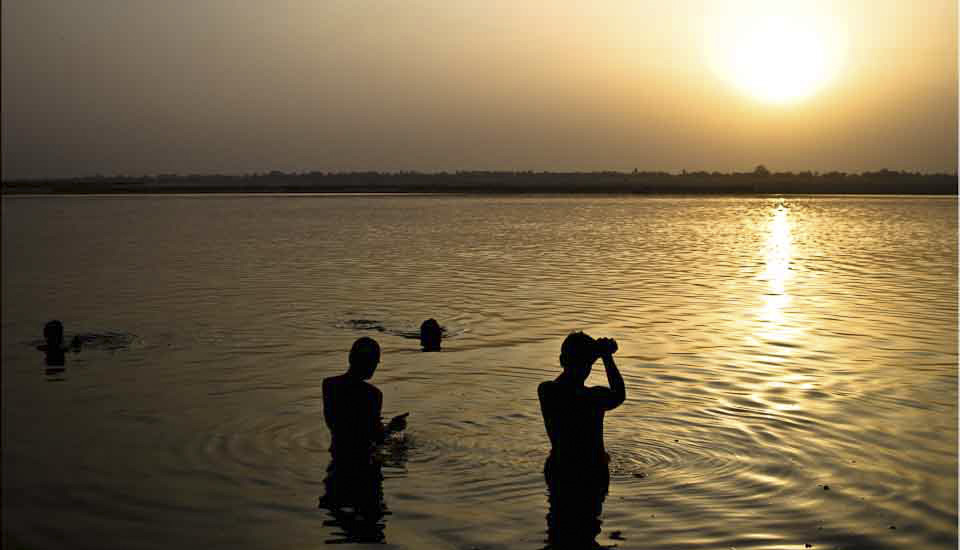
- Performing the Ganga Aarti from Dasaswamedh Ghat, Varanasi
- Buddha Head from Shwedagon Pagoda, Myanmar
- Harry Clarke Window from Dingle, Ireland
- Novice Monk Shwe Yan Pyay Monastery, Myanmar
Packets of 10 for $AU50.
Or - pick any photo from my Flickr or Wanders blog photos.

.jpg)
.jpg)
.jpg)









 For as wonderful as it is to learn about new places and cultures, taking a little bit of it home is an even greater pleasure!