The Dryad Point Lighthouse Even on a cold and rainy spring day, the scenery is spectacular from the BC Ferry that winds up the channels between Port Hardy on Vancouver Island and Prince Rupert on Canada’s mainland.
A boat trip up the Inside Passage has been on my Bucket List since I was a working student in the 70s when it was well out of my price-point. This classic trip – from Seattle or Vancouver to Juneau or Skagway in Alaska – is known for its magnificent scenery.
And it remains elusive to me.
A few years ago, I thought I was making my last trip back to Canada. To make myself feel better about that prospect, I toyed with variations of that iconic cruise only to find that – if I was being remotely sensible – they were still outside my reach!
So, I settled on the next-best-thing: a BC Ferry trip up the Canadian portion of this inimitable waterway.
British Columbia (BC) in Canada’s west has a coastline that is punctuated by over 40,000 islands of varying sizes, and deeply incised by coves, rivers, and fjords that rival those of Norway. Much of the landscape is mountainous and covered in dense temperate rainforest. The traditional inhabitants, the Coastal Salish nations, typically built their villages near navigable waterways for easy transportation, and they relied on seaworthy canoes for much of their daily activity.
Even today, a lot of the province is only accessible by water.
The BC Ferries was founded in 1960 to act as an extension of the public road system. The federal and provincial governments subsidized the organisation to provide essential services between the BC mainland, the coastal islands, and parts of the mainland with no road access. Today, it operates as an independently managed, publicly owned Canadian company – with the provincial Crown as sole shareholder.
The deep and sheltered waterways of the Inside Passage provide a shipping lane protected from the rough waters and bad weather typical of the open North Pacific. This maritime route is heavily trafficked by all manner of marine vessels, including pleasure boats, working boats, cruise ships, cargo ships, and – of course – ferries, that service major and minor routes all along the coast. The magical and poignant book: Passage to Juneau: A Sea and Its Meanings, by British travel writer and playwright Jonathan Raban, offers a unique insight into the history and landscape of these waters.
The BC Ferries operate a regular service between Port Hardy (see: The Fort Rupert Trail) on the northern tip of Vancouver Island and Prince Rupert on the northwest coast of the British Columbia mainland.
I duly booked passage for myself and my rental car, and set off north.
In the Bear Cove Terminal The very modern-looking ferry takes about 16 hours to wind its way up to its final destination – and cars are expected to present themselves between 120 and 90 minutes before sailing. So, it’s an early morning start on a long day – and it is raining! (iPhone12Pro)
Lifeboat The Northern Expedition ferry was built in 2004. She can take a maximum of 87 cars and 640 people – including crew. It pays to book ahead!
Front Row Seats Cabins are available onboard, but I booked myself a seat in the lounge instead. That way I could wander freely without too much concern for my belongings, or just sit and enjoy the view.
BC Ferries Flag on the Prow Of course, the view was mostly rain and mist …
Nature’s Abstracts … and stretches of calm water.
Into the Mist
Addenbroke Island Lightstation on Fitz Hugh Sound The passage is not without hazards, and cheerfully picturesque lighthouses punctuate the trees. What a solitary life this must be!
Disney Wonder A much bigger ship than ours passes to our port, heading south.
Radar and Flags
Islands in the Clouds
Seaforth Channel Marker On the rocks off Denny Island, a marker signals the safe path.
McLoughlin Bay Terminal On the other side of the channel, we make a short stop on Campbell Island, just south of the community of Bella Bella/Waglisla, to exchange goods and passengers.
Bella Bella The candy-coloured houses of Bella Bella stretch out along the channel.
Working Boat on Seaforth Channel Once home to a Hudson Bay fort, Methodist missionaries, and a thriving cannery, today the predominantly Heiltsuk First Nation community of Bella Bella has a precarious and relatively isolated existence.
Dryad Point Lighthouse Towards the top of Campbell Island, the heritage-listed lighthouse signals our sharp turn from Seaforth Channel into Lama Passage.
Boat Bluff Lighthouse A couple of hours later, we are passing what is one of the rainiest places in Canada: the heritage-listed lighthouse on Boat Bluff on Sarah Island.
Butedale With a snow-dusted mountain behind, the impressive Butedale Falls on Princess Royal Island flow into Hecate Strait. Ruins of the ghost-town of Butedale, founded in 1918 as a fishing, mining, and logging camp, are nearby.
Another Waterfall
Misty Mountains The weather remains wet, windy, and cold, and I spend a lot of time sheltering behind wet windows. (iPhone12Pro)
Flying the Flag
Fading Layers The day grows long, and many mountainous islands fall behind us.
Catching Clouds Mists continue to gather in the tall trees …
In our Wake … and our wake marks a trail through snow-caps and rain clouds.
Almost Abstract: Misty Mountains (iPhone12Pro)
Night Lights – City Limits At 11:30PM, we finally sight the welcoming lights on the Port of Prince Rupert. This is the deepest ice-free natural harbour in North America, and the third deepest natural harbour in the world – making it a very busy place. (iPhone12Pro)
I finally reached my room at just before midnight, very ready to lie down.
What magnificent scenery! What lousy weather! I decided to try the trip again, the next year, with fingers crossed for better weather.
Meditation Huts Built in 1963 by the Maharishi Mahesh Yogi as a venue for his International Academy of Meditation and colloquially known as the Beatles’ Ashram after their stays in 1968, Chaurasi Kutia (Eighty-Four Huts) in the foothills of the Himalaya outside Rishikesh is an enchanted place that is being reclaimed by the jungle.
Rishikesh.
Heat enveloping like a wet blanket, the smell of incense and mud, and memories of the late sixties … Sgt. Pepper’s Lonely Hearts Club Band and the White Album …
(Click for: Within You Without You from Sgt. Pepper’s Lonely Hearts Club Band)
Rishikesh is a city of yoga, meditation, and religious philosophy. It is full of sadhus – those who have chosen the spiritual path, and gurus – those who teach others. And, it is full of seekers and pilgrims from all around the world.
One of the the better-known gurus to Westerners was the Maharishi Mahesh Yogi. The Maharishi (great seer) introduced what he called Transcendental Meditation to India and the rest of the world. Born Mahesh Prasad Varma (1918-2008), he earned a degree in physics before becoming an assistant to, and disciple of, Swami Brahmananda Saraswati. After the Swami’s death, the Maharishi began teaching meditation, with his first global tour starting in 1958.
Rishikesh has long been known as the “yoga capital of the world”, so it was an ideal location for the Maharishi to build his study retreat. In 1961 he leased 14 acres (57,000 m2) of land surrounded by jungle from the state forestry department. In 1963, with donated funds from an American heiress, he built his International Academy of Meditation on a hill known as Manikoot, overlooking the Ganges river, opposite Rishikesh.
Locally, the ashram is known as Chaurasi Kutia(Eighty-Four Huts). Perhaps at one time there were only 84 huts, but today the numbers rise into the nineties, and at least one story counts them at 121. In Hindu and Tibetan Buddhist traditions, eighty-four is the number of Mahasiddhas – people who embody and cultivate the “siddhi of perfection”. A signboard on site states that each of the 84 huts represents a different classic Yoga Asana (posture), and “together they represent whole range of human life.” According to the National Park site “84 is a number that represents the base numeral of the number of species we believe to exist on this earth 84,00,000.”
Tales are told of sex, drugs, and impropriety at the ashram – but in later years, George Harrison emphatically denied any stories that cast aspersions on the Maharishi himself, and gave a benefit concert for the Maharishi-associated Natural Law Party. The Maharishi and his teachings are crediting with steering the Beatles away from psychedelic drugs and inspiring them to write many new songs – and his world influence continued long after the Beatles left the ashram.
The Maharishi stopped using the property during the 1970s and the land reverted to the local forestry department in 2003. Today it is managed by the Rajaji National Park.
I was in Rishikesh for a yoga retreat that included a few scenic daytrips (see: A Himalayan Sunrise). I was very excited about the prospect of my trip to the Beatles’ Ashram after hearing about it on my first trip to the city (see: Iconic India). From my accommodation, I was transported as a pillion passenger on a small motorcycle through crowded streets, across the Janki Setu Bridge (the closer suspension bridge, the Ram Jhula, is no longer open to motorcycles), and over rain-damaged, unpaved, and pot-holed roads to the entry to the fairy-tale-like enclave, nestled into the calming greenery of the encroaching jungle.
Come explore:
Welcome to Chaurasi Kutia – Eighty Four Huts The site marketed as the Beatles’ Ashram is now part of the Rajaji Tiger Reserve, under the management of Rajaji National Park. (iPhone12Pro)
One of the 84 Kutia The meditation huts are built from river rock from the nearby Ganges.
Path into the Ashram According to a signboard nearby, each of the 84 hut represents a different classic Yoga Asana (posture). To me, they all look more or less the same!
Looking out from a Kutia The conical meditation huts were built between 1976 and 1978 – long after the Beatles’ stay.
Huts Everywhere The huts are double story, with the living space downstairs, and a ladder-stair to the upper meditation space.
Hut Number 22
The Ganges Brown from the recent floods, even this close to the source – about 200 km (124 mi) from the Gongotri Glacier – the Mother Ganga is deep and wide.
Paul and his Guitar From the 1990s, trespassers on the abandoned site started leaving graffiti as a tribute to the Beatles. Later, after the decision was finally made to preserve the unique heritage of the place, the artwork became more formalised.
Krishna with His Flute The intersection of spiritual practice and Hindu traditions is well illustrated throughout.
Graceful Gazebo
Light and Dark and Lines The abandoned accommodation building, with its ornate window frames, patina of moss and plants, and dappled light, is just magical.
Safe Hands on the Beehive Meditation huts on top the accommodation building are decorated with wonderful murals. The foothills of the Himalaya roll off into the background.
“Let It Be” The ruins of the old yoga studio is patterned with lines and light. The Beatles turned this space into a music hall during their stay. (iPhone12Pro)
The Music Hall The rough and aging walls are now beautifully decorated.
Wanderlust In 2016, artist Miles Toland was one of those invited to decorate the crumbling space. His contributions are ethereal. (See them on his site: The Beatles Ashram).
Rishikesh Outside and across the river, the city hums with life.
Corridor to more Meditation Chambers
The Fab Four Plus One In 2012, street artist Pan Trinity Das (né Graham White) founded The Beatles Cathedral Gallery project to rejuvenate the lecture hall.
The Lecture Hall and Me Everyone wants their picture taken in the redecorated lecture hall. Good luck getting it to yourself!
Grey Langur – Hanuman Langur Working our way out through the back side of the ashram, we stop for freshly squeezed juice. Langurs (Semnopithecus) watch us from the wall overhead.
Young Grey Langur
Mike Love, co-founder of the Beach Boys, was a student of the Maharishi Mahesh Yogi and spent time at the ashram while the Beatles, their partners, Mia Farrow, her sister, and Donovan, were also there. His account of that time there is worth reading (see: The Ashram).
Truly, a magical time – and a magical place.
In the air above the Ganges A hundred fifty down miles from the source of the Holy Mother River Indian spiritual water ripples seen 100 feet below are shining in the sun reflecting through the eyes of one who feels as though he’d been there, or nearly so a long, long time ago – Mike Love, Beach Boys.
Stone Pillars Rising The ruins of the Temple of Apollo at Delphi that remain today date from the 4th century BCE, and stand as a testament to the artistic sensibilities and engineering ingenuity of the ancient Greeks.
The home of the Delphi Oracle has a mystic resonance. The air is electric, infused with the smell of mountain herbs, and full of possibility.
Of course, it might have just been the heat, or the early start. Whatever it was, I felt an energy at the Sanctuary of Apollo in Ancient Delphi that I have experienced few other places.
It is said that this is the centre of the world.
Ancient Greek legend has it that Zeus was searching for the omphalos, the centre of the ancestral mother earth, the ‘navel’ of his grandmother Gaia. He released two eagles from two ‘ends of the world’, and Delphi was where their paths crossed. Zeus then threw a sacred egg-shaped stone and declared that the omphalos of Gaia had been found.
This was home to the Oracle of Delphi, that most-famous ancient oracle, who was believed to deliver prophecies from Apollo.
Mount Parnassus has been home to an important oracle as early as 1400 BCE. The Pytho, and later the Pythia, was the high priestess of the Temple of Apollo at Delphi from about the 8th century BCE. The title refers to the mythical name of Delphi and comes from the Greek verb pythō meaning ‘to rot’: most accounts say that Apollo killed a monstrous python here, and there was a sickly sweet smell emanating from the decomposing body.
Before a divination, the Pythia and her consultants bathed in the nearby Castalian Spring. She then descended deep into a cavern under the Temple of Apollo. There she went into an ecstatic state and channelled Apollo, delivering opaque prophecies that were interpreted and written down by the attendant priests.
Her state has variously been attributed to fumes emitted from geologic fault lines under the temple, and/or the ingestion of Mediterranean oleander. The last reported Delphic prophecy was around 393 CE, when the Roman Emperor Theodosius I passed laws to end pagan activity.
The extensive site of temple ruins on the south-western slope of Mount Parnassus was UNESCO-listed for its natural, historic, artistic, architectural, and spiritual values in 1992, Most of the ruins still visible here date to the sixth century BCE.
The small group that I was travelling with and I had set off from Meteora (see: A Walk through Ancient Orthodox Monasteries) early that morning, stopping for lunch enroute. Before exploring the architectural ruins, we spent time in the Archaeological Museum of Delphi which is adjacent to the site and houses artifacts found in the vicinity.
While I don’t always have a lot of patience in archeological museums, the age and beauty of the artifacts on display – spanning a thousand years, from the Mycenaean era to the Greco-Roman times – was mind-boggling.
Do join me.
Mycenaean Terracotta Females Found in the sanctuary of Athena Pronaia, these sacred figurines date to the 14th century BCE. They are called psi (Ψ) figurines, because their shape resembles that Greek letter. (iPhone12Pro)
Woman’s Head This caryatid – a sculpted female figure serving as an architectural support – is from the Siphnian Treasury and dates to at least 525 BCE. (iPhone12Pro)
Sphinx of Naxos (560 BCE) This wonderful marble sphinx stood upon a 10 meter (33 foot) column next to the Temple of Apollo in Delphi. (iPhone12Pro)
Ancient Frieze (525 BCE) In its day, Delphi was the religious centre of the Greek world, and the public buildings were wonderfully decorated. This section of frieze is from the east facade of the Treasury of Siphnos.
Battle Frieze (525 BCE) In another fragment, the Gods are fighting against giants.
One of the Twin Kouroi : Kleobis and Biton Ancient Greek art was highly stylized. This is the head one of the monumental twins standing on a single base. The story is that after they helped their mother, one of Hera’s priestesses, they were granted “a peaceful death in their sleep” as a reward.
Apollo (480-470 BCE) This kylix, a ritual drinking cup, was recovered from a grave that probably belonged to a priest.
Music in the Marble (128 BC) This is a portion of the third verse of one of the Delphic Hymns, musical compositions dedicated to Apollo.
Bronze Athletes (460 BCE) The artifacts give a wonderful glimpse into the ancient world.
Statue Plutarch or Plato Behind the giant philosopher, there is photographic mural of the excavations at the site.
The Charioteer of Delphi (470 BCE) While most bronzes from ancient times corroded or were melted down, this beautiful life-size piece survived because it was buried under a rock-fall, probably in 373 BCE, and not found until 1896.
Iniohos – He Who Holds the Reins The whole sculpture is thought to have included the young charioteer – probably a slave, as he is not depicted naked as most athletes are – his chariot and horse team. The incomplete bronze was found with fragments of the horses, and an inscription to Apollo, giving thanks for a victory.
The Charioteer He really is quite exquisite, complete with inlaid glass eyes and silver eyelashes.
Tholos (Circular Temple) of Delphi (380 – 370 BC) Coming out of the museum back into the afternoon sun, I look down the hill to one of the many ancient structures in the Sanctuary of Athena Pronaia in Delphi …
Temple of Apollo (490 BCE) … and uphill to another.
Art and Lettering on Ancient Bricks
The Reconstructed Treasury House of Athens in Delphi (507-470 BCE) This was rebuilt to commemorate the victory at the Battle of Marathon in 490 BCE.
Pillars of the Temple of Apollo (490 BCE)
Along the Sacred Way The Sacred Road winds up the hill, through the site. Here, we are looking back at the Treasury House of Athens.
Fallen Capitol Carved marble is all around.
Ancient Greek in the Stone (iPhone12Pro) Whenever we asked our guide about inscriptions like these, …
Ancient Letters … she’d laugh and say, “It’s all Ancient Greek to me!”
The Pillars
The Temple of Apollo Somewhere near that slab is the hidden entrance to the Pytho’s cavern.
Over the Temple Higher up the hill, you get a better view of the temple complex.
The Ancient Theater of Delphi
Fallen Carvings
The middle-aged oracles didn’t have a long life – probably paying the price for the seizures they experienced going into their trances, or the effects of whatever hallucinogen that was causing them.
But, it was reputedly a great honour, and there was never a problem filling the position.
Umbrella Trees over Rushing Water Once upon a time, I had a four-foot (120 cm) umbrella tree (schefflera actinophylla) in a pot in my living room – carefully protected against the sub-zero temperatures outdoors. I never once imagined I’d see them growing, high over my head, in their natural tropical habitat! Here in the Daintree Tropical Rainforest, Rex Creek races towards the Mossman River under my feet.
The Daintree National Park is just magic!
The Daintree Tropical Rainforest, which the Park protects, is Australia’s largest remaining rainforest. Part of the UNESCO-listed“Wet Tropics of Queensland”, it covers over 1,200 square kilometres (463 square miles), and is home to a unique and complex ecosystem, housing many plants and animals not found anywhere else in the world. It is estimated to be between at least 135 million and 180 million years old – making it the oldest surviving tropical rainforest in the world.
The forest stretches from Cape Tribulation in the north, to the Daintree River Estuary in the south, running in a narrow strip (23 km / 14 mi) between the mountains of the Great Dividing Range and the Pacific Ocean. The Park, officially called the Daintree National Park (CYPAL/Cape York Peninsula Aboriginal Land), is broken into two sections: Mossman Gorge and Cape Tribulation, with an area of long-settled agricultural lands and two small towns (Mossman and Daintree Village) in between.
Early in my stay in the far-north town of Port Douglas, I had made the trip into the northern section of the park (see: Tropical Rainforest Magic). I have visited Mossman Gorge in the southern section twice before: once in the early 1980s, and once in the 1990s.
Needless to say, while the rainforest itself seems timeless, I found the infrastructure much changed! Following Google Maps, I made my way to the car park outside the very modern Mossman Gorge Cultural Centre. Opened in June 2012, the Centre is the starting point for local Indigenous-led Ngadiku Dreamtime Walks. When I visited, COVID-19 restrictions were still very much in place, so those walks weren’t happening. The Centre is also home to information about the area, a collection of Indigenous art, all-important coffee and food services, and ticket sales for the essential shuttle-bus to the starting point for walks into the gorge.
February is wet season in Far North Queensland and the weather lived up to its monsoonal reputation: it absolutely poured with rain for much of my walk. At times, hiking on a more-distant path, I had no choice but to wade through large puddles and, at one point, an impromptu rivulet. Fortunately, the water under foot was warm enough, and I was sheltered from any wind, so I could use my umbrella to protect my cameras.
Come for a wander in the the tropical rain:
“Welcome to Baral Marrjanga” There’s no footpath or pedestrian access from the car park to the Gorge, but the shuttle bus was running regularly. Signposting near the bus stop at the Mossman Gorge day-use area points me on my way.
Baral Marrjanga Track The first 330 metres (0.21 mile) of track is an accessible elevated boardwalk leading through the lower canopy of the jungle.
Ferns, Palms, and Creepers The light is dim and filtered under the canopy, and when it is not raining, the air is hot, humid, and still.
Rushing Waters Swollen creeks all race towards the Mossman River, enroute to the Pacific Ocean.
Cassowary Plum – Cerbera Floribunda Lush vegetation is all around.
Jungle Greens The forest is a patchwork of light and dark.
Rainforest Colours A little splash of colour provides contrast with the greens – and food for the native wildlife.
Red Berries I tried – and failed – to identify many of the plants along my route.
Stone Steps Although there are new non-slip surface on the flat sections of path, the old stone steps are slick with rain; I’m glad to have my walking stick for stability.
Rex Creek Bridge Track I think everyone who visits here takes this same picture of the waters of Rex Creek cascading over granite boulders. In fact, I took it twice: on the way out, and the walk back!
Umbrellas in the Rain The current suspension bridge across Rex Creek was built in 2010 to replace the earlier one constructed in 1986 by army engineers. It’s not particularly good looking, but allows wonderful views into the rushing waters.
The Rainforest Circuit Track After the suspension bridge, I picked up the circuit track.
Rocky Path Although mostly well marked, this section of the track is less formal, …
Vines and Roots in the Path … and you definitely need to watch your step!
Rockpool
Woods Tall trees line the sandy track.
Buttress Roots on the Forest Floor Spreading roots help rainforest trees improve their stability and maximise their oxygen and nutrient intake.
And Back Again! The 3.4 km (2.1 mi) Rainforest Circuit Track brings me back to the suspension bridge.
Cascading Waters in the Rain The rain continues – in drops so large I can see them!
Nest in the Treetop This is another view of Rex Creek that appears in pictures everywhere.
Raintrees (Albizia saman) in Mossman After my walk, I drove the short distance to the historic little town of Mossman. There is a real irony in having introduced trees on the main street of a town that is next to a Heritage-listed native rainforest!
In the Trees Above The 120-year-old trees from Jamaica are covered in bromeliads and epiphytic ferns. (iPhone12Pro)
St David’s Church This pretty little heritage-listed Anglican church in Mossman was built in stone some time after the 1911 cyclone destroyed the original wooden building.
Church Bell World wars, further cyclones, and escalation in material costs, all interfered with rebuilding the Byzantine-style stone church, and the building wasn’t completed until 1952.
Nothing was as I remembered it.
But, the whole area is an absolute gem, so it was a joy to explore it, as if for the first time!
Priests on the Steps Every evening around sundown, Hindu priests on the ghat at Har Ki Pauri, Haridwar, perform the Ganga Aarti, a ritual venerating the Ganges.
In the ancient Hindu holy city of Haridwar, on the banks of the sacred river Ganga, there is a ghat (set of steps down to the river) that is said to to have been built in the first century BC by the legendary King Vikramaditya. Called Har Ki Pauri, which means the feet of Lord Vishnu (Hari), it is claimed that in the Vedic (ancient period) times, Vishnu left his footprint on a stone wall here.
This is the point at which the Ganges leaves the mountains and enters the plains. According to ancient and medieval Hindu texts, it is also one of the four sacred spots in India where the nectar of immortality (Amrit) fell to earth during a battle between good and evil.
As a consequence, Har ki Pauri is the most sacred Gangesghat in India. It hosts several special festivals, most notably the Kumbh Mela, which takes place every twelve years (see: Kumbh Mela).
The site is also celebrated for the river itself: according to legend, the Mother Goddess Ganga (Ganga Ma/Mata), with the help of the Hindu God Lord Shiva, came to earth here in the form of a celestial river, the Ganges. Every evening at sundown, priests on the ghats at Har ki Pauri perform the Ganga Aarti, a religious prayer giving thanks to the Goddess.
An aarti is a ritual of light, and always includes jyoti, holy flames. At the Ganga Aarti, the priests perform their chanted prayers with bowls of fire, and tall, flaming candelabras, which they circle clockwise while facing the river. It is a noisy affair, with the priests accompanying their chanted prayers with the ringing of temple bells, and the clashing of cymbals.
The practice is a delight to watch or participate in. The devotees are always happy to be there – making them friendly, welcoming, and willing to be photographed. This was my second evening visit to the ghats of Haridwar with photographer Karl Grobl and local guide DV Singh (see: People After Dark).
Join me for some more environmental portraits from the ghats.
Sadhu on the Ghat Pilgrims – including holy men – come to the ghats on the Ganges from all over the country.
Woman in Green Many pilgrims travel with loads of belongings – including containers so they can take sacred water away with them.
Offerings It is customary to make an offering the Ganga Ma; many people buy ready-made floral arrangements which are designed to float away on the waters.
Preparing Offerings Other people make their own offerings as part of their daily puja (act of worship).
On the Ghat Shrines, offerings, and religious paraphernalia are everywhere on the steps.
Life on the Ghat Any time of day, you’ll find people with their feet in the water, and/or floating offerings.
Temples in the Ganges
Pilgrims on the Steps
Religious Paraphernalia Preparations for the evening’s aarti are well underway.
Blessings
Ingredients for an Offering Making your own offering to the Mother can involve a complex mixture of foods, oils, spice and flowers.
Local Police The police presence is friendly – but watchful.
Raja Birla Tower Looking toward the clock tower from one of the bridges across the river, we can see how the crowd has gathered across the water from the ghat at Har Ki Pauri.
Priests on the Steps I find a spot amid the throng, and watch the priests chant their mantras across the water.
Young Mum People of all ages are arriving at the vantage point.
Making Offerings Milk is one of the many offerings made to Ganga Ma; cow milk is seen as purifying and sustaining.
A Girl in the Crowd I spend much of my time checking out the crowd around me; …
Smiling Girl … I love the smiles I meet.
Fire and Flowers The aarti continues across the water, with chanting and offerings.
Young Woman with her Family
Eyes in the Crowd Everyone joins in the traditional song venerating the Mother Ganges, “Om Jai Gange Mata”, throwing their hands in the air with gusto on the chorus: “Jay Ganga, Qui Jay!”
Priests with Lamps The light from the enormous tiered candelabras is not enough to cut through the descending darkness.
Filming Everywhere you go these days, you will find people recording events on their mobile phones.
Prayers in the Dark The skies darken further, and the aarti draws to a close.
The Flame Dotted around the ghats, aarti flames are kept burning.
Sharing the Flame The faithful hover their down-turned hands over the flame and then reverently touch them to their eyes and face; this imbues the devotee with blessings from Ganga Ma.
Keeper of the Flame The mood is happy and light-hearted.
Like other visitors to the waterfront, I bought a small float with a diya (candle) surrounded by flowers that I could send down the river to light the darkness.
The whole ceremony is joyous and uplifting, and I walked back to my hotel with refrains from the Ganga Aarti song running around my head.
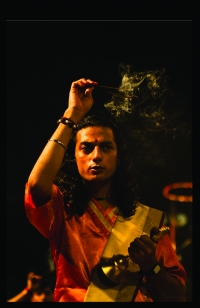
- Performing the Ganga Aarti from Dasaswamedh Ghat, Varanasi
- Buddha Head from Shwedagon Pagoda, Myanmar
- Harry Clarke Window from Dingle, Ireland
- Novice Monk Shwe Yan Pyay Monastery, Myanmar
Packets of 10 for $AU50.
Or - pick any photo from my Flickr or Wanders blog photos.

.jpg)
.jpg)
.jpg)