This week we indulged in a quiet weekend at a charming resort in Jomtien, a beach town close to Bangkok. You know the kind of weekend: eating and drinking punctuated by sitting on a colourful canvas chair on the beach, slathered in sunscreen, saying “Mai Ao” [“No, thank you very much! I don’t want a snakeskin belt/a massage/grilled squid/etc.”] to the veritable stream of hawkers who pass. We were treated to magnificent sunsets (and a sprinkle of rain) with our evening cocktails, but I hadn’t packed my tripod, so the few high-ISO hand-held shots I took don’t warrant sharing.
Mid-Sunday afternoon more rains approached. Having had our fill of inactivity, we looked at the guidebooks to find somewhere close to visit and decided to explore the “Million Year Stone Park & Pattaya Crocodile Farm”.
Now, you wouldn’t think that a tourist attraction of such note would be hard work to find! We had three maps, a guide book and a GPS in the car with us. Unfortunately, in spite of the Thai map download, the GPS had no idea what we were talking about. The paper maps were not much more help; the park seemed to be somewhere in a vague roadless triangle off the major routes. The Michelin guide, however, was quite explicit: “9km north by 3. Turn right into 3420.” We weren’t sure if they meant north of centre or north of city limits, but by the time we reached the next town 15 kilometres away, we knew we’d missed the corner. We turned around and tried again – to no avail. No “Stone Park” signs; no highway 3420 markers.
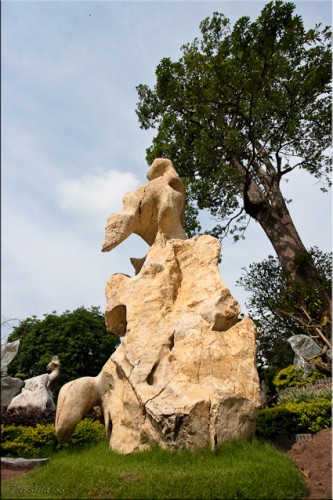
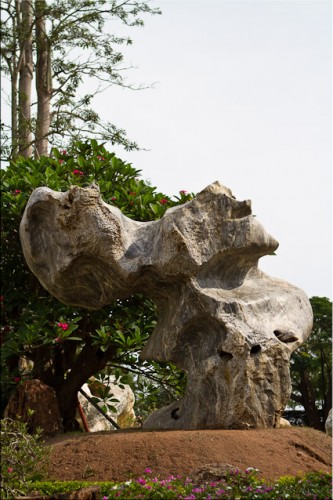
Strange Shapes ~ Carved by Time
I suppose we could have asked someone, but I wasn’t convinced that asking someone about “old rocks” would do it, and I couldn’t remember the word for “million” in Thai. Besides, the weather was lousy, so we weren’t unhappy about driving laps of the highway. We pulled another U-turn and tried again, this time via a new bypass, in case it was the reason our guide book wasn’t getting us there. One of the things about living in a developing country is that sometimes the “-ing” overtakes you! Buildings come and go; roads morph and move… Our guide book is over ten years old, and clearly that bypass wasn’t.
Long story short, two hours later we found the park… thanks to: being able to read Thai, unbelievable persistence, and several more wrong turns and U-turns. But, it was half an hour before closing and the light was going the way of the tour buses. We decided to come back the next morning on our way home. Now that we knew where it was, we thought the signposting would probably leap out at us, but it didn’t. Many corners weren’t marked, most signs weren’t in English and we never did find a marker that said “3420”. Such is life in Thailand… ไม่เป็นไร! Never mind.
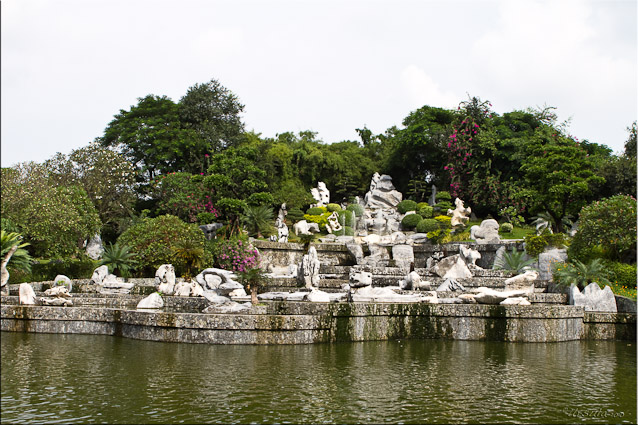
"Million-Year Stone Park" Water and Gardens
The park is nice, the stones and the bonsai gardens are beautiful, and the crocodile show would be exciting if you’d never seen one before. (I think I need to do a separate post one day just on animals.) What really amazed me, however, was the workers. Anyone who has read my first post knows I am impressed by how hard people in Thailand (and other Asian countries) work. “Hard Yakka”, for anyone who doesn’t know, is “hard work” in Australian vernacular. “Yakka” alone is “hard work” in the Jagera Aboriginal language of Moreton Bay. It is the best way to describe the hot, heavy manual labour at the park. Now, you wouldn’t think that million-year-old rocks would be hard work to maintain, but clearly, as you will see from the pictures, it is a big job!
Wet Cement + Hot Weather = Need for Speed
Cement Truck at Work
Bare Feet and Smiles ~ Don't you Love the Protective Clothing?
"Raise Your Eyes to the Skies" Traditional Mon Temple
As I said last week, Kanchanaburi offers much, much more than just the infamous Death Railway. I was going to share some waterfall shots from our most recent trip and from last year, but I’ll save the nature for some other time in favour of some glimpses into the past, distant past, and living-the-past-in-the-present.
It amazes me how many ethnic groups still live in semi-isolated communities scattered all over Thailand and it’s regional neighbours. Some are displaced and in effect stateless, and spend their whole lives in refugee camps. Some, like the Long-Neck Karen, are protected by the Thai government because of their potential as a tourist attraction. Others, like the Mon from Myanmar who have settled in the Sai Yok area of Kanchanaburi, are able to live their traditional lifestyle, albeit somewhat dependent on tourist dollars from the visitors who buy produce and crafts or stay to watch traditional dances.
A Golden Stone, Like the Famous one in Myanmar, Sits atop a Sacred Relic
Kanchanaburi is, and probably always has been, border territory. Not far down the River Kwai Noi from the Mon village are the ruins of a laterite village-temple complex believed to have been a 12th century trading and defence outpost of the Khmer Singh empire. Called Muang Singh (Lion City), the city was important enough to be mentioned in inscriptions dating to the reign of the Angkor King Jayavarman VII. Reclamation work started on the site in 1974, and it’s an elegant, quietly crumbling monument set on 640 rai (about 100 hectares) of well-maintained land. The gentle rains on the day we visited probably only added to the reverent hush.
Nearby, a Neolithic (3,000 BC) burial site has been uncovered and is open to view. The story goes that it was one of the builders of the Death Railway, a Dutch POW, who first found evidence of Neolithic settlement in this area. The Ban Kao Museum houses a number of artefacts unearthed from those times.
Yellow Oleander in the Prasat Muang Singh Carpark
Fresh Frangipani and Crumbling Angkor Empire Laterite
Twelfth Century Prasart Muang Singh
Old Laterite and Young Greens
Khmer Botthisattva
Fallen Hot-Pink Frangipani
Frangipani ~ Okay, so I Like Flowers!
Sacred Khmer Head in the Muang Singh Museum
5000 Year-Old Neolithic Remains
I guess the moral of the story is: You are dead a long time! In the meantime, travel well.
I love trains and train journeys. There is something hypnotic about the rhythmic clack of the wheels on the tracks. And who can resist waving at the people on trains as they pass?
Kanchanaburi, about 3 hours west of Bangkok (on a good day), is home to what must be one of the most poignant stretches of rail track in the world: what remains of the infamous Burmese Railway. The Death Railway as it is known locally (actually, one signpost reads “Dead Railway”) was built, at great cost of life, by Allied prisoners of war as a Japanese supply line between Bangkok and Rangoon.
After the Japanese surrender, about four kilometers of track on the Thai-Burma border was pulled up and never replaced. These days, about 130 kms of track remains on the Thai side and an old train runs up and down carrying tourists.
We rode the train many years ago, and it is a pleasant trip through the sugar cane fields and bamboo forests. This time we drove, which actually presented much more of a challenge, as sign posting to both accessible bits of track disappears and you are expected to choose roads based on intuition!
The last station on the track at Nam Tok is in dense jungle, with the Bilauk Taung Range bordering Myanmar on one side and the muddy River Kwai Noi on the other. Cool caves dot the mountainside while everywhere else the heat radiates without mercy.
หยุด ~ STOP ~ Train Ahead!
"Take Care... Do not tripon bolts or railspikes."
Teak Wooden Trestles form a Viaduct High over the River
If there is a Cave, there will be a Buddha! Kra Sae Cave, Tham Kra Sae
Tourist on the Rails, Outside Kra Sae Cave
Of course, Kanchanaburi offers much, much more than just the railway! We visit annually for the Mizuno River Kwai International Half and Mini Marathon and always find something different to do. This area of rugged mountains bordering Myanmar has all manner of interesting attractions, from prehistoric artefacts and ancient buildings to wilderness areas and magnificent waterfalls. The rivers provide ample scope for boating and rafting, and there are caves of all types to visit. There is birdwatching and elephant riding, and even a “Tiger Temple” where you can get up close and personal to the big cats. But, I’ll save some of that for next week…
Great photos, it is unusual to see the train at this spot from the outside, most pics on internet seem to be taken from inside whilst going over the viaduct.ReplyCancel
Ursula -September 17, 2010 - 11:24 am
Thanks, Guava! We were lucky with the train times. 🙂ReplyCancel
[…] London… and Around638425On the Rails ~ Kanchanaburi638425The OTHER side of Pattaya638425Chillin’ in rainy Koh Chang…618412History and Beauty ~ […]ReplyCancel
[…] Thai soil and were able to force the building of their proposed supply line to Burma: the infamous “Death Railway”. About twenty-two thousand Australians were captured defending British territories in Asia […]ReplyCancel
During my early years in Thailand, I was invited to conduct some teacher-training in the southern province of Ranong. This was pretty exciting for me as it was my first foray off the main tourist tracks and into the real Thailand. My hosts kindly took me on a tour of the area: beautiful coastline with mangrove reserves and waters still frequented by smugglers; milky white rivers with hot-springs so warm you can cook food in them; and steep tropical mountains whose dense forests hide a few tigers and the remains of old tin mines. As we were winding up a hill to the Chinese grave of Ranong’s first governor (Phraya Rattanasetthi or Kho Su Chiang), our driver tooted his horn three times at one of the many blind corners. “Letting oncoming cars know we are coming: very sensible,” I remarked. My hosts chuckled and said no, the horn was to pay respect to the spirits who live at that particular place.
Dressing the Tree ~ Our Street
Of course, I have since learned that spirits and ghosts live everywhere in Thailand. A couple of years ago, someone saw a vision in an old tree down the road from us; overnight the tree was draped in clothes and given offerings of soft drink and flowers.
Local Buddhist practice leans heavily on ancient animist traditions, and no self-respecting Thai will drive a car or live in a house that has not been blessed by protective rituals conducted by the monks. Every building has at least one spirit house, the location of which is determined by the monks. Our apartment has two: one dedicated to the Brahmin god Vishnu (Narai in Thai), and the other to house any ghosts who might be in our neighbourhood. These houses are well cared for with weekly offerings of fresh flowers, incense and candles for the former, and soft drink and food for the later. I still find it a bit startling when taxi drivers take both hands off the steering wheel in order to ‘wai’ these and other spirit sites.
This last weekend, we drove about 350km south of Bangkok into the bottom half of Prachuap Khiri Khan province and stayed on one of the many sandy beaches along the coastline of the Gulf of Thailand. Just that bit too far for most city Thais or foreign tourists, the area is quiet, and it is always a joy to walk through the traditional fishing fleets and share a smile and laugh with the locals. The ubiquitous spirit houses watch over us and the boats are protected by their floral garlands.
Palm Trees and Huts along Bang Saphan Beach
Fishing Boat on the Bay, with it’s Protective Flowers on the Bow
Fish Traps on a Quiet Day
Casuarinas Line the Six Kilometre Half-Moon Bay
A Spirit House Watches Over the Fleet
Five-Year-Old Dengmo and her Older Brother Practice their Culinary Skills
Prachuap Khiri Khan is the narrowest province in Thailand. At one point it is only 13 kilometers from the coast to the mountainous border with Myanmar. On this trip, we headed into the hills just south of that point to visit the Huai Yang National Park with its well-known nine-tiered waterfall. What we saw of the waterfall (we didn’t go all the way to the top) was pretty, but not overly impressive, but it was a nice walk over well maintained paths.
The Well Maintained Paths of NamTok Huay Yang National Park
One of the more Distinctive of the 250 Species of Tropical Bombacaceae Trees
Pretty Falls: Nam Tok (Waterfall) Huay Yang
I know by now that we should be ready for anything, but I admit to being surprised when we rounded a bend towards the large pool at Level Three of the falls and came upon an extraordinary collection of spirit offerings. I will let the pictures speak for themselves!
An Extraordinary Collection of Offerings for the Tree Spirits
Candles and Incense ~ Makeup and Toys!
Earings, Hairclips and a Sunhat
Grooming Aids at the Feet of the Very Western Mannequins
Look up… Look Way up… to where the Tree Spirits are!
A Butterfly alights in the Leaf Litter
Pool at Level Three of Nam Tok Huay Yang
Quiet Water at Level Three of Nam Tok Huay Yang
Insurance – Just In Case the Spirits Don’t Protect You!
Taming the Waters with an Old Tap on one of the Tiers
Here’s hoping the spirits look after you and yours…
There is always time… Thanks for stopping by, Guava. 🙂ReplyCancel
Rob -September 10, 2010 - 9:29 am
Good work Ursula – thanks for the invite. I shall be browsing regularly to seek inspiration for trips. Nice photos!ReplyCancel
Ursula -September 10, 2010 - 2:41 pm
Hi Rob! Welcome back. Glad you popped in! 🙂ReplyCancel
Selim -September 10, 2010 - 11:22 am
Passed thru this lovely area without pausing on my way to another lovely area, Surat Thani. Next trip down south (my favorite area in Thailand so far), I will make it a point to stop and see this falls area from your viewpoint. Nice photos, btw. I am an aficionado myself and I like some of the perspectives. And, the butterfly shot is nice and clear. Western mannequins, makeup, jewelry?ReplyCancel
Ursula -September 10, 2010 - 2:43 pm
Hey Selim!
One day we will make it all the way… Wonderful countryside.
Yes, the mannequins and false eyelashes were unexpected!! 🙂ReplyCancel
[…] mentioned before that Prachuap is the narrowest province in Thailand, running between the mountainous border with Myanmar and the beaches along the Bay of Thailand. Dan […]ReplyCancel
Being a visitor in a place is very different from living there. It’s not so much that we forget where we are, or that we necessarily even take it for granted, but that the business of day-to-day living takes so much of our attention.
I was reflecting on this as I ambled out from our hotel, early on a recent Monday morning, in the Septième in Paris. All around me, people were walking swiftly through the streets, heading to work or other appointments, with their heads down and their minds seemingly on the business at hand. For me, however, it was all wonderfully ‘foreign’. It could only be Paris! Large dogs dragged their owners for walks along the wide, tree-lined boulevards; long lines of people queued into the local bread shops; and if I looked up, the Eiffel Tour was visible, not so far away.
I couldn’t help but wonder how often the local Parisians look up at that wonderfully quirky structure that can be seen from much of the inner city. I’m sure they do – I myself know exactly which spots, on all the roads east into Sydney from the lowly Western Suburbs, where I will first catch a glimpse of the harbour and its wonderful bridge. And, as I sit in the back of taxis, crawling through the sludge that is Bangkok traffic, my breath is still taken regularly by the sun glinting off one of the many jewelled temple roofs.
This is one of the beauties of living in a great city: those moments are always there, even when we are distracted by other things. And so it must be in Paris: people rushing to work on a Monday morning are occasionally reminded where they are, no matter how busy they get.
As a tourist, however, I had the whole day free to revel in it! I hope you enjoy the photo collection.
The Eiffel Tower through the Peace Monument
Peace in 32 Languages and 18 Alphabet Sets
A Shattered Peace
The Peace Monument (2000) by Clara Halter and architect Jean-Michel Wilmotte
La Tour Eiffel (1889) and le Champ de Mars
Climbing up La Dame de Fer (1889)
Cheval ~ Pont Iéna
Rush Hour is Over… Quai Branly
More Glass and Lettering ~ Le Musée du Quai Branly
Les Vélos ~ Quai Branly
Itinerants Living Rough on the Seine
Memories of School History Lessons
Artists at Work ~ Grand Palais
Cherub in the Frieze ~ Grand Palais
Brass Door Knob ~ Grand Palais
Statue on the Pont Alexandre III (1897/1900)
A Bronze Cherub on the Pont Alexandre III points the way to the Iron Lady
Napoleon’s Tomb and Flying Flags: Hôtel des Invalides
Marguerites in Gardens of the Hôtel des Invalides
Au Revoir, Paris! Gare du Nord
More photos from this year’s trip are HERE; photos from our 2008 trip are HERE if you are interested. Until next week, happy travels!
[…] a lifetime later and half a world away, in the parklands along the Seine in Paris (see: Monday Morning in Paris), I was ridiculously excited to come across busts of the best known of those early French […]ReplyCancel
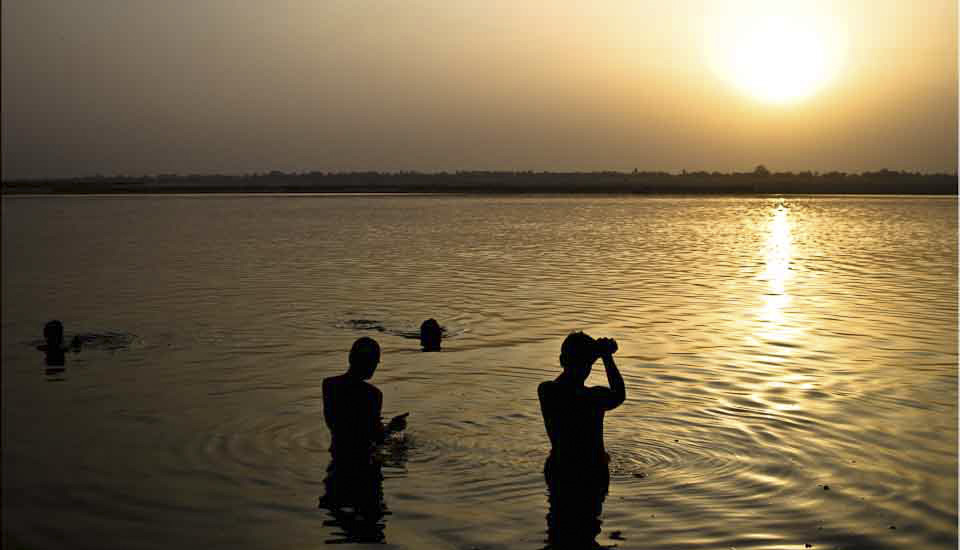
- Performing the Ganga Aarti from Dasaswamedh Ghat, Varanasi
- Buddha Head from Shwedagon Pagoda, Myanmar
- Harry Clarke Window from Dingle, Ireland
- Novice Monk Shwe Yan Pyay Monastery, Myanmar
Packets of 10 for $AU50.
Or - pick any photo from my Flickr or Wanders blog photos.





.png)





.jpg)


 More photos from this year’s trip are


as always… beautiful… back in BK?
Thanks, Signe! Yes, back in BKK… until tomorrow! Weekend on the beach. 😀