There is something poignant about the end of an adventure.
It was cold on the morning of our last day on the Cathar trail. The pale almost-full Easter moon hung low in the dark sky behind the pog (rock) as we trudged from our accommodation in Cazals d’en Dessus back up the hill to the village of Roquefixade. The spring sun struggled to rise from behind the surrounding Pyrenees.
The quiet gave us opportunity to reflect on our time in the mountains: every day – new terrain, new vistas and new challenges; every evening – aches and fatigue, good food and great wine. While it is true that after almost two weeks of walking over the rugged landscape with what was later diagnosed as severely inflamed osteoarthritis of the hips, part of me was ready for a change, it was also sad to know that by the end of the day we would be at the end of our trail.
Seen the ruins of one Cathar Castle – seen them all?
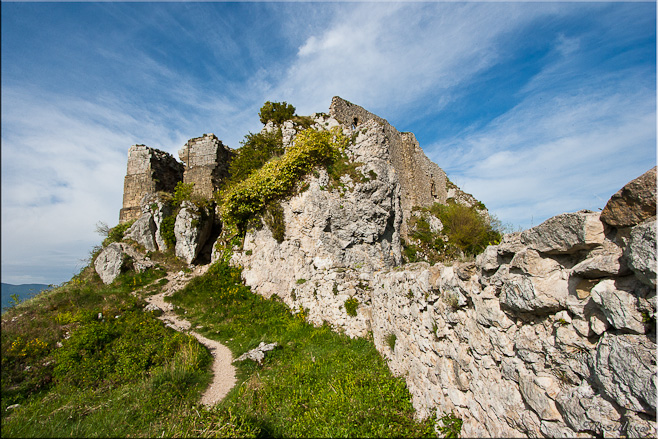
We were tired and the wind was rising as we passed through the small town of Roquefixade (144 inhabitants in 2007) and looked up at the precarious rise to the Château de Roquefixade high above, so we were tempted to bypass the 45 minute climb in favour of shortening our day. But, knowing it might be a long time before we are back this way again, we tied our hats to our heads and clung to the rocks as we braved the winds on the hill.
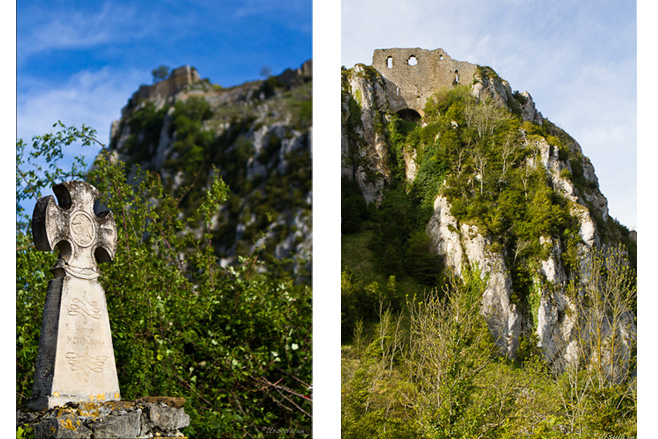
Cross (MCMDXVI; 1986) in Roquefixade below ~ The fortress (11C) of Roquefixade above.
It was worth it.
Like the other citadels in the area, Roquefixade was built in its day to provide a vantage point over the roads in the region. Today, the rocky ruins allow us to marvel at the hardship of lives in mediaeval times in these windy aeries perched on their rocky outcrops.
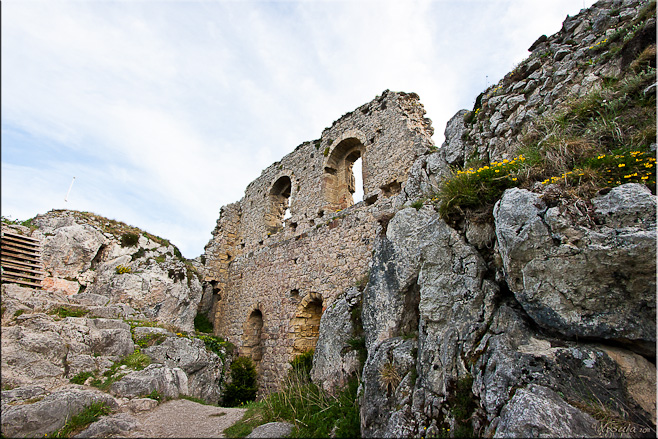
Inside the Roquefixade Ruins ~ Destroyed in 1632 under the orders of Louis XIII
Flowers cling to the mountain-side in the strong winds.
A natural rock garden ~ wild flowers grow among the rocks of Roquefixade pog.
View from Roquefixade: Ariege Midi-Pyrenees
Once we descended from the chateau, we spent the day traversing along paths, through forests, over stony tracks, past ruins and across farmer’s fields.
Spring Oak
Un monticule de pierre (a cairn) marks the Cathar Path.
New growth along the path
Draft Horses in the Spring Grass
A sturdy cow keeps an eye on us as we pass.
The ridge walk ~ High above Foix
Ruins along the pathway
View from the ridge to Foix and the Ariege river below
Memorial on the hillside: "We still laugh - At the foolishness - Just like kids - But not like before" From the song "Evidemment" by France Gall.
Wildflowers on the path down to Foix
Leafy Green Ground Cover
As we descended the hill, it started to rain, making the fortresse of Foix look like a fairy-tale castle in the mist.
We’d been exceptionally lucky with the weather on our twelve days of walking. Although it had often been windy and cold, for the most part it had been clear and dry. It seemed poetic somehow that, as we descended the hill into Foix, it started to rain – and the rains looked as though they would stay for a while. We couldn’t help but feel sorry for those people who had their walk ahead of them, in what was forecast to be inclement weather.
We knew we were back in the "city" when we had to watch out for the cars passing on the highway. Foix
As we crossed the Ariège river into Foix and towards our accommodation, we met with a man with his backpack going the other way. “I’m a real Pyrenean,” he told me in French. “I live up there.” He indicated vaguely the direction we had come.
The Pyrenean
It seemed a fitting end to our trek – to meet a ‘local’ going back the other way.
We did, of course, visit the famous Foix castle – but that is another story for another day.
I note your comment about the rain, which reminds me when I was young and it rained I thought God was sad, perhaps He shared your sadness at leaving this magical place… thanks as always for taking me places I doubt I’ll ever actually walk but am ever so glad you shared them with me.ReplyCancel
gabe -October 13, 2011 - 11:16 pm
Well said and well done both the actual adventure and the story line you created. XXXReplyCancel
Ursula -October 15, 2011 - 2:53 pm
Many thanks to my two most vocal readers. 🙂ReplyCancel
What we think we need is so dependendent on what we already have.
Earlier this week, my husband and I drove the six-plus hours south from Sydney to Eden, a coastal town in New South Wales, Australia. We are having some work done on a small house we bought there in preparation for our relocation at the end of the year. I had gone to some effort to ensure we had the electricity turned on in time for our arrival, so you can imagine my frustration when we got there in the dark and turned on the power mains, only to have the hot water system go: “Snap! Crackle! Pop!” like the popular breakfast cereal, before starting to smoke.
Although I confess to feeling momentarily sorry for myself about not being able to wash my hair and about having to sponge-bathe with hot water from the kettle, I couldn’t help but think back to the few hours I spent on Tonlé Sap Lake in Cambodia earlier this year. As part of a photographic expedition led by Karl Grobl, Gavin Gough, Marco Ryan and Matt Brandon, I spent an overcast morning on a boat on the famous “rising” lake.
Monks' laundry hangs at the "boat dock" on the edge of Tonle Sap at Kampong Khleang.
Boats sit surrounded by edible Chinese water morning glory at the "dock" at Kampong Khleang.
Work starts young ~ our boat 'man' pushes us away from the dock.
Designated as a UNESCO biosphere, Tonlé Sap is the largest freshwater lake in South East Asia. The lake is responsible for 75% of Cambodia’s national inland fish production. Around 3 million people live on or around the lake, making a living fishing the many commercial species of fish, turtles and snakes, or farming the rich soils.
Houses rise high over the low waters of Tonle Sap before the monsoons fill the lake ~ boat, floats and fish-farms sit below.
Whether it is to go grocery shopping or to visit neighbours, everything is done by boat.
Houses rise up on stilts behind tall grass at the moveable shoreline, Tonle Sap Lake.
Tending the fish-traps is no easy task!
Checking the lines and nets.
The local pot shop?
Fresh paint and cheerful plants on a floating house: some house-holders take pride in their surrounds.
A young girl with the family dog, on the "porch" of their floating house.
The living is not easy, however. Every year when the Mekong floods during the June-July monsoons, the Tonlé Sap river flows backwards and the lake level changes from about 1meter in height to as high as 10 meters. Local residents accommodate these drastic changes by either building on high stilts, or floating their houses on old drums. We cruised past, like voyeurs, sitting in relative comfort watching people go about their daily lives: fishermen standing waist-deep in water with nets or fishtraps and women washing cloths by hand or taking the boat to market. We dropped in on the local “fish market”: an exchange of goods and money that takes place in the middle of the lake.
Daily wholesale fish markets ~ Tonle Sap Lake, Cambodia
Fish exchange, Tonle Sap Lake
The Fish Buyer ~ Fish Markets, Tonle Sap
Tallying the Purchases: Fish Market ~ Tonle Sap
Fish scales ~ Tonle Sap
There are 200 types of fish in Tonle Sap; 70 of which are of commercial value. There are 23 snake species, which are being harvested unsustainably, and 13 turtle varieties, as well as a native crocodile.
An insurance adjuster once said to me that the losses from huricane Katrina were much worse than from the tsunami in South East Asia: because the people had more to start with, they had more to replace. I suppose that is one way of looking at things, but it is interesting to me that those of us who have more, really can’t conceive of managing with less – like my “need” for hot water on tap.
It also makes me wonder about how we “value” things. On Tonlé Sap, where people have so much less than most of us reading this post, and where they work long hours eking a living from their surroundings and doing their daily chores, they still have time to smile and wave at passing tourists.
Old boat ~ Tonle Sap
Visiting, or being a voyeur is one thing, but if we had to change places, I don’t imagine I’d do very well. I keep trying to make my life simpler, but I admit, there is probably more in my suitcase than in some of these homes.
Fabulous as always, I was thinking just prior to your comment how these people always smile, waist deep in water working yet the smiles are so genuine and friendly… simplifying sounds great especially when we see greed in our society taking forefront to almost everything else. whats the old saying, there but by the grace of God go I….thanks as alwaysReplyCancel
Patrick Gallagher -May 11, 2013 - 5:00 am
Lovely series of photos and explanation. Thank you for sharing.ReplyCancel
Even with someone else transporting your baggage, a hike in the French Pyrenees is no walk in the park! By Day 10 of our rondonné (“tour”) along the mountainous Cathar Trails in April, we were truly ready for a day off. I guess we are not alone, as the walk organisers have built an extra night’s stay at Montségur into their itinerary.
The delightful town of Montségur is the perfect place to spend an extra day or two. The trip notes suggested a 12 kilometer hike along steep rocky trails to the Massif of Tabe. We opted instead for a more “touristy” day, climbing up to the fortress in the morning before lunching half the afternoon in a charming restaurant with style (and prices) worthy of any Parisian café. It was a wise decision, as half way through the afternoon the skies opened up, and we were caught in the first real rain of our trip. The local museum was the perfect umbrella.
Morning has broken... Montségur
Moss on the roof tiles ~ a sure sign the climate is temperate and damp in Montségur.
Wild orchids line the path between the town and it's fortress.
The climb up to the ruins of château Montségur is steep and treacherous, especially in windy weather. What remains of the castle, which was predominantly built in 1204, is not particularly impressive, but as it is perched 1216m high on a “pog”, a massive rock, overlooking the current village and the surrounding mountain ranges, the views are worth the effort.
Montségur is the best known of the Cathar castles, and was one of the last strongholds during the Albigeois Crusade. It seems like an unassailable location, but in 1244, after ten long months of seige to an army of 10,000, the community of Cathar refugees living on the rock succumbed to what the Michelin Green Guide calls the “Montségur holocaust”.
The colours of spring: dark blue skies, the fresh green of new growth, and the red of a tourist's sweater.
Fresh air and good views: Visitors on the rocks outside the fortress walls of Montségur.
Looking from the Pog over the town of Montségur and the Pyrenees of the Ariège region.
"Can we go now, Mum?" Not everyone is thrilled with the view.
One of the many heartbreaking quotes up the stairway at the museum in Montségur: roughly, "The only way to have a discussion with heretics is to put a sword in their chests..."
Huge numbers of feral cats are fed by our hosts - even after six years of daily feeding, they don't allow humans close.
Our hosts at L’Oustel were true characters: round and rosy, Annick is the embodiment of “apple-faced” as an adjective; Serge is a laughing, bawdy cross between David Jason in “Darling Buds of May” and Gérard Depardieu. The food was, naturellement, superb, and provided topic for discussion as the merits of, for example, illes flottant were compared with des blancs d’oeuf en neige. Ample muscat and wine smothed out any possible edges.
These tiny Pyrenean villages are refuges for artists, many of whom come from other parts of France. Serge, our host, was able to pursue his artistic passions once they moved away from the city, and after working in many mediums found his calling in metal-work. His pieces can be seen around the house and yard, and it is his commisioned oxen that grace the entry to the village.
Flowers, moss and fallen trees followed the creek bed with us.
We were working our way downhill, following damp paths along side a riverbank, delighting in the delicate colours of spring flowers in the wet undergrowth and the hum of the insects in the air, when the silent stillness was broken first by runners from behind us, and then by moto-cross bikes screaming and leaping towards us. Spring had truly arrived!
Crashing into the Silence! Well, it IS a shared trail.
A duck on the pathway - can houses be far away?
I got really excited when we reached Montferrier and I saw a building brightly painted with a sign for a café… unfortunately, the sign was all that remained of the coffee shop, and we had to make do with picnic supples from the local grocers.
Door Knocker ~ Montferrier
There is always one cow who marks our passage while the others graze.
... Another forest...
Pine Cones
Look Up!
There is a prize around every corner.
Beautiful leaves surround us.
Modest ruins in the afternoon light.
Delicate flowers line the path.
When the notes say: “The waymarking is good”, it is no grounds for complaceance; although there were plenty of signs as we traversed two more forests, there were also plenty of sign-less cross-points. But, we eventually worked our way under and around Roquefixade – another Cathar castle dug into the top of another imposing rock – and after enquiries of several locals, found our home for the night.
Roquefixade comes into view ~ our accommodation must be close!
Of course, we were met with muscat, wine, glorious food, new good hosts and our familiar French walking companions, for another wonderful evening around a dinner table.
It’s seven o’clock on a weekday morning. A bus pulls up outside your house and eighteen foreigners with twice as many cameras spread out onto your street, taking pictures of you, your home and your children. How would you react?
Welcoming waves, Kampong Kleang
Now, if it were me, I’d be less than amused by what I would see as a huge invasion of privacy. The people of Kampong Khleang, Cambodia, however, took our morning presence in their community in their strides. The concept of personal space is different in traditional villages, where houses are simple and small, and so much regular daily activity happens outside in public view.
It was raining when the bus stopped so that I and thirteen other keen photographers, with our photographic mentors and tour leaders Karl Grobl, Gavin Gough, Marco Ryan and Matt Brandon, could disembark – with our cameras wrapped in protective plastic and our umbrellas. People smiled and waved from the porches and doorways of their houses of thatch, wood and corrugated iron as we walked up the muddy road – the only road – to meet a boat on Tonlé Sap Lake.
Houses of thatch, wood and corrugated iron cling to the road, hanging over the Tonle Sap River, balanced on bamboo poles.
To do list: pick up the morning shopping - then take the children to school.
There is always time to smile at strangers.
Three sisters gather in their doorway to watch the strangers.
Family Portrait ~ Three Sisters
Older Sister
Khmer Man ~ still wet from his front-yard morning wash
Relaxing on the porch
Across the generations ~ Grandpa and his boy
Man in an army camouflage hat
Children all over the region, even in these remote villages, use universal symbols when they see a camera!
Girls on the front steps
The seamstress starts work early.
Solemn-faced boy
Waiting for the school bell
A young Theravada monk ignores the other "visitors" to the temple grounds.
Boyz in the 'Hood
Serious Girl
Keep still! Street shave. (The round red marks on the barber's forehead and arms are from hot-cupping - a popular remedy for various illnesses.)
The Market: fresh foods ~ muddy- streets
The kids upstairs ~ and there is that "V" sign again!
Mum takes a break from selling melons, while her baby watches me.
This town doesn’t see a lot of tourists. Never the less, the people were completely unselfconscious, smiling and friendly, in our presence. They went about their morning business, engaging with us readily, and most were willing to be photographed.
Some, of course, were completely oblivious to our presence.
Baby in Hammock
I hate having my picture taken. So, I am extremely mindful to make sure I have permission before I take environmental portraits; portraits of people in their natural surroundings. I continue to marvel at how much easier it is to make pictures of people in this part of the world.
In spite of the difficulty of their daily lives, they seem to know how to keep smiling.
Thanks for this and your Tonle Sap post, you’ve captured some amazing images and your stories and insights are “spot on”. Thanks for sharing!
All the best,
KarlReplyCancel
Ursula -October 9, 2011 - 5:02 pm
Thanks for looking in, Karl.
It’s slow work getting through the images I collected on our trip. But, I’ll be ready for another one soon! 😀ReplyCancel
Patrick Gallagher -April 29, 2013 - 6:18 am
Lovely set of people photos, Ursula. Thanks for sharing.ReplyCancel
In Canada, where I grew up, the shift between seasons was slow with subtly changing colours. I always associated red and green with Christmas: the middle of winter, against a backdrop of frozen white.
Red Banksia Leaves ~ Coolum Beach, Queensland
Australia, on the other hand, is the opposite. Reds come out in spring and summer; a white backdrop is more likely to be ocean waves, clouds, white sands or the white-light of a searing-hot day; and even in the tropics, greens are liberally mixed with olives, muted greys and blues.
The dry land and long coastline exposes the continent to severe storms, regular floods and annual bush fires. It is not uncommon for part of the country to be experiencing drought while another region is under rising waters. This year alone, Queensland, in north-eastern Australia, suffered widespread disastrous floods causing deaths and enormous fiscal losses, followed only a month later by a category 5 tropical cyclone, possibly the worst the country has ever seen.
Closer to the equator than most of North America, and surrounded by larger bodies of water, even without inclement weather the country experiences abrupt seasonal changes. One of the things I missed most when I first moved to Australia was the transitional seasons: spring and autumn. In most of the country, the onset of cooler weather is accompanied by rain rather than frost, so leaves are more likely to turn a muddy brown than red and orange before they fall. After the cool of winter, spring growth explodes into an almost instant summer of opulent foliage.
The weather last week in Coolum, Australia, near the coast and just outside the Tropic of Capricorn, was unseasonably cold and wet. But what I noticed most was the prevalence of reds: dashes of red everywhere against the paperbarks, banksia, bottle brush and eucalypts. Definitely not a North American spring!
A lot of new growth is red rather than “spring green”.
Pale rhododendrons with bright red stamens.
Red firecrackers light up their green shrubs.
Deep red spiky Venezuelan Megaskepasma flowers contrast against blue sky and pale green leaves.
Red white and green: Megas flower
New growth in wine red and green.
Splashes of red cabbage trees hiding among the stately paperbarks.
Peeling bark in layers on a paperbark trunk.
The reds, browns and whites of a paperbark trunk.
Touches of red and brown on an arching white paperbark truck.
The dappled green and white bark of a leopard tree (Caesalpinia ferrea)
Tinges of red on a baby paperbark shoot.
Red berries hanging.
Christmas colours: Fresh red grevillea against spiky green leaves.
Grevillea (Proteaceae) flower
Red and pink eucalyptus leaves
Red and yellow wattle on a bush turkey on the move.
Red and green plants flank a female torso outside the Spa at the Hyatt Regency Coolum
Green umbrella ~ Red package ~ Hyatt Regency Coolum
Red-brown banksia
Touches of red and green on the dainty yellow bottlebrush.
A red leaf on a bush growing wild by the golf course.
Red and green ~ after the rain
It might be spring – but it felt a bit like Christmas.
Of course, at the rate this year is going, that will be here soon enough!
It is fascinating that what we see all about us when we stop and consider what we are actually seeing… all those amazing shrubs and trees blend on a daily basis, I love that you focus on the individual nuances rather than the overall blurb, the majesty of colour that makes up the overall vista, that definition is exposed rather than lush clump. Thanks as always for the share.ReplyCancel
gabe -September 16, 2011 - 1:30 am
I know it was hard work but I am glad you got the soundtrack attached. Sounds great.
Lovely post Ursula – are you excited to be going back to Australia?
PS – Stella (the dog) loves the soundtrack – she is hunting around madly for the birds . . .ReplyCancel
Ursula -September 21, 2011 - 3:32 am
Hi Lisa! So glad you stopped by.
At the moment, the move feels more “overwhelming” than “exciting”! It is amazing how much rubbish I have collected in eight years!!
Cheers! 😀ReplyCancel
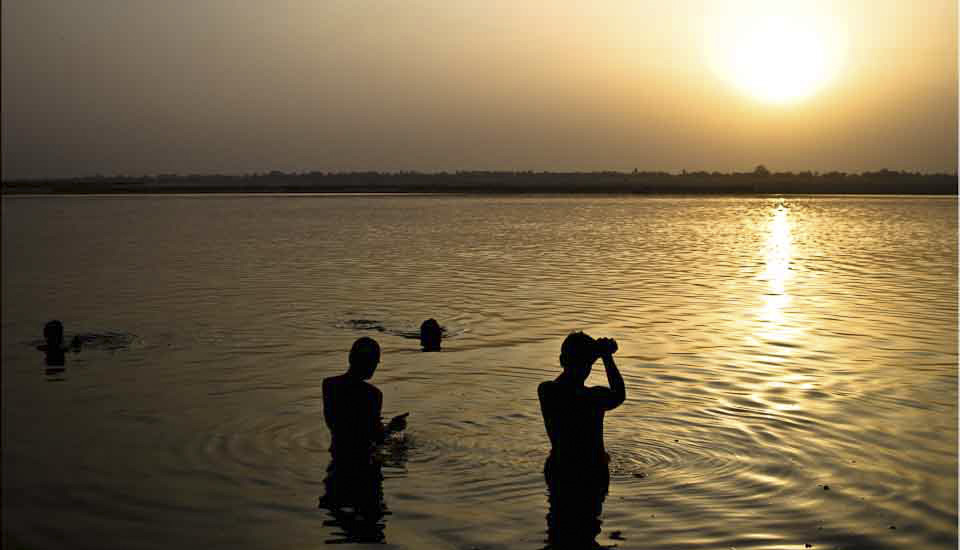
- Performing the Ganga Aarti from Dasaswamedh Ghat, Varanasi
- Buddha Head from Shwedagon Pagoda, Myanmar
- Harry Clarke Window from Dingle, Ireland
- Novice Monk Shwe Yan Pyay Monastery, Myanmar
Packets of 10 for $AU50.
Or - pick any photo from my Flickr or Wanders blog photos.


 It seemed a fitting end to our trek – to meet a ‘local’ going back the other way.




 Visiting, or being a voyeur is one thing, but if we had to change places, I don’t imagine I’d do very well. I keep trying to make my life simpler, but I admit, there is probably more in my suitcase than in some of these homes.





I note your comment about the rain, which reminds me when I was young and it rained I thought God was sad, perhaps He shared your sadness at leaving this magical place… thanks as always for taking me places I doubt I’ll ever actually walk but am ever so glad you shared them with me.
Well said and well done both the actual adventure and the story line you created. XXX
Many thanks to my two most vocal readers. 🙂