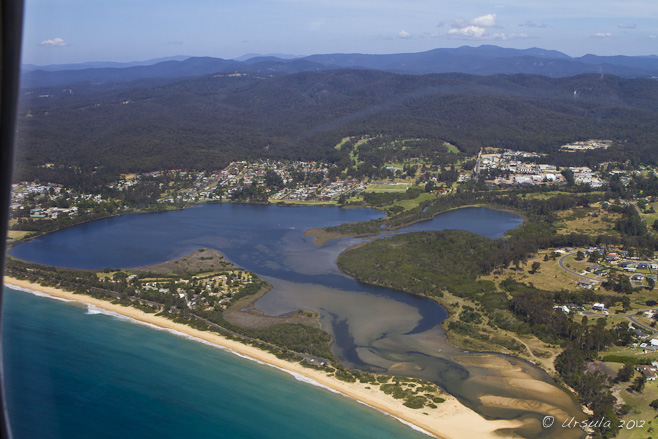
Looking across Aislings Beach and Lake Curalo to the Great Dividing Range, NSW
Nothing can beat a scenic flight over interesting terrain on a clear, sunny day.
We knew we were in for a treat when the skies over our patch of the Australian coast turned pink on the eve of a coastal flight we had booked in a small aircraft. For it is generally true that a red sky at night, with the setting sun sending its rays into a stable high pressure system from the west, indicates good weather is on the way.
And it was indeed a perfect day for flying.
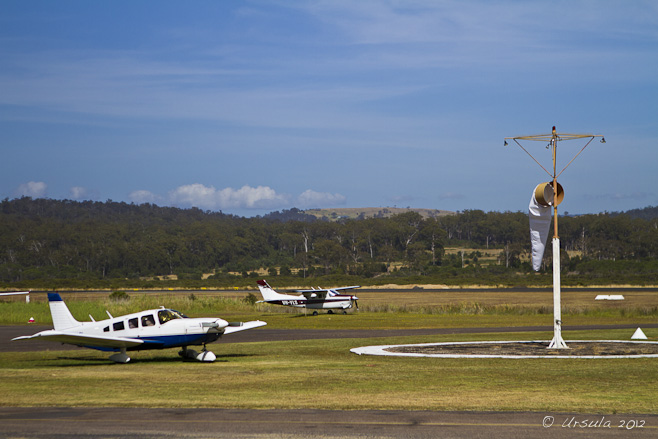
We met our Piper Cherokee Six – and its owner, veteran pilot, Andy – at the small coastal airport of Merimbula. Once we’d had our safety briefing and strapped on our life jackets, we were up and away; off on one of Merimbula Air Services‘ “Gabo Island Adventures”.
Our Piper Cherokee awaits.
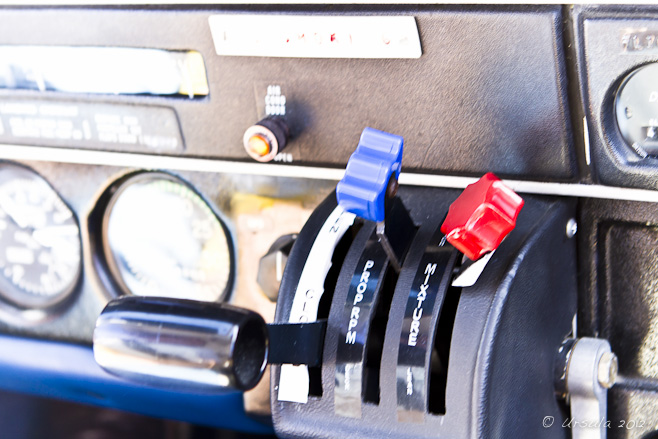
It's all under control.
Our regular lunch spot on Eden Wharf looks so different from the air!
The Tasman Sea crashes onto the red bluffs of the aptly named Disaster Bay, NSW. The City of Sydney (1853-1862) was the first of many ships to be lost in the strong seas common in this area.
The sand dunes and forests of Nadgee Nature Reserve straddle the border between New South Wales and VIctoria, and mark the end of the Bass Strait and the start of the Tasman Sea.
Gabo Island, with its lighthouse and grass landing-strip, comes into range.
The Gabo Lighthouse keeps watch over the ships and the weather on the Tasman Sea.
The first lighthouse was started on the current site in 1847, but the project quickly ran out of money and was abandoned until after the loss 30 lives in 1853, when the steamship Monumental City was wrecked on nearby Tullaberga Island. The current tower is Australia’s second tallest: 47 metres high and 55 meters above sea level. The lighthouse and surrounding fences and are built from beautiful red porphyritic granite quarried on the island itself. Buttresses were added to the fences following a freak wave in 1895 which washed over the island, damaging property.
Grass tussocks huddle in the lee of the buttressed red granite wall.
The island used to house three families: two light-keepers and a weather technician, but of course modern times demand less people-power. Today, there is always a live-in “caretaker”, and one of the other homes is available to recreational visitors or scientists who come to conduct studies. At the moment, two young scientists are in residence: one studying the feral rats who have come on to the island from ships, and the other studying the 30,000 strong colony of Little Penguins who come ashore to burrow every night.
Lighthouse-keeper's house: now the caretakers' accommodation and museum.
Scientist in Residence
Two-hundred and forty steps, all constructed in Manchester, England, lead up to the light.
Caretaker's accommodation from the top of the lighthouse.
Little Gabo Island hosts numerous pied cormorants.
Three visiting children, looking very small from the top of the lighthouse, race across the granite.
Exhibits in the old smithy.
Our pilot Andy sits at ease in the weather station as he talks about the island history.
Looks good, but don't touch! Yellow fungus on old asbestos roofing.
The island has its share of sad stories. As I said earlier, the lighthouse wasn’t completed until 30 lives were lost to a ship wreck in 1853. The governments of the neighbouring states later erected a monument in memorial. Up an overgrown, road there is a small cemetery with three headstone: for two infants who died in 1861, possibly from a contagious illness, and for a young woman who died later the same year in childbirth. As recently as 1929, a lighthouse-keeper’s wife died as a consequence of a fall when medical attention couldn’t be accessed promptly due to rough seas.
Memorial to those lost at sea in 1853 when the "Monumental City" went down.
Blackberries ~ almost in season.
Rail ties on the disused road to the old quarry.
Evidence of life: A bicycle and some sort of scientific paraphernalia sit at the side of the path.
Cows keep the island grass under control.
The old quarry and the impossibly-blue Santa Barbara Bay.
A pile of Gabo granite at the abandoned quarry. In the past, the granite was used in a number of Australian public buildings.
Rubbed smooth by wave action, the pink granite sits in the sapphire waters of the bay.
Santa Barbara Bay is a popular destination for Victorians coming from the mainland to picnic, swim and snorkel.
Time to return home ~ our Cherokee awaits.
Turquoise waters mark the 500 meter wide channel between Gabo Island and the mainland.
Pambula Lake is the last major sight before landing back at Merimbula Airport.
Mid-afternoon, we touched down gently back at Merimbula Airport. Merimbula Air Services call this trip: “A great day out!”, and indeed it was.
Such an amazing place, we didn’t do a flight however took one of the many cruises around the different bays and revelled in the history and marine life that surrounds Eden and the area generally. From the air it is quite magnificent!ReplyCancel
Looking for any info on Gabo Island Lighthouse Keepers
William Henry Owen and His Wife Christina Eleanor (Ellen)back in 1913 to 1918 especially any photos or history.
Summer in Australia’s “high country” is known for it’s clean crisp air, abundant wild flowers and various outdoor activities; it is possibly less well know for its music. But, during ski season there are plenty of live acts in the various pubs and chalets, and summers bring various festivals, including an Irish Cultural Festival and a Jazz Party.
“Personal venues” can be translated as small restaurants not designed for live music, making it imperative to book dinners early if you want a view of the performers unobstructed by walls, pillars or other diners. I don’t have enough of an “ear” to comment on the sound quality in these venues, but certainly found the chattering of other patrons annoying some times – and downright disruptive at others.
On the first evening, we stopped in for sets at a pub and a lounge before heading off to dinner at The Knickerbocker for what proved to be one of the highlights of our weekend in terms of food and service, and with respect to the entertainment: Hat Fitz and Cara Robinson.
Hat Fitz, the epitome of pre-war hill-country and delta blues, on his steel guitar.
Hat’s National Steel Guitar
I saw Hat Fitz perform many years ago at the Byron Bay Blues and Roots Festival, and thoroughly enjoyed his show. The addition of Cara Robinson, multi-instumentalist and powerhouse singer from Ireland, turns his already-good performance into magic. There were a couple of times we had goosebumps as Cara’s voice ranged freely across the scale and held notes effortlessly.
(You can click or double-click the audio link below for a studio version of their performance of Wiley Ways.)
Hat Fitz on guitar with Cara Robinson on percussion.
Cara Robinson on one of her wind instruments.
When Irish eyes are smiling…
Robert Susz, a ubiquitous presence on the live Australian music scene, pops in to play harmonica.
We knew it would be a hard act to follow, so while the different versions of the blues continued in pubs around Thredbo Village, we toddled home to our lodgings for a fresh start at the outdoor performances the next day.
Marco Goldsmith fronts the seven-piece rhythm & blues Blue Heat.
Robert Susz and Dave Brewer from the Mighty Reapers
Robert Susz on his harmonica.
Clayton Doley plays keyboard for the Mighty Reapers
Clayton Doley on keyboard and Vito Portolesi on bass for the Mighty Reapers.
Many hats in the audience.
Performing jazz, blues and boogie-woogie, the “Wild Women” Lisa Otey and Diane van Deurzen in the sunny Village Square.
The Kevin Borich Band rocks out.
It’s still Rock and Roll: Kevin and his National Steel
Cooling off ~ Hat Fitz hatless
Virtuoso Australian guitarist Jeff Lang
Shiny bits: Jeff Lang’s 1960s Black Airline
More Hats in the Audience
Sound Check
The staff race to put up umbrellas…
… but the rains over-take us – as they do at all good music festivals!
Inside the Black Bear with Steve Grieve …
… and Jo Jo Smith.
When the rains came, we ducked into The Black Bear for an early dinner, and rode out the evening on the songs of Jo Jo Smith accompanied by Steve Grieve, before returning home humming and smiling.
sounds like you had a great time… I never realised there was a Blues festival in the mountains, I knew about the Presley weekend in Parkes. I do wish they would publicize this stuff more widely. Back home and you sure know how to find the good stuff not just whilst travelling.. cudo’s!ReplyCancel
[…] for an excuse (as though one is needed!) to head into Kosciuszko National Park, and we enjoyed the Blues Festival there greatly in January, so we decided to try it out. I’m not about to wade into the […]ReplyCancel
[…] decided to ease in with something familiar, Hat Fitz and Cara whom we last saw perform at the Thredbo Blues Festival in 2012. In spite of Cara still wearing an eye-patch following a car accident last December, their […]ReplyCancel
[…] was our third visit to the Thredbo Blues (e.g., The Blues in Colour). I always have one or two acts on my “must see” list, but mostly I love the laid-back […]ReplyCancel
[…] was our third visit to the Thredbo Blues (e.g., The Blues in Colour). I always have one or two acts on my “must see” list, but mostly I love the laid-back […]ReplyCancel
Australia, when it is not being buffetted by typhoons, razed by bushfires, innundated by floods or ravaged by droughts, is blessed with a wonderful climate where sunny clear-blue skies predominate even in winter: truly a Lucky Country.
A couple of years ago, in preparation for our re-patriation from Asia, we bought a small house on the southeastern coast of Australia – our little patch of the Lucky Country – where we intend to retire.
The town is aptly named Eden.
Almost surounded by the eponymous Twofold Bay, this working fishing village and popular holiday resort boasts a safe deepwater habour for recreational and working boats at its heart, beautiful swimming and surf beaches within its boundaries and National Parks all around. It truly is a little paradise!
More about all of that some other time.
Our neighbourhood sits on an estuary, a salt-water inlet, where we can join others in walking running or cycling on the elevated Allan Gibson boardwalk, running through the tea trees. This is our little slice of paradise.
Morning mists on Lake Curolo (05 Nov 2011)
Rainbow Lorikeet over the Estuary (04 Oct 2011)
Little Pied Cormorants (02 Jan 2010)
Black Swans and Cygnets (04 Jan 2012)
White Faced Heron (02 Jan 2012)
It will take us some time to be able to identify the bird- and plant-life along the boardwalk; every time we run or walk along it there are different lights and colours.
Orange Flowers against the Tea Trees (02 Jan 2012)
White bottle-brush (06 Nov 2011)
The boardwalk runs beside the estuary (Lake Curalo) and into the tea trees. (09Nov2011)
Blue Fairy Wren (female) on a Guard Rail: Allan Gibson Boardwalk (02 Jan 2010)
Of course, we are not the only ones using the boardwalk, which links the estuary to a sporting ground, a camping site and the beach, and even when there are no people in view, they are in evidence. Weekends and holidays, it is busy with people cycling, running, fishing, walking or just sitting reading.
Boat on the Estuary (09 Nov 2011)
Lone runner on the boardwalk (06 Nov 2011)
Grasses in Lake Curalo (06 Nov 2011)
There is always a mixture of life on the boardwalk. (02 Jan 2012)
Fishing in Lake Curalo (31 Dec 2011)
Black Swans at Nightfall (05 Nov 2011)
Although we have moved in, it will probably be some time before we really “retire”. Still, when it is so nice being at home, we might travel a little less.
Thanks, Susan! Not exactly the Matterhorn, but we like it. 😉ReplyCancel
Judy Phillips -March 16, 2012 - 11:54 pm
I met you briefly at Coolem Q/land last September, we know Gabe through business and he gave me your card. I am thoroughly enjoying your photo’s and seeing your love of nature and travel expressed with joy through your photo’s. Keep up the great work.ReplyCancel
[…] am also a bit lazy, and aside from regular morning walks on my boardwalk (See: A Little Slice of Paradise), I tend to not explore my neighbourhood as much as I should. So, I’m always glad when […]ReplyCancel
OK, so tarantulas are arachnids, not "bugs", but there were bugs too, as you'll see later. 🙂
A “highlight” for tourists and travellers along Cambodia’s National Highway 6 between Phnom Penh and Siem Reap is the small town of Skuon, 75 kilometres north of the capital, where spiders – fresh and fried – are a specialty.
We, however, were going the other way – from Siem Reap south to Phnom Penh – so my fellow photo-travellers and I, under the tutelage of Karl Grobl, Gavin Gough and Marco Ryan, had all morning in our personal bus to anticipate our spider treats.
Our bus ride on the death-defying single-lane highway, which runs alongside barren fields with land-mine warning signs and gloriously green rice patties, was punctuated by stops. The first stop was at Spean Preah Toeus, the largest and most important of the 11 bridges remaining from the ancient Angkor Empire period. With 21 arches spanning the 86 meters across the Chhikreng River, this 12th Century laterite and sandstone structure (reinforced with modern concrete in the 1960’s) is a major part of an arterial network, and an excuse for a few shops and houses either end.
Spean Preah Toeus (Spean Kompong Kdey)
A Pause from Work: Spean Preah Toeus
A bright, unselfconscious smile lights up the face of a Khmer lad.
Solemn Faces: Girl and Grandpa at Home, Spean Preah Toeus
Old man at home in his "sampot samloy" ("pa kao mah" in Thailand), the woven cotton sarong worn everywhere in Asia.
General Store on the Main Road, Spean Preah Toeus
Modern traffic on the dirt surface of the ancient Spean Preah Toeus, Cambodia
Local Pony Express Transport Service: Spean Preah Toeus
The Pony Express Moving Men.
Our next stop was at the market in Kampong Thom.
I love the colour of local markets, but I find them challenging to shoot. This one was no exception; a roughly built wooden frame supporting a corrugated iron roof provided shade from the relentless afternoon sun bouncing off every surface outside, but made for a dark, stifling, hot and airless interior with blinding back-lights from the outdoors. The people were mostly very accommodating, but there were seventeen of us visitors in an already overly crowded space.
So, under-expose like mad and hope for the best!
Smiles for the camera! These vendors know there is little likelihood of making a sale from this busload of foreigners, but they are happy to be photographed anyway.
Chillin' with the Community
Timeless grace ~ Elderly Khmer Woman
Whenever I see water lilies in the markets, I think of the poignant multi-media piece put together by two of my colleagues. (It can be found at: https://www.jennykrasner.com/2011/10/blog/)
I haven't been keeping up with the latest Lightroom changes, so I spent a little time playing around with the new "curves". I rather like the effect of this over-coloured treatment of a woman making waffles on cast-iron forms in an open fire.
The waffles were pretty good, too!
Sad-faced khmer girl outside the Kampong Thom market.
Our last, much anticipated stop before reaching our Phnom Penh accommodation, was the small town of Skoun (or Skun), where people breed the high-protein local tarantula species (Haplopelma albostriatum) that is a popular delicacy. The street-side market at the junction of two highways also sells a variety of edible insects, as well as fruit and vegetables.
Tarantulas for sale! Skuon
"One man's meat is another man's poison." Delicacy? To me, they just look hairy and horrible!
More local treats: spicy fried cicadas.
Yummy! Battered crickets.
"Sexy Bitch" with an innocent smile.
Beautiful young woman ~ few opportunities.
No need to stress... Saleslady and her mangosteen, pomelo and pineapples.
The tarantulas on sale here have been called “edible spider” in Khmer for more than a hundred years. Although it has been suggested that they became more popular during the Khmer Rouge years when other foods were scarce, fried insects are also popular in Thailand (see “Buddhas, Bugs and the Burmese Border”) and other parts of Asia.
Ursula, this is a wonderful post… the photos are fantastic and they bring back such vivid memories of the trip down National Highway 6. You really captured the essence of that day and obviously,you also did quite a bit of research about the area, and about Cambodian culture and thus, you have provided me and all your viewers a “complete package”. Bravo on another amazing blog post! I can’t wait to see what you come up with next! All the best, KarlReplyCancel
WOW, great share as always, I’m with you on the waffles and the spiders, I respect them and try not to kill them but eat them NEVER….stir fried or battered no bugs for me thanksReplyCancel
Thanks for joining me, Signe. None of our group tried any of the six- or eight-legged treats. I have had to eat ant eggs once, to be polite, in Thailand – and of course, green ants in Northern Queensland, but I sure don’t make a habit of it!ReplyCancel
[…] the stalls, the faces of the people, the goods on sale. While some feature edible insects (e.g. Morning Markets and Bugs for Lunch, Cambodia), others specialise in flowers (e.g. Pyin Oo Lwin Flower Markets, Myanmar; Fragrant Flowers […]ReplyCancel
Buddha on a Hill, Sai Yok, Kanchanaburi Province, Thailand
I love the concept of a “new year”.
I always have. As I said this time last year, I like to regard the period between New Year’s Day and my birthday, which follows closely after, as a time of quiet contemplation – to look back over the accomplishments (or otherwise) of the year before, and make some decisions about directions and priorities for the year ahead.
This coming year is the year of the water dragon in Chinese astrology and “will be marked by excitement, unpredictability, exhilaration and intensity.” With predictions of Armageddon by some religious groups (12/12/2012), and with Nostradamus purportedly predicting the end of the world on a date which coincides with the end of the Mayan Calendar (21/12/2012), many people are watching global natural disasters and political unrest with pessimistic interest.
For my husband and myself, this New Year marks the move from Bangkok, an Asian city of between 12 and 16 million people, to a small Australian coastal town of just over 3000. It also marks our shift from busy paid employment to slightly less-busy, mostly-unpaid employment.
The coming year will also see small changes in my “Wanders”. We will still be “globe-trotting” for work and family commitments – and for fun and photography – and we already have plans in six countries. But we will be exploring Australia, especially our own corner of it, a bit more. I may even get back to the archives and relive some “previously unpublished trips”.
The Buddha's Appeal for Peace
So, watch this space.
In the meantime, we will spend New Year’s eve and day unpacking: we’re surrounded by boxes and furniture from two separate locations piled into a house that is smaller than either.
But, we will always take time to count our blessings.
The photos here comprise a portrait of a Buddha on a hill in the middle of small roads and jungle in the Western reaches of Thailand. It was around this time last year that we were driving past it daily from our hotel on the River Kwai Noi as we played hosts to relatives from overseas. One of our guests asked if we could stop and see the Buddha up close; it hadn’t occurred to me to visit it because, living in Thailand, I had become so accustomed to buddhas on every hill!
Golden Hand of a Large Standing Buddha
Looking up to a Golden Gautama Buddha Image
Buddha's Back
Buddha's Blessings for a Happy New Year
As Buddha images go, it was a nice one. And it provides us with a timely reminder to stop and smell the flowers – and to pay respects to the Buddhas – especially in these “unpredictable” times.
Now I need to get back to unpacking; if the world is to descend into chaos, I want a orderly house!
Wishing you peace and happiness in the coming year.
seems to me boxes will be the order of the day for at least the next few. Have a great time, and may 2012 be all you’ve ever hoped for.. much loveReplyCancel
[…] This time last year we were barely into our current home, surrounded by boxes and chaos. In the intervening twelve months, we’ve managed to carve out some order and to adjust to a different kind of lifestyle in a vastly different environment. But we have also been “on the road” and away from our house for at least half that time. […]ReplyCancel
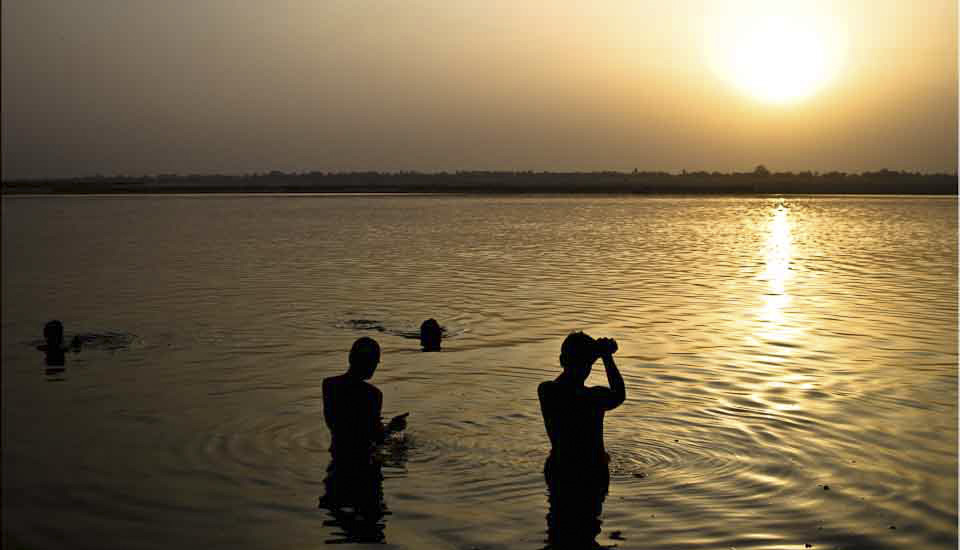
- Performing the Ganga Aarti from Dasaswamedh Ghat, Varanasi
- Buddha Head from Shwedagon Pagoda, Myanmar
- Harry Clarke Window from Dingle, Ireland
- Novice Monk Shwe Yan Pyay Monastery, Myanmar
Packets of 10 for $AU50.
Or - pick any photo from my Flickr or Wanders blog photos.










 Although we have moved in, it will probably be some time before we really “retire”. Still, when it is so nice being at home, we might travel a little less.
.jpg)


 Me, I settled for the photos.


 As Buddha images go, it was a nice one. And it provides us with a timely reminder to stop and smell the flowers – and to pay respects to the Buddhas – especially in these “unpredictable” times.


Such an amazing place, we didn’t do a flight however took one of the many cruises around the different bays and revelled in the history and marine life that surrounds Eden and the area generally. From the air it is quite magnificent!
Hi, Signe,
We haven’t had time to appreciate the area, really – haven’t even been to see Old Tom! But, one day at a time, right? x
wunderschöne Foto’s, ich wünsche Dir noch eine interessante Zeit in Australien
Hi Dietmut,
Nice to have your visit! I’m always glad to be able to understand a little German, even if I can’t speak it. 😉
We will, indeed have an interesting time in Australia. It is a fascinating place and provides me with new challenge photographically!
I see you have been in Hamburg recently: one of my favourite German cities.
Viel Glück! 🙂
Looking for any info on Gabo Island Lighthouse Keepers
William Henry Owen and His Wife Christina Eleanor (Ellen)back in 1913 to 1918 especially any photos or history.
Regards
Robert Hoglund
Donvale, Vic
Hi Robert,
Thanks for your visit to my Travel Blog.
Our trip to Gabo Island was five years ago; I don’t remember the names of the people who’s stories are illustrated in the little museum. The island is managed by the Parks Victoria – may I suggest you contact them?
(http://parkweb.vic.gov.au/explore/parks/gabo-island-lighthouse-reserve)
Cheers, Ursula
[…] For the backstory, please visit my PhotoBlog: https://www.ursulasweeklywanders.com/aviation/red-sky-at-night-sa… […]