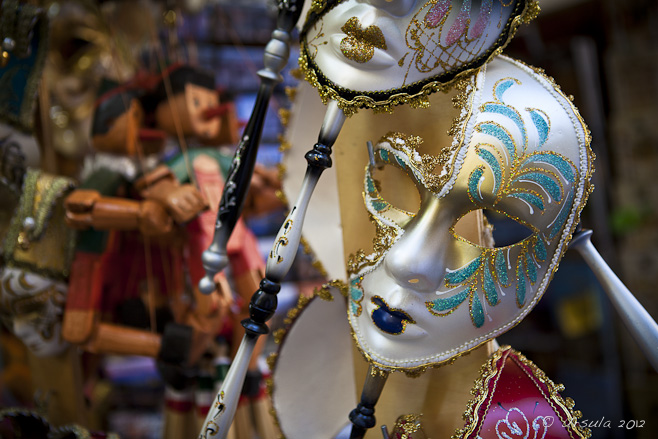
 Masks and Marionettes 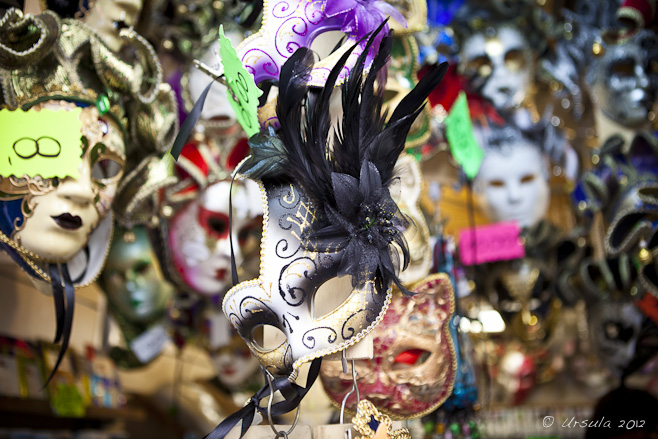 Feathers and glitter. 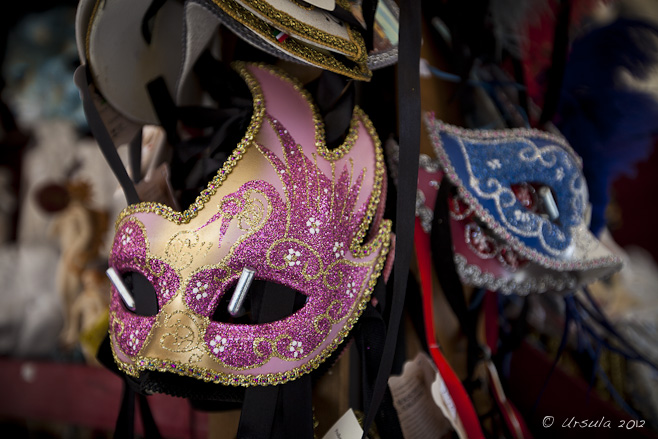 Florentine masks. Masks and marionettes…
In the street stalls and in the shops: elaborately sequinned and feathered masks of all sizes and shapes, and Pinocchio marionettes, pencils, pictures and paraphernalia.
 Pinocchio marionettes and Florentine masks. Pinocchios on strings. Apparently, Florence was the birth- and resting-place of Carlo Lorenzini (1826 – 1890), who (as Carlo Collodi) wrote the original stories of the woodcarver Geppetto and the marionette he crafted and named Pinocchio.
This is one of the many facts about Florence or Firenze that I didn’t know before visiting that fabled city last week.
My daughter and I were taking advantage of a cheap deal: one of those last-minute-specials that are available in Europe if you are willing to weekend with no more than you can carry in one small bag. Whatever I learned about the birthplace of the Renaissance in art history I had long-since forgotten, and my knowledge of the Medici family and the religious and political struggles in Italy is negligible.
So, before going, I looked Florence up on the web, and found a Top 10 Things to Do list, which I scanned and emailed to my daughter. But, we’ve been busy. By the time I was on the plane, I couldn’t remember anything about the art and the museums; all I could remember was the instruction to eat two scoops of gelato a day. I can do that!
My daughter wanted to see David, who (for reasons of modesty?) declined to be photographed. So, we had three days and two tasks: David and gelato. Lots and lots of gelato.
Fresh fruit, chocolate and coconut ~ all in gelato form. Colourful gelatos are an integral part of the Florentine streets. It didn’t take long, walking through the streets and markets, to realise that while Florence is the home of masks (which I had thought of as Venetian) and marionettes (which I hadn’t thought about at all), it is also home to all kinds of beauty, in leather, glass, ceramics, paper and jewels.
The street markets are full of colourful leather coats, bags and gloves. Shops sport shoes and boots in gelato shades. The magnificent churches aren’t the only place to find stained glass in all forms and styles. Ceramics are everywhere: from ornately gilded and painted vases, jugs and containers ~ ~ to Renaissance figurines ~ ~ and “Tuscan” glazed pottery. Beautiful paper-products are hand-made on site. Deep, dark shops sell life’s staples: wines and cold-cuts. Breakfast at Tiffany’s? The beauty of Florence is in its streets; in its world-renowned architecture.
Florentine rooftops. Beauty on the pavements: A chalk Mona Lisa. Cheerful carousels. Violent struggles. Conquest. The magnificent Santa Maria del Fiore Cathedral (Duomo) is a work of art in and of itself. The Ponte Vecchio, now home to expensive jewellery shops, is a glorious reminder of Florence’s equally decadent past. Of course, people-watching is much more fun than architecture, and Italy is always a treat.
The modern Italian family – dressed for a special occasion. A street musician, with his adoring fan, plays chill music. And as a Florentine finale: newlyweds on a bicycle – what could be more Italian? 
The city was bathed in heat and light – a wonderful change from the rain and overcast I’d been enduring for the previous five weeks in England, Ireland and Wales. I fully understand why people love the city – I’d go back any day, and not just for the gelato.
But, I’d be sure to have my two scoops a day!
Bon appétit!
Photos: 10-13July2012
Posted in Architecture,Craft,Fine Arts,Italy,TravelTags: architecture,arts and crafts,blog,Italy,market,Photo Blog,sculpture,travel,Travel Blog,Ursula Wall
Karen Girl in Pigtails Late into our last visit to Thailand, I made another trip “up-country” to visit schools deep in the hills of Mae Hong Son. I’ve talked about previous trips (Budding Potentials, Building Better Futures, Schools at the end of the Road, and True Colours) in several previous posts, but I never tire of accompanying the indomitable Susan Race on her visits north to interview study-scholarship recipients and to inspect building projects.
I’m a little slow on posting about this particular trip for a number of reasons: early into day two my brand new camera decided to stop working (this sort of thing happens to me a lot!), so I was limited in the pictures I took; I’ve been on the road constantly since then, and so am distracted by other things; and most importantly, about two years ago, I promised Susan a website, which I still haven’t finished.
Fortunately, Susan is a very patient woman, which explains how, brick-by-brick and student-by-student, she has succeeded, over the last 20+ years, in improving school retention rates for children living in remote Hilltribe villages in several districts within the Mae Hong Son area of Chiang Mai. You can read more about that when I get the website finished! In my defence, I didn’t know the first thing about web-design or web-construction when I made that rash promise, and it has been a long, slow learning process.
There is a small teaser to the site on the sidebar at the right. At the moment, the link effectively goes to a “bookmark” and no further; the rest will happen in the next month or so… Watch this space!
When I have some free time, I do plan to write more about that particular trip and the various projects we visited and the students we met, but in the meantime I will share a few pictures from the first school we visited: Ban Huay Sa Paet School in Chom Thong district, Chiang Mai Province.
When we arrived at the school, the children were all sitting outdoors, on the wide bench around the bodhi tree, practicing their reading.
Under the bodhi tree in the school yard, Karen children practice their reading together. On Fridays, children come to school in traditional dress. Thai is a second language for these children, as they all speak Karen at home. Two Karen girls in their beautifully embroidered hand-woven dresses smile for the visitor. The boys have that impish sparkle in their eyes that says: “Here’s trouble!” Two girls work on their maths problems in the classroom. A young teacher at the school. Behind the school, there is a weaving area – one of the Queen’s projects – where Karen women weave cloth for export to the city. Weaving requires co-ordinating foot pedals with the shuttle on the weft thread. The weaver is pleased to pause for a picture. The children are happy to take time away from their reading to show the visitors around. Boys join us in the weaving room. Before we can leave, Susan Race (centre) has to have her photo taken with other Expat visitors from Bangkok, men from the District Education office, and the students. While gathering sponsorship money to build auxiliary buildings and support children’s educations, Susan has also been building relationships. Everybody in the area knows her – and knows her energy and staying-power. Neither she, nor the teachers she works with, like Kru Apichart, whose new school this is and who is pictured in Schools at the end of the Road, are ‘fly by nights’. All have demonstrated a longterm commitment to improving educational access for Hilltribe children in the remotest of Thai communities.
The perfect man for the job of official photographer: Khru Sunthorn, another of the dedicated teachers who has been part of helping make Susan’s THEP projects work for more than twenty years.  These faces certainly make me feel better on a gloomy day in London! These faces certainly make me feel better on a gloomy day in London!
As does the knowledge that these children, at least, are getting the educational opportunities they deserve.
Enjoy.
Pictures: 25May2012
Posted in Culture,Education,Thailand,TravelTags: blog,children,education,Mae Hong Son,people,Photo Blog,portrait,portraits,rural,thai,Thailand,Thailand Hilltribe Education Projects,THEP,travel,Travel Blog,Ursula Wall
Blarney Castle grounds and entry tower. “Did you kiss the stone?” my daughter asked me by phone from London.
“No, but I kissed someone who did,” I replied, laughing. “They say that that is the next best thing.”
Now, I could tell you that I didn’t kiss the Blarney Stone because, as I end my second year of Weekly Wanders, I don’t want to add more gab to my postings, but that would be blarney.
Truth is, after exploring the gardens in the pouring rain and working my way around the castle and up the wet and narrow stairways, I couldn’t cope with the idea of removing my hat, glasses, raincoat, umbrella, two cameras and camera bag – all while standing exposed to the wind and rain at the top of the battlements – in order to be suspended upside-down by a gruff man in a raincoat so that I could kiss a rock. My husband, however, was more amenable, and I reckon that was enough for both of us!
I didn’t mind missing out, because – to my mind – the real joy of a visit to Blarney Castle is a walk through the extensive gardens, and taking in the charm of the castle itself. It rained on the day of our visit (as it has just about every day of our stay – Ireland has just finished the wettest June on record), but this only added to my sense that there might just be faeries around the next corner…
It may be summer, but the visitors in the grounds of Blarney Castle, across the River Martin are rugged up in raincoats or huddled under umbrellas. Fir boughs, laden with rain, hang low over a pathway. Rain drops and spider webs cling to delicate plants. Water falls over the Wishing Steps. According to the story, if you walk down the Wishing Steps then backwards up them with your eyes closed, thinking of nothing but your wish, it will be granted. It is easy to imagine flower-fairies living here. This stone is said to be the likeness of the Blarney Witch, who wanders the woods looking for fire wood. The Druid Stones are mossy and over-grown. All that rain is how the island stays “Emerald.” What is left of Blarney Castle (built in 1446) is rather plain on the exterior. Without the benefit of a roof, it is as wet inside Blarney Castle as outside. Moss and ivy grows where the kitchen once operated. On the ramparts, people gather for their kisses. The formal gardens from the ramparts. Hanging from the wet Blarney ramparts to kiss the ancient stone – the ground is far below. Every castle needs a back entry. The paths wind around the castle and back through more gardens. In the still-wet gardens outside the castle, trees from around the world are on show. Tower beside the Blarney River. In the “Poison Garden” there are examples of medicinal plants, including foxglove (digitalis). Ivy grows everywhere. A simple rose climbs the old iron fence.  I didn’t notice any improvement in eloquence from my husband – or indeed myself – but I was entranced by the castle site and left it with pink cheeks and a happy heart. I didn’t notice any improvement in eloquence from my husband – or indeed myself – but I was entranced by the castle site and left it with pink cheeks and a happy heart.
That is its true gift.
Sláinte! Good health!
Photos: 2012June18
Posted in Architecture,History,Ireland,Nature,TravelTags: architecture,blog,flowers,nature,Photo Blog,ruins,Travel Blog,Ursula Wall
With an air of calm, two Buddhas preside over Wat Phra Si Rattana Mah (Wat Phra Prang), Si Satchanalai Thailand is rich with the textures of life and history.
I’ve talked before about our recent visit to Sukhothai, or more properly, the UNESCO-listed “Historic Town of Sukhothai and Associated Historic Towns”. One of those “associated towns” is Si Satchanalai (or Sri Satchanalai, depending on whose transliteration you follow).
The trees and rice patties were full of birds as we drove north on country roads. Here, flocks of Asian Openbills perch in the rice fields. Fifty-five kilometres north of Sukhothai along country roads flanked by fields and rice patties, the ancient city of Si Satchanalai on the banks of the River Yom is in a tranquil location. In addition to various ancient wats (temples), the park includes important archaeological sites where some of the world’s earliest celadon kilns have been uncovered and preserved. In the 14C, Si Satchanalai was the biggest ceramic producer in Southeast Asia, exporting its prized Sangkhalok pottery as far afield as Japan, China, Indonesia and the Philippines.
Old trunk; new growth. Wat Chedi Chet Theao I was struck by the peaceful quiet of the grounds. I am not alone in actually preferring the somewhat understated ruins here to those of the better-known Sukhothai site.
The city and surrounds date back to the 6th century, when the inhabitants were producing tools, beads and terracotta. In the 12th and 13th century, the area was under Khmer control. While this has had little influence on the remaining buildings, the giant fig at Wat Chedi Chet Theao was reminiscent of Ta Phrom at Angkor.
The quiet of a giant ficus. Wat Chedi Chet Theao Smooth growth; rough laterite bricks. Wat Chedi Chet Theao Suggestion of a Buddha, Wat Chedi Chet Theao Visiting monks add life to Wat Chang Lom Many of the ruins date to the rule of King Li Thai (1347-1368) when several buildings were renovated or constructed.
After the death of King Li Thai, the city came under the control of Ayuttaya, before again becoming part of the Sukhothai kingdom in around the 15th century.
Elephants on guard: Wat Chang Lom (Rob) Ruins on the green: Wat Nang Phaya A newly ordained young monk or “nehn” travelling with his elders: Wat Nang Phaya Wat Nang Phaya features laterite blocks decorated with early-Ayutthaya style stucco. Thai temples are full of surprises. We climbed up the hill that houses Wat Khao Phanom Phloeng and Wat Khau Suwan Khiri to be assailed by a cacophony of chittering and the ripe smell of too many animals in one place. I thought it was monkeys or bats, until I looked to the tree-tops to find them full of water-birds: herons, egrets and stork – all squabbling for perching and nesting spaces.
Tree-tops full of cattle egret, with their golden nesting-head-plumage. An egret and a heron share the tree-tops. Asian openbill storks look too big for the trees they are sharing with herons. Several nests contain eggs or chicks. Not all the chicks make it; more than one chick lies on the ground around the temple. Impromptu cairns dot the Wat Khao Suwan Khiri surrounds. A dead leaf seems to illustrate the story of the temple history. As the afternoon lengthened, we drove off the main Si Satchanalai site to another temple located close by, in the fold of the river. We arrived just ahead of the travelling monks who were visiting from a central province east of Bangkok and were greeted by a seemingly ancient man playing a simple stringed instrument and hoping for payment. Naturally, we obliged!
Elderly Thai Musician – Wat Phra Prang Buddha – Wat Phra Prang A senior monk poses for his picture. Wat Phra Prang Ancient laterite wall: Wat Phra Prang Giant standing Buddha – Wat Phra Prang As if to remind us that all things pass – all things change – a Buddha sits with its head fallen. Next door to the old temple ruins of Wat Phra Prang (Wat Phra Si Rattana Mah), new works are being undertaken to expand the new temple of the same name.
The worker on the foundations of the extensions at the new Wat Phra Prang, when asked, said proudly: “Pen khon sukhothai!”: “I am a Sukhothai person!” So, the past links to the future. And the cycle continues.
Happy travels!
Photos: 21May2012
Posted in Architecture,Culture,History,Museum,Religious Practice,Thailand,TravelTags: ancient,architecture,blog,buddha,buddhism,buddhist,history,museum,people,Photo Blog,religion,Religious Practice,ruins,Sukhothai,Thailand,travel,Travel Blog,UNESCO,Ursula Wall
Crystalware Our travels can be a little haphazard sometimes.
We had work and family business in England, so we decided to go walking in the south-west of Ireland. (More about that soon.) Once I had booked our walking trip, I contacted an old friend and colleague from Thailand who had moved back to Ireland some years ago, to see if we would have the opportunity to cross paths. He and his family are in Waterford, which is not far from the Irish Ferries’ dock at Rosslare. So, that was a good enough excuse for a stopover, en route to County Kerry.
Now, as it turns out, Waterford is Ireland’s oldest city, having been established by the Vikings in 914. They called it Veðrafjǫrðr; “Ram Fjord” or “windy fjord”, and sections of the city walls they built still stand.
New growth on an ancient Viking wall ~ Waterford is an interesting mix. Bits of the remaining Viking wall and towers, with later Norman “improvements”, are scattered around the charming and modern city centre of Waterford. After successive attempts, the King of Leinster, with the aid of Norman mercenaries under Richard de Clare, Second Earl of Pembroke (Strongbow), took Waterford in 1170, marking the entry of the Anglo-Normans into Ireland. The rest, as they say, is history.
I didn’t know any of this when I made our plans to stay there. Nor did I realise it was, and is again, home to the Waterford Crystal factory. I’m not a particular fan of cut crystal, but as we were going to be there for a a day, a visit to the factory seemed like a good plan.
As it turned out, watching crystal glassware being made by true craftsmen was an interesting and worthwhile experience.
The modern crystal manufacturing plant and showroom in downtown Waterford was opened in June 2010. Tours of the facility run regularly. Alison, our guide, gives us a brief rundown of the company history. Wooden molds are used for limited edition items; steel is used for production items. The pear-wood moulds for crystal blowing are quickly charred by the molten glass. Making crystal is skilled and labour-intensive. The “blowers” have served apprenticeships of up to six years and need to handle more than one task. The furnaces for melting the glass mixture are over 1,200 degrees centigrade. Turning and shaping the “gob” of molten glass. “The craftsmen have to be, not only capable of working in a team, they also have to be quite athletic.” (https://www.waterfordcrystalworld.com) The newly-blown vase is cut away from the blower. Glassware is annealed on a slow-moving belt through special ovens. Water acts as a coolant as the excess glass is trimmed off … … and as the edges are ground smooth. Marking up patterns can be as “easy” as markers strapped to a turntable. A selection of cut and partially cut crystal trophies and vases – including a London Olympic Games trophy, sit on the marking table. Cutting the crystal takes strength and concentration. Water is again used as a coolant. A cutter is happy to show off his work; it makes a break from the concentration! “Well, I’ve been doin’ it for on forty-four years.” A display of some of the special Waterford pieces. A work station with engraving tools. Art, craft and work… Waterford shop display room. Sales staff check inventory. Chandeliers over a table set with Waterford crystal and table-ware from the partner-companies Royal Doultan and Wedgwood. Carved crystal stemware.  I’m still not cut-crystal’s biggest fan, but I’ve gained a new appreciation for the work and skill that goes into it. I’m still not cut-crystal’s biggest fan, but I’ve gained a new appreciation for the work and skill that goes into it.
And we did buy one or two pieces…
Pictures: 16June2012
Posted in Craft,Fine Arts,History,Ireland,Travel,WorkTags: arts and crafts,blog,Ireland,Photo Blog,travel,Travel Blog,Ursula Wall,work
« Older posts
Newer posts »
|










Oh Ursula – I am so jealous! Florence looks so beautiful!
I WANT TO GO TO FLORENCE!
I WANT TO GO TO FLORENCE!
I WANT TO GO TO FLORENCE!
(Stamp, stamp, stamp!!!)
Anna :o]
Oh Anna!
Those of you who live in England can go ANYWHERE, as my daughter (who has been agency-nursing in London this year) is discovering. The
Groupon specials turned out to be a great deal.
But, next time, we can go together. 😀
I agree with Anna, what a magical place I wanna go too!!!!!!!
For you, Signe, it’s only three flights and a bus away! 😉
A very beautiful and colorful series Ursula. The ice will you have tasted. My granddaughters are also crazy of Italian ice. They are at the moment in Italy. Greetings Dietmut
Hi Dietmut,
I’ve no doubt your g’daughters are having a wonderful time – Italy is such a pleasure!
Thanks for the visit. 🙂