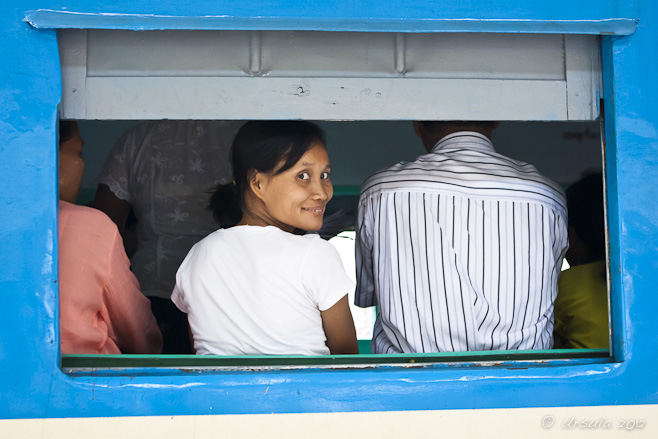
A woman on a crowded Yangon train is quick with a smile for the camera.
After thirty-six hours of airplanes and airports, and sixteen hours of sleep, I’m sitting on my balcony with a coffee while welcome swallows and noisy miners swoop around my head. My ears are ringing with the screech of lorikeets and rosellas as they jockey for position in our trees, and light is falling on the estuary as the pelicans glide in for graceful landings.
It is nice to be home, but my head is still swirling full of images of monks and temples, stilted houses and leg-rowing fishermen. I’ve just had the privilege of spending two weeks in a different time and place: in Myanmar, a magical land poised on the brink of change. I’ve come home with full CompactFlash cards, a full hard drive, and a full brain; it will take me ages to sort through the images and impressions.
Where to start?
With the golden beauty of Schwedegon Pagoda? The iconic wooden U Bein Bridge? The confusion and noise of colourful markets? The profusion of purple-robed monks or pink-clad nuns? The mystic calm of the Began stupas? The balletic-grace of Inlay Lake’s leg-rowing fishermen? The shy smiles of the people everywhere?
In the end, I’ve decided to leave the more “iconic” images for later, and to start at the end: with the oppressively hot, crowded and chaotic Yangon ring-train, where the dusty darkness inside the old carriages contrasts with the blinding light outside, where the fragrance of fresh flowers alternates with the stench of dirty refuse, and where the press of people transporting themselves and their belongings or wares around the rails of Yangon provide a microcosmic view of the country as a whole.
I was travelling with photojournalist and phototour-workshop leader Karl Grobl, his trusty Myanmar “fixer” and guide, Mr. MM, and nine other intrepid culture and photography enthusiasts. For two weeks we’d been touring around this amazing country, treated to local sounds and sights, tastes and smells; searching for “the” iconic Burmese image – all while fiddling with ISO settings, f-stops and exposure compensations. The Ring Train was our last stop and ultimate test: to find subjects in the dark and crowded carriages; to find light where there wasn’t any; to manage exposures in rapidly changing conditions – in short, to make pictures in a nigh on impossible situation.
Most of the the pictures I attempted that day will never see the light of day, but I found a few that I think give us a glimpse into everyday Burmese life.
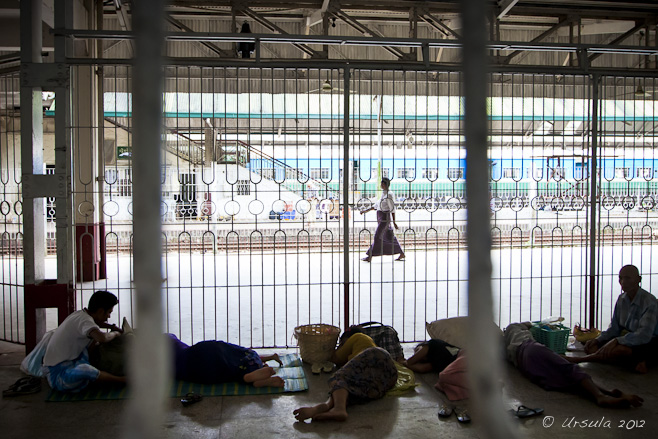
Stark Contrasts: extremes of light and dark illustrate the difference between long periods of waiting and sleeping on the floors, and the purposeful rush when the right train comes in.
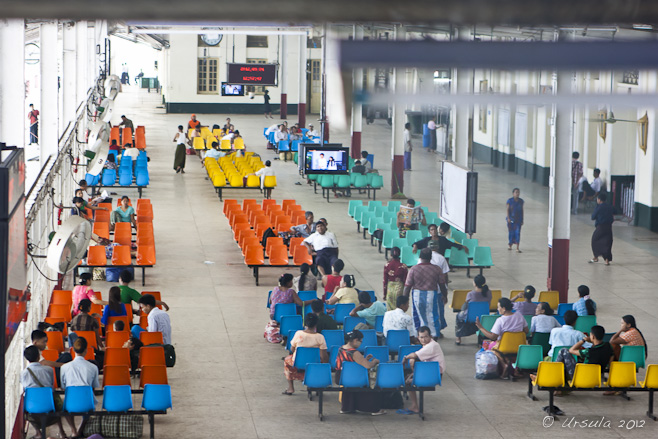
Waiting in Colour: The railway station in Yangon was a much more orderly place than I expected after my experience of trains in India.
Burmese Tracks: The current Yangon Central Railway Station was built in 1954 in Burmese style.
On the Platform: One of the hallmarks of Asia is people’s ability to wait…
Water for travellers is shared all over Myanmar: for a scarce and precious resource, people seem to be rather profligate with it!
Passing Passenger: An elderly Burmese gentleman smiles for the tourist.
Posters all but obscure the platform office. The man working the window is barely visible.
A Glimpse into the Office: With the oppressive heat and humidity, and minimal ventilation, it is no wonder that this worker is down to his singlet.
Waiting for the train.
Portrait of a Burmese Theravada Buddhist monk – after he put his cigarette out!
All over Myanmar, women carry goods on their heads effortlessly.
Contrasts: a man looks out from the dark train interior to the bright Yangon afternoon.
Trussed live chickens vie for space on the floor of the railway carriage.
Looking through the crowds out onto a Burmese train platform.
And the world goes by…
… Jump!
A face in the crowd.
This old lady had a bucket full of kyat, so was doing quite well begging on the train.
Betel nut and “betel quid” chewing is ubiquitous in Myanmar. Even on the trains, vendors are ready to fix a chew or three.
The snack vendor is ready to change train cars; she hasn’t sold much on this one.
Daughter and mum – both sporting thanaka,the cosmetic paste made from ground bark, on their faces.
Markets are everywhere; the military presence is reportedly less than it used to be, although visitors like us still meet friendly “strangers” who ask pointed questions about our group’s size and purpose.
Looking outside.
Vendors squat on the floor where they can find space, selling their food and drink.
Myanmar is home to a number of ethnic groups – most of whom get along well, notwithstanding various fights for independence going on around the country.
Harsh light can’t dim a beautiful Burmese smile.
A cherished boy-child is there to farewell me as I finally leave the Ring Train in the same place I got on.
Like I said, just a glimpse into the colour and magic that is Myanmar; I can only hope it retains what is good and innocent as it is thrust, with the opening of it’s borders, into the future.
I will get back to the more “classic” images soon – in the meantime, I wish you Happy Travels!
Love it, love it, love it!
Ursula, you did it again….capturing the essence of the story through your engaging images and rich, colorful, descriptive text. It’s a wonderful package with your signature “Ursula insights” and your vivid descriptions, all of which make us all feel like we were along for the ride (and some of us were…and we all wish we could describe it as eloquently as you did). Thanks for sharing. Bravo on a story well told. In-flight magazines across the region are in need of stories like this one!
Cheers,
KarlReplyCancel
Wow, transported me right back there In an instant. We “worked” the same car, so wonderful to see your perspectives. When I am “homesick” for Myanmar, I will be a frequent visitor to your blog!! Please keep posting!! Great story!ReplyCancel
Bonnie Stewart -October 1, 2012 - 1:14 pm
Great job Ursula! Wonderful story and pictures. Enjoyed meeting you. BonnieReplyCancel
[…] about the “Circle line” (one including a multimedia piece the other just photos) and a more comprehensive blog post about the journey, wonderfully crafted by Ursula Wall, just click the appropriate link and […]ReplyCancel
“I want people to be overwhelmed with light and color in a way they have never experienced.”
~ Dale Chihuly
Dale Chihuly’s Japanese-inspired Niijima Float Boat and Ikebana Boat.
I was first “introduced” to Dale Chihuly’s glass installation-artworks in Canberra in 1999.
It was while I was wandering around Floriade, Canberra’s festival of spring flowers which is held annually in the park along Lake Burley Griffin, that I came across a version of the Ikebana Boat floating in a pond. This was back in the days of film, but the sight of that glass-filled boat, in amongst the water-weeds, so impressed me that I made framed prints of one of the photos I took.
So, I was really pleased to be able to visit the relatively-newly-opened Chihuly Garden and Glass Exhibition in Seattle Center, Seattle’s 300,000 square-meter downtown parklands, arts and entertainment complex.
Chihuly is a bit of a local hero in Seattle: billed as a “true Northwesterner”, he was born and raised in Tacoma, less than an hour away, and did his early study in the region before moving on to other parts of the country and overseas. In 1971 Chihuly co-founded the Pilchuck Glass School, an international center for glass-art education in Washington State, and he is still very involved with education and arts organisations in the region.
The Chihuly Garden and Glass Exhibition opened on May 21, 2012, after being first proposed by the Space Needle Corporation in 2010, and being approved by Seattle City Council on April 25, 2011.
The International Fountain, build in 1962, is one of the features in the 300,000 square meter Seattle Center park, arts and entertainment complex.
Seattle Center is a centre-piece of every-day life.
The iconic Seattle Space Needle
Chihuly glass sculptures and Seattle Centre buildings reflected in the base of the Space Needle.
An attendant outside the exhibition space helps visitors find their way through the busy Seattle Center park.
The “Glass Forest” concept came out of an exploration of blowing glass to resemble botanical forms. The pieces are blown from the top of a stepladder so the glass can flow to the floor.
In the Northwest Room, walls are decorated with some of Chihuly’s early influences, as represented by his collection of Native American photographs, weaving and tapestries.
Delicate threads and beads are embedded in the soft shapes of Chihuly’s baskets, cylinders, and soft cylinders; all inspired by Native American basket and textile weaving.
Colours and shaped in the Sealife Room.
Part of the Persian Ceiling fixture.
Chihuly says the Mille Fiori (a Thousand Flowers) series was inspired by his mother’s garden.
Japanese-inspired Niijima Floats.
One of the many large “Chandeliers”.
Colour intensity marks the Macchia Forest series.
The 40-foot-tall glasshouse provides a bridge between the darkened inner rooms and the bright outdoor gardens.
The suspended glass flower-sculpture in the Glasshouse is 100 feet long.
In the garden, glass is part of the landscaping.
Chihuly is far from being a starving artist: he is a skilled marketer and his works – large and small – sell around the world.
The eight-inch “Jasmine Basket” retails at $5,500USD.
Shoppers browse and buy – even if it is only post-cards, trinkets and T-shirts.
After dark, the large balls in the gardens reflect the Space Needle.
The back-lit flowers in the Glasshouse provide a frame for the towering Space Needle next door.
It was a delightful sensory treat, and is well worth a visit – both in daylight and after dark.
Glorious, I particularly love the Blue/Glass garden. However they are all so lovely, glass is amazing and his use of colour, the flow and movement is wonderful. Must have been an amazing experience walking amongst it.ReplyCancel
Flame trees abound at Wat Chang Rop, one of the ruins in Kamphaeng Phet Historical Park.
Thailand is a treasure-trove of tropical plant life and ancient religious ruins.
I like it best when the two coincide, as they do in Kamphaeng Phet: crumbling temples located on spacious well-tended sites, shaded by trees.
Kamphaeng Phet Historical Park is part of the awkwardly-named UNESCO World Heritage Site: “Historic Town of Sukhothai and Associated Historic Towns” which, as I have mentioned before, includes Sukhothai itself, Sukhothai North and Si Sachanalai. We enjoyed exploring all the ruins, but Kamphaeng Phet seemed particularly lovely; at least in part because the surrounding trees protected the ruins (and us) from the worst of the pounding May heat.
All the Sukhothai sites date back to the 13th and 14th centuries, but Kamphaeng Phet (Fortress Wall of Diamond Strength), with its strategic importance, has some ruins from the later Ayutthaya era as well.
The Ceylonese-style Wat Chang Rop is adorned with 68 elephants (chang) which surround the base.
Although weathered and badly broken, the half-elephants are unmistakeable.
Called “hang nok yoong” (peacock tail) in Thai, the flame trees (Delonix Regia) splash colour all around Wat Chang Rop.
The ruins of Wat Chang Rop buildings are almost hidden by trees.
Wat Phra Singa, built during the Sukhothai and Ayutthaya eras, is flanked by frangipani trees.
Pink and cream frangipani, Wat Phra Shinga
Flame trees in the background: Wat Phra Singa.
Green weeds: Wat Phra Singa.
Small Shrine
Ancient Buddha
A gardener, in typical Thai labourer-garb, tends the lawns.
A standing Buddha is all that remains of the Buddhas in four postures that used to be around the mondop at Wat Phra Si Iriyabot.
At Wat Phra Si Iriyabot, preparations were being put into place to celebrate the 2500 years since Buddha’s enlightenment.
A worker, in soft leather shoes, builds a scaffolding…
… while four Thai women, covered against the sun, steady the base.
Laterite walls enclose Wat Phra Non.
The bell-shaped chedi of Wat Phra Non sports fresh green growth at the top.
At Wat Phra Kaeo, in the centre of the ruins, workers gather for a break.
Carved elephants surround the base of Wat Phra Kaeo in the centre of Kamphaeng Phet.
Seated Buddhas of all sizes, Wat Phra Kaeo, Kamphaeng Phet.
Reclining Buddha, Wat Phra Kaeo.
The face of calm: reclining Buddha, Wat Phra Kaeo.
There is always a contrast between the ancient ruins and the modern temples in their day-to-day practice. The newer areas of Wat Phra Kaeo were no exception: there were still flowers and Buddha images, but just not the same!
At the entrance to the modern Wat Phra Kaeo, lotus was being dried…
… and gold leaf is offered to a more modern Bodhisattva made from plastic.
Still, beauty is in the eyes of the beholder, and faith is in the practice.
This has to be one of my favourites, the gentleness of the trees overshadowing the ruins, almost like nature taking it back however beautifully maintained so the perception is there and the reality not… just lovely.ReplyCancel
Another nice photo essay Ursula,
I’m a little envious. I’m currently in Thailand and was hoping to get to Sukhothai, it was one of the main reasons I made the trip. Sadly the area is currently effected by flooding, making my visiting the area problematic.
grumble… 🙂ReplyCancel
So sorry to hear that Thailand is flooding again, Kevin! We all went through last year, and management programs were supposed to be put into effect to mitigate future flooring… Clearly not sufficient. 🙁 I hope you enjoy yourself anyway – the country has SO much to offer.
Thanks as always to Signe and Gabe for taking the time to read and comment! 🙂ReplyCancel
Is there a country in the Western world that doesn’t take to the wearing of the green on St Paddy’s Day (March 17th)?
Thanks to the abundant numbers of people of Irish origin living outside Ireland, shamrocks and Kelly green are known far afield.
But, in Ireland, it is not only the shamrock which is green: it is the whole landscape. From olive to kelly and emerald: greens of every shade and hue. And, as the skies opened and the rains fell on our heads on the second day of walking along The Dingle Way in County Kerry, we could easily understand why it was all so lush and fresh.
The narrow country lanes and muddy paths are hedged in with verdant fuchsia bushes.
Camp, Ireland: where modern new homes can feature ancient ruins as part of their front-yard landscape design.
The old Tralee to Dingle road leads off into the greens…
… more greens …
Sheep on the green.
Heather, ferns and foxglove along a boggy creek.
A rusty barrel provides a nice point of contrast against all the green.
Standing stones, ogham stones, stone circles and just plain stones… We were never quite sure what we were looking at!
An evergreen tree farm in the rain.
Rain against the hills.
The rains came and went, as we walked the seventeen kilometres between Camp and Anascaul.
A photographer friend of mine asked me how I had kept my gear dry. Well: disposable plastic rain-coats pulled tight over broad-brimmed hats, plastic sleeves over the cameras, and an umbrella to keep the lenses dry whenever I wanted to take a shot. We were a bit of a sight!
Ferns at the edge of the road-side puddles.
The tangles of brambles made me think of faerie tales and sleeping princesses…
Fenced-in greens.
Wild flowers against more green…
A pale-red roofed barn in the lee of an impossibly-green hill.
Mooo! Curious cows watch us pass…
A creek joins us on our descent into Castlemaine Harbour.
Our trip-notes told us that “excellent lunches” were available at Foley’s Bar in Inch, so we followed the road through the rain and down into town.
The young cailín (colleen) tending bar told us that her family had owned the pub for generations, but they had only just sold the restaurant-portion of the Bar, and the new owner had decided to take the week off! So, we made do with coffee from the bar and muesli bars and nuts from our back-packs, while we chatted with the barmaid. Her family farmed – but things were slow – so two of her brothers were working in Australia. She had considered visiting them, but she was concentrating on her studies, and she loved being in this small corner of the world where she knew everyone and the outdoor activities were plentiful.
Peat fires over Inch.
Rains on the beaches along the North Atlantic.
The cows found us quite a sight as we passed.
More fuchsia hedges contrast the greens as we descend into Annascaul for the night.
It was not a hard walk, but it was wet. When we finally descended into Anascaul (Annascaul on Google-maps), we were very pleased to hear that we could get pizza on site, and not walk any further.
And, red wine makes a nice contrast to all that green!
What a delightful place, quaint and welcoming it seems from your posts and by gosh it is Green…. thanks as always for sharing your trip with us.ReplyCancel
Standing the test of time ~ Some personal effects of General Andrew Jackson; seventh president of the United States.
How will you – or I – be seen in the future; say, one- or two-hundred years from now? What legacy will we leave? How will we stand up against the changes of mores and values that take place over time?
I had cause to think about this last week while visiting The Hermitage, the home and plantation of Andrew Jackson, the controversial seventh president of the United States.
Magnificent eastern red cedar (juniperus virginiana) in the grounds of The Hermitage.
“He blazed new trails and opened new possibilities. He was loved and loathed… revered and reviled… but seldom ignored.” – The Hermitage
The legacy of General Andrew Jackson (1767-1845) is mixed indeed.
He was part of the Revolutionary War for American Independence by the age 13, and later, as Major General of the Tennessee Militia in 1812, he was responsible for leading a force of militia and irregulars to victory against the British at the Battle of New Orleans. But, he also participated in a number of questionable duals: leading to at least one death.
He adopted an orphaned Creek Indian boy, Lyncoya, (c1811-1828) and raised him with his nephew, whom he also adopted. But, he signed off on the Indian Removal Bill (1830) which forced Native American nations from southeastern United States (Cherokee, Muscogee [Creek], Seminole, Chickasaw, Choctaw and others) off their lands. In what is now called the Trail of Tears, Native Americans were forced-marched, suffering great hardships and loss of life, out of their homes and to the “Indian Territory” in what is now Oklahoma.
He reputedly adored his wife, Rachel, and in true frontier style, married her before she was officially divorced from her first husband. He defended her honour vigorously, and blamed his political opponent, John Quincy Adams, for her death after a particularly dirty political campaign. Even so, Jackson ridiculed the fight of women for the vote.
After Jackson’s first electoral campaign of 1824-1825 – where he received the most popular and electoral votes, but was defeated by John Quincy Adams in the House of Representatives – the Democratic Party was formed as a vehicle to lobby for him, leading him to win in his second campaign. In spite of several controversial decisions, he won a second term, serving the maximum-allowable eight years: from 1829-1837. He was a champion of “the humble members of society – the farmers, mechanics and laborers…” And yet he sent troops to quell labor disturbances on the Chesapeake and Ohio Canals.
His belief in democracy was like that of the Romans: only open to free white males. Voting rights for women, Blacks and Native Americans were never even considered. His own estate, The Hermitage, which he bought and operated from 1800, only prospered on the backs of the 150 slaves which he owned.
As I walked around the property, which is now owned and operated by the Ladies’ Hermitage Association, these contradictions were very much at the forefront of my thoughts.
The mansion at The Hermitage was designed with a “Greek Revival” style facade to symbolise American’s love of liberty and democracy.
Orchards and gardens are a large part of The Hermitage’s extensive grounds.
Bill, one of the costumed “Historical Interpreters” who act as guides within the manor. No photography is allowed inside the house.
Daisies in the gardens.
Surrounded by gardens: the tomb of Andrew Jackson.
Delicate life: small dragonfly against the tomb of General Andrew Jackson.
One of the many memorials and headstones in the Jackson family plot: Thomas Donaldson Lawrence, Jackson’s great grandson.
Butterflies in the gardens of the family plot.
Cosmos around the headstones.
The slaves’ quarters are well away from the main house.
Some of the modest cabins which served as slaves’ quarters have been restored.
Alfred was born (as a slave) at The Hermitage and lived and worked there all his life. He was still on the property when it became a public museum, and, at his request, is buried in the family plot.
The reason for the slaves: cotton plants are labour-intensive, and plantation owners did not believe they could grow a competitive crop without free workers.
A delicate cotton flower hides among the green stems and leaves.
The corn crops have died all over the United States this year as a result of drought conditions.
Turkeys in the grass – on the run.
Bell at the back of The Hermitage mansion.
The ultimate in irony? Bobble Heads of President Andrew Jackson, Uncle Sam and other presidents in The Hermitage Gift Shop.
Winds of change? A bronze horse sits in the gift shop window.
While Jackson reserved his idea of “democracy” for a select few, what he did was to set in motion a process of political party politics. The Democratic party, his legacy, was an electoral machine whose organization and discipline would serve as a model for all others. The groups he excluded from power have used the process he set in place to redress the balance.
Eight years was not the “maximum allowable” time Andrew Jackson could have been president. There was no limit then.
Franklin D. Roosevelt served for 12 years and was actually elected to four terms, which would have totaled 16.
This was changed by adoption of the 22nd amendment to the US Constitution on February 27, 1951. Since that time, no one can be elected president more than twice. Anyone who succeeds to become president can only be elected once, if they serve for more than two years of someone’s term.
Therefore, as a practical matter, the absolute limit on how long someone can be president now is 10 years.
Thus Lyndon Johnson, who became president after the assassination of President Kennedy on November 22, 1963, was still able to run for reelection in 1968. If he had been reelected, his total time in office would have been more than 8 years but less than 10.
On the other hand, if Gerald Ford had been elected in 1976, he would have been limited to one full term in office, plus the 2 1/2 years he served once Nixon resigned from office in 1974.ReplyCancel
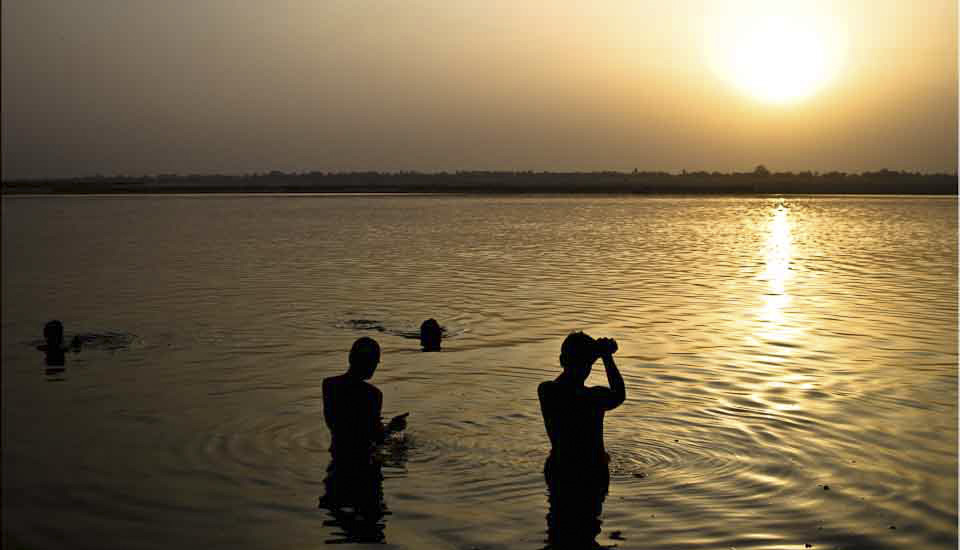
- Performing the Ganga Aarti from Dasaswamedh Ghat, Varanasi
- Buddha Head from Shwedagon Pagoda, Myanmar
- Harry Clarke Window from Dingle, Ireland
- Novice Monk Shwe Yan Pyay Monastery, Myanmar
Packets of 10 for $AU50.
Or - pick any photo from my Flickr or Wanders blog photos.


 Like I said, just a glimpse into the colour and magic that is Myanmar; I can only hope it retains what is good and innocent as it is thrust, with the opening of it’s borders, into the future.






 As I said earlier: a mixed legacy.


Love it, love it, love it!
Ursula, you did it again….capturing the essence of the story through your engaging images and rich, colorful, descriptive text. It’s a wonderful package with your signature “Ursula insights” and your vivid descriptions, all of which make us all feel like we were along for the ride (and some of us were…and we all wish we could describe it as eloquently as you did). Thanks for sharing. Bravo on a story well told. In-flight magazines across the region are in need of stories like this one!
Cheers,
Karl
Thanks so much, Karl and Ayn!
It was so lovely to share the adventure with y’all, and even nicer that you’ve popping in to my PhotoBlog. 😀
Wow, transported me right back there In an instant. We “worked” the same car, so wonderful to see your perspectives. When I am “homesick” for Myanmar, I will be a frequent visitor to your blog!! Please keep posting!! Great story!
Great job Ursula! Wonderful story and pictures. Enjoyed meeting you. Bonnie
What Karl said and more!!!! excellent just loved it. 🙂
Lovely shots, Ursula! My favs – obscured Platform office and the colorful waiting room.
Thanks so much for the visits and comments, Kat, Signe and Bonnie. 🙂
Very nicely done, Ursula.
Excellent series of photographs. Informative
Thanks, Sarah and Patrick – glad you enjoyed the post. 🙂
Fantstic job Ursula. You have real talent both with the pen and the camera.
Thanks, Darrell. You are too kind! 🙂
[…] about the “Circle line” (one including a multimedia piece the other just photos) and a more comprehensive blog post about the journey, wonderfully crafted by Ursula Wall, just click the appropriate link and […]
Thanks SO much for the mention, Karl. 😀