The humpback whales of the Australian east coast are currently making their annual migration south.
Starting from the Great Barrier Reef, where they mate and give birth in warmer waters, they begin moving towards their summer feeding grounds off Antarctica in late July. By October and November, humpbacks are commonly sighted in the sheltered waters off Eden, on NSW’s south coast.
Off course, “sighted” is a relative term. While we were on Cape Byron, in northern NSW last month, we were alerted to the presence of whales: I managed to photograph a spec of a tail on an expanse of Pacific, a splash, and a few smudges of foam on the ocean surface. So much for my first “sighting” of the season!
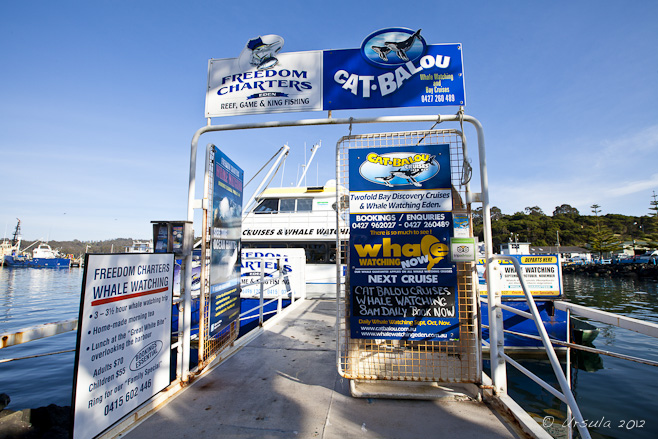
So as not to miss out entirely, on Wednesday we joined a whale-watching cruise with Cat Balou Cruises in our home port of Eden. We’ve sailed with them before: back in March, we enjoyed one of their Twofold Bay Discovery Cruises. The coastline around Eden is stunning, and during the migration season, Cat Balou guarantee whale sightings, so a morning on the water is a pretty safe bet.
All aboard! Entry point for Eden’s whale watching cruises.
Of course, like other whale watching operations, Cat Balou can’t guarantee that the whales will actually do anything. We were lucky enough to see our first wild humpback whales back in July, in the Pacific Northwest off the coast of Vancouver Island – and they were almost indistinguishable from floating logs!
So, we bundled up warmly and crossed our fingers.
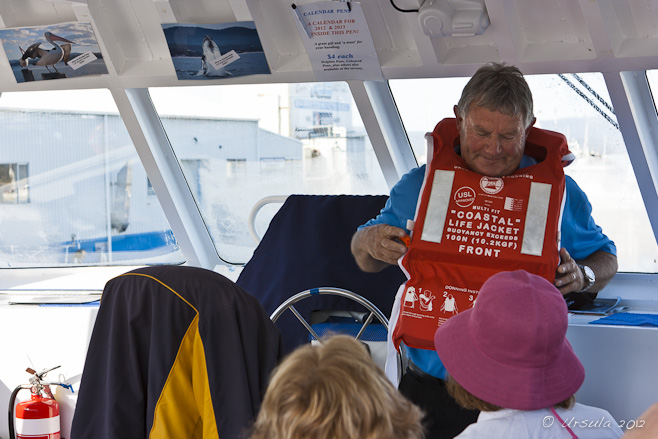
“In the unlikely event…” Owner-operator Gordon demonstrates the lifejackets before we set off.
We weren’t on the water long before we met the strange sight of Australian fur seals (arctocephalus pusillus) “rafting” – floating with their flippers in the air.
Common dolphins (delphinus delphis) raced along side the catamaran as we head off in search of whales.
Smaller and daintier than the better-known smiling bottlenose dolphins, the common dolphins were a delight to watch.
Looking a bit like colourful fried eggs, jellyfish float past us.
As we found our first humpbacks, I was reminded of the well-known Indian story of the blind men and the elephant. You know the one: six blind men try to describe an elephant after feeling only one part: one says the elephant is like a pillar after feeling only a leg; one says it is like a rope or a paintbrush after touching the tail; one says it is like a fan after touching an ear; one says the elephant is like a wall because he felt the body; etc.
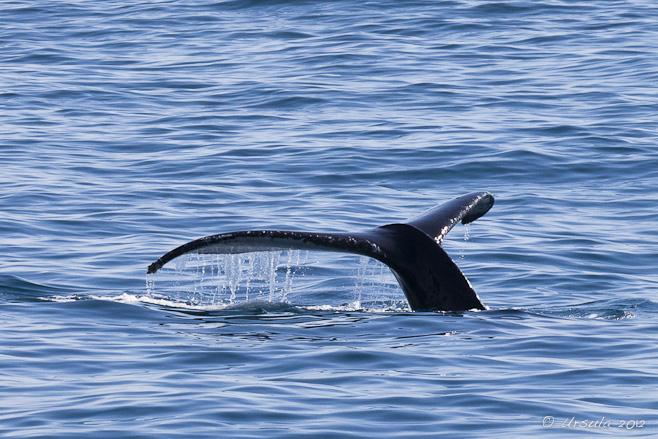
I could not get a whole humpback in my mind’s eye: the whales were indeed out in our waters, but we were seeing only the small dorsal fin, or a huge tail, or a broad, barnacled back, or long pectoral fin – never the whole whale!
The dainty dorsal fins of a mother and baby humpback whale just two kilometres or so off Aislings Beach, Eden, NSW.
Boyd’s Tower, Red Point, NSW.
A Humpback dorsal fin and tail fluke south of Red Point.
All cameras are trained on the bits of whale in the waters.
Passengers on a small fishing craft get lucky as a mother and calf pass directly in front of them.
Owner-operators Gordon and Ros keep watch for more pods from the upper cabin of Cat Balou.
It was a beautiful day on the waters, even if the whales refused to breach. Red Point, NSW.
A “footprint” on the water, created by the humpback’s powerful tail flicks as it dives.
Water splash and barnacles on the broad humpback back.
A spectacular humpback tail slap.
In a shallow cove, a large humpback with her long pectoral fins does slow rolls…
… while calves and dolphin play around.
Phosphorescence glows under a humpback fluke as it slaps the water.
Humpback head and blowholes.
A group of humpbacks heads out of the cove…
… in a tangle of massive bodies.
Black-faced cormorants rest on the water as we head home.
A great cormorant sits guard at the harbour entry.
A baby fur seal sits on the sea wall.
The boat is ship-shape and docked ~
~ and the upper wheelhouse is empty.
There is something magic about whales. The deep roaring rumble they made as they “called” to each other was amazing and it was a joy to watch the massive animals in what can only be described as play.
I admit: I was disappointed that none of them breached in the leaps that humpbacks are famous for – especially when the front cover of our local paper the next day featured a perfect jump photographed only the week before! Like a blind man, I still have only bits of the whole.
But, I feel lucky for that privilege. And, maybe next time, we’ll get even luckier!
How was your return visit to Hervey for the whales? It is just the best place to really experience the whales up close.. And such an amazing feeling when they just roll over and look at you.. Did you have some great experiences again this time?ReplyCancel
[…] We were extremely lucky last year: we participated in whale-watching tours twice. Once was last October, during the antipodean spring, when humpbacks make their annual migration south – past my home in Eden, NSW – to their summer feeding grounds in Antarctica (Watching Water 2). […]ReplyCancel
Mori Flapan -May 3, 2021 - 6:02 am
Hi Ursula
As a fellow traveller (6 years on the road), I really enjoyed your photos. They are the ones I wish I had taken.
I have used two of your photos from this page for the Eden Lookout Point icon. They have been credited to you and I have kept your copyright symbol. The map is not commercial. Please get back to me of you have any objections.
Location, Location, Location! The giraffes at Taronga Zoo have a commanding view overlooking Fort Dennison and central Sydney.
As politically-incorrect as it might be, I love visiting zoos. There is something magical about being able to get up close-and-personal to some of the world’s wild creatures.
Ok – so they are not entirely wild creatures when they are held, and often born and bred, in captivity. I understand the arguments for and against zoos, arguments which have changed over time, and have led to changes in zoo design:
Modern zoos, with their focus on ethics and animal rights, are designed as much (perhaps more) for the comfort of their creatures than for the convenience of their visitors. And although, philosophically, I agree with this, I can’t help but think there is something ironic about being able to get better animal pictures in the wild!
These were some of my thoughts as I dragged the cameras across Sydney Harbour and around Taronga Zoo in Mosman in February, and along the roadways and pathways on the three kilometre stroll around the Taronga Western Plains Zoo outside Dubbo, in central New South Wales, earlier this month. On both visits, many of the animals took refuge away from prying eyes and lenses.
Don’t get me wrong: I loved the zoos themselves. Both the Tarongas are in killer locations.
Opened in 1916, the original Taronga Zoo is located on the shores of Sydney Harbour in the suburb of Mosman. The views across the harbour and over downtown Sydney are stunning. While we were there, a woman told me that the view from one particular spot was Heritage Listed, although I could later find no evidence – outside the view itself – for her claim.
In the Mosman koala house, we found one sleepy marsupial. They were all hiding when we went through the Western Plains Zoo.
The tiny corroboree frog is one of Australia’s most critically endangered frogs.
Small lizard on a log in the reptile house.
Chimpanzees in a huddle, Taronga Zoo.
Most of the chamois were hiding among the rocks, but this one stood out against the sky.
The silverback and his family pointedly ignore the audience.
After a patient wait, the best I could get was the male’s profile, as he delicately extracted the kernels from a pine cone.
A gibbon peaks out from the foliage.
A cheeky rainbow lorikeet with a bad foot mooched food from us as we ate lunch.
Zoo-Keeper Joseph explains the habits of the blue-tongue skink to a small audience…
… and hands the skink carefully around.
Ironically, we get a better look at pelicans at home, as we watch them on the lake, than we did at the Mosman zoo, where the only one we saw was hiding in sleep.
Although it makes efficient use of its space and houses a lot of animals, the 52 acre Mosman site has no room for growth. The Western Plains Zoo was conceived in the 1960s as a facility to allow for the breeding of larger plains animals and to give grazing animals the room they need to roam. An old WWII army training camp in central NSW, about five and a half hours north-west of Sydney by car, was converted into 300 hectares (about 3 sq km) of irrigated grasslands and opened to the public as Australia’s first open-range zoo in 1977.
Welcome to Taronga Western Plains Zoo where they are currently celebrating Kenya and the animals of the savanna.
A we guarded our lunch, an Australian white ibis raided a chip from the empty table next to us.
On their own island, protected by water and distance, ring-tailed lemur can ignore the visitors.
I had as much fun watching the local birds – this one a cheeky apostlebird – as I did trying to find the elusive animals.
Although they don’t have the harbour views that their counterparts at Mosman enjoy, the giraffes at Western Plains have been busy. Little Fanana, meaning ‘to resemble’ in Swahili, was born in August.
The animals are often elusive, but the times for feedings and and zookeeper-talks are posted. So, if you have the time, you can plan your days accordingly.
Zookeeper Melanie explains the habits of the hippopotamus.
After years of living in Thailand, Asian elephants have become almost common-place to us. It was nice to see the African elephant – even if she looked pretty bored, stirring up dirt in the bare paddock.
The magnificent Sumatran tiger didn’t even flick his tail. We commented to each other that we’d been closer to tigers at the Ranthambore Tiger Reserve in Rajasthan.
White Handed Gibbon
It is spring: delicate white blossoms adorn a eucalyptus tree.
A babbler searched for slugs and bugs.
A siamang, largest of the gibbons and lesser apes, takes a flying leap –
– while mother and child come in for a landing.
The young zebra born 24 August, is named Neo, meaning gift in Setswana (Botswana).
Purple wildflowers add colour to the grasslands.
Swamp Wallaby
The little swamp wallaby, drinking cautiously from the pool, reminded me what a privilege it is to get so close to a wild creature.
For while it is true that we have seen many animals better in the wild, in their natural environments, there are many others that we haven’t. Even local animals, like the swamp wallaby, we are more likely to see dead at the side of a road, than drinking from a pool. And, habitats are shrinking the world over.
Fabulous Ursula, its been a few years since I’ve been at either but I love them both. I get that you are torn, me too. But some of these precious creatures aren’t going to survive man, so we need to have safe havens for them, and sometimes a zoo is the only place that can make an income to support them. Hard but necessary I think.ReplyCancel
Shwedagon Zedi Daw, the 99 meter gilded pagoda situated on a hill in Yangon, is the most sacred of Myanmar’s Buddhist sites.
“Then, a golden mystery upheaved itself on the horizon, a beautiful winking wonder that blazed in the sun, of a shape that was neither Muslim dome nor Hindu temple-spire. It stood upon a green knoll, and below it were lines of warehouses, sheds, and mills. Under what new god, thought I, are we irrepressible English sitting now?”
~ Rudyard Kipling, 1889
Shwedagon Pagoda (Shwedagon Zedi Daw) is possibly even more magnificent now than it was when Kipling first saw it.
Situated west of Kandawgyi Lake, high up on Singuttara Hill, its golden dome, reputedly tipped with 5,448 diamonds nd 2,317 rubies, can be seen from almost anywhere in Yangon. It is so much part of the Burmese psyche that Queen Shinsawbu (1394–1472), who donated her weight in gold to repair and maintain the pagoda, had her bed positioned so she could look at it during her final days. By the early 16th century, Shwedagon was the most important Burmese Buddhist pilgrimage site, and in more recent years it has also become a centre – and a symbol – of nationalist and political protest.
Morning light in the sacred Bodhi Tree near Shwedagon’s South Entrance.
Luminous white marble Buddhas, lavishly trimmed with gold, in a shining hall.
Shwedagon Pagoda is revered by Burmese Buddhists because it is said to contain the relics of the present Gautama Buddhaand the three Enlightened Buddhas immediately preceding Him. Legend has it that two Burmese brothers, Taphussa and Bhallika, met the Lord Gautama Buddha in BC 588 and were given eight of His hairs as sacred relics. When they returned to Burma, the presiding King helped them find the site of the older relics enshrined on Singuttara Hill, and the stupa was built – making it over 2600 years old; thus the oldest pagoda in the world.
Historians and archaeologists, however, suggest that the the pagoda was built by the Mon people between the 6th and 10th centuries CE.
Either way, the original site is old, and improvements and renovations of the pagoda and the surrounds have continued over the years.
Looking up to the birds, the spires and the heavens…
A Burmese woman, wearing thanaka on her face, sits in the shadows of the hallway.
A monk saying morning prayers.
Reflections in a golden Buddha
Burmese Buddhist ritual is strongly rooted in astrology which originated from Hindu Brahmanism. According to Myanmar astrology, the week is divided into eight days (Wednesday is split into two parts) and a person’s fate is dependent on the planet ruling over the day of their birth. The base of the pagoda is octagonal, allowing for eight planetary posts, each with a guardian angel or deva, and a small Buddha in a shine. The faithful, who may bring offerings with them, make their devotions or entreaties at the post which corresponds to the day of their birth.
A Burmese monk quietly sitting with his alms (begging) bowl.
Faithful often bring offerings when they say prayers at their planetary post.
Each of the eight posts has lit candles and incense burning.
There are monks in every nook and cranny.
A monk shields his face from the bright morning light as he walks around Shwedagon Pagoda.
A visiting nun pauses to have her photo taken.
There are 64 alcoves around the base of the pagoda; most with Buddha images, many with monks.
We – the intrepid Karl Grobl and ten photographic enthusiasts – visited Shwedagon Pagoda twice on our brief stay in Yangon: once in the morning and once in the evening. We wanted to witness the life of the pagoda, rather than just its intrinsic beauty, and our guide Mr MM assured us that those were the times that would be busiest with Burmese pilgrims.
I was lucky enough to engage in conversation with locals on both visits. In the morning, I met a man who was there because it was his wife’s birthday, and she wanted to make merit. He had lived in both the USA and Thailand as part of a diplomatic family, and we were able to discuss (albeit cautiously on my part!) the impact of the recent political changes. In the evening, I chatted to a young monk about life, religion, and the cultural importance of Shwedagon, as we took refuge from the rain under an awning.
A bilingual Burmese monk, and his not-so-bilingual friend.
A little afternoon rain doesn’t dampen the faithful who have their umbrellas handy.
There were few tourists around, but the locals were out: the same umbrellas that protected visitors from the harsh morning sun now shielded them from the soft evening rains.
At each of the eight planetary posts, there were Burmese buddhists washing the little Buddhas; …
… this both pays homage to the Buddha and cleanses oneself of sins.
As the rain falls and the light drops, we spot monks on the pagoda “terraces”, just below the “bell”.
A reclining Burmese Buddha.
Detail: gilded columns in one of the many halls.
Incense and evening worship.
Night lights over Shwedagon.
While there is some argument that the riches in the pagoda could be used for much-needed infrastructure development, it has survived early Portuguese pillaging, two wars with the British and years of colonial occupation, as well as earthquakes of varying severity.
The military government clearly knows the importance of Shwedagon to the people of Myanmar: in 2006 they commenced work on Uppatasanti Pagoda, an almost-exact replica in Naypyidaw, the new capital of Myanmar. In September 2007, they attempted to restrict access to the Shwedagon Pagoda, leading to clashes between security forces and protesters – mostly monks and nuns – which resulted in at least five dead.
It still stands tall, a glittering jewel that seems to symbolise Burmese resilience and hope for the future.
Beautiful as always, as funny as this is, I asked myself the same question as we neared the end, the … what if the money was redirected etc etc… but it occured to me, without faith, what material objects could these people have that would mean more or be as important, I can’t think of anything one could own that would be more important that how one feels. The history, the sensibility and the devotion can not be equalled.ReplyCancel
Thanks, Signe, for putting it so succinctly! Without faith (in something), life becomes empty. “He who has a why for life can put with any how.”
– Frederick Nietzsche
Thanks for the visits, John and Gabe. The place had me awestruck!ReplyCancel
Selim Hassan -October 25, 2012 - 2:47 am
And Hobbes said … The condition of man is a condition of war of everyone against everyone and the life of man is solitary, poor, nasty, brutish, and short. (Leviathan) But your Nietzsche quote is more uplifting!
I spent the summer of 1984 in and around Yellowstone, primarily flyfishing but also taking some time out for exploring. It is an absolute must-visit for anyone who enjoys and marvels at natural wonders.
But back to Thomas Hobbes … I was resting one evening (all alone I thought) by Lewis Lake in the southwestern part of Y/Park in a little cove when two guys drove up to the lake, walked around a bit and then discussed what a waste it was that all that prime real estate was locked up in a public park. They speculated how they could sell lake-front plots for a huge profit and make a killing. I guess some people don’t realize that sound carries very well over still water. I was pretty naive at that time and was actually horrified that somebody would think to do that to an incomparable public treasure. Now, I know better–we are generally inclined to destroy, not preserve and enhance.
Thanks for the memories, Ursula, and hope to see you again soon in Thailand.ReplyCancel
Morning sunshine over Roaring Mountain, Yellowstone National Park.
How many parks can claim UNESCO World Heritage status?
Yellowstone National Park, the world’s oldest “National Park”, established in 1872 by an act of American congress, has been a designated World Heritage site since 1978. Home to more geothermic activity than anywhere else on earth, Yellowstone is also one of the last, nearly intact, temperate-zone ecosystems, providing a refuge and natural home for many plants and animals that no longer thrive elsewhere.
UNESCO also recognises Yellowstone for its “extraordinary scenic treasures”; an assessment I’d have to agree with. While we loved seeing Old Faithful and some of the other iconic Yellowstone National Park activity, it was equally impressive to see just how much else the park has to offer.
The horses wait for their morning riders: Yellowstone Plateau.
I had vague childhood memories of the Paint Pots at Kootenay National Park in British Colombia, and so was curious to see Yellowstone’s Artist’s Paint Pots. This is one of the less-visited attractions in the park, but we enjoyed the short walk (1.8 km) along the trail and boardwalk that takes you around pretty geothermic hot springs, mudpots, fumarole, and a small geyser.
Small lake, Artist’s Paint Pots, Yellowstone National Park
A bubbling hot spring ~ one of the many fascinating, but nameless, features at the Artist’s Paint Pots.
Subtle colours and beauty ~ Artist’s Paint Pots Yellowstone
Steam rises everywhere from hot springs and from cracks and fissures in the earth.
It amazes me how many plants survive and thrive at the edges of the geothermal pools.
Some of the small springs bubbled with amazing enthusiasm!
Impossibly clear springs contrast with red and white soils and green grasses.
New-growth lodgepole pines grow next to the steaming hot pools.
Nature’s Still Life: This area suffered major forest fire in 1988, and the evidence is still around.
Some of the “paint pots” are brightly coloured by cyanidia, a unicellular red algae.
The milky-blue colour in some of the features comes from silica, suspended in the water.
Visitors try to capture the white-on-white.
The boiling white mud in the Paint Pots is a clay mineral called kaolinite.
There is a constant “plopping” noise as the clay in the mud pots builds up heat and bubbles over.
Another silica milky-blue pond.
Beside the trail back to the car park, autumn Fringed Gentians (Gentionopsis crinito) signal the onset of cooler weather.
It was a delightful stop, and a good introduction to some of the natural beauty the park has to offer.
We looked out the windows of our accommodation at Annascaul, on the southwest tip of Ireland, and although the sky was heavy and overcast, we hoped it might not rain…
We were not half a block out the door, when our hopes were dashed: rain, drizzle, fog, mist; our day was beset with precipitation of all sorts. Although the the Gulf Stream is supposed to warm the Dingle Peninsula, I was not convinced as we started our walk from Annascaul to Dingle, shivering in our raincoats.
Main Street (only street?) Annascaul, including our accommodation, The Anchor.
The South Pole Inn was originally opened by Annascaul’s famous son, Antarctic explorer Tom Crean (1877-1938), after his retirement from the British Royal Navy.
Ireland’s religious roots are in early Celtic Christianity. As a consequence, Madonas and crucifixes are less commonly seen outside churches here than in many other Catholic countries.
Another day walking in Ireland: mist, green, and sheep.
A dappled gray pony is a nice change from the ubiquitous sheep!
If Irish council workers were stopped by rain, they’d never get anything done. These two are cutting back the brambles on the narrow road verges.
A donkey and a skewbald pony watch our passing.
Cottage ruins often seem to be left where they stand.
Descending through the mist and rain into Kilmurray Bay, with the remains of the Minard Castle, built in the mid-16th century by the Fitzgerald’s and destroyed by Cromwell in 1650, perched on the hill.
“A stolen ringbuoy – a stolen life.” Kilmurray Bay
The beach at Kilmurry Bay is framed by rounded boulders thrown up by the sea. The ruins of the Minard Castle tower (fenced off with “Keep Out” warning signs) stand on the hillside.
A small creek runs into Kilmurry Bay from in front of the Minard Castle ruins.
Wet and wild: Buttercups and fuchsia counterpoint the ever-present greens.
Eventually, Lispole village came into view, but it soon became clear that unless we were to deviate from the country road we were on, we would not actually go through it. So, we took advantage of our packed sandwiches and a short break in the rain to have a quick lunch perched on the roadside before heading off up hill again.
A Gothic church in the village of Lispole is set amid green hills and mist.
A wooden door on an old stone shed is almost hidden by grass, creepers and ivy.
Foxgloves give a splash of colour.
View over Short Strand and the hills of Dingle Peninsula.
It was one of those days: whether it was the cold, the damp or our tiredness I don’t know, but our walking route never seemed to quite match our notes. We never saw the Ogham stone that was meant to be in an ancient graveyard (not the first one we missed, either); we didn’t find the “arrow painted on the roof of the turf shed” that was meant to be a way marker; and we didn’t see the point at which we were meant to have two walking options. Fortunately, we ended up on the one we wanted by default, passing the 18th century Garfinny Bridge before finally coming into Dingle.
Called “the rainbow bridge” because of its shape, the pretty Garfinny Bridge arches over the Garfinny RIver.
Built in the 18th century without the use of mortar, the Garfinny Bridge is the last of these bridges standing in Ireland.
Coming into John St., DIngle.
And, as always, the cold, the wet and the fatigue were quickly forgotten over a pint and a plate of fresh fish and chips at the local pub.
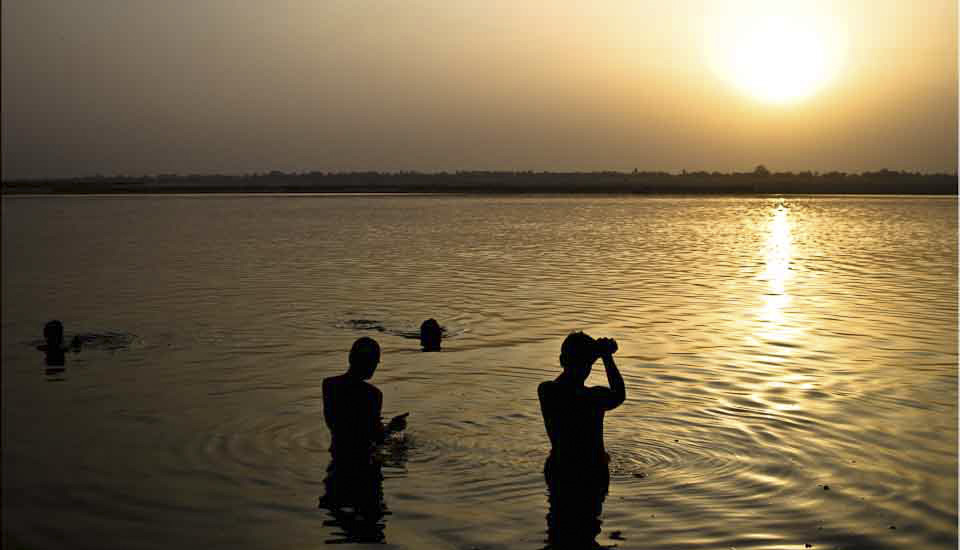
- Performing the Ganga Aarti from Dasaswamedh Ghat, Varanasi
- Buddha Head from Shwedagon Pagoda, Myanmar
- Harry Clarke Window from Dingle, Ireland
- Novice Monk Shwe Yan Pyay Monastery, Myanmar
Packets of 10 for $AU50.
Or - pick any photo from my Flickr or Wanders blog photos.


 I admit: I was disappointed that none of them breached in the leaps that humpbacks are famous for – especially when the front cover of our local paper the next day featured a perfect jump photographed only the week before! Like a blind man, I still have only bits of the whole.




 The 2012 Master Plan for Taronga Zoo and Taronga Western Plains Zoo includes the stated belief in


 It was a delightful stop, and a good introduction to some of the natural beauty the park has to offer.


Amazing creatures
Nice photos Ursula, looks like you were lucky enough to get reasonably close.
Thanks, Kevin and Gabe. Nice of you to stop bye! 🙂
Fabulous, its been some years since we did the same cruise and they are magnificent. Thanks for the share.
How was your return visit to Hervey for the whales? It is just the best place to really experience the whales up close.. And such an amazing feeling when they just roll over and look at you.. Did you have some great experiences again this time?
[…] We were extremely lucky last year: we participated in whale-watching tours twice. Once was last October, during the antipodean spring, when humpbacks make their annual migration south – past my home in Eden, NSW – to their summer feeding grounds in Antarctica (Watching Water 2). […]
Hi Ursula
As a fellow traveller (6 years on the road), I really enjoyed your photos. They are the ones I wish I had taken.
I am currently putting together a Maritime Highlights map of Eden to Green Cape. See https://www.google.com/maps/d/edit?mid=1eDuVdzjgaBne2ra-6to3MFeHVbaSN7Zh&usp=sharing
I have used two of your photos from this page for the Eden Lookout Point icon. They have been credited to you and I have kept your copyright symbol. The map is not commercial. Please get back to me of you have any objections.
Best regards
Mori
Hi Mori,
Thanks for your visit to my PhotoBlog.
Your project looks fascinating! I’m happy for my photos to be included as you have outlined.
Best wishes,
Ursula