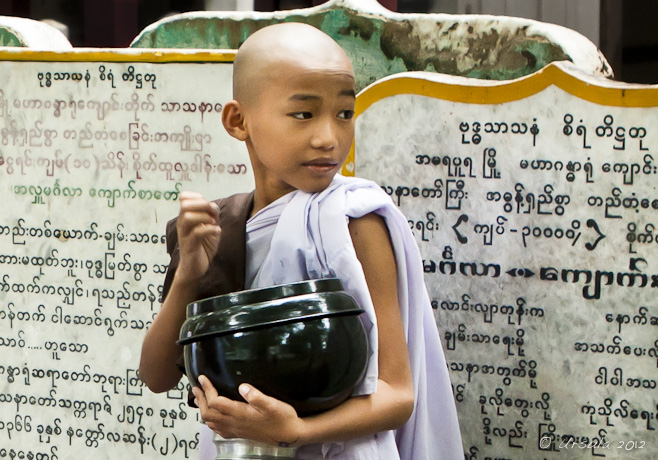
 Phothudaw (ဖိုးသူတော်) – Acolyte
Mahagandayon Monastery, Amarapura It is a different world…
Temples and monasteries are an integral part of life in Myanmar. They accommodate about half a million males, who are either vocational monks or novices, and around 50,000 nuns. That is: roughly one percent of the population actually lives in one of the many monasteries or nunneries, completely dependent on the laity for all their material needs.
Theravada Buddhist monastic life has a strict daily routine revolving around prayers and religious study, but it is the silent alms-rounds (e.g. Sangkhlaburi, Chiang Rai, and Luang Prabang) and the mealtimes (e.g. Lining up for Lunch) that fascinate outsiders and which provide such rich photographic opportunities.
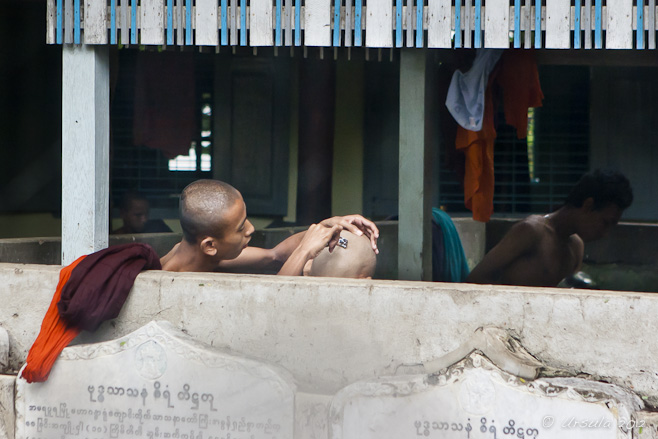 The Morning Shave
Mahagandayon Monastery Being a “tourist attraction” is a dilemma for monastic institutions: while having visitors contributes to their financial well-being, and promotes cultural understanding, it can be disruptive. ‘Boundaries’ are different between cultures, and many tourists seem to be unaware (or to deliberately ignore) local expectations of behaviour within sacred grounds.
Mahagandayon Monastery in Amarapura, outside Mandalay is on just about every Burmese travel-agent’s itinerary. Founded around 1914, it is one of the largest teaching monasteries in Myanmar, and home to up to 2000 monks at any given time.
The common areas of Mahagandayon Monastery are quite open, but visitors are clearly instructed which parts are out-of-bounds to them: an injunction that more than one tourist, unfortunately, ignores. Daily, tourists descend mid-morning to watch the resident monks line up silently and systematically for their lunch – their last meal of the day.
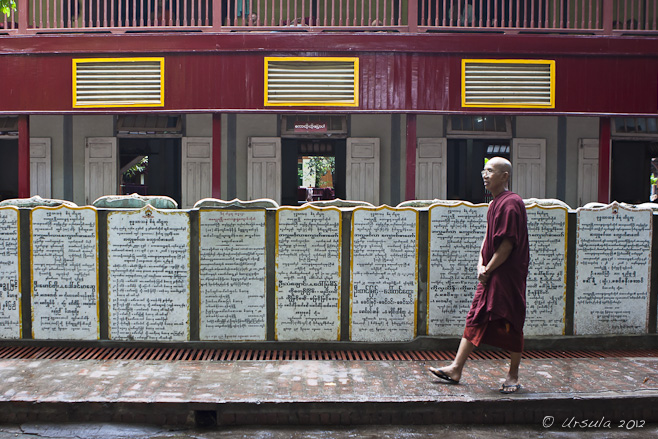 Abbot
Mahagandayon Monastery  Start of the Lunch Lines Eyes Down
Young monks line up for lunch. Young Monk Waiting Best Foot Forward
Bare feet on the wet walkways of Mahagandayon Monastery. Lines Moving into Lunch Because visitors cannot be relied upon not to disturb the monks during their silent mealtime, they are no longer allowed inside the dining hall. So I, my nine photo-group companions, our leader Karl Grobl, and our guide Mr MM, remained outside, in the rainy streets and alleys of the monastery while the the monks ate in peace.
Once they finished eating, they filed out and commenced cleaning up.
Lunchroom, Mahagandayon Monastery Washing Dishes Greeting Visitors and Pilgrims Chinese Monk
Visitors and pilgrims to Mahagandayon Monastery come from all over. Monk Talking to a Visitor
Many of the monks at the monastery were articulate in English, and outspoken about their country’s history and politics. Cross Cultural Discussions Monk in a Lane Way From a balcony, a monk watches the visitors below. Woman Waiting
Indigent people wait… Alms for the Poor
… until the monks give them leftovers. Washing Up We left the monks and the Mahagandayon Monastery to get our own lunch in Sagaing, southwest of Mandalay. Above the Ayeyarwady River, the Sagaing Hills are dotted with monasteries and nunneries; we stopped at one nunnery, where the women were busy preparing food for the next day: for themselves and for the neighbouring monks.
Three Nuns, Sagaing Hill
Even though their last meal of the day is before noon, preparation for the next day’s meal starts early. The nunnery is full of laughter. The women have a natural beauty. Work is easy when you have a friend to laugh and gossip with. An older nun smiles at a kitchen doorway. Another nun collects water. Even though washing-up conditions are a bit rough, everything looks spotless. It is a different world.
Structured. Ordered. With a time and place for everything.
But, there is always acceptance and a welcome for outsiders, and there is always time for a smile and a laugh.
It’s a pretty good world, really, and I hope future visitors show it the respect it deserves, lest we not be invited back.
Pictures: 14September2012
Posted in Myanmar,Portraits,Religious PracticeTags: buddhism,buddhist,children,environmental portrait,monastery,monk,Myanmar,novice,nun,people,Photo Blog,portrait,portraits,religion,travel,Travel Blog,Ursula Wall
Avenue Jean Jaures
Nîmes gets its name from Nemausus, a Celtic god who was worshiped at the local spring. Les Quais de la Fontaine, the embankments of the spring, were laid out in the 1700s. It’s autumn in Australia at the moment, which makes me think of spring in the Northern Hemisphere. Defies logic, I know, but there is something about the freshness of the air this change-of-season that has me humming: “I love Paris in the springtime…” and thinking of my last time in France, back in the spring of 2011, which is when we stopped for a day in Nîmes.
I’d been to Nîmes before: while I was a University student in Western Canada, I spent a summer working for friends who had bought an Auberge (country inn) in Gard, just outside this ancient southern city. I remembered it for it’s well-preserved Roman ruins, it’s cicadas, and its dry, shimmering heat.
I also remember it’s preoccupation with bulls.
Toro Miura qui Possede un Coeur ~ Miura Bull who Has a Heart
Lucien Blanc That summer in Gard was the first (and only) time-and-place I attended a bull fight. Not the ‘glamourous’ Spanish fights with fancy toreadors in tight black pants, sparkly gold boleros, and red capes; no – more a ‘rodeo’ variety in a make-shift pen, with bull-fighters with pink and yellow capes that reminded me of cheap raincoats.
“Torro Piscine”
Bull Ring ~ Scanned photographs from a rustic bullfight near Nîmes, south of France, 1979. It was a very long time ago, and I was keen to see if the city could live up to my distant memories of it. We were on our way to the start of our second walk in the French Pyrenees, travelling south from the Auvergne, so Nîmes was the perfect place to stop over. I booked a room close to the train station, and we set out with a city map, for a walk.
Le Palais de Justice
Inspired by La Maison Carrée, the Nimes Law Courts were built between 1836-1846 by architect Gaston Bourdon. Life in the Palazzo Les Arènes de Nîmes
Nîmes’ elliptical amphitheatre, built around 70 AD, is the best-preserved Roman arena in France. Port de France
Locals go about their business through one of the two remaining gates from the original Augustine ramparts. Modern Urban
Fresh paint and posters set off the old walls in the narrow streets. L’Eglise St Paul
Decorated in Roman provençal style, St Paul’s Church was inaugurated in 1849. Following periods of change, Nîmes had become the major metropolis of Bas-Languedoc by the 19th Century. La Maison Carrée
Built of local limestone by architects from Rome around 20 BCE, The Square House was designed by Marcus Vipsanius Agrippa, who was responsible for the Pantheon in Rome. La Maison Carrée
The temple was originally dedicated to Gaius and Lucius, adopted sons of Augustus. It is one of the most beautiful and best preserved temples in the former Roman Empire. Emperor Antonin (86 – 161)
Nîmes was part of the Roman empire from 118 BCE, and made a “colony” by Augustus in 27 BCE. Avenue Jean Jaures
Leading into the Jardins de la Fontaine. Jardins de la Fontaine ~ The Gardens of the Fountain
Built in the middle of the 18th century, the gardens effectively protect two major Roman ruins. Fresh Green
The trees in the garden are wearing their spring finery. The gardens are home to ancient statues … … and living art. Temple de Diane
My favourite ruin, possibly because it is less well-preserved, is the Temple of Diana. Some say it was built as a sacred fountain dedicated to Nemausus during the time of Augustus. Others say it was built in the 2nd century as a library. Inside the Temple Ancient Pillars Temple of Diane
Fragments of delicately carved stonework remain. Spring Blooms
Trees and bushes with these purple pea-like flowers were everywhere in the south. La Tour Magne
It’s a short walk up the hill from the gardens to the La Tour Magne. La Tour Magne ~ The Great Tower
Once part of the old ramparts. The top storey has disappeared, but the tower still rises to a height of about 32m. Nîmes
A climb up the insides of La Tour Magne afford a great view over the city. The old olive tree and other vegetation at the base of the tower give an indication of the dry heat I remember so vividly from my earlier visit. Even though it was still spring, the day was hot and clear. Les Arènes de Nîmes
During the Middle Ages, the arena was used as a fortress – a refuge for the population in case of danger. It was later filled with private houses, until the nineteenth century. Today, the amphitheatre is used for bullfights, music concerts. and other events. Les Arènes de Nimes
Inside the corridors of the arena, it is easy to imagine the ancient battles. The lion’s cages, and a chapel for the gladiators are all here. Modern “Bull Fight”
We were lucky enough to be visiting during one of the two annual bull festivals: “La Primavera des Aficionados” (Spring of the Fans). Julie Donzala demonstrates her skills. Hot Pink
There are the capes of my memory! Fortunately, the only “bulls” we saw were papier-mâché and wood on wheels. Boy Toreadors
Young lads waiting for their turn with the “bulls”. This horse is being dressed for it’s role as a picador in a fight with real bulls. Cavalier
One of la cavalerie de Philippe Heyral. The Arena
It’s a quiet afternoon in the stands.  Nîmes was still hot. It was still preoccupied with bulls. And the Roman ruins were still fabulous. Nîmes was still hot. It was still preoccupied with bulls. And the Roman ruins were still fabulous.
I didn’t hear any cicadas, but it was only April…
It was good to be back.
Pictures: 09April2011
Posted in Architecture,France,HistoryTags: animals,architecture,blog,culture,France,Nîmes,Photo Blog,travel,Travel Blog,Ursula Wall
Karise Eden
Rocking the Blues Got your gumboots? Got a raincoat, plenty of water, a folding chair and/or an inexhaustible supply of energy? The Byron Bay Blues and Root Festival is the place to be on an Easter (Autumn) weekend in Australia.
There is nothing like music to lift your spirits. Add good company and wholesome food, and you have an unbeatable festival weekend. Of course, into each festival, some rain must fall; the event would not be complete without mud.
Started as the East Coast Blues Festival at the Byron Bay Arts Factory in 1990 with a modest international and local lineup, Bluesfest has evolved into a major five-day event. We only attended three of the five days: we weren’t sure that our ageing ears and bones would hold up to any more!
We decided to ease in with something familiar, Hat Fitz and Cara whom we last saw perform at the Thredbo Blues Festival in 2012. In spite of Cara still wearing an eye-patch following a car accident last December, their powerhouse performance (and between-song-patter) was in no way diminished.
Hat Fitz
Rough, gravel tones belting out a tune. Hat Fitz and Cara Robinson
A musical duo with powerhouse vocals. Taj Mahal
As good as ever… Ben Harper
Bridging the gap between the old and the young The Byron Bluesfest attracts a wonderful range of international performers across a breadth of styles. The last time I attended, back in 1999, I sought out Taj Mahal, Jimmy Webb, Tony Joe White, and other sounds of my adolescence, but I also let my teenaged children introduce me to Ben Harper, Keb’ Mo’ and Angelique Kidjo. What a great way of rediscovering youth, reliving all the great moments since, and getting glimpses into the future of music.
Shuggie Otis
A musical family delivers Robert Cray
Cheeky and smooth at the same time. Over 100,000 people attended this year – not all at the same time, mind you. On Friday, however, as I tried to catch sight of Carlos Santana, whose music was part of the very fabric of my teens. and who, more recently, danced me through my wedding, it felt like they were all in the tent with me – pushing four directions at once.
Smartphone
Sometimes the best view of the stage is through someone else’s smart phone. 🙁 Thank Heavens for the Big Screens!
Squashed into an aisle behind the sound stage, I could barely see over the heads in front… In spite of the obstacles, nothing could diminish Santana’s performance: one hour and a half of unadulterated joy and energy! Somehow, being there, even when you can barely see, is better than a clearer view at home on a television. Confined as we were, bodies squashed together, we danced all the way through the performance, and back out of the tent at the end.
Traditional Blues and Southern Roots
Pat Wilder and the Music Maker Blues Revue I love the mix of old, traditional performers (like the artists supported by the Music Maker Blues Revue) and local talent, like the young Genevieve Chadwick, who we first saw at Thredbo Blues 2013, and Lil’ Fi, who has been a part of the local arts seen for a while. And although none of them are female, we were as captivated by Round Mountain Girls as they were by the mountain that gives them their name. It’s these surprises you find, sometimes while looking for something else, that make festivals such a treat.
Genevieve Chadwick
Her big voice fills the space in the big tent. Lil’ Fi
“Celebrating Curves” Time Out
Bluesfest is a pretty chilled out affair. Chris Eaton
Round Mountain Girls Like a fiddler possessed ~ Rabbit Robinson on stage. Chris Broker, Chris Eaton and Rabbit Robinson of Round Mountain Girls
We were as taken by this band as they were by “Round Mountain”, which possesses them. No Room to Move!
Mojo Tent is already packed out the sides with people. After our experience of not-really-seeing Santana on Friday, on Saturday we tried to stake a spot for another icon of my adolescence: Robert Plant, the inimitable voice of Led Zeppelin, four hours ahead of time. Clearly 99,998 or so people had had that idea before us, and we had to settle for parking chairs in the wings outside the huge, already packed, tent.
Light fell, bands played on and the stars came out; I was thankful that the rains held off… Then Plant’s voice, supported and enriched by the off-beat rhythms of the Sensational Space Shifters, wove its old magic and still thrilled me to the core.
Robert Plant
A long way away ~ but his voice reaches, regardless “The Swamp”
Tony Joe White has lost none of his story-telling appeal since I last saw him in 1999. Karise Eden
Winner of Australia’s first season of The Voice, 2012, Karise packs a Janis Joplin punch. Rain
A little rain can’t dampen festival-goers spirits. Beautiful Tattoos
The festival audience included young and old, and provides for people-watching enjoyment. A New Take on the One-Man Band
Billed as an Australian “musician, activist, and surfer”, multi-instrumentalist Xavier Rudd on didgeridoos, percussion and guitar. Sound Stage
The oft-forgotten people behind the scenes; for the most part, they did an excellent job. Cat Empire
Harry James Angus on trumpet. The Cat’s Eye under Lights
Felix Riebl singing up a storm. I have a soft spot for Cat Empire, as I first saw them in a pub in Darwin on a “night out” with my son. But, frightened by the prospects of another hour and a half standing still in the car park, as we had done the night before, we didn’t stay through to the end of their set.
I guess its a sign that I’m getting rather old for the challenges of festival-going: paying to be wet and tired and muddy, watching on the big screens something I wouldn’t watch on TV at home.
 Would I do it again? Would I do it again?
Hell yes! We have our tickets for next year already.
Music is good for the soul.
Peace, love and mung beans! 🙂
Pictures: 29-31March2013
Posted in Australia,Music,PortraitsTags: 2013,Australia,australian,Byron Bay Bluesfest,environmental portrait,environmental portraits,music,musicians,people,Photo Blog,portrait,portraits,Travel Blog,Ursula Wall
Follow the Walking Man
On Mt Brandon, looking back over the magnificent Smerwick Harbour, Ireland. If you are a regular visitor to this site, you’ll know that I love walking.
The thing is: some days I enjoy it more in retrospect than in real time!
By Day 8 of our walk around the Dingle Peninsula, that was certainly the case. I was tired.
We’d lost the trail on a bog-covered mountain the day before, and doses of anti-inflammatory drugs overnight had not met the challenge of ageing knees and hip joints. Tired and sore.
Then there was the intermittent rain: just enough so that we had to pull the raincoats out of bags at least once a day; just enough to ensure it was always slippery under foot. Tired and sore and wet.
According to our notes, we had another mountain to cross…
Day 8: Ballydavid to Cloghane
This is one of the most remote sections of the Dingle Way; offering you a combination of history and breathtaking scenery.
The trail follows a green road that crosses the shoulder of one of Ireland’s highest mountains “Mount Brandon” standing at 952Mtrs. Passes a standing stone that dates back over 3.500 years; which still displays the symbols of Ogham Writing. Crosses over an area of blanket bog where turf is still harvested in the traditional ways of our forefathers.
Finishing in the quiet village of Cloghane; that lies in the shadow of Mount Brandon.
Distance: 19 km/13 miles, Ascent: 670 m/2010 ft
Flower Border
Flowers in the village send us off on our way… Cow in the Countryside
We had a fair walk along country roads before heading off cross-country. Still Waters
Quiet waters and a dotting of farms under lowering skies. Currach or Naomhóg
The Blasket islanders developed a distinctive regional type of currach (or naomhóg) which they used for transport and fishing. Creek Waters Barbed Wire
Sheep’s wool, stone fence and a green mountain; it doesn’t get more Irish than that. Irish Sheep
The sheep are curious about out our progress. Wild Honeysuckle
Like the Irish spirit, the delicate honeysuckle (Woodbine: Lonicera periclymenum) is flexible, resilient, and deceptively strong. From Mount Brandon
In spite of low cloud, we still have magnificent views back over Ballydavid Head and the Three Sisters. Ogham Stone
This Ogham, dating back to the 4th Century, apparently says: “Ronan, the priest son of Comgan”. We were really excited to reach the Ogham Stone in the saddle between Masatiompan and Mount Brandon: according too our trip notes, there were a number of Ogham stones along our walk, but so far we had not succeeded in seeing any of them. We had looked – but the notes were often a bit vague, so we weren’t sure if we were looking in the wrong place or for the wrong thing. We were beginning to wonder if the stones had all been carried away by archaeologists or leprechauns. This was our first!
Reaching the stone also meant we had reached the high point of our day, and the rest should be down hill. Easy, right?
Wrong! More of a water-runoff-gully than a path, the way down the mountain was steep, mired in mud and water, and frequently slippery. Burdened as we were with day-packs and camera gear, we picked our way down as carefully as we could, grateful for our trusty walking sticks. It took us more than an hour to reach the peat road part way down the hill. By this time, I was ready for the day to be over, but we still had at least eight kilometres to go… I took some comfort in the fact that three young walkers we had passed along the way were still well behind us, so it wasn’t just age that had slowed us down: it truly was a wicked stretch of ground!
Brandon Point
View over the flank of Masatiompan towards Brandon Point. This Way Down
Steeper than it looks, muddy and wet; we were pleased we had our walking sticks. A Cairn along the Way
Previous walkers have marked their passing along the “trail”. Stones along the Path
At this point, the trail became a little drier and more manageable. There’s a walking man ahead! Peat Gathering
Blanket peat covers most of the Dingle Peninsula. Although it is considered a non-renewable and not-particularly efficient energy source, it is harvested by locals for burning as fuel and for sale. Teer Bog Road
A peat-cutter’s road leads down towards Brandon Bay. Another Lamb… Brandon Bay
Cottages come into view; dinner can’t be too far away! More Cows… Brandon Bay
Finally! We are back at sea-level, as the clouds lower over the bay. Fishing Boats
Small craft are tied up at Brandon Pier. Last Light
Rain clouds hover over the beach at Brandon Bay as we make our way to our lodgings near Cloghane. As we sat in the pub in Brandon over a glass of wine and a fabulous hot meal, the wet, the pain, and the tired were forgotten – almost. It was a beautiful walk and I’d do it again…
Well, maybe on a dry day.
Sláinte!
Pictures: 26June2012
Posted in Ireland,Landscapes,Nature,TravelTags: blog,boats,Dingle Peninsula,Ireland,nature,Photo Blog,rural,The Dingle Way,travel,Travel Blog,Ursula Wall,walk
The Pinnacles
The white sands and red clay cliffs make a striking contrast to green eucalyptus, blue skies and water. We live in a glorious corner of the universe, with National Parks, beaches, wetlands and mountains virtually at our doorstep. Trouble is, we are on the road so much that sometimes we forget to get out and explore when we are at home. That’s where having visitors comes in handy: there is no better way to appreciate your own neighbourhood than by showing it off to someone else!
It’s only a short drive from our little “Eden” to the northern half of Ben Boyd National Park – even so, we’d not been there before taking visitors to have a look last February.
The Walking Track
It’s an easy one kilometre circuit out to the Pinnacles and back to the car-park. The Path
A short rise leads us up through the banksia trees. Drying Banksia Flowers (Proteaceae)
Soon they will lose their characteristic flower spikes, and the gnarly “cones” will be visible. Saw Banksia or Old Man Banksia (Banksia Serrata)
I can’t see these gnarled trees without thinking of the Australian children’s writer, May Gibbs… May Gibbs
“Gumnut babies” are the flower/seed pods of the Eucalyptus (https://www.kopida.com/2011/12/may-gibbs.html) May Gibbs
“The Banksia Men Make a Wicked Plot”
(https://thinkdesignerprints.com.au/australiana/) Banksia Branch
Not quite “bad banksia men” yet, but these seed pods are browning. Long Beach
It looked like a beautiful afternoon on the beach. Usually you can walk down and view the Pinnacles from their base, but the steps were closed when we visited. The Pinnacles
The coloured cliffs of the Pinnacles come into view through Banksia branches. More Banksia
Trees line the sandy path around the point. The Pinnacles
The white sand and red clay cliffs of the Pinnacles were laid down over 30 million years ago. Leaf Litter and Seed Pods Termite Mound
The vegetation changes dramatically on the second half of the path, with tall trees and termite mounds. We even spotted two black cockatoo overhead! They were too fast for my camera. The short hike around the Pinnacles left us with time and energy to spare, especially as we couldn’t walk down to Long Beach. Just a ten minute drive up the road is Panboola, a protected wetlands, supported by National Parks and local agencies and industries, situated on 77 hectares (190 acres) of reclaimed farmland, town-land and a horse-racetrack.
It was late afternoon: a perfect time for a stroll.
Entry to Panboola
We parked close to the entry and wandered some of the pathways around the 77ha (190 acre) wetlands. Egret
From a covered pavilion near the entry, we learned about the reserve, and watched local waterbirds. Purple Wildflowers Picnic Table
There are places to sit, if you have time. Purple Swamphens (Porphyrio porphyrio) A Holstein
Areas within the wetland are still used as farmland. Old Stables
Buildings from the abandoned racecourse sit around the track. Old Grandstand Eastern Grey Kangaroos (Macropus giganteus)
Early morning and late afternoon are the best times to meet Australian wildlife. These kangaroos were the biggest I’ve come across. Two more eastern grey kangaroos watch us from a safe distance… … before bounding off into the scrub.  It is amazing what you find on your own doorstep! It is amazing what you find on your own doorstep!
Sometimes we forget that the “familiar” to us is “exotic” to someone else.
And, our own neighbourhoods are always worth exploring.
Happy rambles!
Pictures: 07February2013
Posted in Australia,Nature,TravelTags: Ben Boyd National Park,blog,National Park,nature,Panboola,Photo Blog,travel,Travel Blog,Ursula Wall,walk,wetlands,woods
« Older posts
Newer posts »
|







Beautiful as always Ursula, what fabulous smiles and giving people.
Pleasure, as always, Signe, to have you along. 🙂
Love it, such a beautiful portrayal of the spirit in the monasteries.
Thanks, Ayn. I would have loved more time with the nuns. Amazing place, isn’t it?
[…] “Being a ‘tourist attraction’ is a dilemma for monastic institutions: while having visitors contributes to their financial well-being, and promotes cultural understanding, it can be disruptive. ‘Boundaries’ are different between cultures, and many tourists seem to be unaware (or to deliberately ignore) local expectations of behaviour within sacred grounds.” -Weekly Wanders […]
Thank you for a more detailed insight of what Mahagandayon Monastery has to offer. We were brought there and given basic knowledge of it being a teaching monastery. Like you, we had seen the activities that you had featured in your write up, except the interaction of the monks and the lay “tourist”. I thought, one can not even engage them in any conversation, so, out of respect, I did not speak to any one except ask permission for a photo or two. Most have been very obliging.
Hi Aurora,
Thanks so much for your visit and your comments.
It’s always hard to know how/if we should interact with people in these “foreign” settings – even when our guides have given a briefing. I tend to keep my camera down until I’ve made eye-contact, and “ask” for consent wordlessly. The monks or nuns then take the next step, and I get a better sense what is ok. As you say, they are usually MUCH more obliging than I would be in their shoes!
Cheers! U.
[…] Por ser tudo muito perto, rapidamente chegamos ao aeroporto e, meia hora depois de decolarmos, chegamos a Mandalay. Como a proposta sempre é aproveitar cada minuto, nossa programação já estava pronta e, assim que desembarcamos, fomos até Amapura para visitarmos Mahagandayon Monastery – https://www.youtube.com/watch?v=c8o5nTGX_8U – https://www.ursulasweeklywanders.com/religious-practice/monks-nuns-and-a-monastic-life-mahagandayon-m… […]
The white-robed “boy” in the first photo is a “phothudaw” (ဖိုးသူတော်) a white-robed “acolyte”, Not a “novice nun”!
Thanks for that!