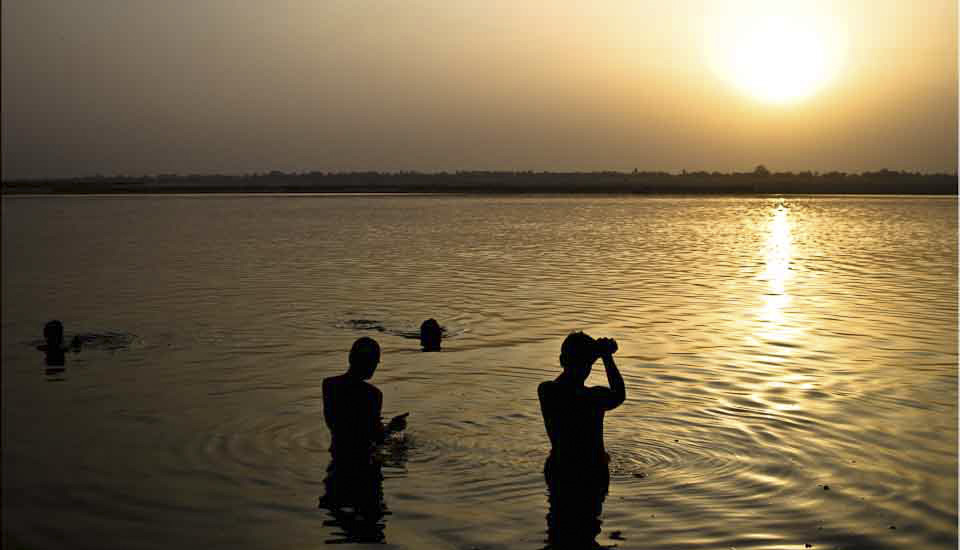
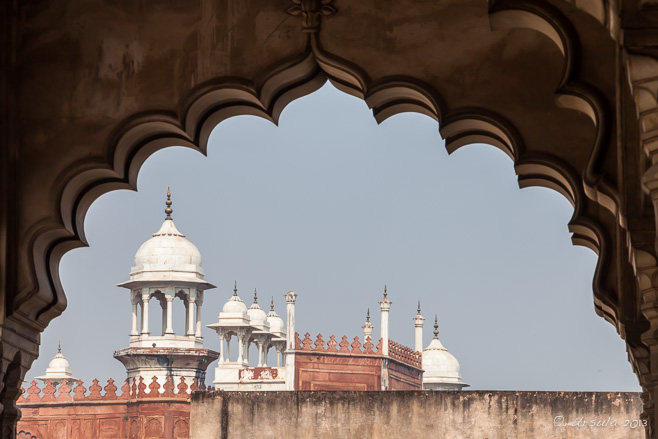
 Inside Agra’s Red Fort
Built by Akbar the Great in red sandstone, and expanded and renovated in white marble by Shah Jahan, Agra’s Red Fort is a testament to Mughal architecture. Agra, in Uttar Pradesh, northern India, is more than just the home of the Tāj Mahal. Once the capital of the Mughal (Moghul) Empire, ruling over all of India from 1556 to 1658, Agra houses many splendid Mughal-era buildings, three of which – the legendary Tāj Mahal, the wonderful deserted city of Fatehpūr Sikrī, and the magnificent Agra Fort – are UNESCO World Heritage listed.
In its current form, Agra Fort – also known as Lal Qila, Fort Rouge and the Red Fort of Agra – was built by the Mughals, particularly Akbar, Jahangir and Shah Jahan, as a walled city. The 380,000 m2 (94-acre) fort, stretching along the Yamuna River and protected by seventy-foot high walls, once housed as many as five hundred buildings in Bengal and Gujarat styles. Some of these original structures were razed to make way for Shah Jahan’s glorious white marble palaces. Others were destroyed by the British between 1803 and 1862 to construct barracks. While only a few of the Mughal buildings have survived, they speak of a rich history and are well worth a visit.
I’ve visited the fort twice: in 2008, on a private trip with my husband, and in 2012 on a group photo-tour with photographer Karl Grobl and local guide, DV Singh.
I loved exploring it and its stories both times.
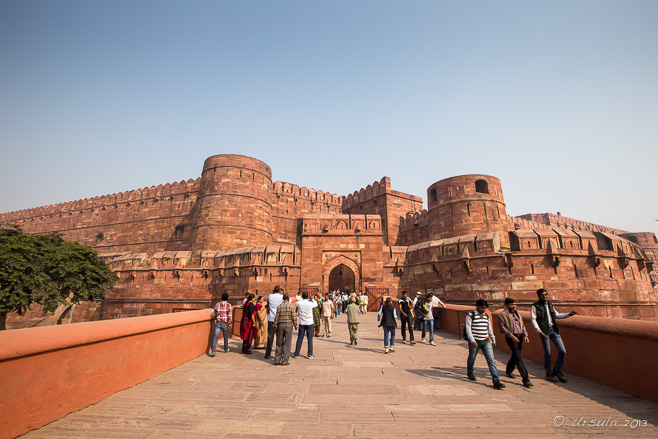 Amar Singh Gate
Tourists enter Agra Fort through the massive red sandstone Amar Singh Gate. 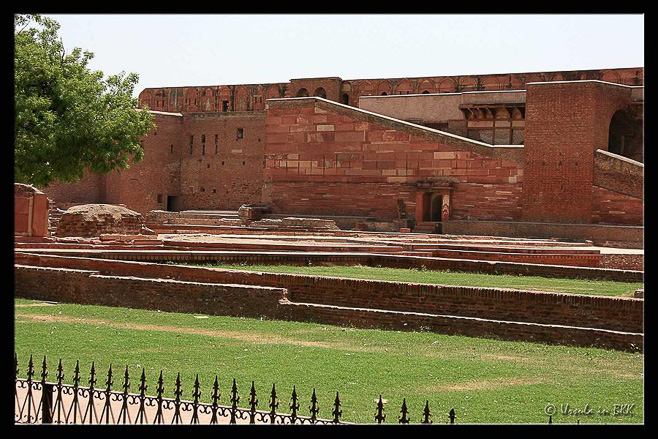 Agra Fort Walls (2008)  Visitors Photographing the Visitors
We all have our cameras at the ready as we enter Agra Fort. Jahangiri Mahal (2008)
A blend of Hindu and Central Asian architecture, the Jahangiri Mahal held the apartments of the Rajput wives of Akbar the Great. Hindu Art
In the 11th century, the ruling Hindu Sikarwar Rajputs had a brick fort here. Some of the treasures from that era are still housed on site. Diwan-i-aam
Built by Shah Janan in 1628 to welcome kings and dignitaries, … Diwan-i-aam
… the many-pillared Diwan-i-Am (Hall of Public Audience) allowed everyone a view of the throne. Woman in the Diwan-i-aam Red Roof Truss (2008) Tomb of John Russell Colvin (2008)
Colvin, lieutenant-governor of the Northwest Provinces of India, died of cholera during the peak of the Indian Rebellion of 1857. His entombment in such a prominent location at Agra Fort, which was at that time a military garrison, is considered by many to be extremely culturally insensitive. Three-Striped Palm Squirrel
One of the first thing I always notice in India is the wildlife: the birds in the skies and creatures on the ground. Khas Mahal and the Anguri Garden (2008)
Agra Fort was a walled palatial city; a fortified royal residence. The Khas Mahal was built by Shah Jehan between 1631-40, for his two favourite daughters. Musamman Burj
Also known as the Saman Burj or the Shah-burj, the Musamman Burj is an octagonal tower standing close to the Shah Jahan’s Hall of Private Audiences, the Diwan-e-Khas. Mussaman Burj – Palace Rooms
The Musamman Burj is made of beautiful marble with (now dry) fountains, ornamental niches, and delicate lattices so that the ladies of the court could look out on the world without being seen. Water flowed through the walls to keep the rooms cool in the heat of the Indian summer. Marble Beauty (Composite 2008)
The workmanship, in the inlaid marble (pietra dura inlay) in semi-precious stones throughout the the palace rooms, is stunning. Palace Prison (2008)
Irony: Shah Jahan, who built large parts of Agra Fort – and who built the Taj Mahal for his beloved wife – was imprisoned by his third son Aurangzeb in the fort from 1658 – in rooms where he had a view of his wife’s mausoleum – until he died January 22, 1666. The Taj over the Yamuna River Flat
From Agra Fort, the Taj Mahal is visible; less so these days through the haze and smog over the river. Mother and Child
Most of the visitors to the fort are Indian; my travel companions and I are in the minority. Inside Agra Fort
The delicate beauty of the Moti Masjid (Pearl Mosque) behind the Diwan-i-Am Courtyard. Wall and Door Gate Keeper (2008) Mosaic on the Gate (2008) Decoration …
In the old days, the sloped entries to the fort protected against attack by elephant… Today, barbed wire laces the perimeters.  It was an amazing era, leaving behind a legacy of beautiful Indo-Islamic architecture that is a joy to behold and explore. One can easily get lost imagining the lives and loves lived within the city-palace walls. It was an amazing era, leaving behind a legacy of beautiful Indo-Islamic architecture that is a joy to behold and explore. One can easily get lost imagining the lives and loves lived within the city-palace walls.
Namaste!
Pictures: 21April2008 and 17November2013
Posted in Architecture,Culture,India,TravelTags: architecture,blog,environmental portraits,history,India,museum,Photo Blog,travel,Travel Blog,UNESCO,Ursula Wall
Etching Details
Making fine Burmese lacquerware is time-consuming and labour-intensive. There is something universal about the search for beauty.
We may not agree on what “beauty” is – indeed, Western philosophy has argued conceptions of beauty extensively over time – but we all seek to surround ourselves with objects that are not merely functional, but are also aesthetically pleasing.
One of the many joys of travel, for me, is seeing how “other people” do things – especially in terms of creating functional objects in beautiful forms. From clothing to architecture, people seem driven to decorate themselves and their environments in ways that are culturally and regionally distinctive.
Take Burmese lacquerware for example: it takes time, skill, a steady hand, and an eye for design to transform simple wood or metal surfaces into richly decorated objects.
For centuries, people in Asia have used lacquer made from the resin of the “Japanese varnish tree” or the “Chinese lacquer tree” (Toxicodendron vernicifluum) to give wooden products a tough, durable and water-resistant finish. A simple red lacquered wooden bowl thought to date to the 5th millennium BC was found in Zhejiang, China. Much later, during the Shang Dynasty (ca. 1600–1046 BC) in China, sophisticated lacquer techniques were developed and it became a highly artistic craft.
The Burmese style of making lacquerware, called Yun-de, was introduced into the country by Yun or Laos Shan artisans from the north of Thailand in the mid-1500s. The lacquer, which comes from the sap of the “Burmese lacquer tree” or “Thitsee” (Melanorrhoea usitata), starts out straw-coloured, but turns black when exposed to air. Many layers of lacquer are applied to a bamboo form, each needing to dry for several days before being polished to a smooth finish, engraved with intricate designs, and painted.
“The best lacquerware in [the] world is crafted in Bagan, Myanmar, a village steeped in two hundred years of practice in the craft.” When I visited the U Ba Nyein Lacquerware Workshop in Bagan, I was able to watch some of the steps in the manufacture process.
On a photographic note: I don’t usually opt for black and white, but my original shots were “noisy” with colour, which I thought distracted from the sense of quiet concentration I felt emanating from the workers. Working in black and white also gave me a chance to experiment with different editing processes.
Weaving the Base
A base for the lacquer coating is made of bamboo strips woven together with horsehair. Weaving Bamboo
The combination of bamboo and horsehair gives the material strength and flexibility. Bamboo Pots
The bamboo form is built up in layers. Chiselling the Base
Bamboo bases are chiselled into the desired form. Applying Thayo
Thayo, a thick mixture of thitsee resin with ash or sawdust, is layered onto the bamboo forms. Subsequent layers of resin might be thinner. Pressing and Polishing
Thayo, the thitsee tree resin mixture, can be sculpted while wet. Engraving Details
Once the many layers of lacquer are dry and polished, detailed patterns can be etched into it. Etching Lacquerware
All the designs and engraving are done free-hand… Etching Lacquerware
… taking steady hands … Etching Lacquerware
… and a great deal of concentration. Painting Lacquerware
Elaborate designs commonly use red, green and yellow colours – or even gold leaf. Painting Lacquerware
Large pieces can take a year to complete. Washing Lacquerware
Even small pieces can take months. Lacquerware Pots
As well as intricate patterns, designs include pictorial scenes from popular stories, and signs of the Burmese zodiac. Final Wash and Polish Sorting Pots and Lids Wall Display
A range of items are on show in the display area, including hsun, rice bowls with stems and spired lids. Vases and Table-Ware Home Decor The advent of plastics, porcelain and metal for use in everyday utensils have greatly reduced the need for lacquerware, and today it is predominantly produced for decorative items and for tourists.
However, while the opening-up of Myanmar has meant more international tourism, it has put whole new pressures on the job market, with young people preferring work in the hospitality sector.
In a recent (February, 2014) news story, Ma Mee Mee, co-owner of the U Ba Nyein Lacquerware Workshop, said: “We are worried that Bagan will lose the battle to save our traditional lacquerware culture.”
 That would, indeed, be a great shame. That would, indeed, be a great shame.
I did my bit, and came home with a small piece of beautifully crafted artwork.
Until next time ~ Happy Shopping!
Pictures: 18September2012
Posted in Craft,Myanmar,Travel,WorkTags: arts and crafts,blog,environmental portraits,Myanmar,people,Photo Blog,travel,Travel Blog,Ursula Wall,work
Elvis is in the Building! Names drop like musical notes
– and me, once again, am caught without an umbrella…
Apologies for the paraphrase, but when I envisioned dropping the names of some of the musical heavy-weights we had the good fortune to listen to at the Byron Bay Bluesfest 2014, I “saw” the names coming down like rain; like the tears in the old Michael Franti song: Caught Without An Umbrella. Music is like that, I guess; it makes for unusual connections.
I remember, many years ago, walking up to the sales register in a record store with a number of CDs: a 1953 recording of Mozart’s horn concertos; an Australian punk-rock album, popular with under-15s that I was buying for my daughter; the first studio album by Michael Franti’s Spearhead (see: Michael Franti and Spearhead); an older album by a contemporary jazz quartet; an early rock compilation; a classic Tony Joe White collection of “swamp music” and a couple of other disk I have forgotten. The store’s owner-operator raised one eyebrow and looked at me quizzically: “You have an eclectic taste in music,” he pronounced, dryly.
I guess he is right: eclectic, but lazy. That’s one of the reasons I love music festivals like Bluesfest: even though it is billed as “Blues and Roots”, in all honesty, almost anything goes! What better place to sample a broad range of music: from the classic roots to the leading edge; small bands and big names; local and over-seas.
Our first two days got off to a great start (Full Blast and Full Colour) and continued with a rich mix of sounds.
Get in Early!
Hearing great bands doesn’t always mean seeing them very well. We delighted in listening to tracks from folk-rock singer-songwriter Jack Johnson from a long way back in the big Mojo tent. Zach Gill joined him on accordion for the laid-back crowd-pleaser “Belle / Banana Pancakes”.
Accordion pop music? How’s that for eclectic? Clairy Browne & The Bangin’ Rackettes
In total antithesis to the soft sounds of Jack Johnson, Clairy Browne & The Bangin’ Rackettes were belting out their brand of jazzy doo-wop in black vinyl dresses and hot red lighting, rounding out another night of varied music. Clairy Browne
Smaller venues – in this case Delta tent – allow for closer access to performers. Terrance Simien and the Zydeco Experience’s Grammy
Early Saturday we were in the Cavanbah tent listening to the infectious Terrance Simien as he explained Zydeco (Louisiana Afro-Creole roots) music and showed off the first Grammy he and his band won in 2009. Another Accordion!
The two primary instruments in Zydeco are the accordion … Stan Chambers (bass) and Ralph Fontenot (rubboard)
…and the rubboard or frottoir (French for friction strip) … Audience Participation
… which children from the audience helped with. Danny Williams
Keyboardist, songwriter, and producer Danny Williams, is proud to be part of both Grammy-winning albums. The most recent one, “Dockside Sessions”, won best regional roots music album in 2014. Kate Miller Heidke
For a complete contrast, our next stop was for the Elizabethan-dressed, operatically-trained, in-your-face (language warning!) Australian singer-songwriter Kate Miller Heidke. Dreads, Beads and Tats
Music festivals are not just about the performers – Face Paint and Cat’s Ears
– people-watching is half the fun. Neville Brothers
With their distinctive mix of rhythm & blues, funk, jazz, and American R&B, the Neville Brothers, with Charles on saxophone and Aaron with his unique vibrato on vocals, filled the Crossroads tent with soul sounds. “Bird on a Wire”
I don’t like people messing with my Leonard Cohen, but I can make an exception for Aaron Neville. Belly Dancer
Back outside in the twilight, local belly dancers shake their stuff. Camera Setup
Silhouetted against an almost-dark stage, a camera operator waits … Gregg Allman
… for Gregg Allman, who sits high up on his keyboard like a Southern preacher at his pulpit. Jeff Beck
The guitarist’s guitarist, Jeff Beck, with Rhonda Smith on bass, follows. Morcheeba
Meanwhile, in Jambalaya Tent, British band Morcheeba, with their contemporary trip-hop rock, fronted by singer Skye Edwards, are pulling in the younger dance crowd. We started our fourth festival morning with some choice Australian acts (Homegrown Favourites) before sampling performers from around the world in an assortment of musical styles.
Foy Vance
Early afternoon in the Mojo Tent … Foy Vance
… singer-songwriter Foy Vance from Northern Ireland sings his original songs. Nikki Hill
American vocalist extraordinaire Nikki Hill … Nikki Hill
… set the Juke Joint on fire with early rock classics. Playing for Change
More happy sounds come out of Mojo Tent as the performers from around the world who comprise Playing for Change sing their up-beat music; … Chali 2na
… very different from the rap stylings from hip-hop artist Chali 2na in the Crossroads. James Cotton Blues Band
In Delta, we went back to basics, and enjoyed music from some real blues veterans: singer Darrell Nulisch, harmonica legend James Cotton, and bass guitarist Noel Neal. Nahko & Medicine for the People
Alternative Australian singer-songwriter and multi-instrumentalist, Xavier Rudd joined the American group Nahko & Medicine for the People on stage for music with strong indigenous (First Nations) references. India.Arie
Multi-award winning American singer-songwriter, musician, and record producer, India.Arie performed in Mojo. Her R&B sounds and messages of education and empowerment are in contrast with … KC and the Sunshine Band
… the pure sunny fun and disco party going on in Crossroads, where KC and the Sunshine Band were joined by exuberant leggy dancers. Harry Wayne “K.C.” Casey
KC first formed the Sunshine Band in 1973 and had a number of disco-pop-funk hits before disbanding it in the early 1980s. The revival group has been performing since the mid-1990s. Jeffery Reeves on Lead Guitar
Lights, dancers, horns, keyboards: KC and the Sunshine Band was one big party – and the audience was dancing along the whole time. Who says disco is dead? After a second listen to the Cambodian Space Project, we checked out the young British Indie folk-rock performer, Jake Bugg.
Jake Bugg
Clearly a hit with the younger festival goers, … … Jake Bugg is big voice from his spot on the stage. Guitars Lined Up
Elvis Costello’s performance segued from one song to another, with guitar-changes, but no pause and very little patter. Elvis Costello
With a career spanning almost four decades, countless songs and albums, numerous awards, including an Honorary Doctorate in Music and a Grammy, Elvis Costello’s performance was a fitting culmination of our five days of fabulous music. “And memories come down and me once again
Am caught without an umbrella.”
 Like I said at the outset: lots of names, big and small. Like I said at the outset: lots of names, big and small.
Lots of great music.
Pictures: 18-21April2014
Posted in Music,Performance,PortraitsTags: blog,environmental portrait,environmental portraits,music,musicians,people,Photo Blog,portrait,portraits,Travel Blog,Ursula Wall
Michael Franti
On stage at Byron Bay Bluesfest, Michael Franti shares his distinctive blend of good vibes, good messages, and good music. Isn’t it funny how we experience a “kinship” with identities whose views and/or behaviour we admire? And, how we feel a “connection” with personalities whose faces are visible in the media or whose opus with which we are familiar? We “know” these people – even though they have no idea who we are.
Music is so evocative that its is no surprise that – although it is a very public medium – it speaks to us at a very private level; particularly if it is music with a message with which we identify. Certainly, music speaks to a time and place, and we often know exactly where we were or who we were with when we first heard a particular song or band.
I confess: I don’t listen to the radio much, unless I am in the car driving. And, I’m more likely to listen to news, views, and music I am familiar with, than I am to listen to anything avant-garde. It is not the norm for me to be up with trends until they are tried-and-true (i.e., no longer trendy!). So, it was pretty unusual for me to be hunting down a band that wasn’t across every bodies lips in 1994, after hearing a short snatch of song that had come through on a clock-radio – tuned to Triple J, an Australian platform for new music – before it turned itself off for the night.
(Double click for the audio clip: Hole in the Bucket, from the 1994 Spearhead album Home.
I was captured by both the tune and the clever lyrics. It was a sort of reggae-rap; again, not my normal fare. My mental associations with the lyrics, as happens with a good poem, shot off in a non-linear manner, connecting to all kinds of images and memories.
The track’s chorus comprises the traditional children’s song: “There’s a hole in the bucket, dear Liza, dear Liza….” Harry Belafonte’s well-known 1961 rendition of this song was on one of the very-few non-symphonic, non-operatic LPs that I had access to as a child. Later, as a young adult, I saw Belafonte perform it live in concert. So, hearing the refrain embedded in a rap song – about a man deciding whether or not to give spare change to an indigent beggar on the street corner – got my attention.
The song is called “Hole in the Bucket”, as I discovered after trying to hum a few bars to the owner-operator of a local independent record store (Do you remember those?). He was able to point me to the disc: Home, the first studio album by Spearhead, Michael Franti’s (then) newly formed band.
I fell in love with the whole album. Whether it is a well-written book or a skillful lyric, I am easily seduced by artfully-crafted words – and the words on that album are adroitly composed: sharp and insightful, with enough honesty to stop short of being maudlin, and enough empathy to keep from being just clever.
“I’m not responsible for the man’s depression
how can I find compassion in the midst of recession?”
In 2000, I dragged a girlfriend out to a Sydney nightclub because Michael Franti and Spearhead were playing. We were amongst the oldest fans at the venue, and were flattered and amused (even though we knew the bouncers were kidding) when we were age-carded at the door. The band were on their third album by then, but had lost none of their energy, or social consciousness. The political messages – and the warm humanity – were still in evidence.
That was a long time ago, and we’ve all grown older since then. But, unlike many of us who become more cynical with age, Franti seems to have retained – and expanded upon – his positive energy. In the intervening years, he has written a children’s book on recycling, helped fund a birthing centre in Bali, produced an award-winning documentary on the effects of war in the Middle East, and sponsored and promoted various fair-trade, whole food, and healthy lifestyle endeavours.
I was thrilled to see that Spearhead, now on their eighth studio album, were on the Byron Bay Bluesfest 2014 lineup. Rolling Stone agrees that Michael has mellowed, and his “formative punk rap … [has] veered toward full-on jam pop.” But, the review of the “All People” album continues: “Well-crafted, unfailingly likable, the music hints at his activist-sage roots; check out the apocalypse-minded, Matrix-produced rap-along “11:59.” For those who plan to go down dancing, he’s a solid man to have on the mic.”
I can’t argue with that! His Sunday night set in the Crossroads tent was one long party.
Michael Franti
Centre stage in the Crossroads tent, Michael Franti has the crowd jumping up and down with positive energy from the very beginning. Michael Franti
He performed the songs from the most recent album, All People. Spearhead
Michael Franti has always surrounded himself with excellent musicians. J Bowman
The current lineup of Spearhead includes guitar virtuoso J Bowman, who also acts as production partner to Franti. J Bowman
He contributed an infectious energy to the gig. Michael Franti
The performance moved forward with exuberance and without pause, … …alternating between “big” moments from the stage … … and more intimate moments from the floor … … as Franti climbed down into the crowd. Six-foot-six, habitually barefoot, Michael Franti is a regular yoga practitioner. Backlit, J Bowman wails his guitar. Henry Wagons
In true festival fashion, eccentric Australian showman Henry Wagons was invited to join Spearhead on stage… Rocking On!
… after meeting Michael at an afternoon session of Rockwiz, an Australian television quiz show series. Carl Young on Bass
Versatile musician Carl Young has been with Michael and Spearhead since 1994. Franti in the Crowd Kids on Stage
Franti calls all the kids in the audience onto the stage for one of the final songs… Sara Agah; Behind every Good Man…
As part of the “after party”, while Michael gets back into the audience, his partner, Canadian nurse and jewellery designer, Sara Agah, and the other “back stage” people, are called out front.
Happy music with positive messages –
How could you help but leave smiling?
Pictures: 20April2014
Posted in Music,Performance,PortraitsTags: American,blog,environmental portrait,environmental portraits,music,musicians,people,Photo Blog,portrait,portraits,Travel Blog,Ursula Wall
Women around the Stepwell
The Chand Baori stepwell, built between 800 and 900 AD, gives us a glimpse into Rajasthan’s past. One of the pleasures of ground travel is the access you get to those places outside city centres. Ancient treasures and glimpses into the old ways of doing things can often be found just “off” the usual paths.
The ancient Rajasthani village of Abhaneri is only a fifteen minute detour off the main Jaipur – Agra highway. Abhaneri is home to a ruined tenth-century temple to Harshat Mata, Hindu Goddess of Joy and Happiness – and home to one of India’s largest and deepest remaining stepwells.
Stepwells. If you have never heard of them, you can be forgiven!
When I was doing background research on the Chand Baori stepwell in Abhaneri, I came across one site that called it “famous”. And, according to Wikipedia it was featured in the movie Paheli. I had to look that up as well: turns out it is a Bollywood film from 2005. Famous, perhaps – but not in my usual sphere.
Another useful website I found was entitled: India’s Forgotten Stepwells. So, not so famous after all! I’d seen pictures of women in saris against the Escherian-like steps leading into the well’s bottom – but I’ve never given the architecture or the purpose much thought.
Stepwells are found in arid regions of South Asia, extending into Pakistan, but are most common (according to Wikipedia) in western India. They were built to help solve the problem of having an unpredictable water supply in regions with long periods of dry heat, alternating with weeks of monsoonal rain. Surface water evaporates quickly in the dry season, and regular wells made water hard to access when the water levels dropped dramatically.
The earliest stepwells most likely date to about 550 AD, but the most famous were built in medieval times. It is estimated that over 3,000 stepwells were built in the two northern states [of Rajasthan and Gujarat]. Although many have fallen into disrepair, were silted in at some point in antiquity, or were filled in with trash in the modern era, hundreds of wells still exist. In New Delhi alone, there are more than 30.
I had never seen a stepwell before, and was keen to visit this well-preserved example of Indian architecture.
Girls Going to School
It always amazes me how crisp and clean students’ uniforms are in the mornings as they walk through the wet, dirty streets to school; Abhaneri, Rajasthan. The Chand Baori Stepwell
Common in western India, stepwells not only provided access to cool water, they were a gathering place and the centre of many cultural activities. Enter Escher…
This well was built by King Chanda between 800 and 900 AD and then dedicated to Hashat Mata, Goddess of Joy and Happiness. The 3,500 steps extend 13 storeys – about 100 feet or 30+ meters – into the ground. Family on the Walkway
Access to the steps is now fenced off for safety. The day we were there, no one was allowed in: no “women on the wall” photos for us. Young Woman in Green
Daily use of the stepwells was discontinued under the British Raj. Authorities, worried about hygiene and water quality, installed pipes and pumps to replace the communal wells. This change might have make life easier and safer, but it disrupted traditional social and religious practices. Young Woman in Blue
Instead of walking down into the well, the brightly-clad visitors promenade around it, … Young Woman in Pink
… happily stopping to have their pictures taken. Pavilions in the Stepwell
Covered “pavilions”, accessed by narrow ledges, provide a social function in giving shade, while also buttressing the walls against the intense pressure of water when the well is full. Stone Frieze Pieces
Build before the rule of the Muslim Mughals, the stepwell was richly decorated with Hindu art. Stone Frieze Pieces
Stone carvings of deities that have come off the original structure, are placed around the upper walkway. Blue Door The Potter and his Wife
Across the road from the stepwell, a potter works his wheel while his wife smokes a clay pipe. Working the Wheel
Everything is done by hand – even the spinning of the potter’s wheel. Repeating Circles
Each pot is shaped by hand, then placed on the board before firing. Hands of the Potter The Potter The Potter’s Wife The Potter at Work Woman Smoking
This clay pipe is one of the potter’s making. Firing The Clay Pots
These little clay pots are used for drinking chai, that wonderful sweet, spicy tea that is a staple of my diet when I visit India. The Potters Wife and the Wares
Samples of the potter’s wares sit on the edge of the firing pit as his wife smiles at the visitors. It was a short detour –
– but an interesting glimpse into the old ways; simpler, more social and communal, but much more labour intensive.
It’s a trade off, really. One that is being re-evaluated in today’s world.
Artisans are looking to age-old crafts for techniques and inspiration; social-scientists are studying traditional societies for models of social cohesion; and environmental planners and contemporary architects are re-examining India’s old stepwells as a potential solution to continuing concerns about access to water.
We can all learn from the past.
Namaste!
Pictures: 16November2013
Posted in Architecture,Every Day Life,India,TravelTags: architecture,arts and crafts,blog,environmental portrait,environmental portraits,people,Photo Blog,ruins,travel,Ursula Wall
« Older posts
Newer posts »
|