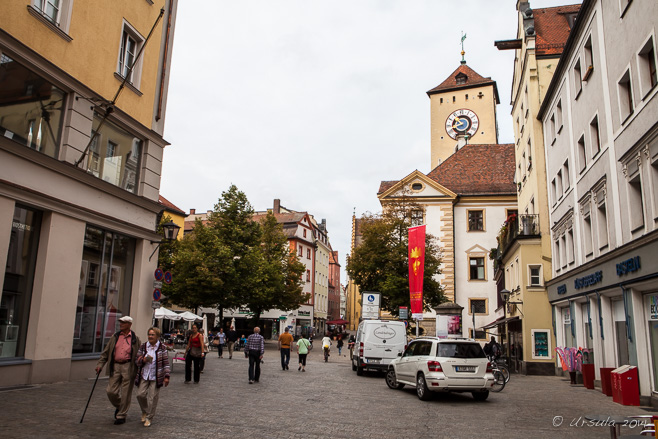
Regensburg Streets Ancient history, charming buildings, and quirky shops attract tourists to the charming little Bavarian city of Regensburg.
The cities of Europe – even those which are lesser known to those of us who spend little time there – are fascinating for their charm and their long and rich history.
Regensburg, sitting at the confluence of the Danube, Naab and Regen Rivers, has been the centre of trade, political battle, and religious turmoil since the Stone Age. Located at the northern-most point of the Danube, Regensburg became the site of an important Roman encampment as early as 90AD.
Believed to be the seat of bishops from late Roman times, it is certain that the Bishopric of Regensburg was formally (re-) established in 739. Part of the Duchy of Bavaria from early 6th century and the capitol of Bavaria until the 13th century, Regensburg was also important during the reign of Charlemagne, and had a pivotal role in early Catholicism. Even after the city adopted the Protestant Reformation in 1542, the town remained the seat of a Roman Catholic bishop and several abbeys.
With the building of the Stone Bridge across the Danube in the middle of the 1100’s, Regensburg became a major centre of international trade, the local centre of culture, and renowned for gold work and fine fabrics.
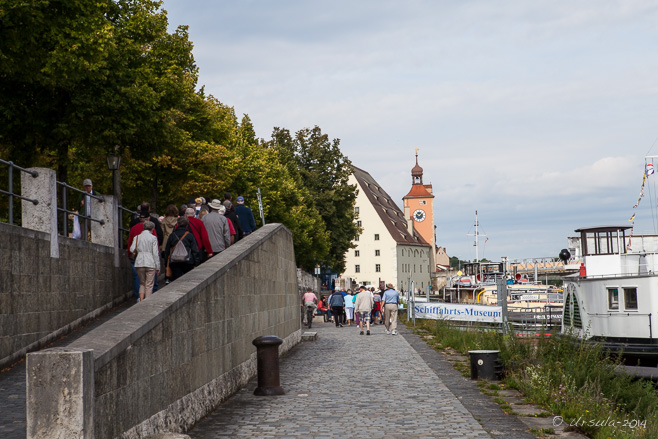
Tourists on the Canal Regensburg, one of Europe’s best-preserved medieval cities, is ranked among Germany’s top tourist sights. Today, many international tourists arrive by canal boats and take walking tours through the old town centre.
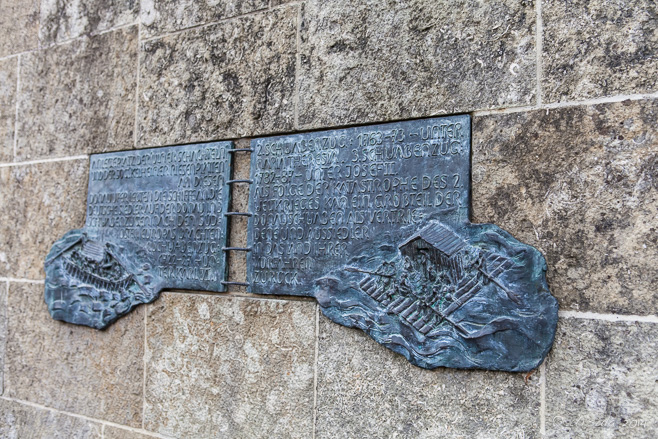
“Fragments of Memories” A memorial plaque on the Danube River at Regensburg names the emigrant ships that docked here in the 1700’s.
East Tower of Porta Praetoria The Romans had their first fort in Regensburg from 90AD. Roman Fort Castra Regina (“Fortress by the River Regen”), originally built in 179, had an entry gate in each wall, with each gate flanked by two massive towers.
Porta Praetoria In 1885, the remains of the Porta Praetoria, dating back to ancient Roman times, were rediscovered when the Bischofshof Brewery, built on the site some time later, was being renovated.
Roofline From the cobbles to rooftops, history is in the stones all around.
City-Map Diorama Gudhorn, a local guide, points out the old-city features to her walking group.
Regensburg Housing Even the modern housing, on the other side of the river, has charm.
The Alte Würstküche The “Old Sausage Kitchen” is reputedly Germany’s oldest restaurant: every day, staff in the 900 year-old building make and serve 6,000 sausages – with sauerkraut and mustard – to customers.
Men at Coffee As is the case across Europe, much business is conducted in the coffee shops, in the streets.
David and Goliath … past a mural of David and Goliath, originally painted by Melchior Bocksberger in 1573, on a building which stands in the place of an old 12th century inn in the “goliards” – a Goliathhaus: a word which, ironically, has nothing to do – etymologically – with the Goliath story.
Old Regensburg A walk down Goliathstraße – “Goliath Street” – towards Haidplatz (Meadow or Heath) Square, leads, naturally enough …
Balcony Everywhere, the old buildings have fresh paint and fresh flowers.
Statue of Don Juan de Austria Oh, how complicated are the royal houses of Europe! Don Juan de Austria (Don John of Austria), who was born near here in 1547, was the illegitimate son of Holy Roman Emperor Charles V, heir to three of Europe’s leading dynasties andKing of Germany, Italy and Spain, with Barbara Blomberg, a young Regensburg woman. Don Juan was well schooled, and was later recognised officially as an heir.
Old-Town Plaza The plaza around the Old Town Hall is a pleasant place to gather.
Old Town Hall Parts of the Old Town Hall itself date back to the 14th century.
Bay Window The window and door details on the Old Town Hall are intricate and beautiful.
Arched Courtyard Everywhere around the Old Town Hall plaza, there are colourful nooks and crannies.
Dirndles for Sale Traditional clothing styles are experiencing a revival, and modern shops feature the Bavarian dresses in up-to-date fabrics.
Home of Reformation Discussions More accidental history: Philipp Melanchthon (Schwartzerdt), follower and friend of Martin Luther, leader of the Lutheran Reformation, held discussions with Dr. Johann Maier von Eck, defender of Roman Catholicism in this house in 1541. The Lutherans (Protestants) won.
Schindler’s House The city takes pride in the fact that Oskar Schindler, saviour of over 1200 Jews, lived here for a period of time after the war.
Another Clock Tower More cobbled streets and archways lead to the famous 12th-century stone bridge .
Regensburg Cathedral The Romanesque Cathedral of St. Peter was originally begun in 1273 and completed in 1525, with ongoing additional touches and restorations through to the 2000s.
“Hutkönig” the Hat King With an extensive range of men’s and women’s millinery, the “Hutmacher am Dom” got our complete attention for as long as it took to find the perfect style and fit.
“2000 Years” A modern sculpture incorporating 200 fish – to represent 2000 years of Regensburg history – also marked our return to our boats.
Wandering around an old city is a great way to learn some history –
[…] UNESCO-listed centre of Regensburg, one of Europe’s best-preserved medieval cities (see: Bavarian History and Charm), we set off on an optional afternoon trip to Kelheim, at the southernmost point of the […]ReplyCancel
Sisterly Care Young girls smile unselfconsciously for the visitors as they fix each others hair on the front stoop of a blue Jodhpur house.
India!
Hot air and warm smiles.
Chaos everywhere: trash and cow pats underfoot, birds overhead, and roadways crowded with pedestrians, cows, cars, and bikes all around.
But it’s the colourthat I love…
And the natural grace of the people: everywhere you look there are people, young and old, draped on doorsteps or leaning against walls, their faces open and staring – or smiling – at the visitors, seemingly just waiting to be photographed against the weathered, textured, colourful walls of their cities.
Jodhpur is Rajasthan’s “Blue City”. Houses in the older sections of the city – around the 15th century Mehrangarh Fort – are predominantly painted blue. Most guides will tell you that these houses belong to Brahmins, the “purest” of Indian castes: traditionally the priests and guardians of Hindu religious rituals and spiritual knowledge. Other sources suggest that the blue is more than just indigo tint, but includes the addition of copper sulphate aimed at eradicating termites.
Whatever the reason, the old city’s walls and doors are alive with colour – as I rediscovered on a wander throughout the streets and up to the rooftops of the ancient city with Photographer Karl Grobl and guide DV Singh late on a November afternoon.
Stand-Off! Typical Indian chaos: as we try to make our way up the hill to Jodhpur’s Old City, our bus is completely blocked by traffic and roadworks. Smaller vehicles sneak past on either side, leaving us motionless for a very long time. Eventually, our guide got off our bus, engaged in several altercations with other drivers, and eventually guided our driver through the mess. Of course, we’d have to come back the same way later!
Woman in the Street Meanwhile, people on the street watch on, …
Watchers in the Street … fascinated by the strangers in the bus.
Corridors and Lane Ways Finally! Our bus gets us up to the old city, where we wander the streets and lane ways on foot.
Bike and Textures
Woman at the Window Blues and greens frame the faces of the neighbourhood. Wires hang everywhere.
Kids in the Doorway A family poses spontaneously at their window: …
Kids in the Doorway … always ready to smile at the strangers.
Textured Doorway
Rubbish in the Lane Ways
Waving at the Strangers
Boys on the Stoop
Boys at the Doorway
Woman at a Doorway
Old Jodhpur Street
Woman on her Porch
Woman in a Window As the Autumn sun starts lowering, we are welcomed up to the roof-top of one of the homes.
Mehrangarh Fort From the roof, we have a view over the blue-painted houses around the Mehrangarh Fort.
Dog on a Wall Rocky walls, brambles, and piles of rubbish are also on view from our rooftop.
Textured Rooftops
Men on the Rooftop
Man on the Roof
Chai Dishes We were treated to chai…
Our Chai Wallah … made for us by the son of a prominent Brahmin: a dedicated engineering student at a local university.
Blue Walls in the Afternoon In the lowering light, the blue of the walls around us seems deeper.
How do a people preserve the important values inherent in their culture – more than just a traditional headdress and a signature food – without sacrificing the good things that participating in the modern world can offer?
I often ask myself this when travelling – especially in poorer areas of the world where the people trying to preserve their traditions are not part of the dominant ethnic group.
Samosir Island, a volcanic island in Lake Toba in North Sumatra, Indonesia, is the centre of Batak culture. Descendants of a powerful Proto-Malayan people, the Batak comprise “six (or nine – depending whom you believe) separate groups with different (but related) languages and customs.” The largest of these related groups – and the most culturally distinctive – is the Batak Toba people. Until the arrival of the Dutch in the 1920s, the Toba lived in relative isolation, in the region on and around Lake Toba.
The traditional Batak clan houses, Rumah Bolon, with their elegant saddle-shaped roofs made of thatched sugar palm fibre, are a distinctive sight all around the Batak highlands. Elevated on stilts to protect the occupants against floods or wild animals, these beautiful houses were built without any nails. Some are hundreds of years old. Many are abandoned and falling into complete disrepair. Others have been modified: their old roofs replaced with sheets of corrugated tin. Very few traditional-style houses are being built today – which is why some better-maintained examples of the old styles have been preserved as cultural museums.
The Huta (Village) Bolon Simanindo, once the home of Batak King Raja Sidauruk and his 14 wives, was restored and opened to the public as a museum in 1969. The museum houses a royal boat and a small collection of tapestries, cooking utensils, masks and weaponry.
The real drawcard for tourists, however, is the daily cultural dance performance. While pluralistic religions are not recognised by the state, and most Toba these days are Christian, the dances illustrate some of the old Animist traditions that are still alive and well.
Graves of the Royal Family The Bataks have a long, proud tradition.Hulon Bolon Simanindo, or Bolon Simanindo Village, was once the home of Batak King Sidauruk and his 14 wives. The family’s royal tombs sit at the entrance to village, which is now a little museum dedicated to preserving and sharing Toba Batak culture.
Toba Batak Musicians Toba are said to be capable musicians. Traditional music greets us as we enter the village courtyard in time for the daily dance performance.
Toba Batak Dancers The “villagers” enter the courtyard, leading a buffalo which plays a key symbolic role in the traditional cultural practices.
Courtyard Toba Batak houses stand side by side, with their front gables facing the village courtyard or street. The pole the buffalo is tied to is a Borotan, a ritual slaughter pole, decorated with leaves to represent the tree of life: the Banlan.
Toba Batak Man We have been given notes, telling us what the dancers are doing: …
Hair and Headdress … mostly, they are offering ritual prayers to the god(s), asking that the buffalo behave well, so that participants will be granted sons, daughters, wealth and health.
Ritual Offerings
Buffalo on the Borotan Slaughter Pole Once the buffalo is slaughtered, the meat will be shared.
Gondang Siboru In one number, only the women dance – hoping that one of the men will propose to them.
Young Couple One couple pairs up and dances together. Of course, it is hard to ignore the fact that most of the dancers are quite old – and probably married already. One has to wonder how well the old traditions will carry forward.
Gondang Pangurason The spirit of an ancestor comes and possesses one of the dancers…
Blessings … who then blesses th0se gathered with Holy Water.
Dancing Tourists The tourists are then loaned festive shoulder cloths (kain pelangi) and invited to dance a few rounds.
Magician In the Tor Tor Tunggal Panaluan dance …
Magician … the performer is communicating with the gods, making a specific request for the community.
Sigale Gale The last dance features a wooden marionette, who in this case represents the dead son of the king. There are several stories about the meaning of these wooden effigies, but the common thread seems to be that it is bad luck to die childless, so a symbolic “child” is needed to avert misfortune.
Toba Batak Woman
Toba Batak Woman
The Royal Boat The decorations on the boat – as on the buildings – are in the traditional Batak colours of red, signifying zest for life; black symbolising death; and white, representing the holy spirit.
Dancing Masks In the old days, wooden masks assisted dancers to tell important stories.
King’s Tomb As we leave the museum, we once again pass the tombs of the king and his family. As ornate as these tombs might seem, they pale in comparison with the many costly and opulent mausoleums all over the island – usually much more lavish than the houses that the living are relegated to! Being seen to honour one’s ancestors is still incredibly important.
It was impossible to tell from the dance performance how much of the old traditions are “lived” – rather than just put on display for the tourists. According to Wikipedia, the Toba Batak people maintain distinct aspects of their language and culture, even when they move away from the Toba region.
They are reputed to be confident and outspoken: characteristics which should stand them in good stead as they move into the future while maintaining some traditions from the past.
Morning over St Mary’s Asylum Another English winter day breaks cold and clear as a sun with little warmth rises over the public greens at Burghill.
It’s no surprise that every Brit, regardless of age or gender, owns at least one pair of gumboots or wellingtons. You can’t get far in the English countryside without them.
Winter in England has a reputation: grey and bleak and wet.
While it is true that the whole time I’ve been here, it has been wet, at least under-foot (hence the need for rubber boots), everyday has offered at least some sunlight and blue sky. It has been a pleasure walking past the fallow fields on country lanes and roads, past thickets and hedgerows and copses – such British words – alive with the chirping of small birds.
On a recent Sunday walk in Herefordshire, West Midlands, I encountered stretches of ice, puddles of water, expanses of frost, a small patch of snow, and a whole lot of mud. I was thankful for my new rubber boots at every step.
In spite of the vagaries of the terrain – and the dangerous blind corners on roads with no shoulders or verges, bounded by brambles and hedges so there is no escape from the pavement – it was a pleasant walk from my bedsit in one of the renovated buildings around St. Mary’s(Psychiatric) Hospital, Burghill (established as Hereford County and City Lunatic Asylum in 1868) to Credenhill Park Woods, site of a 2000+ year old Iron Age hill fort…
Every little corner of England is layered with history – ancient and modern.
Morning Frost There is frost in the hedges and black-ice underfoot: it’s a cold February morning in Hereford.
Snow on the Brecon Beacons Once out of the St Mary’s housing estate, there are view over Bakers Furlong farmlands and all the way to the mountains of South Wales.
Public Footpath to Burghill? Footpaths and bridle paths can be found all around the countryside. The trouble is that the signposting leads into unmarked fields, and without a proper ordnance map or local knowledge it is not clear where the path is meant to go and where the gate out of the field might be found.
Burghill Farm Growing frames wait for the new season.
Fallow Fields The winter fields are cut down and plowed over.
Herefords The popular and hardy Hereford beef cattle, now found in over 50 countries, were bred right here in Herefordshire.
Manor House The hill that comprises Credenhill Park Wood rises up from the surrounding estates and farmlands…
Credenhill Street … as the road winds around the base into the outskirts of Credenhill village.
“Old Cottage” This charming English-Heritage Listed timber-framed cottage with a traditional thatched roof was built in the late 17th or early 18th century, with some later modifications.
Snowdrops Small signs of spring rise up out of the dirt and litter at the side of the road.
Winter Fields Muddy roads lead off across the fields in all directions.
Horses in the Park Credenhill Park Wood is a 90-hectare (223-acre) woodland in the Hereford Hills near the village of Credenhill. One of the paths around the ancient semi-natural woodlands is available to specially-licenced horse riders.
Leaf Litter Steep side-trails that lead between the main trails are muddy and covered in fallen leaves.
Winter Woods It’s dark in the woods: a thin afternoon sun angles through the thick trees. The park is a mix of native broadleaf trees and non-native conifers that were introduced over the years for commercial purposes.
Fort? Deep in the woods, there is a fort of some sort in a small clearing.
Open Plateau Some of the land at the top of the hill has been cleared, allowing 360° views over the countryside. A covered picnic table probably gets more use in warmer weather.
On the Ramparts The path around the top of the hill fort ramparts may be passable, but it is slippery and rough with tangled roots.
Under the Ancient Yews The hill fort was built more than 2000 years ago, during the Iron Age. Excavations around the defensive earthworks have given some insight into how it was constructed. An explanatory signboard sits under the branches of a three-hundred year old yew tree.
Stairs Steep stairs lead up and down the ancient ramparts, which still rise to over 10 metres high in places.
Holly
Ivy
Into the Woods The woods are a dense mix of broadleaf trees (beech, ash, and hazel) and non-native conifers.
Livestock Enclosure Part of the hill is fenced off for stock grazing.
Wild Clematis Back on the roadway outside the woodlands, wild clematis winds around the winter hedges along the roadside…
Tree on the Road … and trees without leaves stand tall against the afternoon sky.
There is life in the English winter woods: I saw plenty of birdlife, including three pheasants that whooshed over my head when I startled them. Squirrels and rabbits are never far away.
It’s a lovely place for walks – as long as you dress warmly, and pack an umbrella just in case…
[…] Hills … on other days, I donned gumboots and ventured into the hills and countryside (see: Credenhill Wood). (08February2015, Canon EOS 5D […]ReplyCancel
Leg Rowers and Paddlers The water lanes through the floating fishermen’s village on Inlay Lake are busy with boat traffic.
It can be so easy – especially for people who have never travelled outside their own corner of the world – to take one’s way of life for granted: to feel entitled to a certain level of safety, opportunity and comfort.
But, imagine not being able to step outside your door because there is no solid ground beyond your simple wooden house. Imagine having to do everything – laundry, gardening, shopping, visiting, everything – from a boat. Imagine having to paddle or row everywhere. Imagine not being able to go for a walk or a run.
It is an eye-opener to see how some people live.
Inlay Lake, in the heart of Shan State, Myanmar, is home to about 70,000 Intha people. They are renowned for the unique leg-rowing style that the men use so that they can see over the floating plant life (see: Ursula’s Weekly Wanders: Iconic Images). Most Intha reside in villages and towns on the lake’s edge, but some live in simple houses made of wood and woven bamboo, raised up on stilts, over the lake itself. There they fish and tend their floating gardens.
One September afternoon I was privileged to tour one of these “floating” villages from the relative comfort of a wooden motorboat.
Boat on Inle Lake Most of the transport on Inle Lake is via shallow wooden boats loaded to the gunwales. Many boats have simple unmuffled diesel motors: a troublesome source of water and noise pollution.
Grass and Mountains The Shan Hills surround us. If it wasn’t for the unremitting noise of our motor, it would be beautifully peaceful on the lake.
Boat Operator We race across the open waters…
Inle Lake Fisherman … while a fisherman stands quietly on his anchored boat with his woven fish-basket behind him.
Spirit House The Intha people are predominantly Buddhist, but some of the old Animist practices live on.
Giant Golden Chicken Burmese barges often have giant golden chickens at the prow; I have no idea why.
House on Stilts Raised up on poles, this house – unlike many others we saw – has a lovely large porch.
Jasmine Inle Retaurant Our lunch stop is at a multi-story restaurant on the water…
View over the Lake … where we had a wonderful meal in the airy rooms upstairs, …
Houses and Temple … with views over the lake and the Shan Hills.
Restaurant Staff Two women from the restaurant help push our boat back off after lunch.
Temple on Inle Lake
Boat on Inle Lake The muddy waters are busy with heavily laden boats.
Farmer on the Lake The poles allow the planted vegetables to climb – and also prevent the whole patch floating away.
Young Man on the Lake Even the young take their turns checking the plants.
Women on the Lake The water corridors extend through the vegetation.
Woman Paddling
Tending the Crops
Grocery Store The stilted buildings crowd the narrow waterways …
Bringing Home the Groceries … which are full of boats laden with people and baskets of goods.
Water Hyacinth ~ Eichhornia Crassipes Although pretty, water hyacinth is a non-native pest which grows fast, clogging the smaller streams and depriving local plants and animals of light and food.
Little Girl at the Window As our boats chug between the rows of houses, locals watch from the windows of their modest homes.
Woman at the Window
Old Woman at the Window
Man and Baby
Old Man Some of the faces are as weathered as the wooden walls…
Fixing the Pole What the neighbourhood lacks in amenities, it makes up for in community. A group of men works on getting new poles installed.
Afternoon Light The afternoon light angles across the water, into our eyes, …
Old Man … casting a warm glow on elderly faces.
Women on the Water People call out to their neighbours as they row through the “streets”.
Young Rower The lads start leg rowing at a young age – although I think this one is still having to concentrate.
On the Stoop I can’t imagine how one safely contains active toddlers in houses that open directly onto the water!
Kite Flyer Flying kites is one of the few activities available to kids without electronic gizmos – or local parks or playing fields.
A Last Look over the Water
Purple Evening We head “home” when the light drops to the point where we can barely see… but the boats don’t stop.
One of my Facebook contacts is participating in a “30 days of gratitude” project, posting what she is grateful for daily. It has made my Newsfeed a much nicer place.
The world as a whole would be a nicer place if we all took notice of how lucky we are, instead of feeling entitled to all the “things” that we have – and more. After all, so many of the opportunities that come to us along the way are the byproduct of where and when we were born.
Every time I travel, I am grateful for the opportunity to visit new places. In many of these places, people have very few of the material advantages most of us take for granted. It reminds me just how different one’s day-to-day life can be, and I am always appreciative of the locals who are willing to share a little of their world with me.
[…] written before about it’s floating villages (Life on the Water) and about it’s distinctive leg-rowing fishermen (Iconic Images). Most of the […]ReplyCancel
[…] square-mile (117 square-kilometer) lake is known for its leg-rowing Intha fishermen and its floating villages. Amongst the reeds and narrow waterways, the ethnic markets and buddhist pagodas are also worth a […]ReplyCancel
[…] was in Nyaung Shwe on the north shore of Inle Lake in Myanmar, with photographer Karl Grobl, local guide Mr MM, and nine other photography […]ReplyCancel
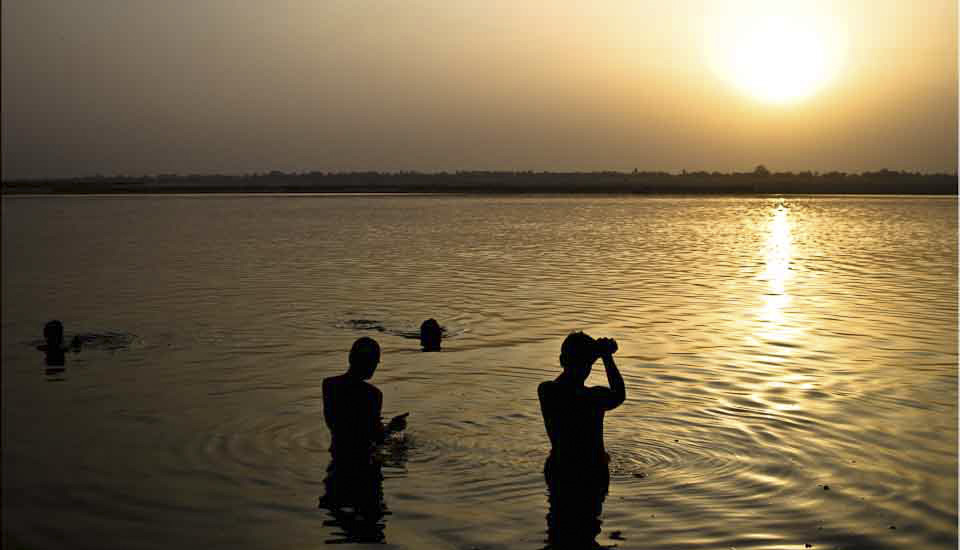
- Performing the Ganga Aarti from Dasaswamedh Ghat, Varanasi
- Buddha Head from Shwedagon Pagoda, Myanmar
- Harry Clarke Window from Dingle, Ireland
- Novice Monk Shwe Yan Pyay Monastery, Myanmar
Packets of 10 for $AU50.
Or - pick any photo from my Flickr or Wanders blog photos.







 Chai, chaos and colour…


 They are reputed to be confident and outspoken: characteristics which should stand them in good stead as they move into the future while maintaining some traditions from the past.


 Until next time~


[…] UNESCO-listed centre of Regensburg, one of Europe’s best-preserved medieval cities (see: Bavarian History and Charm), we set off on an optional afternoon trip to Kelheim, at the southernmost point of the […]
[…] beautiful post about Regensburg I found is here.If you want to know more why this place is a UNESCO World Heritage site, then you […]