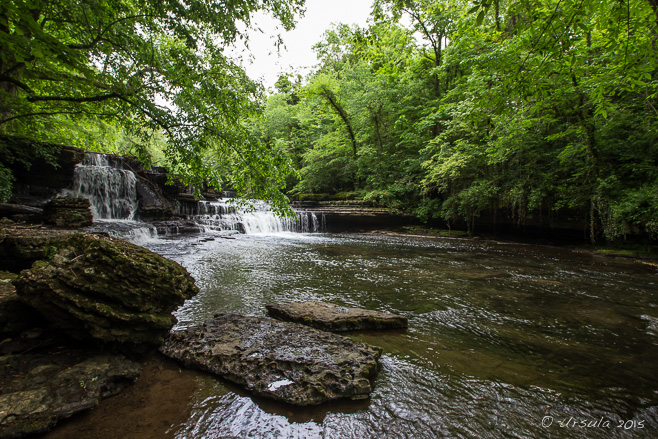
 Falls on the Little Duck River
The prehistoric Native-American ceremonial mound site in Manchester Tennessee, erroneously called “Old Stone Fort” by early European settlers, is almost completely surrounded by beautiful waterways – which probably contributed to its selection as a sacred site. (18May2015) Tennessee is in the middle of “The South”; Middle Tennessee is – as you’d expect – in the middle of the state; and the area south of Nashville is – more or less – “the middle” of the middle.
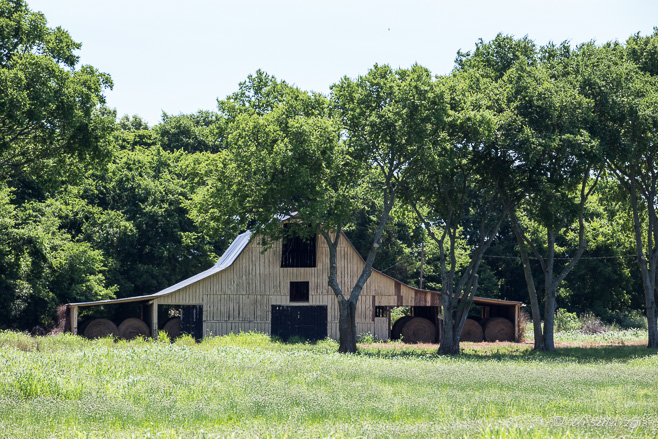 Middle Tennessee Barn
Whether the barns are weathered and worn …
Rutherford County (14June2013) 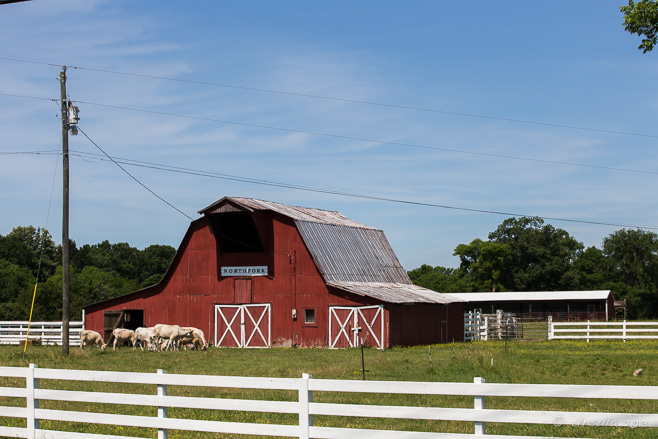 Northfork Barn
… or trim and freshly painted, they are beautifully shaped.
Bedford County (14June2013) Middle Tennessee is known for its farms, beautiful horses, rolling green landscape, and bluegrass-country music. Although it is defined by the serpentine curves of the Tennessee River, it is its tributary, the Duck River that we see daily when we visit. We have family that was transplanted – many years ago- to Bedford County, just south of Nashville, so we usually include a paddle on a portion of the 457 km long Duck in our stay.
 Paddling on the Duck River
Never let it be said that Southerners don’t have a sense of humour: when we go canoeing, our grandson wears a tee shirt with “Paddle faster! I hear banjos.” written on the back. The movie Deliverance was actually filmed in northeastern Georgia, but the countryside is similar.
iPhone6+Snapseed (16May2015) Eastern Gray Squirrel – Sciurus Carolinensis
The expansive housing estates, with their large properties surrounded by trees, make for plenty of back-yard wildlife. (19May2015) “Redbird”
The Northern Cardinal (Cardinalis cardinalis) is a non-migratory year-round Tennessee resident. (21May2015) House Finch and Golden Finch
With the the right kind of seed, red house finches (Haemorhous mexicanus) and American goldfinches (Spinus tristis) are easily attracted to backyard feeders. (21May2015) I try to do something new and different on each visit, which is not hard because it is an area rich in natural beauty (see: Woods and Waterfalls). It is known for it’s southern country ways: huge cream magnolias and magnificent white colonial homes, fine horses and low-slung barns, “dry counties” and Tennessee bourbon (q.v.: A Shot of Jack).
Presidents have lived there (see: A Mixed Legacy) and there are countless Civil War battlefields and graveyards in the immediate vicinity. The scars haven’t all healed, and the stories are still fresh in people’s collective consciousness.
One of the sites we visited on our most recent trip was the Carter House just outside of Franklin, Williamson County. A guided tour of this State Historic Site is more a story-telling history-lesson than house tour. Most of the house itself – built by Fountain Branch Carter in 1830 for his wife Polly and their twelve children (nine of whom reached adulthood) – is not actually open to visitors. Instead, the guide relates the story of the house and the family, before bringing Civil War history vividly to life as he narrates his account of the Battle of Franklin, one of the most costly defeats for the Confederate States Army.
Before daybreak, November 30, 1864, Union Brigadier General Jacob D. Cox co-opted the house and turned the parlour into his command centre. The Carter family, with their slaves and various neighbours, took refuge in the basement while the battle raged all around. The Carters’ middle son Tod, who had been serving as an aide to Confederate Brig. Gen. Thomas Benton Smith, was wounded in the battle. He was, however, rescued from the battlefields, and died, two days later, in his childhood home.
The Carter House
Deceptively small from the front, the double-story house with basement and various outbuildings, is actually quite large. Over a thousand bullet holes from the Battle of Franklin are still visible in the outer walls. (15May2015) Carter House Kitchen Civil War Gun – Carter House – Franklin, Tennessee The Sam Davis Home, built in 1810 in nearby Smyrna, Rutherford County, was the upper middle class home of the Davis family. Sam, the eldest child, was attending the Western Military Academy in Nashville when the Civil War started in 1861. By 1863, he was a “Coleman Scout”, a scout and courier for the Confederate Army.
On November 20, 1863, he was captured by the Federal Army with Union battle plans in his possession. The conventions of war were that “scouts” wore army uniforms; a suspect who was seized while in disguise was designated a “spy” and could be executed. Sam Davis’ uniform was incomplete, and he refused to divulge who had given him the plans, reputedly saying: “If I had a thousand lives to live, I would give them all rather than betray a friend or my country.” So, he was hanged on November 27, 1863 aged 21, to be remembered as the “Boy Hero of the Confederacy”.
Classroom Memorabilia – Sam Davis Museum (20May2015) Guide Lee Lankford
After we have watched the Audio-Visual story of Sam Davis and visited the museum, our guide escorts us into the house itself. Dining-Room : Parlour
The rooms are dark, but well-appointed. On the Stairs
Two sets of stairs lead to the upper story. Wash Stand Upstairs Room
All the girls in the family shared a room – Cotton Handiwork
– separated from their brothers’ room by Grandma. The Original Keys
Lee carries the large keys that open the house and outbuildings. Kitchen Musicians on the Porch
Locals gather in the shade of the porch to fiddle bluegrass sounds. The area is also rich with Native American history.
In Coffee County, there is a stunningly beautiful peninsula formed where the Little Duck and Big Duck rivers almost meet, then spread apart for a while, and then meet to become the Duck. During the Middle Woodland Period, some 1,500-2,000 years ago, Pre-Columbian Native Americans built a perimeter wall of stone and earthwork around a 50 acre (0.20 sq km) mound. Archaeological evidence suggests the walls were built in stages between 30-550 AD, and that the area was used continuously for about 500 years. By the time European settlers arrived in the area, the mound had been abandoned for many years and it’s purpose had been forgotten. The new arrivals assumed it was a fort, hence the name: Old Stone Fort. Now, however, it is believed to have been a sacred ceremonial gathering site. At the narrow neck between the two rivers, there are parallel mound walls which orient to within one degree of the summer solstice sunrise.
Over the past two thousand years, the walls have settled and rounded, and it is hard to imagine how the area once looked. But, the 2 km (1 1/4 mile) walk around the wall, through the green forest, with the waters far below the hill on all sides, is magical.
Stone Raptor Pipe
The artefacts in the museum are amazing for their detailed and beautiful design. The design of this pipe is very reminiscent of West Coast Native American art. Adena Effigy Pipe
Tubular pipes were common in the Adena culture. This one is in the shape of a Indian man of the time. In the 50 Acre Woods
Under the management of the Tennessee State Parks, the woods are surrounded by beautiful waters and criss-crossed with trails, making them attractive for days out. Eastern Box Turtle (Terrapene Carolina)
A box turtle tries to hide in the leaf little at the edge of the Little Duck River. Big Falls – Duck River
Rough paths lead down from the Wall Trail to the river’s edge… Big Falls – Duck River
… where each waterfall is more beautiful than the last. We heard a lot of stories, learned a lot of history, and explored a lot of wonderful, green, countryside.
 It left me looking forward to our next visit! It left me looking forward to our next visit!
Till then
Happy Rambles!
Pictures: 14June2013 and 15-20May2015
Posted in America,Animals,Biography,History,pre-history,USATags: architecture,blog,history,landscape,museum,nature,Photo Blog,travel,Travel Blog,Ursula Wall
Bái Tử Long Bay
A Dragon’s Pearl junk at rest in Vườn Quốc Gia Bái Tử Long (Bai Tu Long National Park), North Vietnam. <<Knock, knock, knock!>> “The cooking class is starting upstairs,” said one of the boat’s crew through a closed cabin door downstairs.
“I guess the optional cooking class is not so ‘optional’!” I whispered to my husband, laughing.
We were already standing in the dining room of our purpose-built traditional Chinese junk, waiting. I was keen to watch and participate in the preparation of our afternoon Vietnamese spring rolls. Plus, I’d forgotten how low temperatures can be in North Vietnam in February, and had no warm clothing in my bag, so I couldn’t stay outside on the upper deck admiring the foggy winter scenery.
We were cruising through the waters between the port city of Halong and protected Bai Tu Long Bay, after being picked up in Hanoi very early that morning (see: Yen Duc Rice Fields). I had visited Halong Bay on a two-day trip with my daughter some eight years before, and had always wanted to revisit with my husband.
The area, which includes over 1600 mostly uninhabited islands and islets, was designated a UNESCO World Heritage site in 1994 for its spectacular seascape of limestone karst pillars and its biological interest. Although all activities in the region are under strict regulation to minimise environmental impacts, the increase in tourism along with ongoing marine transport, fisheries, and daily activities of the local people, create a continued tension and challenge.
The region has become increasingly popular and, as a consequence, crowded, so visitors are often steered to Lan Ha Bay, at the south end, or towards the adjoining Bai Tu Long Bay, just north – even though tour operators tend to refer to all of these as “Halong”.
Bồ Hòn Island
Bồ Hòn Island (Soap-Berry Tree Island) is part of a beautiful chain of islands on Hạ Long Bay. Famous for its view over the World Heritage site waters and for its magnificent caves, it was already a busy and popular stop for visitors eight years ago when I was there. According to local operators, the area is much more crowded today, with as many as 500 boats moored in Halong waters overnight. (Photo: 12January2008) Hon Gai International Harbour
That was then; this is now.
Our boat leaves from a completely different harbour, and I miss the hustle and bustle of the commercial docks I’d set off from in 2008 – and that I had already excitedly told my husband about. The afternoon haze bounces off the waters of this quieter harbour as we wait in drizzly winter weather for our tender to collect us. Our Tender Awaits
Green matting is laid out to keep us from slipping as we make our way down the steep concrete steps to our tender. Bái Tử Long Bay
Limestone karst islets pass by us as we settle into our cabin. Ingredients for Spring Rolls
In the teak- and oak-lined dining-room, the fresh and colourful ingredients for the spring rolls we’ve been promised are set out and waiting. Our Chef and Our Translator
Soon we are joined by the boat’s chef who talks us through the ingredients and process in making the filling for spring rolls. Breaking Eggs
Eggs help bind the filling mixture. Adding Flavour
A sprinkle of salt completes the ingredients. Mixing Spring Rolls
The filling is evenly mixed … Filling Spring Rolls
… before being spooned into the rice paper and rolled up into neat parcels. Making Sauce
The chef mixes the dipping sauce before setting us to work filling and folding our own rolls. Chef in the Galley
We follow the chef into the galley to watch as spring rolls are fried up… Frying Spring Rolls
… for our afternoon snack. Ship’s Helmsman and Mate
Up in the wheelhouse, the helmsman and mate are happy to take their eyes off the ‘road’ and flash smiles for the camera. On the Boat Deck
Passengers brave the cold as our boat continues into the karst cliffs rising all around us. Boats on Bai Tu Long Bay
Our boat anchors, and we have the opportunity to climb into kayaks and paddle around Cap La Island. Kayaking at Cap La Island
The paddling warms me up. I am shocked by how dirty the water is with rubbish and slime-slick; between that and the cold air- and water-temperatures, I am surprised that some of our companions choose to go swimming. Sun Lowering on Bai Tu Long Bay
The sun lowers in the winter sky, the waters go quiet, … Bai Tu Long Evening
… and the world goes still. “Lovebirds”
Back in the dining room, the chef shows off his food-decorating skills: a pair of lovebirds carved from turnips wish us good luck and happiness. (iPhone6) Cruising, cooking class, and kayaking: it was a full day, really.
Top it off with plenty of fresh, tasty food and good drink and company, and you have a satisfying feast.

Dreaming of lovebirds and rocked by gentle waves, we drifted off to sleep…
‘Till next time,
Happy Sailing!
Pictures: 20February2016
Posted in Food,Nature,Travel,VietnamTags: environmental portrait,environmental portraits,food,landscape,National Park,nature,Photo Blog,travel,Travel Blog,UNESCO,Ursula Wall,Vietnam
Kim Churchill
Australian folk, rock, and blues singer, songwriter, and musician Kim Churchill plays guitar, blues harp (harmonica), stomp box, drums, lapsteel and tambourine – sometimes all at once! This year marked the 27th annual Byron Bay Bluesfest – that celebration of Blues and Roots music held every Easter in the sub-tropical Autumn on Australia’s East Coast.
I love it!
Now, I know I’ve said that before (Back to the Roots), but what else can you say about a collection of top-notch artists that ranges from acoustic solo performers and one-man bands through to big bands, and from street buskers to international big names?
Regardless of the size of the ensemble, we were treated to a long-weekend of fabulous music. Unlike performances in more formal venues, cameras are allowed: in the performance tents my cameras and I had reasonable (not great – oh, how I often wished for a press pass!) visual access to the musicians we were enjoying.
Join me for a glimpse of some of the people we were entertained by.
Kim Churchill
Barefoot and down-to-earth, the Australian surf-enthusiast and one-man band Kim Churchill engaged easily with his audience, telling self-depreciating stories with gentle humour, and creating an entrancing sound described by one music critic as “psychedelic whale music, ocean-side blues …” Grizzlee Train
Winners of the 2015 Byron Bluesfest Busking Competition, young Australian friends Brandon Dodd and Josh Dufficy have moved from the busking tent to sharing the stage with many big names in Australian blues and rock music, and backing Australian country singer-songwriter Kasey Chambers. Eugene “Hideaway” Bridges
Playing classic blues with undertones of soul, funk, rock and gospel, Bridges performed with the help of a small group of backing musicians. Kasey Chambers
Unbilled performers and unexpected musical combinations are one of the great joys of music festivals. “Hideaway” Bridges was joined on stage by Australian country singer-songwriter Kasey Chambers. Tedeschi Trucks Band
Bands don’t come much bigger than the bold, brassy, Grammy-Award-winning Tedeschi Trucks Band. Susan Tedeschi and Derek Trucks
Susan Tedeschi, recognised for her original song-writing, her singing voice: a powerhouse blend of Bonnie Raitt and Janis Joplin, her blues-rock guitar playing, and her commanding stage presence, and husband Derek Trucks, formerly of The Allman Brothers Band, and called by Rolling Stone the 16th top (out of 100) guitarist of all time, are the drivers of this completely absorbing stage act. The National
It was a full-on lights, back-screen and sound experience: American indie rock band The National, from Cincinnati, Ohio, were a hit with the younger audience members. Tweedy
With a soft-rock sound that reminded me of early British pop, Tweedy is an American father and son rock band composed of Jeff Tweedy, from the group Wilco, and his son, Spencer. Graham Nash
We older audience-members remember the early pop-tunes of the Hollies, and the later folk-rock songs from Crosby, Stills, Nash and Young. Graham Nash and Shane Fontayne
Graham Nash was joined by English rock guitarist Mick Barakan “Shane Fontayne” to deliver old favourites and new releases. Jackson Browne
Another “old favourite”, Clyde Jackson Browne – American singer, songwriter and musician – performed his well-know songs, many of which were originally performed by other people, and newer songs from his recent studio album. Jackson Browne
An inductee to the Rock and Roll Hall of Fame and the Songwriter Hall of Fame, Jackson Browne has sold over 18 million copies of his 19 albums. Melissa Etheridge
Another house-hold name to those of us of a “certain age”, the Grammy-award-winning American rock singer-songwriter and guitarist Melissa Etheridge was in great form. Melissa Etheridge
Her powerful, well-crafted lyrics were carried effortlessly by her husky, ranging, voice. St Paul and the Broken Bones
The sleeper-success of the festival would have to have been the brassy, big-band soul-sounds of St Paul and the Broken Bones from Birmingham, Alabama. Paul Janeway
St Paul and the Broken Bones’ vocalist Paul Janeway grew up in a strict religious household and trained to be a preacher before finding his voice in his own music. Night Falls over the Grounds
Getting caught up in music, it is easy to forget what time of day (or night) it is – but hunger brings me out regularly in search of the varied food on offer. Rick Vito with Mick Fleetwood Blues Band
They don’t get much bigger (or taller) than Michael John Kells “Mick” Fleetwood. I saw him in the mid-seventies with Fleetwood Mac, the British-American rock band he co-founded. The stage at Bluesfest was filled with his drum kit; I had to watch carefully to get glimpses of him through the cymbals. Rick Vito
American guitarist and singer Rick Vito replaced Lindsey Buckingham as lead guitar in Fleetwood Mac from 1987. Rick Vito
With a long history of playing with Bob Seger and numerous others, Vito had no problem commanding attention on the stage. Mick Fleetwood
Why do we get so excited by “famous people”? It was a buzz listening to Mick address the crowd while roadies re-arranged the drum kits on stage.
And there was so much more …
… watch this space!
Whether its made by solo performers or big bands, by new kids or old hands, is there anything better than great music?
I think not.
Let’s dance!
Pictures: Photos: 24-27March2016
Posted in Australia,Music,Performance,Popular CultureTags: blog,Byron Bay Bluesfest,environmental portrait,environmental portraits,music,musicians,people,performance,Photo Blog,portrait,portraits,Travel Blog,Ursula Wall
Garðskagi Lighthouse
Garður, a small village on the Reykjanes Peninsula in southwest Iceland, is a popular day-time stop for bird-watchers and picnickers. At night, busloads of tourists arrive from nearby Reykjavík in the hope of seeing the Aurora Borealis. When travelling in search of natural phenomena, luck is everything.
My husband and I visited Iceland last March for a three-day visit. We were already going to be in England during the northern winter, so when I saw the package “deals” to see the strong>Northern Lights and to go Whale Watching on the North Atlantic, I couldn’t resist.
Of course, whales can be elusive creatures and the Aurora Borealis is not always visible – even in Iceland in winter. Even so, our tickets had to be booked well in advance, and we could only hope for favourable conditions.
As luck would have it, the Northern Lights were the best they had been in years the day before our arrival. The night we were booked to see them, the sky clouded over and it rained, meaning that all tours were cancelled.
On our last day in the country, we crossed our fingers extra-hard for good weather; for while our tour tickets would be honoured for months, our flights were not changeable, and we couldn’t just hang around!
Conditions were far from perfect, but we enjoyed an interesting – if rather long – day anyway. We walked down to Reykjavík Harbour mid-morning so we could see exactly where our whale-watching boat would leave from – and judge how much time we could spend& at the nearby Saga Museum before our sailing.
Boat on the Docks
Old Reykjavík Harbour is an eclectic mix of relatively modern architecture and maritime heritage. Boat in Drydock
The weathered boats offer up interesting colours and textures. The Saga Museum
A stunning sculpture of a running horse is installed outside the building on Reykjavík’s Old Harbour that has been the home of the Saga Museum since 2014. We are glad to get inside, out of the rain. Papar: The First Inhabitants
Iceland’s first residents were papar or “fathers”, believed to be hermit Celtic monks, looking for uninhabited places to contemplate their Christian faith.
The Saga Museum features 17 displays of this type depicting key moments in Icelandic lore and history. The mannequins were very lifelike, and through the displays (some of which are quite gruesome), we learned more about Iceland’s past than we ever thought we’d need to know! Ingólfur Arnarson and Hallveig Fróðadóttir
The Norse word saga (pl. sögur) means: “what is said, statement” or “story, tale, history”.
The received lore is that Iceland’s first permanent Norse settlers – arriving in 874 – were Ingólfur Arnarson and his wife Hallveig Fróðadóttir. Ingólfur had been forced to leave Norway after reputedly murdering his brother. His step brother, Hjörleifr Hróðmarsson, sailed with them to Iceland – but Hjörleifr was subsequently murdered by his own Irish slaves in retaliation for his mistreatment of them.
The other accepted legend is that when Iceland was first sighted, Ingólfur threw his high-seat pillars (a sign of his being a chieftain) overboard, and decreed that they would all settle wherever the gods chose for the pillars to wash ashore. The wooden pillars, carved with the family name and emblem, and with representations of the gods, were found in the bay which they named Reykjavík.
The stories in the Saga Museum are indeed sögur! Melkorka Mýrkjartansdóttir and Ólafur Pá
Many of the women in Iceland’s early days were of Celtic origin, captured and enslaved by the Viking men. According to legend, Melkorka Mýrkjartansdóttir, who was later found to be the daughter of an Irish king, was taken into slavery when she was fifteen and purchased by Höskuldur Dala-Kollsson.
Melkorka had a son, Ólafur Pá, of whom Höskuldur was very fond, and who grew up to be a good and generous person. Úlfljótur and Grímur Geitskór
Around 927 AD, the Icelandic chieftains decided to base their legal system on foreign prototypes. Úlfljótur, a farmer with legal experience, was sent to Norway to study their system of laws, while his foster brother, Grímur Geitskór toured Iceland in search of the most appropriate place for the new parliament. In 930, the Alþingi (Althing), or general assembly, met for the first time in what is now Thingvellir National Park. Þorbjörg lítilvölva: the Little Prophetess
The ancient Vikings, who believed in the old gods or Æsir, distinguished between völvur, or “seers”, who could predict the future, and witches or sorceresses, who sought to change it. Þorbjörg lítilvölva is described in detail in the Saga of Eric the Red. Boats on the Docks
After a delicious and uniquely Icelandic lunch at the café at the Saga Museum, we worked our way to the tourist boats… Whale Watchers
… where the tourists are already in their foul-weather suits. The Docks
The whale-watching boats leave from the old Reykjavík docks,& … Reykjavík Harbour
… which have been refurbished for pleasure boats. North Buoy Marker
Our boat leaves harbour, and heads north … The Greenland Sea
… into the Greenland Sea. Northern Fulmar (Fulmarus Glacialis)
In the Greenland Sea, we come across seabirds, … Watching for Whales
… while the guides keep a lookout for whales. They find some in the distance, and get excited, but – I don’t want to rain on their parade – we get them closer and clearer (and warmer) at home during the annual migrations. Northern Gannet (Morus Bassanus)
We find more sea birds… Northern Gannet (Morus Bassanus)
… as they dive in and out of the waters and fly off. Great Cormorants (Phalacrocorax Carbo)
A ‘gulp’ of cormorants are startled by our approach… Great Cormorant (Phalacrocorax Carbo)
… and fly off. We don’t usually eat hot dogs, but we got off the whale-watching boat cold, hungry and a little disappointed at the lack of cetaceans. So, when we came across the little food-stall housing “Bæjarins Beztu Pylsur” (“the best hot dog in town”), which we had heard was “the best hot dog stand in Europe”, we had to join the queue and try one of “Europe’s top 10 local flavours…”
We weren’t disappointed, and the snack fortified us for the long wait until our trip into the night later, in search of the Northern Lights.
Flösin Café and Garðskagi Folk Museum
The night was almost pitch-black as we piled out of our parked busses and, like moths, head towards the only lights. Garðskagi Folk Museum
The small municipal museum in Garður prides itself on its collection of working Guðni Ingimundarson engines. Flösin Café Bar
In view of the freezing-cold night air, we were more interested in getting hot drinks at the little bar upstairs… Looking for the Lights
… before heading outdoors onto the balcony in search of lights. The Aurora Borealis was subtle: most of the time, it could only be seen through the camera lens. It was almost invisible to the naked eye. Garðskagi Lighthouse
There two lighthouses at Garður; the only one lit against the night sky was the newer, taller (28.6 m) one – built in 1944. Keflavik International Airport
Morning came only a few hours later, and soon we were back at the airport, watching the sun rise over the terminal. (iPhone) The Jet Nest
In the cold morning light, we enjoyed another sculpture (see: Reykjavík): this one called The Jet Nest, by Magnús Tómasson. It shows a jet wing breaking out of an egg like a baby bird, and sits on a pile of Icelandic volcanic rock. (iPhone) “Breeze”
Nína Tryggvadóttir (1913 – 1968) was one of Iceland’s most important abstract expressionist artists. She farewells us with her poetic words at the airport… “The breeze of your movements still stirs the air though you have gone.”

What a lovely thought – and especially fitting in a country where weather has a personality all its own.
Until next time –
Happy Travels!
Pictures: 19-20March2015
Posted in History,Iceland,Nature,TravelTags: blog,fishing boats,history,landscape,natural phenomenon,nature,Photo Blog,sculpture,travel,Travel Blog,Ursula Wall
Woman and Boy
Kohl-darkened eyes shine out of murky, back-lit interiors; even the low light can’t hide the brilliant colours of mum’s turquoise sari. With 83 people per kilometre, compared with about two and a half people per km in the Sahara, the Thar Desert – that large arid region that stretches across most of the border between India and Pakistan – is the most densely populated desert in the world.
About 85% of this desert is in India, and about 60% of that covers Rajasthan – where it is home to 40% of the state’s population.
As you would expect given the harsh climate, the Hindus, Muslims, Sikhs, and minority groups who live in the desert are a hardy lot. Outside of the desert cities of Jaisalmer and Bikaner, most of these people live in small, scattered villages, growing drought-tolerant crops and raising robust animals.
But, they are also known for their rich and colourful cultural traditions, including their folk music and poetry. I love the soft desert colours woven into the rugged dhurries, and the wildly vibrant colours in the saris and soft furnishings.
I also love how welcoming the people are.
I visited a number of desert communities during my stay in Rajasthan (India+desert) with photographer Karl Grobl and local guide DV Singh. Granted, the villagers received a small stipend for allowing entry to our group of photography enthusiasts, but I never felt ‘in the way’ as people went about their daily lives, pausing to look at the camera with open faces.
Taking candid portraits in Northern India is such a pleasure!
Old Man at Daybreak
Mornings in the desert are cold – the village residents are well wrapped-up when we arrive for our visit. A Room in the House
The rooms indoors are simple but colourful, with richly decorated fabrics in true Indian style. Ancient Millet
One of the oldest grains cultivated by man, millet (“basra” or बाजरी) is a Kharif – or monsoon – crop, grown and harvested during the rainy season. Old Man in the Courtyard
Rural Indians – especially in the desert – work hard. But, they have also mastered the ability to sit with a stillness that – even during meditation – I struggle to achieve! Young Woman and Child
The young children are shy; their elders have no trouble making clear, direct, eye contact. Woman in Orange Hennaed Hands
When asked (through sign language: I speak no Hindi, and English drops off long before one reaches these villages), the self-possessed woman in the orange sweater was happy to show off her henna decorations. As far as I could find out, there had been a local wedding recently. Autumn (post harvest) is a big time for the long, loud, and extravagant wedding celebrations in Rajasthan. Family Group
It is still early-morning, but the Autumn sun is starting to burn off the night chill and is casting sharp shadows. Woman and Child Man at the Well
Water, a precious commodity in the desert, has to be carried by bucket from the village well. Smiles from the Woman in Orange Woman in Green with Child
Back inside one of the houses, a grandmother shows off her toddler. Young Woman in a Doorway Three Faces in the Doorway
People in India, whatever their ages, seem to just drape themselves photogenically in windows and doorways. Eyes Everywhere!
Of course the risk when travelling with a group, is that as soon as you have worked up to the shot you want, other people with cameras walks over, and the subjects’ eyes go everywhere. Child in the Kitchen
Meanwhile, one of the young children has decided it is past his breakfast time. Man Child and Wife
Numerous studies have looked at the place of females in Indian society, and they say that it is the ‘most dangerous [place] in which to be a girl’. Father and his Girl
While I’m sure that this is true, it is also true that everywhere I’ve been in Northern India, I’ve seen (and photographed) proud dads with their daughters. Shrine in the Fields
Whatever religion local people practice, their practice of it is an integral part of their daily lives. Man in a Moustache
It there anything more Indian than a man in a moustache? This man was our driver – his English was rudimentary, … Medicinal Plant
… and all he could tell me about this plant growing at the village boundary, was that it was medicinal. Man in Red Turban
When it is time for us to go, the village elders say their goodbyes … Woman in Yellow Sari
… and the women go back to work. I alway feel so privileged to have the opportunity to make portraits in these communities, and to have a small glimpse into other people’s lives.

Until next time ~
Namaste!
Photos: 10November2013
Posted in Every Day Life,India,Portraits,TravelTags: children,environmental portrait,environmental portraits,India,people,Photo Blog,portrait,portraits,rajasthan,thar desert,travel,Travel Blog,Ursula Wall
« Older posts
Newer posts »
|







Do you mind if I share your Sam Davis Home photos to the Rutherford County Historical Society facebook page? I will give you photo credit and cite you as a source.
I’m very happy for you to do that, Carol!
You will find more pictures on my Flickr page (https://www.flickr.com/photos/ursula_bkk) if you search Sam Davis’ name, or check my “Tennessee Tales” album.
Best regards, Ursula
[…] are believed to have hunted and camped in what is now Tennessee as early as 12,000 years ago (see: Southern Short Stories), and when Western settlers moved into Middle Tennessee during the 1700’s, it was in […]