Our Lady of Lourdes Indian Band Catholic Church – Sechelt A simple church built of wood, Our Lady of Lourdes, was transported by barge to this spot on the waterfront on Shíshálh Nation lands in 1973 to replace an earlier building which had burned down. (iPhone6)
Woods and water are the central features of Canada’s Sunshine Coast.
This rugged, mountainous, landscape on the southern-mainland coast of British Columbia (BC) in Canada’s west is bounded by the Coast Mountains on one side and the Strait of Georgia on the other. Although it’s just a stone’s throw from Vancouver, no access roads have been built around the fjords or through the mountains, and the region is only accessibly by air or water. Most residents and visitors are dependent on the BC Ferries, which act as an extension of the local highway system.
Coniferous trees – especially Douglas fir and western red cedar – cover the steep slopes and have always been important to the life and livelihood of the people. The indigenous Coast Salish people built their longhouses and dugout canoes from the resilient and ubiquitous western red cedar. Much of their artwork was carved into and painted onto the beautiful local timbers.
The first European visitors explored the area from the waterways in the late 1790s (e.g.: José María Narváez, George Vancouver, Dionisio Alcalá Galiano & Cayetano Valdés), leaving their names on many of the local geographic features. The first European settlement didn’t happen for almost another century with the arrival of loggers, farmers, and fishermen.
Logging has always been important, developing into a broader timber industry in the early 1900s: most of Canada’s softwood comes from BC. Patches of brown, felled, land can be seen breaking up the forests of Douglas-fir, western red cedar, western hemlock, yellow cedar, juniper, yew, red alder, grand fir, mountain hemlock, broadleaf maple, sitka spruce, lodgepole pine, balsam fir, western white pine, white spruce, white birch, and black cottonwood trees that extend almost endlessly up the mountainsides to the snow caps. Smoke plumes rise up from the timber- and pulp-mills, meeting the clouds that frequently threaten coastal rains. Arbutus trees cling to rocky cliffs high above the rushing waterways; those waterways are made treacherous by the scattering of dangerous dead-heads – the almost-unseen stray logs that have escaped the long log-booms that drag far behind the sturdy tug boats that tow them.
The evidence of the importance of wood is everywhere.
Wooden Boat – Gibsons Whether in or out of the water, boats – of all shapes and sizes – are a feature of the West Coast. (iPhone6)
Wooden Bench – Sechelt Benches – donated in the names of loved ones – sit along the Boulevard on the Sechelt waterfront, overlooking Trail Bay. (iPhone6)
Watchful Totem – Sechelt The northern-most West Coast Native tribes (the Haida, Tlingit and Tsimshian) were the first to carve the cedar totem poles we are now used to seeing. Through cultural exchange, this art form spread across the whole region. This particular watchful face looks to the waters west of Shishalh tribal lands in Sechelt. (iPhone6)
A “Fixer-Upper” – Earl’s Cove Even wood as resilient to the elements as western red cedar (Thuja plicata) can end up mossy in the damp shadows and weathered by time. (iPhone6)
BC Ferry – Earl’s Cove The mountains are high, the rivers are wide, and the forest is thick: if you want to drive, car ferries are the only way to access the Sunshine Coast roads. (iPhone6)
“Welcome to the Heart of Powell River” Powell River is the site of Western Canada’s first pulp mill, built in 1908. The pre-planned model company town was started in 1910. In 1995, the township and the 400+ original buildings that remained within the boundaries were designated as a National Historic District of Canada.
Rodmay Heritage Hotel Built in 1911 as the Powell River Hotel, the Rodmay was the first commercial building in the old township.
Postmaster’s House One of the first buildings in the township was the former home of the local doctor – build in 1910 to replace the earlier tented accommodation. The Postmaster’s House followed soon after. A typical Craftsman Style house built in 1912 of cedar shakes and shingles, it is now a private home.
Dwight Hall The community centre, built in 1927, is still home to community activities.
Patricia Theatre Once housed in an older building (1913), the Patricia Theatre (1928) is the oldest, continuously running cinema and vaudeville business in Canada.
Federal Building The 1939 building that was once the site of the Post Office, the Customs and Excise services, and the Canadian Telegraph operations, has been re-purposed to house the local craft brewery.
Cedar The trees in the gardens, …
Cherries … and those lining the streets, are lovingly cared for.
Japanese Maple Even plants that are not indigenous …
Honeysuckle … do well in this wet and temperate climate.
The Old Courthouse Inn The Provincial Building (1939) once housed the local police, forestry services, and other provincial government services.
Old Lamp The interior of the old Provincial Building has been lovingly refitted and filled with antiques (iPhone6) …
The Sheriff’s Office … and operates as a charming boutique hotel: The Old Courthouse Inn.
Derelict The wet weather takes its toll, and not all of the buildings have kept up.
Arbutus Apartments Build as the Oceanview Apartments in 1916 for married employees without children, the beautifully maintained Arbutus Apartments remind us again that the whole raison d’être for the township …
Mill Smoke and Roof Work … was the mill, which as Catalyst Paper Mill, still operates. In its glory-days, the paper produced here supplied 25 newspaper outlets. In the foreground, you can see a carpenter working on the eaves of St Luke’s Hospital, originally built in 1913 by Dr Henderson.
While wood, and timber products, are still important to the livelihood of the Sunshine Coast, the area is reinventing itself as a centre for recreation, tourism, and retirement living. The forests still play a major role: providing a beautifully aesthetic backdrop, places to walk and sit, pulp for specialised papers, timber-products for modern building, and beautifully grained woods for homewares and artworks.
The Curtain Wall Trim Castle is the largest Cambro-Norman castle in Ireland – and possibly the prettiest and most interesting, as well.
Seen one castle, seen them all?
Not quite!
During our wet month in Ireland in 2012 (Ireland), we visited a lot of castles in various states of ruin, renovation, or disrepair. What surprised me most was how different they all actually are.
Perhaps it was the brief respite from the rain, but my husband and I agreed that our guided tour of the keep at Trim Castle – the largest Cambro-Norman castle in Ireland – was the most interesting castle tour we had participated in. And, having rare blue skies overhead made the castle surrounds more attractive.
Trim Castle sits strategically on raised ground on the south bank of the River Boyne in Trim, County Meath,about 40 kilometres (25 miles) up-river from the Irish Sea. Once upon a time, that mattered. County Meath marked the outer northern boundary of “The Pale” (An Pháil): that part of Ireland under direct control of the Plantagenet Kings of England in the late Middle Ages.
A fortified ringwork was started in 1172 by the Lordship of Meath, Hugh de Lacy, and the castle itself was built over a period of 30 years – being finished around 1224 by de Lacy’s son Walter. The central three-story keep is cross shaped, with twenty corners: a unique design for a Norman donjon or great tower. The land and buildings were sold to the State in 1993. The Irish Office of Public Works then conducted a major six-million euro project of archaeological and conservation works, including partial restoration of the moat and the installation of a protective roof, before re-opening the castle to the public in 2000.
It’s a very pretty castle, and I really liked the concept of using a clear roof to allow light into the keep tower, while maintaining the character of the ruins.
Caisleán Bhaile Atha Troim Old stonework leads us over the moat and in through the Trim Castle entry gate.
Trim Castle Keep The castle keep (also known as a donjon or great tower) is three stories high and forms a cross in the centre of the grounds.
The Great Hall Only the harbour wall remains of the huge late 13th-century three-aisled great hall.
Trim Castle Ruins A river gate was built into the wall near the Great Hall so that goods could be taken in directly from boats on the water. The ruin on the other side of the River Boyne is the Yellow Steeple – the last relic of what was once St. Mary’s Abbey.
The Keeper of the Key Access to the keep is only by guided tour. At the appointed time, we found our guide with the giant key to the keep door.
Keep Model On the ground floor, there is a model of the keep structure, which our guide explains to us.
Inside the Keep Stairs and walkways rise up through the old, mossy interior.
Spiral Staircase Before we head up the steep staircase, our guide explains how it spirals to the right: that way any attackers who made it this far would need their right hands for the central support, forcing them to put their swords in their left hands. Defenders, on the contrary, have their right hands free.
Arches and Stairways Dark rooms are all through the keep, with their beautiful old stones attracting moss in the damp low light.
Deep Windows Windows through the thick keep walls let some light into the small rooms.
Upper Floors I love the contrast of the sleek modern scaffolded walkways and clear tubular framed roof …
Corridor in the Keep … against the mossy crumbled appearance of the ancient stone walls and the rough-hewn floors where the walkways end.
Plants and Moss Even though the roof keeps the rain off our heads, there is still enough moisture in the old walls to support plenty of vegetation.
Listening Our guide is full of fascinating information and stories about the castle.
View over Trim Outside at the top of the keep we get good views over the town…
Barbican Gate … and over the curving curtain wall and the huge round Barbican Gate.
Weeds in the Rocks Back outside the keep, plants grab hold where they can.
St Patrick’s Church Not to be confused with the older Cathedral Church of St Patrick on the other side of the river, the elegant St. Patrick’s Church sits outside the castle’s curtain wall.
The Curtain Wall The inside of the curtain wall is buttressed and honeycombed with rooms.
Outside Trim Castle Behind the curtain wall of Trim Castle, the top of the cruciform keep can be seen.
The Dublin Gate The arched Dublin Gate in the southern curtain wall is distinctive and beautiful.
Arch in the Gate It is also a great place for children; …
Outside the Curtain Wall Beyond the curtain wall, the more modern city encroaches on the castle. There was a lot of controversy over allowing the construction of the five-storey hotel across the road.
Trim Castle stood in for the English town of ‘York’ in Mel Gibson’s movie Braveheart, and was also used as the location for the ‘London square’ scenes.
Young Himba Girl with Beads The women and girls of Otjomazeva Village in the Kunene region of Northern Namibia lay out beads and trinkets for tourist visitors. This pubescent girl is orange from the ochre paste that Himba females apply daily.
“If you educate a boy, you educate an individual. If you educate a girl, you educate a community.”
Article 14 of the UN Declaration on the Rights of Indigenous Peoples states that: “Indigenous peoples have the right to establish and control their educational systems and institutions providing education in their own languages, in a manner appropriate to their cultural methods of teaching and learning.”
Sounds easy enough. But, how many nations actually provide education in indigenous languages? And, to be fair, even if they tried, how many poorer nations could afford to utilise indigenous languages as the primary means of instruction?
And, who determines “a manner appropriate to their cultural methods of teaching and learning.” Better yet, who determines appropriate content?
Last year, I had the wonderful privilege of spending time with some Himba people in Northern Namibia (see: Mother and Child; Model Shoot). The Himba are a beautiful, proud tribe who have deliberately resisted integration into the modern world.
Linguistically and ethnically related to the more populous Herero, the Himba have wandered across what is now Northern Namibia since the early 16th century. After the crippling bovine epidemic of the late-1800’s, they forged a separate cultural identity, barely surviving attempted genocide under the colonialist German South-West AfricaGovernment (the Herero Wars of 1904–1908), repeated severe droughts, and the guerrilla warfare that was part of Namibia’s war of independence and neighbouring Angola’s civil war.
Today, roughly 50,000 Himba remain, eking out an existence in semi-nomadic villages. While their tribal structure and traditions help them live in one of the most extreme environments on earth, these same strong traditions may be preventing them from forging a bridge with the modern world. At the moment, their only ‘integration’ means earning money from tourists who visit the villages for quickie-tours, and who may buy a few trinkets: money which often gets spent by the men on alcohol in nearby towns (e.g.: Vanishing World). Getting an education means having to dress in western clothes and being exposed to non-traditional values, and often leads to a lowering of pride in, and attachment to, one’s own culture. “Today, traditional Himba culture in Opuwo seems less highly esteemed by other tribes and by Himba youth, and traditionally-dressed Himba are often mocked.”
So where does this leave the Himba with respect to the UN Article 14? Under German and British rule, the Himba associated schooling with Christian missionaries who undermined traditional worship of cattle, the ancestors, and the God Mukuru, for whom a sacred fire is kept lit at all times. Under Namibian law, ten years of schooling is free and compulsory. Schools in Opuwo, capital of the Kunene region and the major urban centre, are modeled after British elementary schools and curriculums, and therefore quite foreign to Himba values. Mobile village schools, originally funded (from 1998) by the government of Norway and Iceland, were taken over by Namibia in 2010 and converted to permanent buildings. According to Wikipedia, Himba leaders have complained that the “culturally inappropriate school system… would threaten their culture, identity and way of life as a people.”
These were some of the questions running through my mind when I interacted with the girls and women in the village of Otjomazeva.
Into Otjomazeva The Himba village we visited is a semi-permanent collection of huts surrounded by a simple kraal fence. When we arrived, our photo-tour leader Ben McRae was mobbed by children pleased to see him back.
Fragrant Smoke On our first visit, we spent time inside one of the dark village huts learning a little about Himba culture. In lieu of using precious water, Himba women “bathe” in fragrant smoke and cover themselves in scented ochre clay and butter paste. (More about that some other time.)
Himba Girl Child What interested me was the interaction between the infant girl and our participants. I wasn’t sure if mum was just tired, or actually depressed, but whenever the focus was off her, she withdrew markedly. Himba don’t count their ages in years, and no-one could tell me how old the mum was – only that this was her eighth child.
Mother and Child Himba girls are married off shortly after puberty, so this woman has probably been pregnant or nursing most of her adult life.
The Bridal Headdress This young girl’s future husband has probably already been selected for her. She didn’t seem thrilled to model the headdress she will wear for her wedding ceremony.
Himba Girl Child Once she was let loose, on the other hand, she was happy to engage with us.
Himba Girl Child
Young Mum Data from around the world show that the higher the level of a woman’s educational attainment, the later she is likely to marry and the fewer children she is likely to bear. (e.g.: World Economic Forum) Too late for this beautiful young woman: she’s barely a teenager herself, …
Woman and Child … but her headdress tells us she has either had a baby or has been married a year.
Young Mum Her friend, who was not much older, was nursing her first child.
Old Aunties from Angola Child-minding falls to all Himba women – not necessarily only the children’s parents. This sick or tired child found a lap with one of two visiting relatives from Angola.
Old Auntie No one knows how old these women are, and I couldn’t help but wonder what they think of the changes they have seen.
The Girl Within But, when one of the old Aunties finally addressed the camera and smiled, I felt like I could see the coquettish girl she had once been.
Mother Selling Trinkets Late in the afternoon, the women lay out trinkets for sale to visiting tourists.
Old Woman with Trinkets Older women don’t always wear their headdresses.
Young Girl with Gourds This young girl is identifiable as pre-pubescent by the two forward-braids on her head.
Laying out Trinkets for Sale Older girls going through puberty wear multiple forward-facing braids designed to cover their faces for modesty.
Young Bride This young woman was relatively newly married.
Himba School Girl When we returned to the village the next day, I came across this young woman. When I asked our guide (the only English-speaking Himba in the kraal) why she had no braids and was not wearing ochre, I was told it was because she was attending school. Compulsory school uniforms do not accommodate ochre. When I expressed surprise that she wasn’t allowed to keep her hairstyle (I understand the issue with the ochre body-butter, as it leaves marks everywhere), our guide Tom said: “It’s only hair!” But, everything I have read suggests that traditional hair and clothing are integral to Himba identity. I was surprised she had to give up her hair to attend school, and I couldn’t help but wonder who had made that decision for her. It also made me wonder how it was that the other school-aged girls had their hair, but not their studies.
Himba Woman This beautiful woman has the gentlest soul. She and I couldn’t be more different, but we seemed to have an affinity.
Making Breakfast Most Himba meals consist of porridge: water is boiled over the fire and some maize or pearl-millet flour is added. Meat – usually goat – is reserved for special occasions.
Young Himba Woman
A Child with a Child What will the future look like for these semi-nomadic people?
Everyone wins when children — and especially girls – have access to education. An educated girl is likely to increase her personal earning potential and prepare herself for a productive and fulfilling life, as well as reduce poverty in the whole community. Investing in girls’ education also helps delay early marriage and parenthood. Our booming economies in Africa need more female engineers, teachers and doctors to prosper and sustain growth.”
– Angelique Kidjo.
I have no idea how – or if – the Himba will leap that gap between making porridge in a tin and being engineers and doctors.
I also don’t know if a change would make them any happier than they seem to be now.
[…] is home to semi-nomadic tribes whose ways of life have barely changed for hundreds of years (see: Women of the Himba, and Himba Model […]ReplyCancel
Les -June 13, 2023 - 6:19 am
I found your article thoughtful…sort of.
I guess it is thoughtful but of what thoughts? Why, for their cultural integrity, should any of the Himba be forced or encouraged even to go to school? They have and know their own culture and understand it, themselves and their place in the world far better it seems, than those of us in the industrialied/post-industrial (esp. the post-industrial) world. And it’s always amusing to read writing done as if the women’s or the men’s life is ‘easier’ or ‘harder’ than the other. Different, when accepted by the owner of that life, ought to be non-judgementally viewed. Why is it that we moderns seem always to feel the need to ‘protect’ non-modern people? Perhaps we focus on the speck in their eye to more ferociously avoid awareness of our own beam?ReplyCancel
That Indian Smile! A red ghoonghat (veil) can’t hide this young villager’s magnificent smile.
Like the rest of India, the Great Thar Desert is a beautiful expanse, full of contrasts.
At one end of the spectrum was the luxury tented resort where I, my tour companions, photographer Karl Grobl, and local guide DV Singh, were all staying; Manvar Desert Camp, amongst the dunes of the Great Thar Desert and just off the Jodhpur- Jaisalmer highway, feels like a serene oasis in the daytime heat. The dry air hums all around the beautiful, minimalist sandy exterior, while the interiors of the spacious tents are cool and quiet. The official literature states that: “Staying [in] the tents is really relaxing & soothing experience.”
I would second that: it is hard to describe the calm I felt while staying there.
Manvar Desert Camp A semi-circle of deluxe tents is a luxurious oasis in the Thar Desert sands.
Quiet Time The air sizzles with heat and promise.
Dining Tent “Casual elegance” is the easiest way to describe the dining tent, with its canvas chairs and linen napkins.
However, step outside the boundaries of the resort camps – or, more accurately, ride a jeep outside – and the hardships that come from trying to eke a living out of the desert environment become more evident. We visited several villages during our desert stay (see: Life in the Thar Desert; Camels in the Desert; Opium for Breakfast; Living in the Thar Dunes; and Morning Portraits in a Thar Village). Each village impressed me with it’s simplicity: life is not easy here. But, even though they might work hard, people in the villages were always happy to come and meet the visitors.
Khiyasariya, about 120 km from Jodhpur, was one of the last desert villages I visited in the area. According to the 2011 Census, Khiyasariya has about 155 houses, 1166 hectares of land, and a total population of 993 people.
Come and meet some of them:
Men on the Wall Everywhere you go in India, people are hanging around, draped as if they just are waiting for us to pass and photograph them.
Sacred Cow You know you are close to a village of some affluence when you come across livestock grazing on the sparse desert grasses.
Walking to the Well Women in Khiyasariya have a long walk to the closest water source.
Walking with Water How the woman walk so gracefully with the full containers on the return trip amazes me!
Man with Pipe Meanwhile, one of the village elders …
Smoking Man … enjoys his afternoon smoke, …
Head Man … pausing occasionally for photographs in the bright afternoon light.
Woman and Child The young women of the village are happy to show off their bare-bottomed babies.
Washing Dishes Kitchen tasks are all manual, …
Carrying Wood … and like water, wood for fuel has to be gathered regularly.
Kitchen
Woman in Pink … before looking at the camera with an open face…
Woman in Pink In another window, a woman looks out from behind her pink ghoongat …
Woman in Pink … and following us to the village gate.
Over the Fence As we get ready to leave the village, people come out to see us off.
Woman and Child Proud mums try to get their children …
Woman and Child … to smile for the camera, …
Kohl-Eyed Infant … but the kohl-eyed youngsters are not sure what to make of the strangers.
At the Gate Villagers watch as we leave Khiyasariya…
Village Kids … and the school-aged kids come out to wave us off.
Moustachioed Finery Our jeep-driver sports a wonderful Indian moustache.
Old Man and a Goat As we drive back to our camp, we come across one of the old men of the village.
Old Goat Herd He is happy to stop and chat as he makes his way back to Khiyasariya …
Sundown … and the sun goes down over his goats.
We headed back to our camp for a dinner and entertainment under the stars: the nights are filled with traditional gypsy folk music and dance (Celebrating Music and Motion).
Russell Morris With a musical career spanning fifty years, Russell Morris is a true veteran, and easily one of my favourite Australian musical story-tellers.
For a country with a relatively small population, Australia is home to a lot of talent in just about every domain – and popular music is no exception. This always surprises me somewhat, because a small populace means a small support base; unlike the “big names” in the big markets overseas, it must be hard for working musicians to make a solid living.
I guess this is one reason why those who last the distance do so because they clearly love what they do. That – along with the music itself – makes their live performances a joy to be part of.
Bluesfest at Byron Bay is billed as “Australia’s Premier Blues and Roots Music Festival”; it encompasses a much broader range of music than that would suggest, however, and I always look with interest to see who is being included in the five-day Easter-long-weekend lineup of local and international artists.
As usual, this year was a treat! We enjoyed a range of talent: fresh-faced and established; local and international; in “unplugged” and “big band” formats (see: Bluesfest 2016).
Join me for a few more musical portraits: a sampling from a great local lineup.
Tex Perkins I loved the self-titled Dark Horses album (2000) and was keen to catch Tex Perkins on stage.
Tex Perkins and Raul Sanchez: “The Ape” The guitar riffs bounced off each other and all over the stage.
Jug Band Outside in the sunshine, the world feels completely different. In addition to the “Busking Tent”, the festival hosts numerous impromptu “street performers”, like this jug band whose name I did’t catch.
Kim Churchill Kim Churchill is one young local performer who already has a significant presence overseas. We loved him and his down-to-earth barefoot charm (see: Buskers to Big Bands).
Ash Grunwald My friend recommended we catch Ash Grunwald, an award-winning local blues artist who was new to me. We loved him. He has nine albums under his belt; clearly others are already won over.
Kasey Chambers and Ash Grunwald Australian country singer-songwriter Kasey Chambers is branching out…
Kasey Chambers … and bringing more wailin’ rock and blues to her music. She joined Ash and the band for a couple of songs.
Ash Grunwald Alone again, Ash commands the stage.
Night Scenes The Mojo Tent was crowded and bouncing Sunday night for one of my favourite ska and jazz bands, The Cat Empire.
Felix Riebl and Cat Empire Popular with the younger crowd, I first saw these guys play in a Darwin pub with my son in the early 2000’s. Official photographers are everywhere: it is times like this I wish I had a Press Pass!
Felix Riebl It is hard to keep a long lens still amid a jostling crowd! And, it’s even harder to keep still myself: The Cat Empire makes music to dance to.
Harry James Angus and Cat Empire I love their clever lyrics, big, brassy sounds and catchy tunes.
Richard Clapton Richard Clapton is a rock and roll mainstay on the Australian music scene. His songs were a regular feature on local popular radio stations when I first landed in the country in the late 70s.
Dom Turner Dom Turner and the Backsliders are celebrating thirty years of playing, touring and recording. It’s probably about that long ago I first saw them in the Basement, a Sydney club.
The Backsliders This is another band I was determined to see. Playing traditional Mississippi delta and hill country blues as well as original songs, they clearly still love every minute.
Dom Turner Founding member Dom Turner is known for his slide guitar. I lost track of how many different instruments he picked up during the set.
Peter Robinson Peter Robinson plays guitar with a passion.
CD Signing CD signings are a chance to play “devoted fan” and get a moment with one’s favourite artists. Russell Morris was most gracious – and of course, the CDs are great.
Sundown And, so the sun sets over another year of great music…
I can hardly wait until next Easter when we’ll do it all again!
[…] I’ve said it before: for a country with a small population, Australia has a disproportionate wealth of musical talent (see: The Local Lineup). […]ReplyCancel
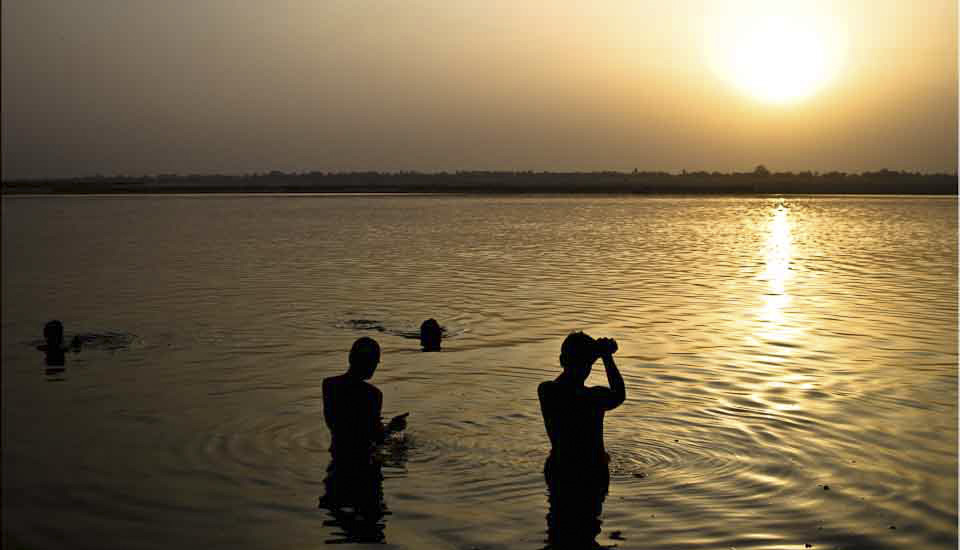
- Performing the Ganga Aarti from Dasaswamedh Ghat, Varanasi
- Buddha Head from Shwedagon Pagoda, Myanmar
- Harry Clarke Window from Dingle, Ireland
- Novice Monk Shwe Yan Pyay Monastery, Myanmar
Packets of 10 for $AU50.
Or - pick any photo from my Flickr or Wanders blog photos.

.jpg)
.jpg)
.jpg)








 I also don’t know if a change would make them any happier than they seem to be now.